
Housing politics
Public Sector Workers Get Rewarded, Landlords Get Punished

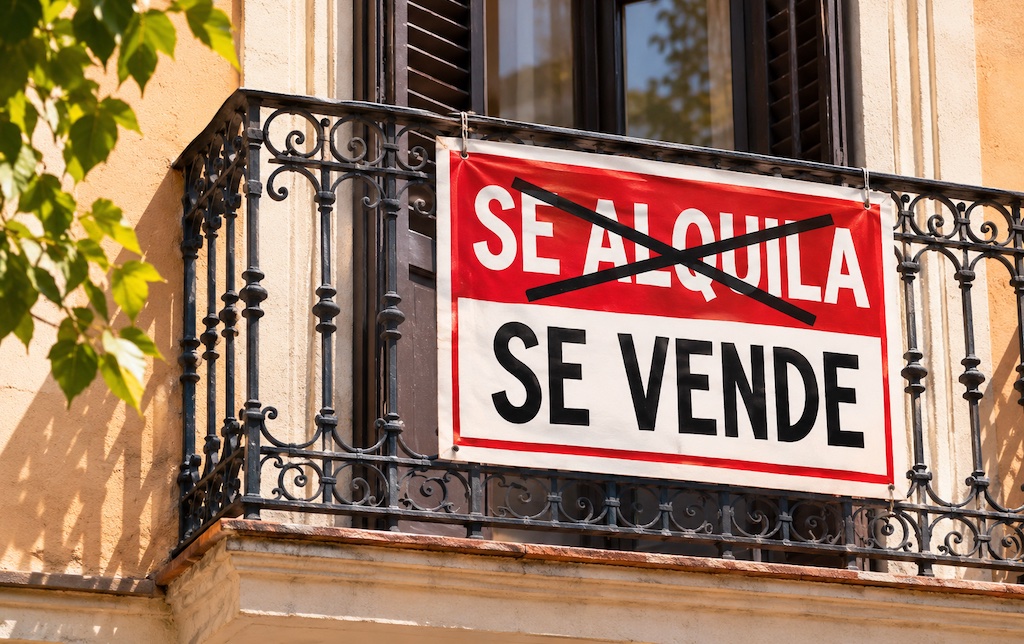
With elections just days away, Spain’s Socialist-run government has announced generous income increases for public-sector workers and other favoured groups while forcing landlords to take a real pay cut. The consequences for housing supply will be grim.
Pay rises for some, income cuts for others
Just nine days before Spain’s general election, the Socialist-led government announced a 4.5% pay rise for public-sector workers in 2027 and a 5.3% increase in the minimum wage. Pensions are also heading for an inflation-linked increase, expected to be around 3.5%.
The public-sector agreement dates from last year, but the timing of its approval is politically convenient, to say the least. It looks just like electoral populism.
Meanwhile, landlords face the opposite treatment. Under October’s new rental regulations, annual rent increases are generally capped at 2% without a fresh agreement, while some rents cannot rise at all. Tenants can also qualify for compulsory contract extensions of up to two years.
With inflation running at 4.9%, landlords are being forced to accept declining real rental income. Meanwhile, maintenance, insurance, community charges and taxes keep rising, squeezing net returns even harder.
Punished for providing housing
Landlords invest their savings and capital in providing homes for people who cannot afford, or simply don’t want, to buy. They provide an essential service while accepting substantial costs, responsibilities and financial risks.
And most aren’t institutional investors or so-called vulture funds. According to the Bank of Spain, around 90% of landlords are private individuals, most owning just one or two rental properties.
Yet the government treats them as if they deserve punishment for investing their capital in rental housing.
Rent controls aren’t technically fines, but forcing landlords to accept declining real returns amounts to a financial penalty for providing a perfectly legitimate and necesssary service.
The immediate beneficiaries are sitting tenants, who enjoy below-inflation rent increases and greater security of tenure. In effect, purchasing power is being transferred from landlords to sitting tenants.
The invisible losers
But there’s another group of losers who barely feature in the debate: people looking for somewhere to rent.
Landlords aren’t stupid. Why tie up hundreds of thousands of euros in rental housing, with all the costs, restrictions and risks of non-payment, when other investments might offer better risk-adjusted returns with far less hassle? Right now you can get a better return from cash in a savings account.
Spain already suffers from a chronic shortage of rental housing. Making private investment less attractive risks shrinking supply further, leaving prospective tenants competing for even fewer homes. Landlords can sell up or invest elsewhere. New investors can simply avoid the rental market.
So it’s clear that this government thinks that public-sector workers and other favoured groups deserve protection from inflation with public money, while landlords are allowed no such protection. Prices and taxes rise across the economy, but rent controls focus the pain on landlords, who get punished for investing their personal savings in Spanish rental housing. If the Socialists are still in power after the GE on Sunday, nobody should be surprised if the stampede out of the sector continues.













Spain has approved a controversial new housing decree imposing sweeping restrictions on landlords and a 10% VAT on holiday rentals from December. What does it mean for property owners?
On 12 November, the Permanent Deputation of the Spanish Congress approved Royal Decree-law 29/2026 by 35 votes to 34, confirming measures introduced by Prime Minister Pedro Sánchez’s government in October following the controversial eviction of an elderly tenant in Madrid.
This decree, in force since 8 October, includes restrictions on evictions involving so-called ‘vulnerable’ occupants until 2030, additional tenancy extensions, limits on rent increases, tighter regulation of seasonal and room rentals, restrictions on certain property investors, and new tax measures.
A second decree, which would have introduced automatic five- or seven-year extensions of residential tenancies and substantial compensation for landlords refusing to renew, was rejected by 35 votes to 34. If you want a deeper dive into the measures included in both bills click on learn more.
Learn More
Spain’s two housing decrees: What has been approved and what was rejected?
Updated 12 November 2026
The Spanish government introduced two emergency housing decrees in October 2026, widely known as the Maricarmen decrees. On 12 November, the Permanent Deputation of Congress approved the first by 35 votes to 34 but rejected the second by the same margin, with the votes reversed.
Here is a summary of the principal measures and what they mean for property owners and tenants.
Decree 29/2026 — Approved and in force
This decree came into force on 8 October and has now been ratified. It introduces the following measures:
- Eviction protections: Extends protections for vulnerable tenants and occupants without alternative accommodation until 31 December 2030, subject to conditions and exceptions, including for private owners with no more than two properties. Compensation mechanisms apply in certain cases.
- Rental contract extensions: Qualifying tenants with existing residential leases expiring before the end of 2028 can request extensions of up to two additional years. Existing statutory three-year extensions in designated stressed housing markets take precedence.
- Rent increases: Until 31 December 2027, annual rent increases are generally limited to 2% without a new agreement, or frozen where the existing rent exceeds the applicable reference-price ceiling.
- Seasonal and room rentals: Tighter rules require genuine justification for temporary tenancies and restrict their use to circumvent ordinary residential tenancy protections. Rent ceilings apply in designated stressed markets, including limits on the combined rent charged for individual rooms.
- Landlord obligations: Additional restrictions on charging tenants property taxes, agency fees and compulsory insurance, alongside stronger tenant rights concerning maintenance and preferential purchase rights.
- Property investment: Certain corporate investors and large landlords are prohibited from acquiring residential properties for less than 70% of their official valuation, subject to exceptions.
- Holiday rentals: A new 10% VAT charge applies from 1 December 2026 to furnished accommodation let for stays of 30 nights or fewer, even without hotel-style services. An exception applies to accommodation in the owner’s habitual residence.
- Property taxes: Municipalities are given powers to impose additional property-tax surcharges on qualifying vacant homes and tourist accommodation in designated stressed housing areas.
- Tax incentives: New income-tax deductions for qualifying tenants and revised tax reductions for landlords who meet certain conditions, including affordable rents.
- First-time buyers: A new €10 billion financing programme, called TU CASA, provides for interest-free loans of up to €50,000, subject to eligibility conditions, to help qualifying buyers purchase their first home.
Decree 28/2026 — Rejected
This separate decree proposed substantially greater security of tenure for residential tenants but was defeated before its scheduled commencement on 15 November.
Its principal proposals were:
- Automatic tenancy extensions: After the initial statutory rental period of five years for private landlords or seven years for corporate landlords, tenancies would renew for successive periods of the same duration unless either party gave the required notice.
- Longer notice periods: Landlords wishing to terminate at a contractual expiry would generally have to give six months’ notice, rather than four.
- Compensation for non-renewal: Landlords choosing not to renew would generally have to compensate the tenant with the greater of 12 months’ reference rent or one month’s reference rent for every year of occupancy.
- Exceptions: Compensation would not normally be payable where the landlord genuinely needed the property for personal or qualifying family use, the tenant was not habitually resident, the tenant had another suitable home locally, or certain other statutory conditions applied.
The rejection means these proposed changes will not take effect. Existing tenancy duration and termination rules continue to apply, subject to the separate extensions and protections introduced by the approved first decree.
What happens now?
Decree 29/2026 remains in force following parliamentary ratification. Decree 28/2026 has been rejected and will not take effect.
However, with a general election scheduled for 29 November, the future of Spanish housing legislation remains politically uncertain. A new government could amend or repeal the surviving measures.
Property owners should check how the approved changes affect their individual circumstances, particularly before renewing or terminating tenancies, arranging seasonal rentals or letting holiday accommodation.
Holiday rentals face 10% VAT from December
The biggest news for many owners from outside of Spain is that from 1 December 2026, furnished properties let for stays of 30 nights or fewer will generally attract VAT at 10%, even when the landlord provides no hotel-style services.
Until now, ordinary holiday lettings without hotel-style services have generally been exempt from VAT. The new law removes that exemption for short stays, with an exception for accommodation in the landlord’s own habitual residence.
This means that someone who owns a second home in Spain and rents it to holidaymakers for a week or two when not using it will normally have to charge VAT. The change also affects occasional landlords, not just professional holiday-rental businesses.
A €1,000 holiday rental would therefore cost €1,100 including VAT if the tax is added to the existing price. Alternatively, an owner keeping the advertised price at €1,000 would have to account for approximately €91 in VAT out of that amount.
The change applies to mainland Spain and the Balearic Islands, but not the Canary Islands, Ceuta or Melilla, which have different indirect-tax systems.
What will holiday-home owners have to do?
Owners whose lettings become subject to VAT will generally need to register their activity with the Spanish tax authorities using the relevant census declaration, usually Form 036, issue the appropriate invoices or records, and submit periodic VAT returns, normally using Form 303.
That could impose a significant administrative burden on owners who only rent out their properties for a few weeks each year. Non-resident owners will also need to establish who is legally responsible for accounting for the tax, particularly when bookings are handled through an agency or online platform.
There is also the question of whether owners can recover VAT on expenses relating to their rental activity, potentially offsetting part of the new tax liability.
The legislation establishes the 10% rate and its commencement date, but practical questions remain concerning existing bookings, advance payments, invoicing arrangements and the treatment of mixed personal and rental use. Owners should obtain professional tax advice before changing their procedures.
More hassle guaranteed
The government argues that its measures will improve housing affordability and discourage speculative investment. Critics warn that additional restrictions and taxes will discourage private investment and reduce the supply of rental accommodation.
Holiday rentals are an obvious political target, but taxing second homes used by their owners for part of the year is unlikely to make much difference to the supply of affordable housing where it is most needed.
With a general election scheduled for 29 November, the future direction of housing policy remains uncertain. A new government could reverse some of these measures, although the approved decree remains law unless changed.
Foreign owners should start thinking about any eventuality. The 10% VAT charge is scheduled to start on 1 December, and anyone offering short-term lets should review their pricing and tax arrangements before then.


Barcelona’s rent controls have kept official rental prices in check, as intended. But the latest figures for H1 2026 reveal a rental market still struggling to recover from a collapse in new contracts, leaving thousands of prospective tenants unable to find a home.
The Catalan government (Generalitat) has published the latest INCASÒL rental statistics for the first half of 2026, offering another opportunity to assess Barcelona’s rent control experiment, introduced in March 2024.
And, predictably, the Generalitat is celebrating the results. Rents are under control, we’re told. Unfortunately, that tells us remarkably little about whether people can actually find somewhere to live.
Controlled rents are controlled. What a surprise.
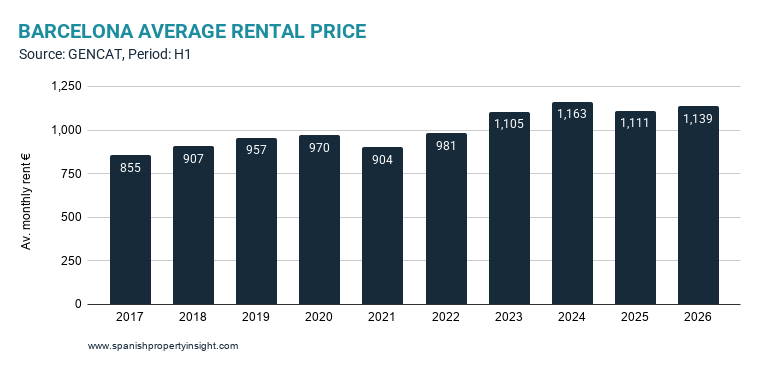
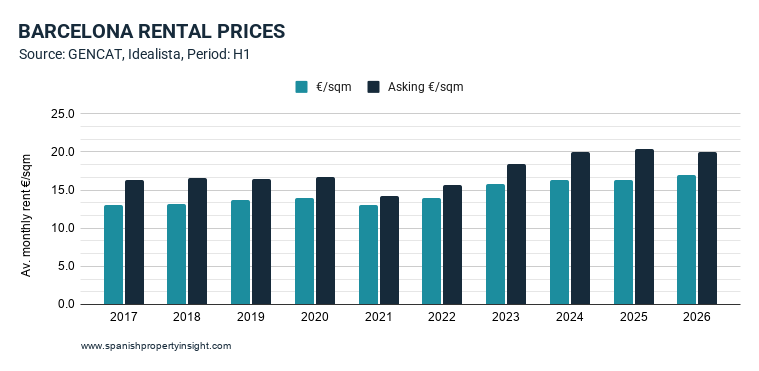
According to the latest figures, Barcelona’s average monthly rent increased by 2.5% year-on-year to €1,139 in H1 2026, whilst the price per square metre rose by 3.9% to €17.
The government presents this restraint as evidence of success. But when rental prices are controlled by law, it’s hardly surprising that the prices declared in official contracts remain constrained.
The real question is what happens to the market when prices are no longer allowed to balance supply and demand.
The collapse in rental contracts tells a different story
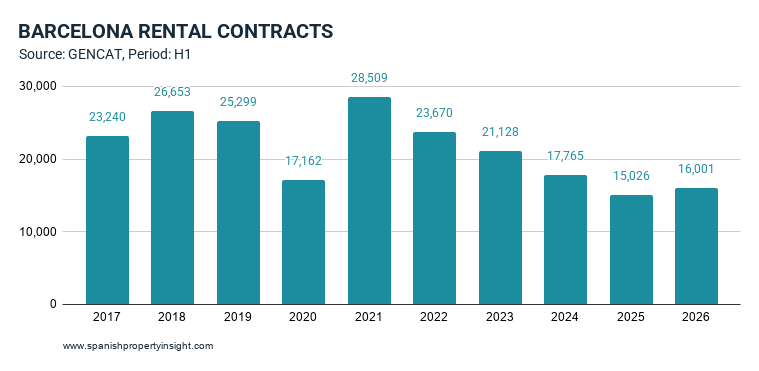
The number of new rental contracts increased by 6.5% to 16,001 in H1 2026, suggesting that the relentless decline following the introduction of rent controls may finally have bottomed out.
But before the politicians start opening the champagne, some perspective is needed.
There were 26,653 contracts signed in H1 2018, compared to just 16,001 this year—a decline of 40%. Even compared to the ten-year average, the number of contracts remains 27% lower.
In Q2 alone, just 7,845 contracts were signed, compared to 13,672 in the same quarter of 2018—a collapse of 43%.
And these figures refer to residential rental contracts lasting more than a year. Seasonal rentals are recorded separately by the Generalitat, so they cannot explain away the decline in ordinary rental contracts.
Asking prices fall, but what is really available?
Meanwhile, advertised rents on Idealista fell by 2% year-on-year to €20/sqm, narrowing the gap with official contract prices, which had widened dramatically after rent controls were introduced.
That is an interesting development, but asking prices are becoming an increasingly questionable guide to market conditions when so little accommodation is genuinely available.
A rough search of Idealista suggests around 2,000 rental listings in Barcelona, of which perhaps 650 are for long-term accommodation. And even an advertised flat is no guarantee of availability. Enquire about one and you may discover it has conveniently just gone, but the agent will happily add you to a waiting list.
In such a starved market, listings can serve as much to generate enquiries as to advertise genuinely available homes.
Meanwhile, the widening gap between asking and declared rents in recent years raises another uncomfortable question: how much rent is now being paid unofficially, including cash payments that never appear in INCASÒL statistics? The figures cannot tell us, but the incentives for undeclared payments are obvious.
The people who don’t appear in the statistics
The index chart below illustrates the bigger picture. Since 2016, contract rents per square metre and asking rents have both risen by around 44%, whilst new rental contracts have fallen by 21%.
More strikingly, rental transactions have plunged since 2022, whilst prices have continued rising.
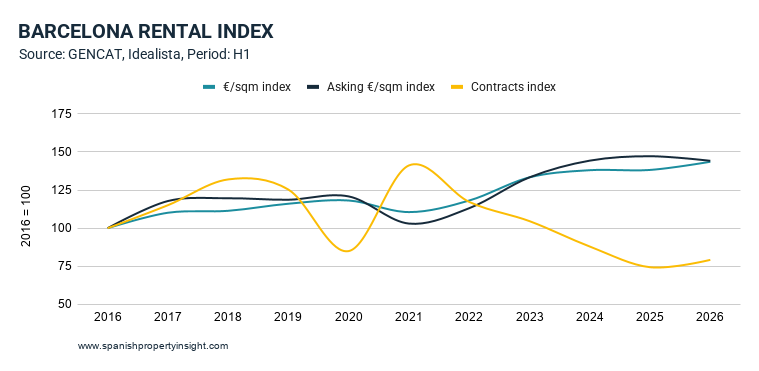
The people most disadvantaged by this situation don’t appear in the rental-price statistics at all. They are the prospective tenants who cannot find a home, even if they could afford a higher rent.
Rent controls favour sitting tenants and applicants with impeccable financial profiles. But when landlords have dozens of applicants competing for the same property at a controlled price, why take a chance on anyone with a less-than-perfect profile?
The least fortunate get pushed to the back of the queue, which is a strange outcome for a policy supposedly designed to help the vulnerable.
A government victory lap around a shrinking market
The Generalitat boasts that rent increases remain below inflation and that the overall stock of active rental contracts is growing. But that can happen simply because sitting tenants stay put for longer, reducing turnover and opportunities for newcomers.
Two years into Barcelona’s latest experiment with rent controls, the picture is becoming clear. The fall in new contracts may have stabilised, but rental opportunities remain dramatically below historical levels, whilst official rents are rising again.
Politicians can control what landlords charge on paper. They cannot legislate homes into existence.
And for the thousands of people who cannot find anywhere to rent, the government’s celebrated price containment is of precisely no use whatsoever.

Andy Taylor: Duran Duran Guitarist Dies Aged 65

Manifestaciones 25-N Contra La Violencia De Género, En Directo | Miles De Personas Recorren Las Calles De Las Principales Ciudades Contra La Violencia De Género

‘Why Do You Think That You Could Do That?’: The ‘misogynistic’ Interview That Questioned Hailey Bieber’s Business Credentials


-

 New Developments4 weeks ago
Luxury Villas For Sale, Estepona – ProjectL1
-

 New Developments3 weeks ago
The San Roque Club – Townhouses For Sale
-
countryside4 weeks ago
Rural revival: Five Almeria villages make moving inland easier and more enticing
-
costa blanca live music3 weeks ago
Beatles tribute: The Liverpool Band returns to Orihuela Costa
-

 New Developments3 weeks ago
Stylish 3-Bedroom Apartment With Panoramic Sea Views – Benalmádena
-

 America3 weeks ago
Así Ha Sido La Primera Jornada Del World In Progress 2026: Del Anuncio De Sánchez De Ayudas Para Las Víctimas De Urda A La Reivindicación De Rebeca Grynspan Del Papel De La ONU
-
Eating out in Gibraltar4 weeks ago
Young woman left horrified after Gibraltar restaurant receipt carries shocking racist slur
-
All Saints4 weeks ago
Driving to Andalucía this weekend? DGT warns of extra traffic after train crash