Connect with us

%

Rediscovering The Natural World Through Art

Published

on

rediscovering-the-natural-world-through-art

“Biomagico” invites you to view a series of pieces designed around the idea of reconnecting ourselves with the natural world. Organised by Torremolinos Cultura, this solo collection from international artist Jesus Calzada will operate completely free of charge for all visitors. Guests will have the opportunity to view the public display from July right through to October.

Environmental surrealism walks hand in hand with fine art

Gallery schedules run from Wednesday to Sunday weekly, with doors open from 10:30am until 2pm, and reopening for evening sessions between 6:30 pm and 10pm. Mondays and Tuesdays will be closed to the public.

The artist behind the collection, Jesus Calzada brings extensive commercial and cinematic experience to this individual display. His professional background balances traditional pictorial arts with professional art direction in high-profile television commercials, music videos, and major cinema. Media enthusiasts may recognize his behind-the-scenes set designs for global brands like Coca-Cola and IKEA, along with collaborations with filmmaker Pedro Almodovar. Known additionally for creating public murals and event posters, his creative fine art has previously featured in galleries across Paris, Venice, Mexico, and Buenos Aires.

Caldaza describes his inspriration behind Biomagico, “Nowadays human beings have significantly lost their link with nature, with an estimated decrease of more than sixty percent in this connection during the last 200 years,” to which he added that “modern life in cities has distanced people from natural environments, causing daily interaction with it to be minimal, giving rise to a phenomenon known as ‘extinction of experience’ or ‘disconnection from nature’”.

Opening night schedule confirmed

Doors open for the official launch gathering this Thursday, 9 July, starting at 6:30pm. Setting the pieces inside Casa de los Navajas Torremolinos gives the exhibition an interesting contrast, placing contemporary eco-surrealism inside a landmark local building. Art lovers have a three-month window to catch the display in person, with the final public viewings scheduled for October 4.

For more information visit the Torremolinos Culture website

%

Almuñecar Gets Tough On Illegal Jet Ski Use With Drone Surveillance

Published

on

almunecar-gets-tough-on-illegal-jet-ski-use-with-drone-surveillance

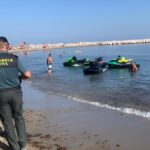
Jet Skiers stopped by police in Almuñecar. Credit: GC

Police in Almuñecar have intensified monitoring of jet ski operations along the Mediterranean coast to address repeated violations in swimming zones. Drone patrols commenced recently over affected areas.

Daily drone patrols target problem behaviours

Drones equipped for aerial observation are now flying above designated swimming sections. Any jet ski detection leads to automatic recording of photographs, video footage and precise GPS locations. Council teams and local police officers are examining this material and passing details to the harbour master for formal proceedings and fines where appropriate.

Operations will cover the period from 1pm until 7pm daily. Weekend coverage applies until July 15 before full daily service extends through 31 August.

Real-time assistance and evidence gathering

Footage will identify unauthorised mooring, high-speed travel through channels, hazardous manoeuvres and swimming line crossings. This system supports enforcement while also enabling immediate alerts to lifeguard stations during swimmer emergencies.

Priority coverage centres on Velilla Beach in Almuñecar and La Herradura. The equipment range extends roughly one kilometre, permitting observation across much of the local coastline.

Clearer boundaries reduce accident risks

Extra buoys now delineate swimming and navigation areas at 200 metres from the shoreline. Signposted access channels guide boats safely and minimise potential conflicts during high summer visitor numbers. Such measures contribute to accident prevention and greater order on the water.

Focus on protected coastal areas

Regional coordination has now been put in the spotlight around Maro-Cerro Gordo. This special and very delicate protection zone includes a nautical mile allocated for anchoring and experiences substantial recreational boating throughout summer.

Established requirements for jet ski users

Difficulties with jet ski activity have continued for years, often linked to limited experience among leisure users and inconsistent adherence to existing standards. Operators must observe several core conditions.

Distance from the shore requires at least 300 metres under the new rules. Full nautical mile separation applies near nature reserves. Entry and exit occur solely through waterways marked with buoys. A minimum spacing of 50 metres between jet skis and other boats is compulsory. Speed stays below three knots, or 5.6 kilometres per hour, inside marked zones. Swimming boundaries must never be crossed.

Approved life jackets form part of compulsory equipment. The minimum rider age is still 18 years old, with 16-year-olds permitted under written parental or guardian approval. Maximum capacity per jet ski totals two people and no more. Any minor requires adult supervision. Remaining seated throughout journeys receives a strong recommendation.

These combined actions promote safer conditions for beachgoers and water users during peak season.

Continue Reading

%

Will I Get Seasick On A Cruise?

Published

on

will-i-get-seasick-on-a-cruise?

The water your ship crosses will shape your experience. CREDIT: Nicoleta Ionescu / Shutterstock

Ask the Officer: Your cruise questions answered by a former senior ship’s officer

“I really want to try cruising but I’m terrified of getting seasick. Am I being silly, or is it a real risk I should plan around?”

You’re not being silly. It’s one of the most common concerns I heard in fifteen years at sea, and one of the least honestly answered.

I remember Rachel. She was a theater kid grown up, full of warmth and ambition, who came to seafaring the way some people do: as a second chance, a calling, a life that felt more alive than the one she’d left behind. Her first contract took her to New Zealand and Australia. It was, as luck would have it, one of the worst regions in the world to discover that your body and the ocean have different ideas about motion. She spent much of that assignment in and out of the ship’s doctor’s surgery, trying every remedy available, until she eventually found her way to my office. I helped arrange a transfer to a calmer itinerary, one where the only waves she had to face were the ones from guests at the end of a show. She went on to thrive. But it took time, and it cost her more than it should have.

Rachel’s story wasn’t unusual. What was unusual was that someone had been honest with her about the risk before she signed her contract. No one had been.

Sales copy rarely admits this. Brochures don’t come with sea state warnings. And yet the water your ship crosses will shape your experience more fundamentally than the cabin category, the dining options, or the itinerary highlights. Some routes are genuinely testing, for passengers and crew alike. I have sailed crossings where even I, someone who loves rough weather and considers herself a seasoned sailor, could not look at a screen without feeling the room tilt.

The good news is that the ship’s team works hard to soften the blow. Captains route around bad weather wherever the schedule, fuel, and maritime rules allow. Stabilizers, gigantic plane-like wings that extend from the sides of the hull, reduce the roll significantly. Speed adjustments help find a friendlier rhythm between waves. The bridge is not indifferent to your comfort. But some itineraries cross waters that cannot be routed around, and on those days the sea has the final word.

So here is the honest answer: seasickness is a real risk, it varies enormously by route and ship size, and your tolerance is not a character flaw or a badge of honor. It is simply a setting. The smartest thing you can do is pick your first cruise with that setting in mind.

Ship size matters more than most people realize. On a modern mega-ship, you would be surprised how often you have to remind yourself you are even at sea. In calm waters especially, these vessels barely move. If anxiety is your main concern, a large ship on a sheltered route is about as gentle an introduction to ocean travel as you will find.

If you want to remove the variable entirely, river cruising is worth considering. No open water, no swell, and some of Europe’s most beautiful scenery passing at eye level. It is a different experience from ocean cruising, but for someone who wants to test their appetite for life on the water without the motion question hanging over the trip, it is a genuinely good starting point.

For ocean cruising, start with sheltered waters. The Mediterranean, the Norwegian fjords, the Caribbean in calm season, Southeast Asia: these are forgiving places to find your sea legs. Build confidence there. The wilder crossings will still be waiting when you’re ready, and New Zealand, I promise you, is worth the planning it takes to get there well.

Come prepared too. Whatever remedies work for you, buy them before you board. The ship will have options, but the choice is wider ashore and you’ll know what your body responds to.

The sea doesn’t need to test you in order to welcome you. Choose the right water first, and you may find it cradles you instead.

Have a cruise question? Write to contact@theofficersdesk.com. Selected questions will be featured in upcoming columns.

Vega Mare is the author of Inside the Floating City and The Discerning Voyager.

Continue Reading

%

Priced Out Of Home: Why Working People Are Now Living In Caravans In Spain

Published

on

priced-out-of-home:-why-working-people-are-now-living-in-caravans-in-spain

More people are living in caravans across Spain. Photo credit: Sonia Bonet/Shutterstock

For many people, living by the sea sounds like the dream. For around 100 people on Málaga’s Sacaba beach, it has become the only way they can keep a roof over their heads. Now they fear they could lose even that. Finding somewhere to live has become one of the biggest worries for people across Spain. Rents continue to climb, buying a home feels out of reach for many, and affordable housing has become increasingly difficult to find. 

In cities such as Málaga, where demand has surged in recent years, many residents say they are being priced out of the very places where they work. That reality is now playing out in full view on the edge of one of the Costa del Sol’s busiest beaches. Around a hundred people remain living in caravans, camper vans and motorhomes at Sacaba despite an expected eviction that, for now, has yet to happen. For those living there, every passing day brings more uncertainty. They know they could be asked to leave at any moment, but many insist they have nowhere else to go.

“They’ll come when our guard is down”

Residents woke this week expecting the Policía local and municipal tow trucks after Málaga City Council announced plans to clear the site, instead, the morning passed quietly. that has done little to reassure the people living there. Many believe the operation has simply been delayed and fear the authorities will return once the attention surrounding the case fades. One resident summed up the mood, saying they believed officials would “throw us out when our guard is down.”

For families, pensioners and workers living at Sacaba, that uncertainty has become part of everyday life. Some have packed belongings ready to leave at short notice, while others simply wait, unsure whether tomorrow will bring another normal day or the loss of the only home they have.

This is no longer just about caravans

It would be easy to dismiss Sacaba as another dispute over illegal parking, that would miss the bigger picture. Many of the people living there are not tourists extending a holiday or travellers choosing an alternative lifestyle. They are workers, couples and families who say they have been pushed there by a housing market they can no longer afford.

Some hold down full-time jobs in Málaga. Others have lived in the city for years. Despite working, they say paying market rents has become impossible. The camper van or caravan was never meant to be permanent,It became the only realistic option.

A problem being repeated across Spain

Housing organisations have warned for years that rising rents and a shortage of affordable homes are forcing more people into increasingly precarious living situations. What was once considered unusual is becoming more common. Across Spain, more people are living in caravans, converted vans or temporary accommodation because they cannot secure a conventional rental.

Others move between campsites or informal settlements while trying to save enough money to return to permanent housing. Málaga has become one of the cities most affected by rising housing costs. Demand has grown rapidly, fuelled by population growth, tourism and international buyers, while the supply of affordable homes has struggled to keep pace. For many local workers, the result has been simple. They earn enough to work in the city, but not enough to live in it.

Residents want a solution, not a confrontation

Those living at Sacaba insist they are not refusing to cooperate, their message has remained consistent. They are asking for somewhere else to go. Residents have proposed creating an association, registering formally and opening discussions with Málaga City Council in the hope of finding an alternative location rather than simply being removed.

Housing campaign group Un Techo por Derecho, which has been supporting residents, argues that clearing the site without providing another option will not solve the housing problem. It will simply move it elsewhere.

The council has already taken action

Although the expected eviction has not yet taken place, Málaga City Council has already restricted access to the area. Fencing has been installed and new caravans have been prevented from entering, signalling that officials still intend to recover the land. Exactly when any removal operation might happen remains unclear. That uncertainty has left residents constantly watching for police vehicles or council contractors arriving at the entrance.

What happens next?

Nobody knows how long the current situation will continue, the council has not confirmed when any eviction could take place, while residents remain convinced it is only a matter of time. Whatever happens over the coming days, Sacaba has become more than a local dispute over caravans parked near the beach.

It has become another symbol of Spain’s housing crisis, for years, caravans parked beside the sea have been associated with holidays, freedom and weekends away. Today, for around 100 people on Málaga’s coastline, they represent something very different. They are kitchens, bedrooms, living rooms and, for now at least, the only homes they have left.

As the debate over housing affordability continues across Spain, Sacaba offers a stark picture of what happens when wages fail to keep up with the cost of somewhere to live. For the people waking up there each morning, the conversation about housing is no longer political or theoretical. It is about whether they will still have somewhere to sleep tomorrow.

Continue Reading

Trending

Copyright © 2017 Spanish Property & News