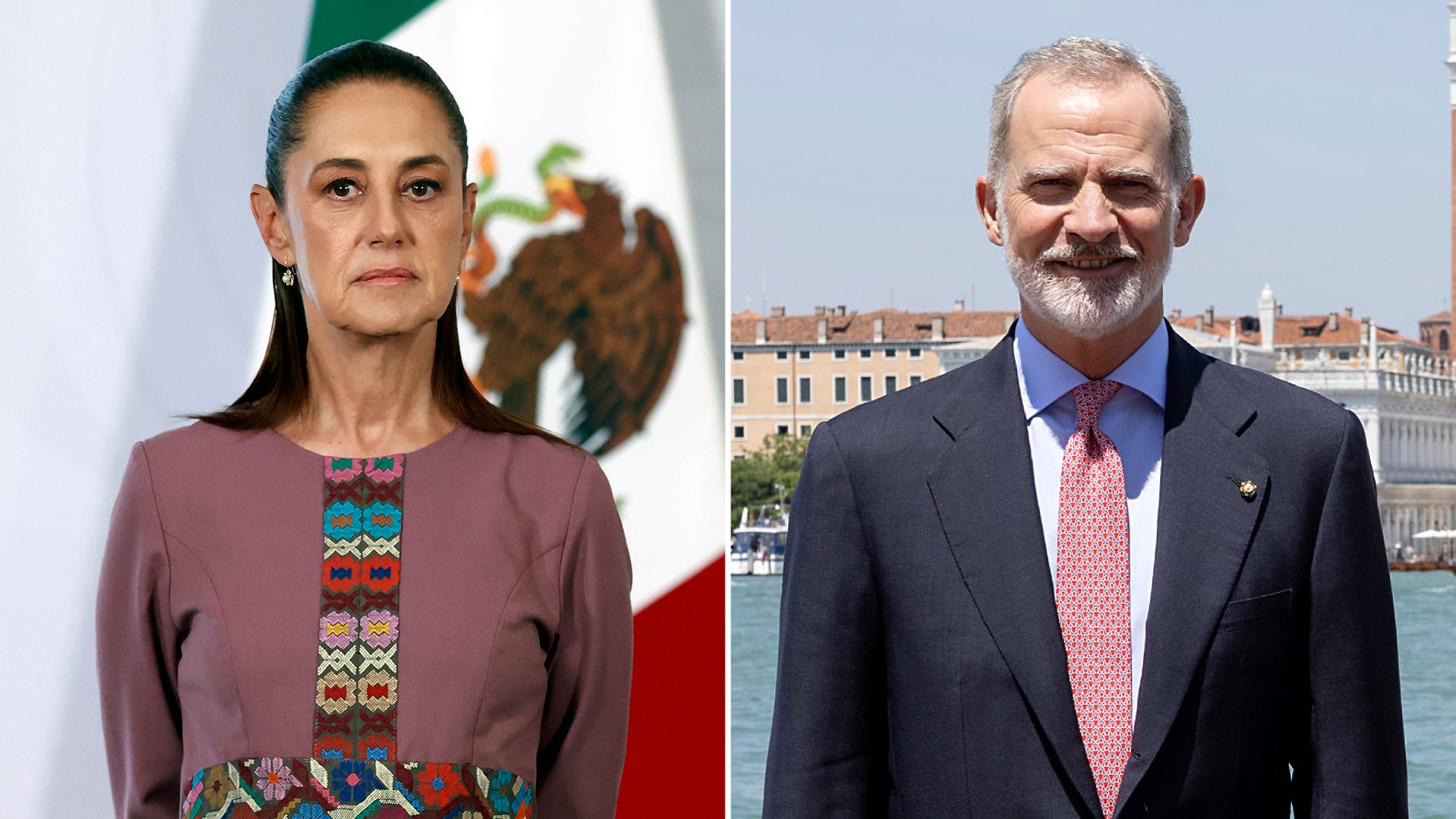
The meeting scheduled at Mexico City’s National Palace on Thursday will not only seal the diplomatic reconciliation between Spain and Mexico after seven years of tension. The long-awaited photo of concord between President Claudia Sheinbaum and King Felipe VI also marks the continuation of the path that the Mexican president is forging for herself. Sheinbaum inherited the bilateral dispute from her predecessor Andrés Manuel López Obrador, and without changing the substance of the matter—the request to the Spanish Crown to acknowledge the violence perpetrated during the colonial era—she began building bridges as soon as she took office. That rapprochement, beyond the obvious cultural and economic ties and interests between both nations, has also become a strategic political alliance following the relentless pressure on Mexico from Donald Trump.
Without fanfare, and relying above all on cultural diplomacy, Sheinbaum has been repairing the broken communication channels with gestures from both sides following the controversial letter that López Obrador sent the Spanish royals in 2019, and whose request for a public apology was ignored. Reconciliation with Spain has not been the only pivot of the Mexican president. In just over a year and a half in office, Sheinbaum has taken steps to consolidate her own project, asserting her style across nearly all centers of power. Most evident among these are a more active security strategy and a relaunch of foreign policy, two of the areas where López Obrador was the weakest. The latter’s habitual reluctance to look beyond Mexico’s borders was summed up in one of his favorite slogans: “The best foreign policy is domestic policy.” Another of his phrases embodied his softer stance on confronting crime head-on: “Abrazos, no balazos (Hugs, not bullets).”
It has not been an easy path. The former president, who is the founder of the political party Morena and linchpin of the Mexican left, still commands formidable political capital. He left the presidency with his popularity hovering near 70%. Aware of his influence, he announced he would withdraw from the public spotlight so as not to condition the new president, whom he had been grooming as his heir during the turbulent internal succession in the party. “The figure of López Obrador is unusual because of his great popularity and because, for now, he is observing the principle of non-interference, which has no precedent in recent Mexican history,” says international relations expert Gabriel Guerra Castellanos, who also notes that “the president has been carving out her territory day by day, with symbolic gestures and substantive policies.”
The channel was advancing but, as in so many other cases, the Trump whirlwind ended up shaping it. Since his return to the White House, the Republican leader has deployed the most aggressive version of his policy. Beyond economic threats (over non-renewal of the USMCA free trade agreement or the imposition of tariffs), the U.S. president repeats every month his desire to intervene militarily in Mexico to fight organized crime. The tension has even led the U.S. Department of Justice to accuse Morena governor Rubén Rocha of working for the Sinaloa Cartel. “This level of pressure hadn’t been seen in a century,” says Abelardo Rodríguez, professor of international studies at the Ibero-American University, “and, of course, President López Obrador hadn’t experienced it either, given that he even had a good relationship with Trump.”
That shift in the external environment has reconfigured Sheinbaum’s playing board. “Mexico’s foreign-policy axis in the world runs through the United States,” Rodríguez adds, arguing that the challenge with its northern neighbor has forced the president into “strategic repositionings.” This includes the change of ambassador in Washington, the signing of Mexico’s treaty with the European Union, the latest rapprochement with the United Kingdom and, of course, building bridges with Spain. This thaw is also ideologically useful for both countries after recent setbacks for the left in Peru and Colombia, emphasizes Mexican historian Alfredo Ávila: “Both Pedro Sánchez’s government and Claudia Sheinbaum’s know they are increasingly isolated. That they could shake hands, first, and that the president will now meet the king, are steps toward trying to form a progressive alliance at a moment when the far right is sweeping elections everywhere.”
It is in this same context that Sheinbaum’s presence at the progressive summit Sánchez organized in April in Barcelona should be viewed. It was the first trip by a Mexican president to Spain since 2018 and, moreover, the first trip by a Morena president to Europe. The alliance appears likely to continue consolidating. In November, Madrid will host another summit that Spain hopes will reaffirm the role of the Ibero-American community in the face of White House pressure.
Thus, although specialists believe the upcoming photo of Felipe VI at the National Palace could not have taken place under López Obrador, it is not so much because the presidents have major differences in how they understand history, but because of the external whirlwind. “López Obrador’s and Sheinbaum’s views of history are very similar. It is the traditional view taught in Mexico at the end of the last century: a heroic bronze-age history, as we call it in reference to bronze monuments, with great heroes and villains. Of course, the heroes are the nationalist Mexican patriots and the villains are those who submit to foreign interests, the elites and the oligarchies,” Ávila adds.
Colmex historian Lorenzo Meyer agrees that the emphasis on pre-Hispanic peoples connects with one of the theoretical pillars of Obradorismo, the so-called Mexican humanism. “While many on the left look to the future, he turns to the past and finds characteristics in pre-Hispanic cultures worthy of praise.” Thus, in the Morena imagination, the struggle against the colonizer and against large landowners would be “a struggle in favor of a different Mexico, and therein lies the legacy of the Spaniards.”
That is why Sheinbaum continues to insist she wants Spain to learn another version of the Conquest. The only thing the president has revealed about her meeting with the king is that it will be “very brief” and that she will speak to him about Mexico’s indigenous peoples. “That idea of convincing Spain of the true history of the Conquest sounds more like a pretext to justify the fact that it is distancing itself from the previous administration’s position while the relationship is actually thawing,” assesses international relations expert Pía Taracena, who adds that three elements had to align for Thursday’s meeting: “the change of the person leading Mexico, the way the king acknowledged the abuses that occurred during the Conquest and the president’s willingness to open the channel more.”
When Sheinbaum won the election two years ago, she did not invite the Spanish king to her inauguration, and no delegation from the Spanish government attended either. But something changed. Contacts to explore a potential major exhibition on Indigenous art in Spain began in her first days in office. At that Madrid exhibition, in March, Felipe VI made the gesture of acknowledging the “abuses” of the Conquest. Previously the Spanish monarch had referred in that same setting to “injustice and pain” during colonization. Sheinbaum responded to those “gestures” by inviting the king to the World Cup. A seemingly routine protocol step, it gained relevance with the later formal invitation to Thursday’s heads-of-state meeting at the official residence and seat of Mexican power.
Sign up for our weekly newsletter to get more English-language news coverage from EL PAÍS USA Edition