AEMET says Spain’s heatwaves are becoming more frequent and more intense. Credit : Mazur Travel, Shutterstock
Spain has reached another climate milestone, and this time it is one that meteorologists say has not happened in at least 76 years. According to provisional figures from Spain’s State Meteorological Agency (AEMET), June 22 and June 23, 2026, were the hottest days ever recorded for that point in the year since records began in 1950.
The figures also come with another warning. Scientists believe the heatwaves Spain has experienced in recent years are becoming more frequent, lasting longer and arriving earlier in the summer, with new projections suggesting the country could face far more days of extreme heat in the decades ahead.
The latest heatwave may have felt exceptional to millions of people, but AEMET‘s analysis suggests it is also part of a much bigger pattern. From record breaking temperatures in northern Spain to increasingly hot nights in major cities, the country’s climate is showing changes that are becoming harder to dismiss with each passing summer.
Spain’s hottest June days on record have rewritten the history books
The figures published by AEMET are still provisional because calculations were made before the latest heatwave had completely ended. Even so, they already reveal something extraordinary.
An analysis by José Ángel Núñez Mora, Head of Climatology at AEMET in the Valencian Community, found that June 22 and June 23 recorded an average temperature anomaly of 7.1C above normal across mainland Spain. In simple terms, the country was more than seven degrees hotter than would usually be expected for those dates.
That comfortably surpassed the previous June record, which had only been set on June 30, 2025.
Perhaps even more remarkable is where June 23 now sits in Spain’s climate history.
Across the entire historical record, regardless of the season, it has become the 21st hottest day ever measured in mainland Spain. Almost every day ranked above it belongs to July or August, with only one exception dating back to July 1995.
For meteorologists, that matters because June has traditionally been the month when temperatures are still building towards their summer peak. Seeing figures like these before July begins shows how much earlier intense heat is arriving.
Northern Spain saw some of its most extraordinary temperatures ever recorded
The south of Spain is no stranger to temperatures above 40C, but one of the biggest stories from this heatwave unfolded hundreds of kilometres further north.
On June 23, Tama, in Cantabria’s Liébana region, reached 43.7C, setting a new all time maximum temperature record for the region during any month of the year.
Bilbao also experienced something that had never happened before.
Weather observations there date back to 1947, yet the city had never exceeded 40C on three separate days in the same month. This June it happened on June 21, June 23 and June 24.
The 42.7C recorded on June 24 also became the highest temperature ever measured there during either June or July.
For many people living in northern Spain, these were temperatures more commonly associated with parts of Andalusia than the Bay of Biscay.
The contrast illustrates how widely this latest heatwave spread across the country, reaching areas that have historically escaped the worst of Spain’s summer extremes.
Heatwaves are becoming more common and nights are staying hotter for longer
Individual records often grab the headlines, but AEMET says the long term figures tell an equally important story.
Between 1975 and 2025, Spain experienced 78 official heatwaves, adding up to 458 days of extreme heat.
What stands out is how quickly those numbers have changed.
During the first half of that period, from 1975 to 2000, Spain recorded 129 heatwave days. Between 2001 and 2025, the figure rose to 329 days, more than twice as many.
The last decade shows an even clearer picture. Spain has averaged around 22 heatwave days every year, compared with roughly three days annually during the late 1970s and early 1980s.
According to AEMET, heatwaves are now tending to cover larger areas of the country while producing stronger temperature anomalies than they did in previous decades.
The agency’s projections suggest that trend is likely to continue.
If greenhouse gas emissions follow an intermediate scenario, Spain could experience around 47 heatwave days each year by the end of the century.
Under higher emission scenarios, that average could increase to around 60 days annually, while the most severe projections point to 77 days of heatwave conditions every year.
The daytime heat is only part of the picture.
Summer nights have also become steadily warmer, particularly along the Mediterranean coast, where cities often struggle to cool after sunset because of the combined effects of climate change and the urban heat island effect.
Barcelona and Valencia now experience far more tropical nights, when temperatures stay above 20C, than they did during the second half of the twentieth century. Madrid has also recorded a marked increase at both the Barajas and Retiro observatories.
According to AEMET, the warming is primarily linked to the increase in greenhouse gases produced by burning fossil fuels. Weather balloon observations show the rise in temperature is not limited to the ground. It extends throughout the lower atmosphere, reinforcing the conclusion that Spain’s climate is continuing to warm.
For most people, the latest heatwave will be remembered for uncomfortable nights, relentless sunshine and soaring daytime temperatures. For meteorologists, it also leaves another set of figures showing that what once counted as exceptional is becoming increasingly familiar. As summer has only just begun, AEMET says more heatwaves are likely to arrive before the season is over.


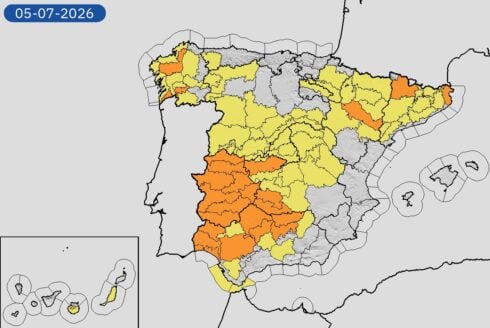
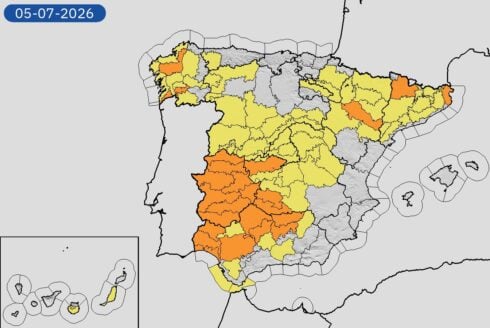 SPAIN is bracing for another punishing heatwave this weekend, with temperatures set to soar above 40C across parts of the country. State weather agency Aemet issued a flurry of orange
















 HUNDREDS of people were evacuated or forced to shelter indoors as a major wildfire tore through northeastern Spain on Thursday. Firefighters battled the blaze overnight after flames engulfed 40 square




 Abelardo de la Espriella2 weeks ago
 Uncategorized1 week ago
 Amazon2 weeks ago
 Andalucia1 week ago