
Forecasts
Spain Forecast To Lead European House Price Growth For Years To Come


Author:  Mark Stücklin
Posted on
Spain is expected to have one of the fastest-growing housing markets in Europe for the rest of the decade, which is good news for homeowners but increasingly painful for those struggling to get on the property ladder.
According to ratings agency Standard & Poor’s (S&P), Spanish house prices will rise by 9.1% this year, followed by another 7.4% in 2027 and 6.2% in 2028. That would make Spain the strongest-performing housing market in Europe over the next few years.
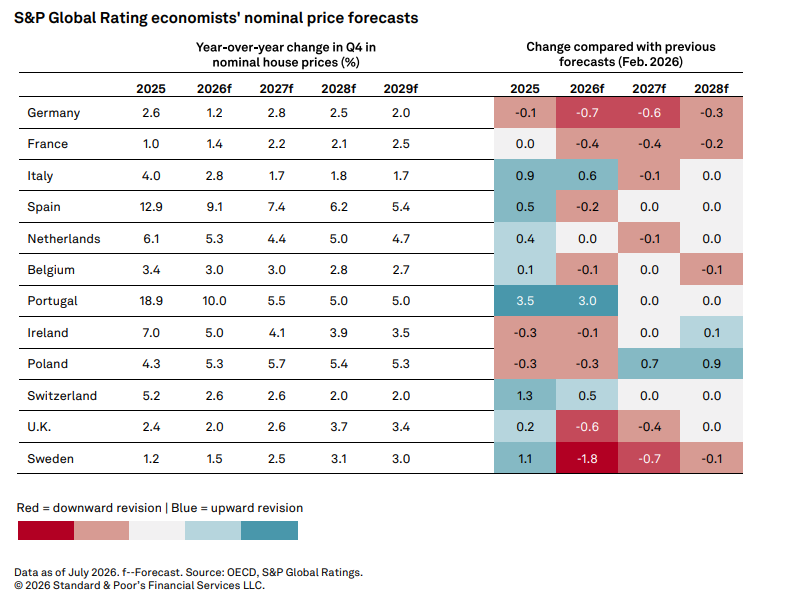
The main reason, according to S&P, is simple: there aren’t enough homes being built. Strong job creation, rising wages and immigration are all increasing demand, while new supply remains constrained by planning delays, labour shortages and high construction costs.
The outlook is not unique to Spain. S&P expects house prices across Europe to keep rising until at least 2029. However, Spain, Portugal and Ireland stand out because they suffer from deep structural housing shortages that are unlikely to be solved any time soon.
Governments across Europe have announced housing plans and spending programmes, including Spain’s €7bn State Housing Plan, but S&P warns that these measures will take years to have any meaningful impact. In some cases, policies that stimulate demand without increasing supply could even push prices higher.
Winners and losers
For homeowners and investors, this is encouraging news. Rising property values boost household wealth and reward those already on the housing ladder.
But there is another side to the story.
Rapid house price growth also creates winners and losers. First-time buyers face ever higher barriers to entry, while rising prices tend to feed through into higher rents, putting additional pressure on tenants. Housing affordability is becoming a growing political issue across Europe, and Spain is no exception.
The frustration of younger generations locked out of home ownership is already fuelling political anger and demands for government intervention. That’s one reason why Spain has seen a growing appetite for policies such as rent controls, higher taxes on investors and restrictions on tourism accommodation, even if many of these measures do little to address the underlying problem.
The fundamental issue remains a shortage of homes. Until Spain builds significantly more housing, the country’s property owners can probably expect further gains in value, while those trying to buy or rent will continue to feel the squeeze.







Industry insiders expect the Spanish housing market to cool in the second half, but with prices continuing to rise.
A new survey of more than 400 estate agents by mortgage lender UCI and the Spanish International Realty Alliance (SIRA) suggests the market will remain resilient in the second half of the year, but at a more subdued pace than the exceptional conditions seen recently.
The headline finding is that agents expect home sales to fall by around 3.2% compared with the same period last year. Rental activity is expected to weaken even more, with a projected decline of 7.1%, while new mortgage lending could slip by around 2% if geopolitical uncertainty keeps pressure on interest rates.
Prices expected to keep rising despite slower activity
That said, estate agents don’t expect prices to follow transactions lower. The survey forecasts average house prices will rise by around 3% this year, while rents could increase by about 5%. Those estimates are more restrained than in the previous edition of the survey, but they still point to continued upward pressure on prices.
The reason is familiar enough: demand continues to outstrip supply across much of Spain, particularly in major cities, economically dynamic regions, and destinations popular with international buyers. Although around two-thirds of agents say the supply of homes has stabilised or even increased, they clearly don’t believe it will be enough to rebalance the market any time soon.
Confidence turns down
The survey also reveals that confidence within the industry has eased. Agents are less optimistic about transaction volumes than they were six months ago, and their overall outlook for the market has fallen for the fourth consecutive survey. Even so, they still rate prospects for 2026 at a respectable 6.4 out of 10.
Should buyers and sellers take these forecasts seriously? Probably, but not as gospel. Estate agents are on the front line of the housing market and often spot changes in sentiment before they appear in the official statistics. On the other hand, they don’t have a crystal ball, and markets can change direction quickly when economic or political conditions shift. Furthermore, their professional bias can show up in the surveys, in which agents never say that prices will fall.
As it happens, the latest data is in line with agent forecasts for the second half, at least in broad terms of direction. Sales fell by 8% in Q1, whilst prices rose by 7%, according to the notaries’ association.
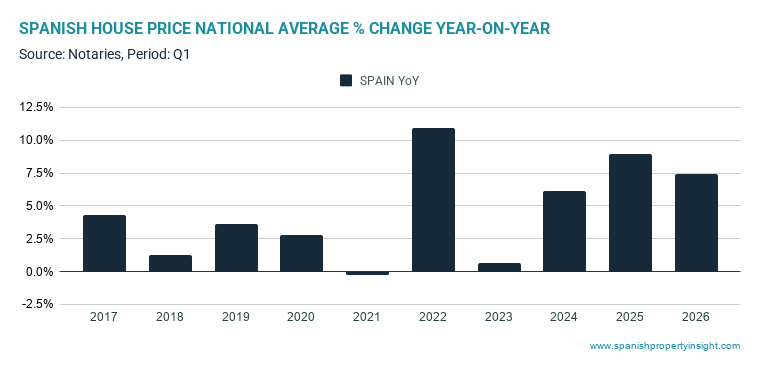
Overall, the message from industry insiders is straightforward: expect a calmer market than last year, but don’t expect house prices to go down. As long as the supply of homes remains constrained, prices are likely to keep edging higher even if transaction volumes lose momentum.



Industry insiders expect the Spanish housing market to cool in the second half, but with prices continuing to rise.
A new survey of more than 400 estate agents by mortgage lender UCI and the Spanish International Realty Alliance (SIRA) suggests the market will remain resilient in the second half of the year, but at a more subdued pace than the exceptional conditions seen recently.
The headline finding is that agents expect home sales to fall by around 3.2% compared with the same period last year. Rental activity is expected to weaken even more, with a projected decline of 7.1%, while new mortgage lending could slip by around 2% if geopolitical uncertainty keeps pressure on interest rates.
Prices expected to keep rising despite slower activity
That said, estate agents don’t expect prices to follow transactions lower. The survey forecasts average house prices will rise by around 3% this year, while rents could increase by about 5%. Those estimates are more restrained than in the previous edition of the survey, but they still point to continued upward pressure on prices.
The reason is familiar enough: demand continues to outstrip supply across much of Spain, particularly in major cities, economically dynamic regions, and destinations popular with international buyers. Although around two-thirds of agents say the supply of homes has stabilised or even increased, they clearly don’t believe it will be enough to rebalance the market any time soon.
Confidence turns down
The survey also reveals that confidence within the industry has eased. Agents are less optimistic about transaction volumes than they were six months ago, and their overall outlook for the market has fallen for the fourth consecutive survey. Even so, they still rate prospects for 2026 at a respectable 6.4 out of 10.
Should buyers and sellers take these forecasts seriously? Probably, but not as gospel. Estate agents are on the front line of the housing market and often spot changes in sentiment before they appear in the official statistics. On the other hand, they don’t have a crystal ball, and markets can change direction quickly when economic or political conditions shift. Furthermore, their professional bias can show up in the surveys, in which agents never say that prices will fall.
As it happens, the latest data is in line with agent forecasts for the second half, at least in broad terms of direction. Sales fell by 8% in Q1, whilst prices rose by 7%, according to the notaries’ association.
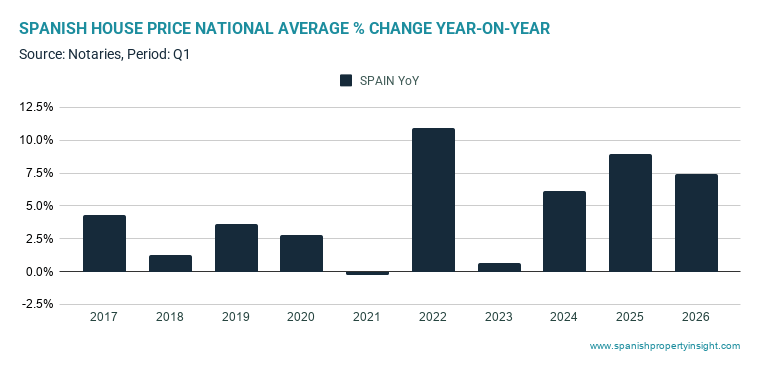
Overall, the message from industry insiders is straightforward: expect a calmer market than last year, but don’t expect house prices to go down. As long as the supply of homes remains constrained, prices are likely to keep edging higher even if transaction volumes lose momentum.

Red Bull told to replace Max Verstappen with F1

Inglaterra – Argentina, Las Semifinales Del Mundial En Directo | Tuchel Hace Tres Cambios En El Once Y Scaloni Apuesta Por Giuliano Simeone En Lugar De De Paul

Spain Forecast To Lead European House Price Growth For Years To Come
Alhaurin el Grande and Coin launch historic 1.5 million kilo season for premium tomato

Los Aficionados Al Ciclismo En Barcelona: “Que Venga El Tour De Francia Es Como Ir Al Mundial De Fútbol”

Cheap Flights And Mass Tourism Are Adding €3,800 To The Cost Of The Average Spanish Home, New Report Warns


-
Alhaurin El Grande2 weeks ago
Alhaurin el Grande and Coin launch historic 1.5 million kilo season for premium tomato
-
 Antoni Gaudi2 weeks ago
Los Aficionados Al Ciclismo En Barcelona: “Que Venga El Tour De Francia Es Como Ir Al Mundial De Fútbol”
-
 Business & Finance2 weeks ago
Cheap Flights And Mass Tourism Are Adding €3,800 To The Cost Of The Average Spanish Home, New Report Warns
-

 Barcelona2 weeks ago
Spain Is Set To Be Swarming With Rock Legends This Weekend – Here’s What You Need To Know
-
 Dutch demand2 weeks ago
Dutch Demand For Spanish Property Keeps Rising As Others Cool
-
4 billion fine2 weeks ago
Google loses €4.1bn EU fight over the apps Android users see first
-
Latest2 weeks ago
Conservatives And Far Right To Govern Spain’s Andalusia Region
-

 New Developments2 weeks ago
🌅 Stunning Penthouse With Panoramic Sea & Mountain Views Benalmádena