
Iran conflict
Spain reopens Tehran embassy in fragile ceasefire – But what about staff safety?


Madrid diplomats have shown fresh engagement with Iran as regional tensions continue. No matter how many times the word “ceasefire” is announced, the missile attacks seem to keep intensifying. Foreign Minister José Manuel Albares has announced that Spain will immediately reopen its embassy in Tehran. Ambassador Antonio Sánchez-Benedito received orders to return and resume operations following temporary closure on March 7 due to airstrikes.
Diplomatic gamble on peace
Spain has been acting against many of its European partners and taking a position on the reopening as active support for peace efforts during the two-week ceasefire involving the United States, Israel, and Iran. Albares has stressed the need to contribute from every possible channel, explicitly including Iran’s capital. Some describe the move as a commitment to dialogue and multilateralism at a critical juncture. Spain appears first among Western nations to take this step post-truce.
However, critics highlight the fragile nature of the ceasefire and ongoing volatility across the Middle East. Relations with Israel remain strained after Spain’s permanent withdrawal of its ambassador from Tel Aviv.
Danger money questions for embassy staff
No details have emerged on special hazard pay or enhanced compensation for personnel returning to Tehran. Standard diplomatic protocols usually cover high-risk postings with security measures and evacuation plans. Yet recent evacuations during active conflict raise concerns about adequate protections if hostilities resume. Staff previously left due to direct threats from airstrikes on the Iranian capital.
Divided reactions split public opinion
Supporters praise the decision as pragmatic diplomacy essential for de-escalation and regional stability. Voices sympathetic to balanced engagement argue that keeping channels open prevents isolation and aids potential influence on issues such as Strait of Hormuz security. Iranian-affiliated commentary has welcomed the initiative warmly.
Opponents accuse Spain of tilting too closely toward Tehran while criticising Israel. Israeli officials, including Gideon Saar, lambasted the move as shameless alignment without sufficient distance from Iran. Some analysts question the wisdom of rushing back as the first Western country during a short truce that could collapse quickly. Online discussions reflect sharp polarisation, with accusations of ideological bias under Prime Minister Pedro Sánchez’s government versus calls for maintaining Western unity.
Security risks are, nonetheless, still there despite the so-called pause in direct hostilities. Wider regional instability, including proxy tensions, will add layers of uncertainty for diplomats and local workers. Spain’s independent foreign policy line draws both applause for peace advocacy and razor-sharp rebukes for perceived naivety.






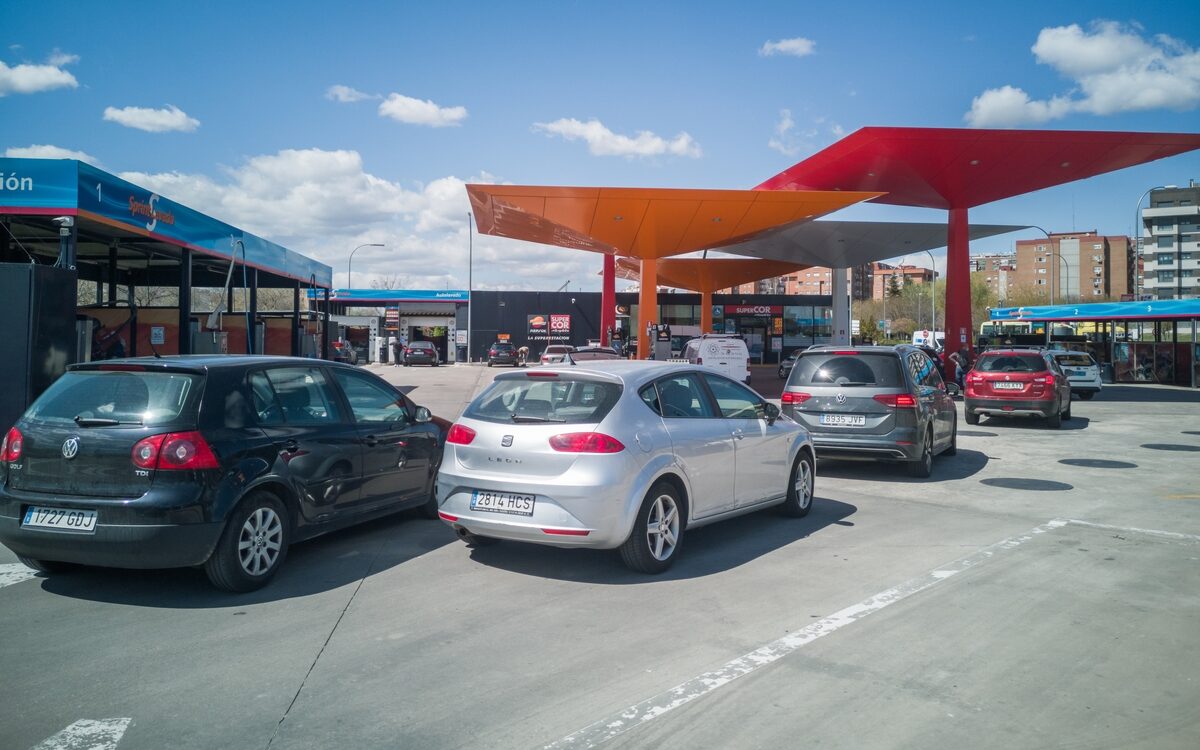
Queues to fill up at the petrol station.
Credit: Natalia de la Rubia – Shutterstock
Oil markets have witnessed dramatic gains on Monday, April 13, after President Donald Trump declared an immediate naval blockade of the Strait of Hormuz following the collapse of US-Iran negotiations.
Sharp rise hits global fuel benchmarks
Brent crude, the European benchmark, has jumped nearly 7.3 per cent in early trading to go over the $102 per barrel mark by the time European stock markets prepared to open. West Texas Intermediate (WTI) crude climbed even higher, rising almost 8.5 per cent to reach $104.70 per barrel. Such rapid moves reveal acute concerns over potential disruptions to roughly one-fifth of global oil supplies that normally transit the narrow waterway.
Traders reacted immediately to the news. Earlier uncertainty around a possible ceasefire and reopening of the strait had pushed prices lower, with Texas crude closing Friday at $96.57 per barrel after a 13 per cent weekly drop, making filling up at the pump feel a little more normal in the past few days. Monday’s reversal erased much of that optimism within hours.
Trump orders naval action after failed talks
In response to failed peace talks, Trump posted on his Truth Social that the US Navy would begin blocking every vessel attempting to enter or exit the strait with immediate effect. US Central Command (CENTCOM) confirmed operations would start at 3pm on Monday, and target all maritime traffic to and from Iranian ports.
“Effective immediately, the US Navy will begin the process to block all vessels attempting to enter or exit the Strait of Hormuz,” the president stated. This measure is planned to prevent Iran from disrupting flows first and profiting themselves in these heightened tensions.
Why the Strait matters for energy markets
The Strait of Hormuz serves as a vital artery for oil exports from the Gulf region. Any lengthy restriction risks severe supply shocks, higher fuel costs worldwide, and knock-on effects for inflation and economic growth. Analysts say that even short-term uncertainty can propel prices sharply higher, as seen in previous geopolitical flare-ups.
Markets are now bracing themselves for more volatility. Energy traders are monitoring developments closely, while consumers face the prospect of rising petrol and heating bills if the blockade carries on like this. Diplomats continue searching for de-escalation paths, yet Monday’s events go to show the fragile balance in the region.
US oil exports doing well
Meanwhile, US crude oil exports are rising to record levels with the ongoing Strait of Hormuz crisis, with analysts projecting volumes to reach around 5.2 million barrels per day in April and May 2026. Empty tankers continue to stream toward the US Gulf Coast in more numbers to load American crude for onwards shipment, particularly to Asian buyers looking for replacement supplies after Middle East flows collapsed.
Far from any slowdown, American oil is flowing out at historic rates precisely because of the blockade and restricted Gulf exports, with the trend accelerating following today’s developments.
Immediate impact on petrol and diesel prices
A $10 rise in Brent crude typically adds up to 3 to 6 euro cents per litre to European pump prices, depending on taxes, refining margins, exchange rates, and so on. Retail prices in Spain therefore stand to rise as much as €10 per average car tank. The rise might not be obvious for two or three days, making early in the week a good time to fill up.




Former Mercedes chief reveals troubled relationship with F1 champion
‘More And More’ Americans In Europe Look To Renounce Passports After Fee Cut

S

Luxury Villas For Sale, Estepona – ProjectL1

Stylish 3-Bedroom Apartment With Panoramic Sea Views – Benalmádena
Brussels warns Spain that migrants regularised under controversial scheme will be deported back to Spain if they try to move to other EU countries


-
 New Developments3 weeks ago
Luxury Villas For Sale, Estepona – ProjectL1
-
 New Developments3 weeks ago
Stylish 3-Bedroom Apartment With Panoramic Sea Views – Benalmádena
-
eu response to spain migration policy2 weeks ago
Brussels warns Spain that migrants regularised under controversial scheme will be deported back to Spain if they try to move to other EU countries
-

 %3 weeks ago
Poland Disconnects Utilities At Russian Consulate That Moscow Refuses To Hand Over
-

 Uncategorized4 weeks ago
Lewis Hamilton goes from Karate Kid to Samurai Warrior with Kill Bill guru
-
AER Lingus4 weeks ago
High-speed internet at 35,000 feet: Aer Lingus launches Starlink Wi‑Fi
-

 Uncategorized3 weeks ago
How Lewis Hamilton spent break with A-list star
-
Groundforce4 weeks ago
Spain’s Easter holiday airport strikes: Walkout suspended over weekend but disruption expected to kick in from first day of Semana Santa