Connect with us

%

Spain Vs France Digital Nomad Visa: Key Differences 2026

Published

on

spain-vs-france-digital-nomad-visa:-key-differences-2026

Spain’s digital nomad visa gives remote workers a named immigration route. France takes a different path: it has no official digital nomad visa in 2026, so applicants must match their work model to an existing French visa category. That distinction affects your paperwork, income proof, tax exposure, family plans, and your employer’s compliance risk.

Introduction: Spain has a dedicated route; France uses alternatives

Spain created its international telework route under the Startup Law framework introduced in 2023. France relies on long-stay visitor, independent-professional, entrepreneur, and Talent Passport routes. For a detailed look at the French side before choosing a path, learn more about the France digital nomad visa and the alternatives that actually exist.

The right country depends on more than lifestyle. A U.S. employee working remotely for a New York company faces a different legal question from a freelance designer billing German clients or a couple living on investments.

Spain vs. France at a glance

Start with the legal category, then compare the practical consequences. The table below helps you identify where your income model fits before you spend money on translations, insurance, or an application.
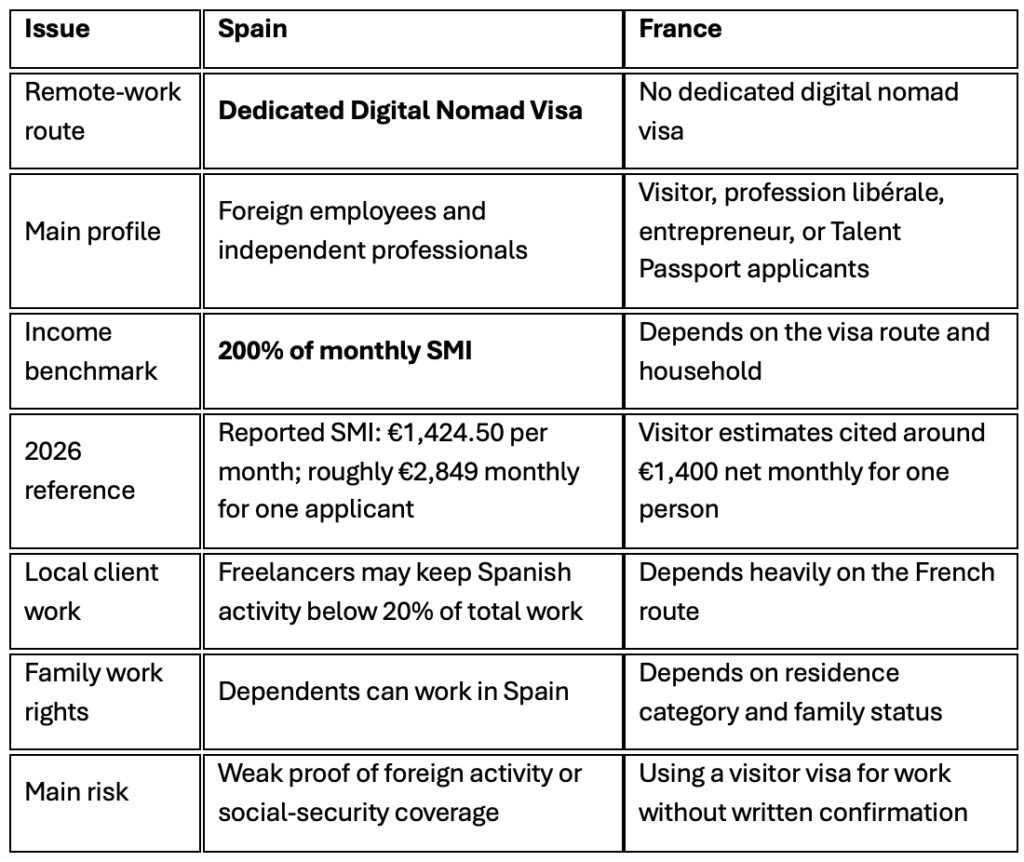
Overview table of visa applications Spain v France

Spain’s 2026 figure reflects the SMI approved on January 29, 2026, backdated to January 1. Older guides cite €2,160, €2,646, or €2,760 monthly. Those figures belong to earlier calculations and should not be treated as current requirements.

France’s options for remote workers

The visitor route suits financially independent residents

The French long-stay visitor visa fits people with passive income, savings, pensions, or other resources that support life in France. It is commonly issued for up to 12 months and can be renewed when financial means, insurance, and residence conditions continue.

Remote work for a foreign employer sits in a compliance-sensitive area. The visa wording bars professional activity in France, while some applicants describe foreign remote employment as acceptable. Get written guidance from the relevant French consulate before relying on that interpretation. Tax residency, payroll, and employment law create separate questions.

Profession Libérale, entrepreneur, and talent passport routes

A Profession Libérale route suits a consultant, freelancer, or independent professional with a real French business plan and viable income. A cited benchmark is roughly €1,766 per month. The reported fees are about €269 for the long-stay visa plus about €200 for validation after arrival.

Entrepreneurs need a credible project, funding, and evidence that their activity can support them. The Talent Passport business-creator route sets a higher bar: a Master’s degree or five years of professional experience, a business plan, and a €30,000 investment. It is not a catch-all digital nomad option for ordinary remote employees.

France’s routes demand a close match between your stated activity and your documents. A contract, client list, invoices, business registration plan, and projected income must tell the same story.

Spain’s Digital Nomad Visa: Eligibility, income, and documents

Spain’s digital nomad visa ties residence to foreign employment or professional activity. It is a work-based immigration route, not a lifestyle label. Employees need proof that their foreign company has carried on real activity for at least one year. Applicants must also show a relationship with that company or client for at least three months.

For a solo applicant, official consular guidance sets financial means at 200% of the Spanish monthly minimum wage. The first accompanying family member adds 75% of SMI, while each further family member adds 25%. Spain also accepts a university or postgraduate degree, or three years of relevant professional experience.

Freelancers need to separate foreign and Spanish revenue carefully. A self-employed applicant may work with Spanish companies only where that activity stays below 20% of total professional activity. An employee should not assume the same flexibility to add local clients.

Prepare the file in a deliberate order:

  • employment letter, contract, payroll records, or client agreements;
  • company registration and proof of overseas activity;
  • bank statements proving the income threshold;
  • health insurance, social-security evidence, and an NIE where required;
  • criminal-record certificates for the prior two years, plus the five-year declaration;
  • apostilles or legalisation, followed by official Spanish translations.

A consular visa can last up to one year. Certain visa-exempt nationals may apply from Spain for a residence authorisation that can run for three years. Citizenship and lawful status at the time of filing determine whether that in-country route is open.

The differences that matter in practice

Legal fit should come before Paris, Barcelona, school options, or broadband speed. The following profiles show why the same remote job can lead to different visa choices.
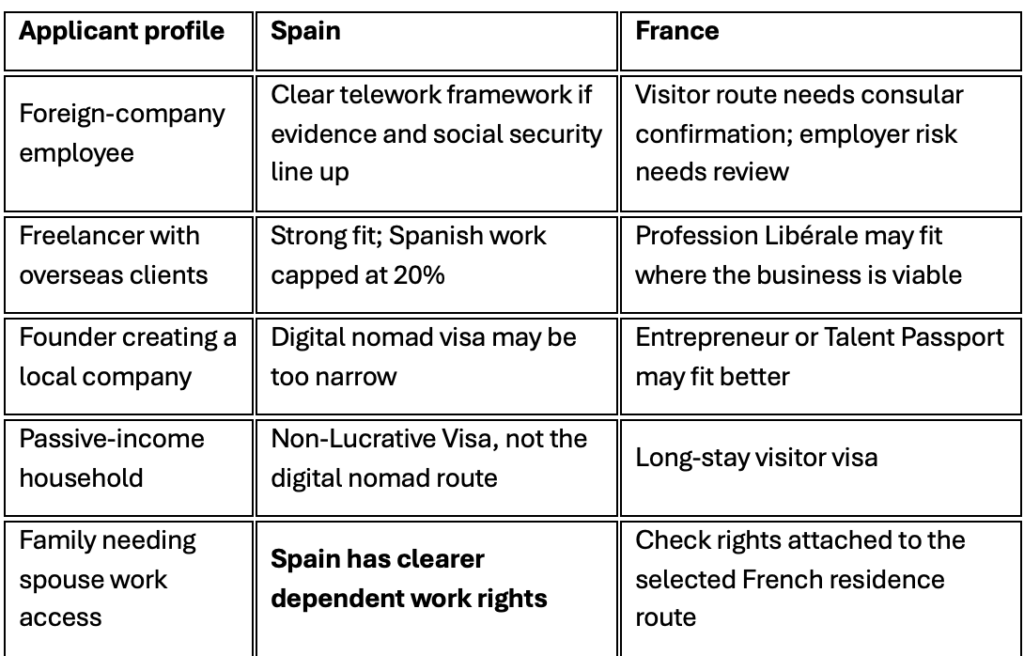
Overview table of the difference of what matters in practice

Spain’s Non-Lucrative Visa requires 400% of IPREM for the main applicant. With a reported 2026 IPREM of €600 per month, that equals €2,400 monthly or €28,800 yearly before dependent additions. It bars work, so it does not suit a person planning to work remotely.

Both countries allow Schengen travel, yet Spanish residence does not authorize living or working in France, and French residence does not authorize living or working in Spain. For long-term planning, Spain references five years toward long-term residency. Nationality timelines, physical presence, and route renewals require separate checks.

Taxes, social security, and total relocation cost

A visa approval is not tax clearance. Spending more than 183 days in Spain or France can trigger tax residency, though treaty rules and effective residence facts also matter. Spain’s special impatriate regime, sometimes called the Beckham Law, may apply for up to six years if its conditions are met. The reported 24% IRNR rate is not a universal digital nomad tax rate.

Employees should ask their employer about payroll, permanent-establishment exposure, labor law, and social security before moving. UK applicants should check whether an A1 is available; Spain’s guidance references CA3822 for employees and CA3837 for self-employed people where applicable. Insurance, apostilles, sworn translations, tax advice, housing deposits, and visa fees belong in the real relocation budget.

Remote work policy is still catching up with cross-border employment. As digital nomad programs evolve across Europe, income thresholds and compliance rules can change quickly. Recheck every figure and document rule shortly before you apply.

Which country and route fits your situation?

Choose Spain’s digital nomad visa when you want a defined remote-work category, can document foreign income, and may need work rights for family members. It is particularly direct for employees and freelancers whose clients remain outside Spain.

Consider France when your situation fits a visitor, independent-professional, entrepreneur, or Talent Passport route. France can work very well for a France-centered life plan, yet the visa category must match what you actually do. Do not build your move around an informal reading of visitor status.

Application and relocation checklist

First, confirm your citizenship, country of legal residence, and visa channel. Map every income source and client location. Then review tax, payroll, and social security with the relevant professionals. Collect certificates early, check their validity dates, apostille or legalise them, and commission the right translations before submitting your application.

After approval, the real work starts: housing, a bank account, health coverage, tax registration, school enrollment, and business formalities all have their own deadlines. If retirement rather than remote work is your plan, compare the rules before you retire in Spain under the Non-Lucrative Visa.

Spain wins on clarity for qualifying remote workers. France rewards applicants who choose the right existing route and prepare a consistent file. If your move involves French administration, a family, housing, healthcare, or a new business, seek a personalized France assessment before booking flights. A careful review upfront can prevent a visa choice from creating tax, work, or residency problems after arrival.

This article is for informational purposes only and does not constitute legal, immigration, or tax advice. Always seek independent professional advice before making any visa or relocation decision


%

Spain’s New 400 Phone Rule Starts Saturday

Published

on

spain’s-new-400-phone-rule-starts-saturday

Spain introduces new 400 phone numbers to identify sales calls from October 17. Credit : Andrii Iemelianenko, Shutterstock

If you live in Spain and regularly receive unwanted sales calls, a new rule coming into force on Saturday, October 17, could make them easier to identify. Companies covered by the legislation will have to use nine-digit telephone numbers beginning with 400 when making commercial calls.

The measure is designed to help consumers distinguish commercial calls from other communications, rather than ban telemarketing altogether. The rules were formally established in a government resolution published in Spain’s Official State Gazette (BOE) on April 16, giving telecoms operators and businesses six months to prepare.

Similarly, commercial telephone calls will now be regulated in a dedicated nine-digit number, and this will enable subscribers to distinguish between commercial calls and ordinary calls and customer services.

However, the legislation includes exceptions, and a call from a 400 number should not automatically be regarded as fraudulent.

What changes for sales calls in Spain from October 17?

Under the new system, companies affected by the law must use the telephone numbers starting with 400 when making business calls to potential customers.

This change is to make the phone call more easily understandable before you even pick up the receiver.

Sales calls could come from different phone numbers in the past, which made it difficult for consumers to distinguish between legitimate calls and marketing calls or scams.

According to the resolution of the Spanish government, which is in the BOE, the 400 series has been specially reserved for commercial calls. The new law establishes a six-month period of implementation, from the date of its entry into force on April 17.

October 17 marks the deadline when the new numbering requirements are due to become fully operational.

Speaking at the Foro CREO event on October 14, Minister for Digital Transformation Óscar López explained that this measure will apply to any company that contacts people who are not their customers to offer their products and services.

The minister explained that the consumers would then recognize the purely commercial nature of these calls, and could therefore choose whether or not to answer them.

The rules are not meant to mean that every call from a company has to begin with 400.Customer service calls are treated separately. Depending on the kind of call, companies use geographical telephone numbers, designated short numbers or the 800 and 900 ranges.

The National Markets and Competition Commission (CNMC) has also explained that the legislation allows certain businesses and circumstances to be exempted from it.

Can you call back a 400 number or block sales calls?

One of the most important changes in the new numbering system is that 400 numbers can only be used to make outgoing calls.

The BOE resolution expressly prohibits incoming calls to these numbers. To be clear, if you don’t answer a call from a number beginning with “400,” you won’t be able to call it back.

The numbers are used exclusively for commercial communication and may not be used for ordinary customer service numbers.

There is also a clause in the law enabling the telephone companies to offer subscribers the possibility of blocking calls from the 400 number range.

However, the law speaks of the ‘option’ that service operators can offer upon request, not the automatic blocking that every service provider must have. To avoid such calls, people should ask their telephone service provider if they block the number 400.

Also, consumers should note that a prefix known to the public is no guarantee that the caller is reliable.

If you receive an unexpected call, you should not give out any bank details, passwords or PINs. If a person claims to be from your bank, the power company, the telephone company, or other company, hang up immediately and contact the company independently at the official telephone number of the company.

What happens if a company keeps calling from another number?

The new rules are supposed to make it easier to identify the commercial calls, and prevent businesses from using other numbers for the same purpose.

According to the Ministry for Digital Transformation, telephone companies are supposed to block commercial calls that do not comply with the new rules on calling.

The CNMC is responsible for supervising the allocation and use of the 400 range, alongside the responsibilities of other relevant authorities.On October 14, Óscar López also explained that consumers receiving calls from other telephone numbers can also inform the CNMC about suspected abuses.

However, because the legislation provides for certain exceptions, not every commercial call made from a different prefix necessarily constitutes a breach of the rules.

This new measure, which is part of the Spanish fight against telephone fraud and for greater transparency in communication, is to be found in a new scheme for detecting telephone fraud.

The government had already introduced a number of measures to tackle telephony fraud, including a prohibition on suspicious telephone traffic and stricter controls over the identification of SMS senders.

Anti-fraud measures were said by Óscar López  to have blocked more than 400 million calls and 32 million messages in the course of the campaign. The 400 range adds another layer of protection by making it possible to differentiate more clearly between commercial calls and ordinary communications.

Continue Reading

%

Spain’s 24-Hour Shop With No Tills Expands To Barcelona Airport

Published

on

spain’s-24-hour-shop-with-no-tills-expands-to-barcelona-airport

Customers enter by identifying themselves with their mobile phone number. Photo credit: ACHPF/Shutterstock

If you have ever needed a drink, a sandwich or a snack at an awkward hour, you will know how useful it is to find a shop that is actually open. Now, a Catalan chain that lets customers shop without going through a traditional checkout is bringing its round-the-clock convenience stores to Spain’s airports, starting with a new shop at Barcelona-El Prat.  Big Fish is not a conventional supermarket. Its small, automated shops sell ready-to-eat food, drinks, snacks and other convenience products for people who need something quickly, rather than somewhere to do their weekly shopping.

The stores operate 24 hours a day and are designed to let customers pick up what they need without waiting for a cashier. The new shop occupies 60 square metres in Terminal 2 of Barcelona-El Prat Airport, in the international departures area near the W boarding gates and beside the duty-free store. It is Big Fish’s first airport location and takes the company into the travel retail market, where passengers often have limited time to buy food or drinks before boarding. 

How does the automated shop work?

Customers enter by identifying themselves with their mobile phone number and bank card. Once inside, they can browse the shelves, pick up products and leave without scanning their purchases or paying at a conventional till.  The system uses cameras, intelligent sensors and computer vision to identify which products customers take or return. 

It then calculates the bill automatically, with payment handled through the card registered when entering the shop. The technology comes from Techtail, another business within Grupo Moure, which also owns Big Fish. Rather than relying on vending machines, the format allows customers to walk around a shop, handle products and check packaging before deciding what to buy. 

At the airport, Big Fish is using its READY concept, built around products that are ready to take away, eat or drink. The range is intended for quick purchases during a journey, from refreshments to food that can be eaten before boarding or taken onto a flight.  The shop is open around the clock, according to airport operator Aena. That means passengers can use it outside the opening hours of many conventional retailers, including those travelling on early departures or late-night flights. 

Big Fish expands across Spain

The airport opening brings Big Fish’s Spanish network to ten stores. The chain has recently expanded in Madrid, adding locations in Vicálvaro and Vallecas, and is continuing to look for new sites.  Before entering airport retail, the business had focused on convenience locations where people want to make quick purchases, including service stations and other busy sites. Barcelona-El Prat gives the company a new setting for its automated format, with a steady flow of travellers who may want refreshments without spending time in a queue. 

The airport shop follows a tender awarded by Aena, the operator of Spain’s airport network. For Techtail, the location also provides an opportunity to put its automated retail technology to work in an international airport environment.  There has been no confirmed announcement of further Big Fish airport openings, so Barcelona-El Prat remains its first location in this sector. But with ten stores now operating across Spain and the company exploring further sites, the airport launch marks another step in its expansion.

Continue Reading

%

Spain Minimum Wage Could Hit €1,306 In 2027

Published

on

spain-minimum-wage-could-hit-e1,306-in-2027

Spain’s minimum wage could rise to €1,306 in 2027. Credit : Alex Malt, Shutterstock

If Spain’s two largest trade unions get their way, workers earning the minimum wage could receive nearly €1,200 more a year in 2027. The proposed increase would push the monthly minimum above €1,300 for the first time, as rising prices continue to put pressure on household budgets.

On October 13, UGT and CCOO demanded a minimum wage increase of at least 7 per cent for 2027, arguing that workers need a substantial pay rise to recover purchasing power lost to inflation.

The proposal would raise the minimum wage from €1,221 to approximately €1,306 gross per payment, based on Spain’s standard system of 14 annual payments. However, the increase has not yet been approved by the government.

How much could Spain’s minimum wage increase in 2027?

The proposal made by the UGT and CCOO on this matter is that Spain’s minimum wage, known as the Salario Mínimo Interprofesional (SMI), would increase by about 85.50 € per month.

Under the unions’ proposal, the minimum wage would rise from €1,221 to approximately €1,306 gross per payment, based on 14 annual payments.

In the case of employees who have their pay increase spread over 12 monthly instalments, the proposed increase would mean a gross monthly salary of about €1,524 instead of 1,424.50.

For example, a minimum-wage worker who works full-time would receive almost €100 more on their monthly pay packet under the 12-payment system.

These figures do not take into account the deductions for taxes and social security contributions. The real rise in take-home pay will depend on the circumstances of each worker.

The present minimum wage was determined by Royal Decree 126/2026. It raised the minimum wage by 3.1 per cent for 2026.

This increase of €37 added to the former monthly minimum salary was not, however, sufficient, according to the unions, to protect the workers from the rise in prices.

That means that the seven percent increase would be more than double the percentage increase introduced this year.

Why are Spanish unions demanding a 7% pay rise?

The demand comes amid the high cost of living, and in particular the cost of housing, a very important part of which falls on workers with lower incomes.

On October 13th, at a joint press conference, the UGT General Secretary, Pepe Álvarez, and CCOO leader Unai Sordo, argued that wages should increase much faster to ensure that the workers’ purchasing power was not weakened.

According to Agencia EFE, Álvarez said the proposed increase takes into account the gap between the 3.1 per cent minimum wage rise approved earlier this year and subsequent inflation.

The unions consider that an increase of at least seven per cent would help compensate for that difference, as well as protecting them from further rises in prices.

Their demands also extend beyond the minimum wage. Pay rises, according to CCOO, must increase from 4 to 7 per cent, arguing that wages across the Spanish economy must better reflect the rising cost of everyday essentials.

A further great problem is that of housing; it is not uncommon for people with wages above the minimum to find it difficult to pay their rent, especially in areas where property prices have risen sharply.

It is a proposal of interest to British people who work in Spain, especially in hospitality, tourism, retail or lower-paid areas.

The minimum wage applies to eligible employees regardless of nationality, although the amount a worker receives depends on factors including working hours and contractual arrangements.

This communication precedes the general strike, planned for 11 November, organised by the UGT and CCOO over demands concerning wages, housing and prices.

The minimum-wage demand is now included in these more general demands, but the strike does not determine whether or not the government will grant the requested increase.

When could Spain’s new minimum wage be approved?

Workers, whatever the figures are, should not expect an immediate change in their wages.

The Spanish Government has begun preparations for the next revision of the minimum wage, with its advisory council of experts having been instructed to study the rate of increase appropriate to 2027.

Labour Minister Yolanda Díaz asked the committee to study how to protect purchasing power against inflation.

According to RTVE, the government intends to approve the next minimum wage before elections due on November 29. The increase has not yet been decided, and the government’s eventual decision may vary from the seven per cent demanded by the unions.

The minimum wage is set by the government after consultations with the unions and employers’ associations. Agreement between all parties is not legally required for a new minimum wage to be set. Any change which might be approved must be formalised by legislation and published in Spain’s Official State Gazette, the BOE.

For the moment the statutory minimum wage continues at € 1,221 gross in fourteen instalments, or € 17,094 a year for a full-time worker. But whether it goes to something like €1,306 in 2027 will depend on the outcome of the forthcoming negotiations.

Continue Reading

Trending

Copyright © 2017 Spanish Property & News