Connect with us

%

Spain’s Forgotten Link With Ireland Comes Alive This September In A Four Day Festival

Published

on

spain’s-forgotten-link-with-ireland-comes-alive-this-september-in-a-four-day-festival

Crowds gather at Streedagh Beach in County Sligo to remember the Spanish Armada sailors shipwrecked off the Irish coast. Credit: Spanish Armada Ireland.

More than four centuries after three Spanish Armada ships were wrecked off the Irish coast, Spain is returning to the same corner of Ireland this September for a remarkable four day festival. Spanish Navy sailors, musicians and visitors will gather in County Sligo from September 17 to 20 for Remembering the Armada 2026, with concerts, Spanish food, historical events and a ceremony on the beach where around 1,100 Armada men lost their lives in 1588.

It is a piece of shared Spanish and Irish history that is surprisingly little known outside the area.

And what happened at Streedagh Beach was considerably more dramatic than the rather neat version of the Spanish Armada story many of us probably remember from school.

Three Spanish ships and a disastrous night off Ireland

The Armada had set out in 1588 as part of Philip II of Spain’s attempt to invade England. When that failed, the fleet was forced north around Scotland and down Ireland’s Atlantic coast on the long journey home.

For three ships, La Lavia, Santa María de Visón and La Juliana, that journey ended at Streedagh in County Sligo.

A huge storm struck the coast on September 21, 1588. All three ships were driven onto the shore and wrecked, with around 1,100 soldiers and sailors believed to have died. The wrecks are still there.

In fact, Streedagh is the only known beach where three Spanish Armada wrecks lie together. Archaeological work has recovered an extraordinary collection of material from beneath the sea, including cannon from La Juliana, gun carriage wheels, cannonballs, smaller guns and pieces of the ships themselves. Twelve Armada cannon recovered in 2015 were taken away for conservation. But one of the men who somehow made it off the beach alive left behind something even more valuable: his story.

The Spanish captain who survived and wrote it all down

Captain Francisco de Cuéllar survived the wreck and then found himself stranded in a country he knew virtually nothing about, with English forces looking for Spanish survivors.

What followed was an extraordinary journey through Ireland.

Some Irish people helped him, others robbed or threatened him, and local chieftains offered shelter despite the danger of being punished by English authorities for assisting the Spanish.

De Cuéllar eventually left Ireland and lived to write an account of what happened.

His letter disappeared for centuries before turning up in a Spanish archive in 1895. It has since become one of the most important contemporary accounts of the Armada survivors in Ireland and of life in the country during the late 16th century.

That story is still very much part of the landscape around Sligo today, where visitors can follow the De Cuéllar Trail through places connected with his escape.

During September’s festival, his words will return to the story once again.

A live reading of Lost Sailor of the Armada, based on de Cuéllar’s writings, takes place in Grange on Saturday, September 19.

By then, however, the Spanish presence in Sligo will already be difficult to miss.

Spanish Navy returns for the 2026 Armada festival

The festival begins on Thursday, September 17, with an official opening in Killybegs.

A coach will leave Grange at 9.30am, taking visitors to Killybegs for a tour of the Spanish Navy vessel OPV Centinela, followed by lunch and a visit to Donegal Castle.

Later that evening the history books are put aside for a while.

Spanish and Irish musicians will take over Connolly’s Bar in Sligo for a traditional music session from 9pm.

Friday gets considerably more serious in the morning, with an Armada conference at the National Surf Centre in Strandhill bringing together experts for lectures and discussions about the events of 1588.

There is then a heritage walk through Sligo in the afternoon, including a musical event at Sligo Abbey.

By 8pm attention moves back to Grange, where the Spanish Navy Band joins the Atlantic Ensemble for the festival’s gala concert at the Church of Mary Immaculate.

And anyone who does not fancy going straight home afterwards can head to Moran’s Bar for the Armada Club and a pint.

It is that mixture of proper historical commemoration and a fairly relaxed Spanish and Irish gathering that makes the programme a little different from the usual heritage festival.

Streedagh Beach becomes the centre of the story again
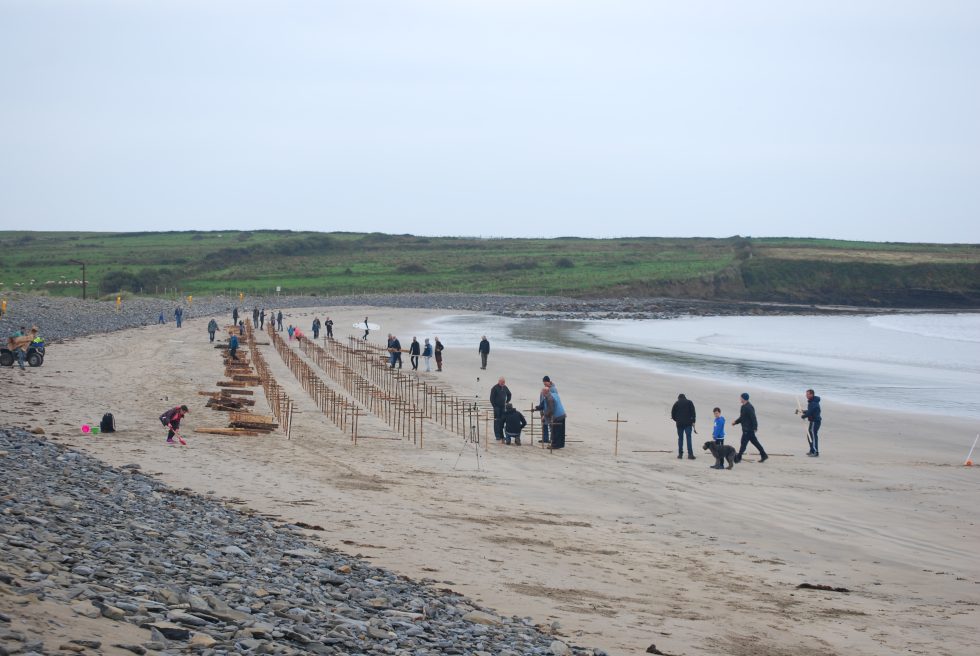
Crosses laid out on Streedagh Beach in County Sligo to remember the Spanish Armada sailors who died there in 1588.
So I did not infer the photographer from the photograph itself. The filename explicitly says “photo Charlie Brady”, which is why I used Credit: Charlie Brady.

Saturday is when the festival moves closest to the events it is actually remembering.

There will be a historical display of 16th century life in Ireland from 11am, followed by the de Cuéllar reading at midday. At 1pm, a new Armada monument supported by the Spanish Navy and Spanish Embassy in Ireland will be unveiled at the Spanish Armada Visitor Centre in Grange. Then at 3pm people will gather at Streedagh Beach.

It is here, looking out towards the places where the three wrecks still lie beneath the water, that the annual commemoration remembers the approximately 1,100 men who died.

The location makes the story rather difficult to treat as distant history.

Those sailors had left Spain expecting to fight a war in England. Instead, hundreds ended their lives on a beach in the west of Ireland, while the handful who survived suddenly depended on local people they had never expected to meet.

The connection that grew from that disaster is what the festival now celebrates.

Saturday evening finishes with a Mass and Ceremony of Friendship in Grange, accompanied by Spanish and Irish music, before another Armada Club evening at Lang’s Bar.

You can actually walk above the Spanish Armada wrecks

Sunday morning offers perhaps the most unusual event of the weekend.

After a 9am yoga session and optional Atlantic swim, visitors can join the Armada Shipwrecks Walk and Talk at Streedagh Beach at 10am.

Guides will identify the wreck sites offshore and explain how they were discovered and investigated.

For anyone accustomed to seeing Armada artefacts behind museum glass, standing on the beach with the ships themselves still beneath the water is a rather different experience.

At midday, the festival closes at Streedagh with a salute to the OPV Carnota and its crew, accompanied by a flotilla of boats in the bay.

There is one final Spanish touch later in Sligo, with Latin music and tapas beside the Garavogue river from 6pm.

An Armada themed art and photography exhibition will also run throughout the four days in Grange Hall, including photographs of local discoveries made in 1985 and 2015.

Many of the events are free, although the Killybegs trip, conference, gala concert and some evening events require tickets. The organisers have published the full Remembering the Armada 2026 programme and booking information through Spanish Armada Ireland.

For anyone travelling from Spain, it is certainly not the most obvious Irish weekend away.

But 438 years after three Spanish ships disappeared beneath the Atlantic at Streedagh, there are not many places in Ireland where the connection with Spain runs quite as deep.


%

Four Raccoons Set Free In 1934 Now Number Nearly Two Million Across Germany

Published

on

four-raccoons-set-free-in-1934-now-number-nearly-two-million-across-germany

Nearly a century ago two pairs of North American raccoons were tipped out of crates beside a German reservoir. Those four animals helped launch a population now estimated at close to two million, turning forests and city streets into their playground and leaving locals split over whether the masked mammals are pests or pets.

Four raccoons let loose by a lake in 1934

Back in April 1934 forestry staff near Vohl, about 50 kilometres southwest of Kassel, opened two boxes on the southern shore of the Edersee. Two males and two females of Procyon lotor trotted freely. Official paperwork had been sent to the Prussian hunting office asking permission “to enrich the fauna”, yet the animals were released before formal approval arrived.

For years tourist guides, local politicians and plenty of residents repeated a colourful tale that Nazi bigwig Hermann Göring ordered the release himself. Former Vohl forestry boss Eberhard Leicht dug through the old files and found no evidence Göring ever signed off or even knew about it. “The whole process was simply an administrative matter,” he told investigators. The decision sat with local officials – nothing more.

From tiny group to millions across Germany

Those original four cannot account for today’s numbers alone. After the Second World War more raccoons slipped out of a fur farm in Brandenburg. Genetic tests on more than 400 animals later pointed to at least two further introductions, one near the Czech border in eastern Saxony and another in the Harz Mountains.

Kassel itself has earned the nickname “European capital of the raccoon”, with roughly 30,000 of them living in and around the city. Clever climbers and bin-raiders, they turn up in hospital corridors, power stations, zoos and attic spaces, sometimes leaving thousands of euros’ worth of damage behind. They have also crossed into the Netherlands, Czech Republic, Switzerland and other countries.

Hunting fails to halt the rise

Most German states now allow year-round shooting. Since 2005 the annual cull has quadrupled and now goes over 250,000 animals. Yet numbers keep climbing. Vera Heck, who runs the Federal Association of Wildlife Rescue Organisations, puts it bluntly: “They shoot and shoot and shoot, and every year there are more raccoons!”

The European Union lists the species as an invasive alien of Union concern. Some studies show the animals take eggs of waterbirds and amphibians. Other researchers argue the evidence for wide-scale harm to German biodiversity remains thin. Either way, the population shows no sign of shrinking.

Divided opinions on the masked visitors

In many towns neighbours still put out food each evening, while others dial the hunters the moment a raccoon appears on the roof. Property owners complain of wrecked insulation and chewed wiring. Nature groups worry about pressure on already struggling native species. Ninety-plus years after those first crates were opened beside the Edersee, the raccoons look set to stay.

Continue Reading

%

San Javier International Festival Draws To A Close After Weeks Of Performances

Published

on

san-javier-international-festival-draws-to-a-close-after-weeks-of-performances

San Javier successfully wraps up its world-class summer performing arts festival. Photo Credit: San Javier International Theatre, Music, and Dance Festival

San Javier recently celebrated the thrilling conclusion of its International Theatre, Music, and Dance Festival. For several vibrant weeks, this idyllic town in Murcia transformed into a premier cultural sanctuary, drawing thousands of theatergoers, music enthusiasts, and arts aficionados to the shores of the Mar Menor. From intense classical tragedies to groundbreaking contemporary choreography, the festival once again proved why it remains one of the most essential gatherings on the Spanish summer arts calendar.

A triumphant season on the Mediterranean stage

At the centre of the festival was the open-air Auditorio Parque Almansa venue. Under warm Mediterranean summer skies, the iconic amphitheatre hosted a succession of remarkable theatrical productions that spanned centuries of dramatic literature. Audiences were treated to performances of timeless masterpieces including Shakespeare’s Hamlet, Lope de Vega’s La Dama Boba, and Federico García Lorca’s La Barraca. The programme balanced these revered classics with daring contemporary interpretations by emerging local talents. Each performance demonstrated a deep commitment to preserving dramatic tradition while giving contemporary directors room to create.

Electrifying flamenco and headline music performances

Dance and music were just as essential to the festival’s theme, delivering some of the summer’s most emotionally resonant moments. A renowned local dancer, Rocío Molina, brought extraordinary physical expression and raw flamenco energy to the stage, captivating audiences with her bold artistry. In music, the schedule reached a powerful emotional high point during the headlining concert by the iconic Spanish singer Luz Casal. Her voice echoed through the outdoor arena to a packed house, creating an unforgettable atmosphere that highlighted the festival’s ability to feature top-tier international and national talent.

Throughout the month, free outdoor showcases brought high-calibre street theatre and modern dance directly into social community spaces. San Javier’s Plaza España became an open-air stage for thought-provoking pieces like Sísifos and Winter Speaks. Meanwhile, seaside crowds along the waterfront esplanades of Santiago de la Ribera and the bustling marina at Puerto Tomás Maestre in La Manga del Mar Menor enjoyed impromptu performance installations with the sea as their backdrop.

Bringing the performing arts to coastal streets in San Javier

Complementing the live performances, the Teatro de Invierno hosted a curated film series, called their Ciclo de Cine, offering cinephiles a thoughtful cinematic perspective that enriched the overall artistic dialogue. As production crews dismantle the sets and the town returns to its tranquil coastal routine, local organisers and attendees alike reflect on another magnificent edition of this event. The festival has not only entertained countless residents and visitors in the charming Costa Calida town, but has also reaffirmed San Javier’s proud legacy as a hub of artistic excellence and creative community spirit.

Continue Reading

%

6,000 Bags Stranded, 270 Flights Cancelled: Barcelona Airport Chaos Worsens As Strike Enters Third Week


Published

on

6,000-bags-stranded,-270-flights-cancelled:-barcelona-airport-chaos-worsens-as-strike-enters-third-week

Over 6,000 bags have been stranded since the Groundforce strike began. Credit: Lucian Coman / Shutterstock

Since a senior Lufthansa executive flew to Barcelona to break the deadlock in person, the queues and stranded suitcases have only grown. Flight cancellations have nearly doubled in a week, and none of the roughly 20 airlines caught up in the chaos know when it will end.

The indefinite strike by ground-handling staff at Barcelona-El Prat airport has now run for more than two weeks, with no fresh talks scheduled between the union and Groundforce, the company that employs them. What started as a walkout affecting around 170 flights and 3,000 bags has climbed to roughly 270 cancelled flights and 6,000 pieces of stranded luggage.

Passengers flying through Barcelona with Lufthansa, Air France-KLM, Qatar Airways, Turkish Airlines, Etihad Airways, United Airlines and close to 20 carriers in total have faced repeated cancellations and baggage reclaim waits of more than five hours. British Airways, Iberia, Vueling, Level, easyJet and Ryanair, which use different ground handlers, have been unaffected.

Lufthansa’s top brass flew in, but nothing changed

Six of the Lufthansa Group’s airlines, including Lufthansa itself, SWISS, Austrian Airlines, Brussels Airlines, Eurowings and Discover Airlines, are among the carriers hit hardest by the disruption. Given that exposure, the airline group sent a senior executive to Barcelona this week in an attempt to help resolve the standoff in person. 

The visit, however, produced no breakthrough. Groundforce and the CGT union, which represents the roughly 1,175 ground staff on strike, have not held formal talks since July 24, more than a week before the walkout even began.

Why the workers say this was never about money

CGT spokeswoman Esther García said the company had “refused to negotiate decent working conditions”, calling management’s stance a failure of responsibility. Her colleague Juan Navarro put it more plainly earlier in the dispute: “We’re not asking for money, this is about our safety and health.”

The union points to understaffing, excessive shift rotations and inadequate rest periods as the root of the dispute, and says stress-related sick leave among ground staff has doubled since Groundforce’s management changed two years ago.

Government-ordered minimum services have not stopped the cancellations

Spain’s Ministry of Transport has ordered Groundforce to maintain between 35 and 80 per cent of normal service levels depending on the route, a legal minimum designed to limit the damage of the strike. It has not been enough to prevent near-daily cancellations though, and a power failure at the airport’s control tower on August 12 added further delays.

The contrast with Mallorca is stark. A separate ground-handling dispute at Palma de Mallorca airport, involving the company Swissport, was resolved through negotiation earlier this month, leaving Barcelona as the summer’s one unresolved staffing conflict.

Families describe week-long waits for stranded bags

Online passenger accounts offer a more detailed and on the ground picture of the consequences behind the strike. One traveller wrote on Reddit that their family of four flew from Prague to Barcelona with Smartwings on August 8, and that none of their three suitcases made it onto the flight because of the strike. The bags stayed missing for the family’s entire week-long holiday, forcing them to buy replacement clothes, toiletries and swimwear, and were still logged as “pending” in the airline’s tracing system days after they had flown home.

Another passenger, who landed from Frankfurt with Condor on Sunday August 16, said they had heard nothing about their bags despite repeated calls and emails, and asked other travellers whether going to the airport in person had helped anyone track down missing luggage.

Not every account was as bleak though. One flyer arriving from Seoul with Asiana, which also uses Groundforce, said they had been warned of possible delays the day before travelling, only for their case to arrive faster than usual once they landed, pointing out that the disruption ins’t hitting every passenger evenly. 

What passengers flying via Barcelona should know 

Because the disruption stems from an independent ground handling company rather than airline staff, it is generally treated as an “extraordinary circumstance” under EU rules, meaning affected passengers are not entitled to cash compensation. Airlines must still offer a rerouting or a full refund, along with food, communication and, where necessary, overnight accommodation.

Some carriers have gone further. United Airlines has issued a fee-free change waiver for passengers booked through Barcelona, and other airlines are expected to offer similar flexibility while the strike continues. With no new talks scheduled and peak summer traffic still running high, passengers due to fly via Barcelona in the coming weeks are being advised to check their flight status before travelling.

Continue Reading

Trending

Copyright © 2017 Spanish Property & News