%
Survey Shows 47% Of People In Spain Actively Avoid Mass Tourism Spots
Published
7 hours agoon
By
Molly Grace
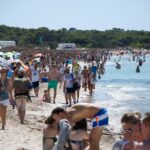
High visitor numbers have contributed to congestion in public spaces. Photo credit: Wirestock Creators/Shutterstock
A recent survey done by Booking has found that 47% of people in Spain avoid overcrowded holiday destinations when planning travel. The responses relate to travel behaviour and attitudes towards tourism pressure and sustainability.
Spain remains one of the most visited countries in the world. Tourist flows are concentrated in coastal regions, major cities and island destinations, particularly during peak summer months and public holiday periods.
These locations continue to attract both domestic and international visitors at scale. The survey focuses on how Spanish residents describe their own travel choices, particularly in relation to destination selection and perceived crowd levels.
Crowding as a factor in destination choice
Many respondents say crowd levels influence where they go on holiday. This includes avoiding well-known destinations at peak times and selecting alternatives with lower visitor density. Some travellers report shifting travel dates to avoid the busiest periods. Others choose inland or rural areas instead of coastal resorts and major urban centres. Smaller towns and less visited regions appear more frequently in responses where travellers describe quieter environments as a preference.
Traditional decision factors such as cost, climate and accessibility remain important. However, crowding is now present alongside these considerations in a significant share of responses. In some cases, respondents describe avoiding destinations that are widely featured on social media or associated with high seasonal congestion. This includes locations that experience short periods of intense visitor pressure compared with more stable year-round tourism flows.
Concentration of tourism pressure in key regions
Tourism remains a major sector in the Spanish economy, supporting employment across hospitality, transport, retail and related services. The structure of demand, however, remains uneven across the country. Barcelona is among the most frequently cited urban destinations in discussions around visitor pressure. The Balearic Islands, including Mallorca, Menorca and Ibiza, also experience high seasonal concentration.
In the Canary Islands, tourism demand is spread more evenly across the year but still reaches high levels in peak periods. These areas experience the most visible effects of visitor density, including congestion in public spaces, strain on transport systems and pressure on housing markets in tourist zones.
Local authorities have introduced or considered a range of measures aimed at managing these pressures. These include tighter regulation of short-term rental accommodation, limits on cruise ship arrivals in specific ports, and campaigns designed to distribute tourism more evenly across regions. Some cities have also focused on regulating visitor flows in specific districts during peak times, particularly in historic or high-footfall areas.
Domestic travel behaviour and regional redistribution
Responses from Spanish residents indicate movement away from heavily visited destinations towards less frequented regions within the country. Smaller towns and inland provinces appear more frequently in travel choices described by respondents. These areas typically experience lower visitor numbers compared with coastal and metropolitan destinations, particularly outside major cultural or seasonal events.
Regional tourism bodies have expanded promotion of inland areas, focusing on heritage sites, natural parks and local cultural routes. These initiatives aim to increase visitor distribution beyond traditional coastal hotspots. In some cases, respondents describe choosing destinations based on perceived space, quieter environments and lower seasonal congestion. These preferences appear across both short domestic breaks and longer holiday periods.
Role of lesser-visited destinations
Areas outside Spain’s main tourist corridors continue to develop tourism infrastructure aimed at attracting domestic visitors. Inland regions promote historic towns, wine routes, hiking areas and protected natural landscapes. These destinations typically receive lower visitor volumes than coastal resorts and major cities but have increased visibility in domestic tourism campaigns.
Local economies in these regions often depend on smaller-scale visitor flows spread across the year rather than concentrated seasonal peaks. Responses in the survey suggest that some travellers are more willing to consider these destinations as alternatives to established holiday locations, particularly during peak summer months when congestion is highest in coastal areas.
Tourism structure and regional imbalance
Spain’s tourism sector continues to be one of the largest in Europe, contributing significantly to employment and regional economic activity. However, visitor distribution remains uneven.
High-demand destinations concentrate large volumes of visitors in relatively small geographical areas. This creates periods of intense pressure on infrastructure, housing and local services in specific locations, while other regions receive comparatively low numbers of tourists.
The imbalance has been a recurring issue in discussions about tourism management in Spain. It affects housing availability in central tourist zones, transport capacity during peak periods and the sustainability of certain local economies reliant on seasonal demand.
Policy response and management measures
Local and regional authorities have introduced a range of measures aimed at addressing pressure in high-traffic destinations. These include restrictions on new short-term holiday rental licences in some cities, enforcement actions against unlicensed tourist accommodation, and limits on cruise ship arrivals in certain ports.
Some municipalities have also introduced measures aimed at regulating access to heavily visited areas during peak hours or seasons. These policies are designed to reduce congestion in specific districts rather than limit overall visitor numbers nationally.
At the same time, tourism boards continue to promote regional diversification, encouraging visitors to explore less visited areas of the country.
Interpretation of survey responses
The survey reflects self-reported behaviour among Spanish residents rather than measured travel outcomes. Respondents describe how they approach destination choice and which factors they consider when planning trips.
Crowding appears alongside price, accessibility and climate as part of that decision-making process. The proportion of respondents who avoid overcrowded destinations indicates that visitor density is a relevant factor for a significant share of those surveyed. The data captures stated preferences at the time of the survey and provides a snapshot of how domestic travellers describe their own behaviour in relation to popular destinations.
What the survey shows
The survey shows that 47% of people in Spain report avoiding overcrowded destinations when planning travel.
Responses describe adjustments in destination choice, timing and location type, including movement towards less visited regions and lower-density areas.
Tourism remains a major part of Spain’s economy, supporting employment across hospitality, transport and related sectors. However, visitor numbers are unevenly distributed across the country.
You may like
-
Eustáquio Clasifica A Canadá Para Octavos Y Salva Al Mundo De La Prórroga
-
New Spain Road Sign Could Cost Drivers €200
-
La Marcha Del Orgullo Crítico Reivindica Un Movimiento Libre De “negocio”: “Este Acto De Rabia Y Subversión Ha Sido Secuestrado Por Las Marcas”
-
Thunderstorms Strike Eastern Spain Before 42°C Heatwave
-
Cambrils residents sue council as looky looky men block the seafront promenade
-
Granada ring road horror: Wrong-way driver video goes viral
The DGT’s new P-35 sign warns of a weaving lane ahead. Credit : X – DGT
Ask most drivers what a triangular warning sign means and they’ll probably answer without thinking. Sharp bend. Roundabout ahead. Slippery road. But show them the P 35 sign, with its two cars and crossing arrows, and many are left scratching their heads.
That uncertainty is exactly why Spain’s Directorate General of Traffic (DGT) introduced it into the country’s official road sign catalogue. The sign warns drivers that they are about to enter a weaving lane, a stretch of road where vehicles joining a motorway and those preparing to leave it have to share the same space before going their separate ways. It might not sound particularly dramatic, but misunderstand the rules and the consequences can be expensive. Failing to respect priority can lead to a €200 fine and, in some cases, the loss of up to four points from your driving licence.
The layout itself is not new. Drivers have been using weaving lanes for years. What is new is the sign warning people that one is coming, and many motorists are only now discovering what it actually means.
The sign looks simple enough but it catches many drivers out
The first reaction many people have when they spot the P 35 sign is to assume it is another version of the familiar merging traffic warning.
It isn’t.
A weaving lane works differently because two manoeuvres happen at the same time.
One driver is trying to join the motorway while another is trying to leave it. For a short distance, both vehicles use the same lane before their paths separate.
If you’ve ever found yourself accelerating onto a motorway while another car suddenly moves across towards the exit you were aiming for, you’ve already experienced this situation.
The difference is that the P 35 sign tells you it is about to happen before you get there.
The DGT introduced the sign after updating Spain’s official vertical road sign catalogue in 2025. It normally appears between 150 and 500 metres before the weaving lane begins, giving drivers enough time to prepare.
Its design follows the standard warning format used throughout Spain.
It has a red border, a white background and two black cars connected by arrows that cross in the middle. The image is intended to show exactly what will happen ahead. Two streams of traffic will briefly overlap before separating again.
Once you understand the meaning, the sign is fairly straightforward.
The difficulty comes when drivers are unsure who should move first.
Who has priority? The answer is not always what drivers expect
This is where many motorists get caught out.
It is easy to assume that vehicles already travelling on the motorway always have priority. In most situations, that is true.
However, weaving lanes are governed by the normal priority rules set out in Spain’s General Traffic Regulations, and those rules depend on what each driver is doing.
A vehicle joining the motorway must normally give way to traffic already using it.
However, if a driver leaving the motorway has already started moving into the weaving lane, that vehicle takes priority over one that is still entering.
The DGT also offers practical advice rather than simply quoting the regulations.Drivers leaving the motorway are encouraged to ease off the accelerator slightly so they can move in behind the vehicle joining the road.
Meanwhile, motorists entering the motorway should build up speed positively, where conditions allow, so they can merge smoothly ahead instead of remaining alongside another vehicle.
Good timing often matters more than sudden braking.Using indicators correctly is equally important.
The signal should be activated before changing lanes, giving other drivers enough warning to react safely. Waiting until the manoeuvre has already started defeats the purpose.
Motorists travelling on the main carriageway also have a role to play.
Whenever traffic conditions allow, moving into the next lane can create valuable space for vehicles joining the motorway. If changing lanes is not possible, reducing speed slightly can make merging much easier and help avoid sharp braking.
A moment’s hesitation can quickly become an expensive mistake
The P 35 sign may be new, but the penalties for ignoring the rules are well established.
Drivers who fail to respect priority in a weaving lane can face a €200 fine, while more serious infringements may also lead to up to four penalty points being removed from their licence.
For many motorists, the greater risk is not the fine itself but simple confusion.
Road signs become so familiar over time that drivers often react automatically without really looking at them. A new sign breaks that habit.
That is exactly why the DGT believes the P 35 deserves attention.
Motorway traffic is already moving at high speed, leaving little time to make decisions. When several vehicles are trying to change lanes within a short distance, uncertainty can quickly turn into sudden braking, missed exits or near misses.
The sign is not asking drivers to learn a completely new rule.
Instead, it serves as an early reminder that the next section of road demands a little more attention than usual.
Spain’s road network continues to evolve, and the country’s road signs evolve with it. Even experienced motorists who have spent decades behind the wheel occasionally come across a symbol they have never seen before.
The P 35 is one of those signs.Learning what it means now is far easier than trying to work it out while travelling at motorway speed with cars joining from one side and leaving from the other. It could also save drivers from an avoidable fine and make one of the busiest parts of the motorway a little safer for everyone using it.
Summer storms end June in Spain. Credit: Yuriy Semak – Shutterstock
Spanish weather forecasters are saying thunderstorms will affect large parts of the east of the country from Monday before an all-new heat dome causes temperatures to rise above 40ºC in southern valleys by midweek.
Following weekend storms in the north of the country, attention now shifts to eastern areas as heavy showers and storms develop while temperatures begin their climb in southern and central zones.
Monday, June 29, Spain weather: Thunderstorms in east and rising temperatures
Eastern areas are predicted to see mostly clear skies at the start of the day, with moderate rain falling along the Cantabrian coast where accumulations could reach between 5 and 10 litres per square metre. Showers will intensify during the afternoon across the Pyrenees, interior Catalonia, southern Aragon, interior Valencia region, Murcia region, eastern Andalucia mountains and the eastern half of Castilla-La Mancha. Accumulations of 20 to 30 litres per square metre are likely to occur near the centre of the country accompanied by frequent lightning, possible hail and strong wind gusts.
Mucha precaución en zonas de tormenta, sobre todo en carretera. Son tormentas de corta duración, pero con fenómenos adversos en las zonas de paso.
Imágenes la @DGTes de la A3 a su paso por Utiel, Caudete de las Fuentes y la zona del embalse de Contreras. pic.twitter.com/ufNPBrCnIJ— AEMET Comunitat Valenciana (@AEMET_CValencia) June 28, 2026
Residents in these eastern zones may face sudden changes with storms bringing lightning strikes and gusty conditions that disrupt outdoor plans. The morning rain will stay lighter in northern coastal districts, while afternoon weather cells are expected to concentrate further south and inland. Forecasts from models keep totals manageable yet locally heavy enough to cause surface water in low spots and complicate driving conditions.
Stationary high-pressure systems are trapping a lot of hot air over southern regions and pushing temperatures higher, making for a muggier feel. Heat warnings cover the Guadalquivir Valley, southern plateau and Madrid region, where many locations will exceed 36ºC. Similar highs of 35ºC to 36ºC will continue to affect interior Catalonia and the lower Ebro areas. Extremadura and western parts will also record readings above 36ºC as the warmth builds from the south and west.
Tuesday, June 30, Spain weather: Stability returns with some showers
Some semblance of stability is expected to take hold over most of the country, though with weak rain, especially on the north coast of Spain. Isolated showers will develop in the evening over eastern mountain areas with limited totals expected. Drier air will spread from the west and reduce storm chances across the central and southern interior.
Temperatures then climb even more still, with 40ºC in the Guadiana and Guadalquivir valleys. Southern areas will feel the strongest heat, while northern coastal strips remain cooler under lingering cloud and light rain. Models show the heat establishing firmly in these valleys with very little relief overnight in many low-lying areas.
Eastern mountain districts stay the main focus for any late-day activity, though amounts stay small. Most other regions will enjoy longer dry spells as the overall pattern calms compared to Monday. Spanish weather outlooks improve for travel and outdoor events away from the far north coast.
Wednesday, July 1, Spain weather: Lingering showers before heat turns up
Light rain returns to the north coast while afternoon showers form in interior Catalonia and Mallorca. These features stay light and manageable with accumulations well below Monday levels in most places. The rest of the country is expected to see mainly dry conditions under increasing high-pressure influence.
Heat continues to build, with the most extreme readings expected in southern valleys. Forecasts indicate a maximum of 42ºC in Seville, 41ºC in Badajoz and 40ºC in Cordoba by Thursday, though the heat is due to intensify from Tuesday. Guadalquivir and Guadiana areas feel the peak effects first with very little breeze to ease the conditions.
The intense warmth will probably last until Friday, as most Julys begin, when high temperatures extend to the southern plateau and interior Galicia. Spanish heatwave forecasts show this pattern dominating through the middle of next week with minimal rain chances after Wednesday.
Summer has truly arrived in Spain, and the weather shows it.
%
Morocco Returns To GMT: Could Europe Finally End Changing Its Clocks?
Published
1 day agoon
June 28, 2026By
Molly Grace
The European Union’s attempt to end seasonal clock changes highlighted this tension. Photo credit: hydebrink/Shutterstock
Morocco is set to move its clocks back by one hour after the summer of 2026, returning to Greenwich Mean Time (GMT) after around eight years on GMT+1. In practical terms, the country will move away from a near-permanent daylight saving system and reintroduce standard time during winter months.
The adjustment itself is simple: clocks go back one hour after the summer period ends. But the wider significance is less about the mechanics and more about what it signals. Time systems are rarely changed unless governments believe the trade-offs between daylight, productivity and coordination have shifted. Morocco’s decision suggests that balance has been reconsidered.
What is happening is a reversal of Morocco’s GMT+1 policy. How it works is a seasonal return to GMT after summer. Why it matters is that it reopens a wider question Europe has been unable to answer for years: whether seasonal clock changes still make sense, and if not, what should replace them.
Europe’s long-running debate on clock changes remains unresolved
Europe has been discussing the end of changing the clocks forward for years, but no reform has been implemented. In 2019, the European Union backed a proposal to stop changing clocks twice a year. The idea was to allow each member state to adopt a fixed time permanently, removing the seasonal shift between winter and summer.
On paper, the reasoning was straightforward. Clock changes were seen as increasingly outdated in a global economy where digital coordination matters more than local daylight savings. They were also criticised for being disruptive, particularly in the days immediately after the shift. But the proposal stalled, member states could not agree on a single approach. Some preferred permanent summer time, others preferred permanent winter time. Geography complicated the issue further, since daylight patterns vary significantly between northern and southern Europe.
As a result, the reform was left in limbo. No new system was agreed, and the existing cycle of changing clocks in March and October continues. This is the key contrast with Morocco. While Europe debates and delays, Morocco has reversed its approach and returned to a more traditional structure.
Why Morocco is moving away from GMT+1
Morocco adopted GMT+1 in 2018, largely to align more closely with European working hours and improve consistency in business and trade. In practice, it reduced time differences with key trading partners for much of the year. But over time, domestic concerns became more prominent than international alignment.
One of the main issues was the effect on daily routines during winter. Later sunrises meant darker mornings for schoolchildren and workers, which became a recurring public concern. While the system was designed for efficiency, it created friction in everyday life.
The return to GMT is therefore not a sudden shift but a correction. It prioritises natural daylight alignment during winter months, even if it reduces the year-round synchronisation with Europe. It also reflects a broader reality: time systems are not neutral. They shape behaviour, routines and even perceptions of the working day. When that balance feels off, governments eventually revisit the structure.
What Europe could realistically gain from ending clock changes
If Europe were to revisit and implement its stalled proposal, the potential benefits would be practical rather than symbolic. The most immediate advantage would be stability. Removing seasonal clock changes would mean no biannual disruption to sleep patterns, schedules and transport timetables.
It would also reduce avoidable friction in cross-border coordination. Airlines, rail networks, logistics companies and digital platforms currently operate across two time shifts each year, requiring constant adjustment. Other potential benefits include:
- fewer scheduling errors during transition weeks
- more consistent international business coordination
- improved clarity for digital communication across time zones
- reduced disruption to sleep and productivity immediately after clock changes
There is also a wellbeing argument. The clock shift has been linked to short-term disruption in sleep patterns and concentration for some people, particularly in the days immediately following the change. While the effects are temporary, they are repeated twice a year across large populations.
However, any reform would still face the same political barrier: agreement on what permanent time should look like. That issue remains unresolved.
Will Europe actually follow this direction?
Despite repeated discussion, there is no confirmed timeline for the end of clock changing in Europe. The European Commission’s proposal remains effectively frozen. Member states still operate under the existing system, changing clocks in spring and autumn as a default.
The core problem has not changed: countries experience the changes very differently. A permanent “summer time” may suit some regions but feel extreme in others, while permanent “winter time” has the opposite effect.
Because of this, the debate has persisted without resolution. The system continues not because it is widely supported, but because no alternative has achieved consensus. Morocco’s decision does not directly force Europe to act, but it does sharpen the contrast. One system is being revised and simplified at national level. The other remains unchanged despite years of discussion.
How Morocco’s change affects its own rhythm
Within Morocco, the return to GMT will be most noticeable in winter. The country will shift back to standard time after summer, resulting in:
- earlier alignment of sunrise and sunset with daily routines
- a clearer separation between summer and winter schedules
- seasonal variation in time difference with external partners
For international coordination, this introduces more fluctuation across the year compared to the previous near-permanent GMT+1 system. Timing will depend more visibly on whether other regions are observing daylight saving time at the same moment. The change is not disruptive in itself, but it removes the sense of a fixed year-round offset.
A small shift that brings a bigger question
On the surface, Morocco’s return to GMT is a straightforward administrative change. But in context, it sits inside a larger unresolved debate about how modern societies organise time. Europe has been discussing simplification for years without implementation. Morocco has now adjusted its system in the opposite direction, prioritising seasonal alignment over permanent offset.
Neither approach is necessarily final. Both reflect attempts to balance local experience with international coordination. What remains uncertain is whether Europe will eventually resolve its debate, or continue adjusting clocks twice a year while others quietly move away from it.
When is the next F1 race? British Grand Prix schedule and details for 2026
Eustáquio Clasifica A Canadá Para Octavos Y Salva Al Mundo De La Prórroga
Survey Shows 47% Of People In Spain Actively Avoid Mass Tourism Spots
Dinosaurs are roaring over to Estepona this summer in a massive 5,000m² exhibition
Families Caring For Elderly Parents In Spain Say Brexit Has Left Them With Impossible Choices
Max Verstappen rules out Nurburgring return after 24 hour-heartbreak
Tags
Trending
-
Costa del Sol1 week ago
Dinosaurs are roaring over to Estepona this summer in a massive 5,000m² exhibition
-
%1 week agoFamilies Caring For Elderly Parents In Spain Say Brexit Has Left Them With Impossible Choices
-
Uncategorized2 weeks agoMax Verstappen rules out Nurburgring return after 24 hour-heartbreak
-
%1 week agoOne Of Spain’s Top Supermarkets Has Just Been Ranked Among Europe’s Most Innovative In A Major New Report
-
Costa Blanca North1 week ago
Denia launches new La Marineta music festival this summer with Fangoria and Nil Moliner
-
Latest2 weeks ago
KEY POINTS: What Changes About Life In Spain In July 2026
-
Latest2 weeks ago
400,000 More Migrants Than Forecast Apply For Spain’s Residency Amnesty
-
ElPais1 week agoPrimary Elections In New York, Maryland, And Utah: Date And How To Vote