Puente told reporters: “This is not an interrogation and only I will talk.” Photo credit: Gil Corzo/Shutterstock
Spain’s railways are facing serious questions after the deadly collision at Urda, nine months after the Adamuz disaster killed 46 people. The latest tragedy has brought renewed attention to warnings about railway safety, demands from Adamuz victims for trains to be stopped until the network’s reliability could be guaranteed, and a controversial television appearance by Transport Minister Óscar Puente just days before the new crash.
The disaster has also reopened debate about government financing for railway projects overseas while passengers at home face questions about the safety and reliability of their own network. The causes of the Urda collision has not yet been established, but the Spanish people want answers.
Victims had already warned about railway safety
In July, the Association of Victims of the Adamuz Derailment formally asked the Transport Ministry, rail infrastructure manager Adif and the Spanish Railway Safety Agency (AESF) to suspend rail traffic until the system’s safety and reliability could be guaranteed. The request followed a warning from the Railway Accident Investigation Commission (CIAF) that existing arrangements did not include a system specifically designed to detect rail breaks. The victims wanted traffic halted until the necessary technical measures and safety assurances were in place.
The request was made months before the Urda collision. It does not, however, establish that it was the same issue that caused both disasters. The investigation into Adamuz also raised questions about how railway defects were assessed. In September, Adif defended its maintenance procedures, saying the irregularity detected at the site in October 2025 remained within safety tolerance and did not require intervention.
That was Adif’s assessment of the specific defect, not a blanket certification that every part of Spain’s rail network was risk-free. The evidence shows that safety concerns had been raised before the Urda Collision, but the cause of the latest collision must first be be established by investigators.
Puente’s joke about Renfe sparks anger
The timing of Puente’s television appearance could not have been more poorly timed and has added to the anger of current and past rail victims. On October 21, the minister appeared on Cara al Show, presented by Marc Giró on laSexta channel. In a promotional sketch of Spain’s rail services, a lift stopped working and an announcement said the delay was caused by a technical fault. Puente replied: “Good grief. As if we didn’t have enough problems with Renfe already.” The sketch ended with the participants dancing, and Puente shared the clip on social media with the caption: “If I survive this…”
Even though the joke was made before the Urda collision, the Adamuz crash had already happened. Forty-six people had died in January, and survivors and families were still dealing with the consequences. Mario Samper, president of the Association of Victims of the Adamuz Derailment and himself a survivor, condemned the sketch. He said it was unacceptable for the minister to joke about Renfe’s problems while 46 people had died and families had been devastated. The association called for Puente to leave office, describing his behaviour as insensitive.
Comments that incriminate
His earlier comments about the state of Spain’s railways have also resurfaced. Speaking in Congress in September 2024, Puente declared that “Spain’s railways are living the best moment in their history”,pointing to record passenger numbers and improvements in services. He acknowledged that the network still had shortcomings, but maintained that the overall service had never been better. Following the latest disaster, those words have taken on a different significance for critics questioning the state of the country’s rail infrastructure.
To add to the outrage the minister’s handling of questions after the Urda collision has added to the controversy. During a press conference on October 28, Puente told reporters: “This is not an interrogation and only I will talk.” His response added to the frustration surrounding the government’s handling of the disaster, with journalists seeking answers about the collision and railway safety and Puentes trying to silence reporters. Critics argue that his remarks and his response to questioning have done little to reassure victims and passengers who want clear answers.
More than €750 million for Moroccan trains
The government’s railway financing abroad has also become part of the debate about priorities and public money. In February 2025, Spain announced financing of more than €750 million for Morocco to buy 40 intercity trains from Spanish manufacturer CAF. The agreement was made through the Fund for the Internationalisation of Companies (FIEM), with financing backed by a sovereign guarantee from Morocco. There were also earlier loans for rail projects in Morocco and Uzbekistan. In 2019, up to €190 million for Casablanca tram projects and €57.5 million for Uzbekistan trains and equipment were approved as repayable loans. These were intended to support overseas contracts for companies operating in or from Spain, rather than grants handed over without repayment.
And even though these are loans, not grants, the spending still raises questions about the government’s priorities. The government has chosen to use public financing to help Spanish businesses secure railway contracts abroad. After two major rail disasters, passengers and taxpayers can reasonably ask how that sits alongside the investment, maintenance and safety measures needed at home. The Moroccan train contract also has an economic purpose, supporting work for CAF’s Spanish factories. It would therefore be misleading to describe the entire sum as money simply given away or to assume it could automatically be transferred to domestic rail maintenance. The question is whether the government is doing enough on both fronts.
Questions the government must answer
Urda’s cause remains under investigation, and of course no conclusion should be drawn before the evidence is established. But the sequence of events raises serious questions that go beyond one collision or one television appearance. Victims of Adamuz had already asked for railway traffic to be suspended until safety could be guaranteed they also had asked for the findings of the cause of the crash to be made public, something that the government has refused to do. Investigators had highlighted a gap in rail-break detection, while Adif maintained that the defect identified at the Adamuz site had remained within accepted safety limits. Now another catastrophic collision has occurred, and investigators must determine exactly why.
The government will need to answer questions about safety warnings, maintenance decisions, oversight and the measures taken after Adamuz. For passengers, the immediate priority is to establish what happened at Urda, publish the findings and act on any safety deficiencies investigators identify. For families still grieving, and for the millions who depend on Spain’s railways, assurances alone will not be enough they want the current government gone and someone to be held accountable for these tragic and preventable deaths.
A charity car gathering in Motril is set to bring more than 400 vehicles together, with the event raising funds to give disadvantaged children a summer break in 2027. It follows other charity car gatherings in Andalucia which have brought motoring enthusiasts together to support worthwhile causes.
The first Concentración Solidaria de Motril will take place at the town’s Recinto Ferial on Saturday, November 14. Organised by Mijitas Racing Club and charity INPAVI, the event is expected to attract classic cars, sports and rally vehicles, customised models, motorcycles and trucks. The region has previously hosted other charity classic car rallies in Spain, as well as popular classic car events in Malaga Province.
Fast and Furious “drift” event
Visitors will also be able to see cars inspired by the Fast & Furious films, while a drift zone is planned for controlled driving demonstrations. Entry for the public is free, making the gathering an option for motoring enthusiasts.
Money raised will support INPAVI’s Educa Vida summer camp, which provides activities and support for children from families facing financial difficulties. Motril Town Hall says the fundraising target is to provide places for 80 children in 2027.
The summer scheme gives children a safe and structured place to go when school closes. Activities include educational support, social activities and daily meals, helping families who may struggle to afford organised childcare and holiday activities. The University of Granada’s information about Educa Vida explains the programme’s educational and social objectives.
Raffle, competitions and foodtrucks
More than 50 volunteers from INPAVI teams in Motril, Granada and Malaga are expected to help run the event. A charity raffle will offer prizes worth more than €900, while children can enjoy bouncy castles, face painting, drawing and games.
Food stalls are also planned, with burgers, hot dogs, kebabs, baked potatoes, waffles and sweets available. Vehicle exhibitors will pay €15 to enter their cars or motorcycles, with seven categories of prizes due to be awarded at 4pm.
The gathering runs from 10am to 5pm at the Recinto Ferial. Motril’s official event announcement and the official tourism calendar provide further details for anyone planning to attend. Organisers hope the combination of unusual vehicles, family activities and fundraising will draw a large crowd and help give local children a summer experience they might otherwise miss.
Around 700 people took to the streets of Salobreña on Sunday, November 8, to support the fight against cancer at the town’s first Salobreña en Marcha contra el Cáncer.
Organised by the local branch of the Spanish Association Against Cancer (AECC), the charity event brought together residents of all ages for a colourful show of community support.
Event a show of community support
Rather than being a competitive sporting event, the initiative was designed to encourage people to get involved, enjoy themselves and contribute to an important cause. Participants joined the colourful march, helping raise funds for the AECC’s work supporting people affected by cancer, as well as its prevention programmes and scientific research.
The association provides practical and emotional assistance to cancer patients and their families, including psychological support, social services and help with financial difficulties that can accompany treatment. Research funding is another important part of its work, helping scientists develop better ways to prevent, detect and treat the disease.
The impressive turnout was particularly encouraging given that this was the first edition of the Salobreña event. Organisers had hoped to bring the community together behind the cause, and the 700 participants demonstrated considerable local support.
Pink wave sweeps through Salobreña
The march had originally been planned for October 18 but was postponed because of the weather, eventually taking place on November 8. Similar initiatives have attracted strong support elsewhere in southern Spain, including the Mijas Marea Rosa walk and cancer awareness activities in Nerja.
Salobreña’s streets were filled with colour on Sunday, but the message behind the event was serious: cancer affects families across the community, and local support can make a meaningful difference.
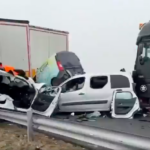
The collisions continued as vehicles approached the scene in poor visibility. Photo credit:@volkova_ma57183 on X
Thick fog can be every driver’s nightmare, but when it descends without warning, the danger is even greater. With visibility suddenly reduced to just a few metres, there may be no time to brake or avoid the traffic ahead. That is what happened on Bulgaria’s Trakia Motorway, where dozens vehicles were caught up in two devastating pile-ups.
The wreckage stretched across both carriageways of the motorway linking Sofia with the Black Sea port of Burgas. Cars and lorries were crushed together, emergency crews had to fight their way into the pile-ups, and the route was closed in both directions as rescuers worked to reach those trapped.
Fog turns motorway into scene of mass collision
The first emergency call was received at around 7.10am local time on Tuesday, November 10. The crashes happened near the Zimnitsa junction in the Yambol region, in southeastern Bulgaria. A total of 86 vehicles were involved. Sixty-three were caught in the pile-up on the carriageway towards Burgas, while another 23 were involved in a separate collision on the opposite side, heading towards Sofia.
Officials said visibility had initially been between 70 and 80 metres before suddenly dropping to around 10 metres. The fog arrived quickly, leaving drivers with little warning of the stationary or slowing traffic ahead. The road surface was also wet, adding to the difficulty of stopping safely.
First collision involved lorry and passenger bus
According to the initial account from the Interior Ministry, the first crash began on the Burgas-bound carriageway when a lorry blocked the path of a passenger bus. A second lorry, which was carrying grain, then became involved, followed by further vehicles crashing into the wreckage.
The collisions continued as vehicles approached the scene in poor visibility. A second chain-reaction crash developed on the opposite carriageway, where investigators believe some drivers may have become distracted by the disaster unfolding across the central reservation.
All the reported fatalities occurred on the side heading towards Burgas. Authorities have stressed that the precise causes are still being investigated, although the sudden fog, wet conditions and driving speeds unsuitable for the weather are among the factors being examined.
Drone footage reveals the horrifying scale of the tragedy on Bulgaria’s Trakia Motorway. Over 50 vehicles, including cars and trucks, were involved in the massive pile-up, leaving at least 12 people dead and dozens injured. One of Bulgaria’s deadliest road disasters. 😭 https://t.co/NfyVJyGotH
The scale of the crash required a major emergency operation. Police, firefighters and medical teams from neighbouring regions were sent to the scene, with 15 fire engines and hundreds of police officers involved in the response. Rescuers had to remove sections of the crash barriers to reach some of the injured. The fog also prevented helicopter evacuations, complicating efforts to move casualties quickly.
Injured people were taken to hospitals in Yambol, Sliven and Burgas, with several requiring intensive care and emergency surgery. The latest figures released on Tuesday afternoon put the death toll at 12, while around 50 people had been injured. Officials had warned earlier that the number of casualties could change as hospitals continued treating those involved.
Bulgaria declares national day of mourning
Prime Minister Rumen Radev visited the scene and described the crashes as a tragedy for the country. The government announced that Wednesday, November 11, would be a national day of mourning for those who died.The scale of the disaster also disrupted official engagements. Radev cancelled scheduled events, while European Commission President Ursula von der Leyen, who was visiting Bulgaria, shortened her trip and expressed condolences to the victims and emergency crews.
Two separate investigations have been opened because the crashes occurred on opposite carriageways. The National Investigation Service is expected to take over the enquiries, with investigators examining how the first collision developed and why the second pile-up followed.
The tragedy has also renewed questions about warnings for drivers in areas where fog regularly forms. Officials have raised the possibility of improving road markings and installing more reflective measures to make dangerous stretches easier to navigate when visibility deteriorates. For now, investigators must establish exactly how a sudden change in weather turned a busy motorway into Bulgaria’s worst multi-vehicle disasters.












 %3 weeks ago