Connect with us

%

Ten Valuable Horses Hurt In Horror Crash As Lorry Overturns On Spain’s A-5 Motorway

Published

on

ten-valuable-horses-hurt-in-horror-crash-as-lorry-overturns-on-spain’s-a-5-motorway

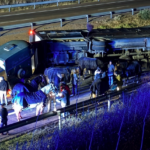
Removing the horses from the overturned vehicle was complicated. Photo credit: Eurotruckstar on Facebook

Nothing can be more distressing than seeing an injured animal on the road, but when that animal is a highly trained horse worth potentially hundreds of thousands of euros, the consequences can be devastating. Ten horses belonging to Diego Ventura, one of the world’s leading bullfighters on horseback, were involved in a serious lorry accident with two of his star horses among the most badly injured.

The lorry overturned near Trujillo in Cáceres province in the early hours of Monday, October 19, as it returned from Zaragoza following the final bullfight of the season. Brillante and Fouto suffered the most serious injuries, while the other horses also sustained injuries of varying severity. 

A difficult rescue on the A-5

The accident happened at kilometre 266 of the A-5, near Santa Cruz de la Sierra, as the vehicle travelled south towards Badajoz. The horses were returning from Zaragoza, where Ventura had performed at the Feria del Pilar on Sunday evening. The lorry was carrying ten horses, along with two drivers and two members of the stable staff. Ventura himself was not travelling in the vehicle. When news of the accident reached his team, his manager Andrés Caballero travelled from Madrid to the scene. Members of the stable staff were helped by people travelling in a vehicle carrying horses belonging to Portuguese rider Rui Fernandes, which was following behind. Ventura later went to the scene himself. 

Removing the horses from the overturned vehicle was complicated by the internal partitions used to keep them separated during transport. All ten animals were injured, with Brillante and Fouto reported to be in the most serious condition. Initial reports said neither was in danger of dying, although further veterinary examinations were needed to establish the full extent of their injuries. 

The driver suffered minor injuries, while a Guardia Civil traffic officer was taken to Cáceres University Hospital after being kicked in the knee by one of the horses. The officer had been attempting to move the animal away from the carriageway. The crash forced the closure of the A-5 towards Badajoz. Traffic was diverted from kilometre 248 onto the A-58, before joining the A-66 towards Mérida. The road reopened around lunchtime after the lorry was removed and the carriageway cleared. The cause of the overturning had not been established in the initial reports but it is believed that the driver fell asleep at the wheel.

Who is Diego Ventura?

Born in Lisbon in 1982, Diego Ventura is a prominent figure in rejoneo, the form of bullfighting in which a rider performs on horseback. He built his career in Spain and became a regular name at major bullrings, including Madrid’s Las Ventas. His performances have earned him a substantial following among fans, and he is known for his extensive stable of specialist horses. 

In rejoneo, horses are trained to work close to a bull during a performance, responding to the rider’s cues as they turn, approach and move away from the animal. Different horses may have different roles in the ring, and developing one capable of performing at this level takes years of training. A proven horse is therefore not easily replaced: its value lies not just in its physical qualities, but in its experience and the partnership it has developed with its rider.

What can a rejoneo horse be worth?

There is no confirmed public valuation for Brillante or Fouto, so their individual worth cannot be stated reliably. However, horses trained for elite rejoneo can command substantial sums, depending on their breeding, ability, training and record in the ring. In a 2011 interview with Mexican newspaper El Economista, Ventura discussed the high value of horses in his profession, citing figures of around €400,000 to €500,000 for an animal with the qualities required at that level but that of course is a historical estimate, not a current appraisal of either horse involved in the crash. 

The cost of a professional stable extends well beyond buying the horses. Their care involves specialist training, feed, veterinary treatment, transport and experienced staff. An injury can also mean months of rehabilitation, depending on its severity, with no guarantee that a horse will be able to return to the ring. For now, the priority is the veterinary care of the ten injured horses, particularly Brillante and Fouto. Their recovery will depend on the injuries they have sustained and how they respond to treatment.

%

Spain Raises Child Maintenance Aid To €300

Published

on

spain-raises-child-maintenance-aid-to-e300

Spain raises unpaid child maintenance support to €300 a month for eligible families. Credit : Lordn, Shutterstock

Children in Spain whose parent fails to pay court-ordered maintenance could receive up to €300 a month from the state under new rules approved by the Government. The maximum advance has risen from €100, and support can continue until the child turns 18 if the maintenance obligation is still in force.

The change is part of a wider package of social protection measures approved by Spain’s Council of Ministers on Tuesday, October 20. It is designed to provide greater financial security for children whose parents fail to meet their legal obligations following a separation, divorce or other court proceedings.

According to an official announcement by Spain’s Ministry of Inclusion, Social Security and Migration, the government has approved an increase in the maximum monthly advance available through the Fondo de Garantía del Pago de Alimentos, or Child Maintenance Guarantee Fund.

The reform does not mean that every single parent in Spain will automatically receive €300. The payments are intended for eligible families where court-ordered child maintenance has not been paid, and the amount depends on the maintenance awarded and the applicable conditions.

Who can receive up to €300 in child maintenance support in Spain?

Spain’s Child Maintenance Guarantee Fund provides financial advances to protect children when a parent fails to pay maintenance ordered by a court.

The scheme applies to qualifying cases involving divorce, separation, marriage annulment and legal proceedings concerning parentage or child maintenance.

Previously, the maximum payment was €100 per month for each eligible child. Under the reform approved on October 20, that ceiling increases to €300.

This is a maximum rather than a fixed entitlement. For example, if a court has ordered a parent to pay €200 a month in maintenance, the fund would not automatically provide €300. The amount of the court order remains relevant when determining the advance.

Families must also meet eligibility requirements, including financial conditions. Eligibility also depends on household income, meaning that not every family affected by unpaid maintenance will qualify for financial support.

The fund is particularly important for parents who have primary responsibility for their children but cannot rely on maintenance payments arriving regularly.

However, it is not the same as a general child benefit or a payment available to every separated parent. Applicants need to demonstrate that the maintenance obligation exists and that the required payments have not been made.

The advances are provided by the state, rather than representing an increase in the amount that a court has ordered the non-paying parent to contribute.

How long can families receive the payments under the new rules?

The second major change concerns the duration of support.

Until now, advances from the fund were limited to a maximum of 18 months, whether those months were consecutive or spread over a longer period.

The government has approved the removal of that limit. Under the approved reform, advances can continue until the maintenance obligation ends, but no later than the beneficiary’s 18th birthday.

This could make a substantial difference for families dealing with prolonged non-payment, rather than a temporary interruption in financial support.

Families considering a first application should nevertheless check the official requirements, including income limits, documentation and evidence of unpaid maintenance.

The reform was approved by the Council of Ministers on October 20. Its practical application depends on the legal text and its entry into force, so families should not assume that the higher amount is already available for payment.

The announcement forms part of a broader reform of Spain’s social protection system. Other measures include changes to support for parents caring for seriously ill children, protections for women affected by certain incapacitating health conditions, and expanded access to survivor benefits.

The government has also approved changes affecting unmarried couples with children who may qualify for a widow’s or widower’s pension. Euro Weekly News has separately reported on how unmarried parents previously refused Spain’s widow’s pension could benefit from the changes.

For parents in Spain facing unpaid child maintenance, however, the immediate significance of the latest announcement is the combination of a higher monthly ceiling and a potentially much longer period of financial support.

Instead of being restricted to €100 a month for a maximum of 18 months, eligible families could receive advances of up to €300 per child each month while the qualifying maintenance obligation continues, within the new age limit.

Continue Reading

%

Could AI Decide You’re Bad At Your Job? Spain’s Rules On Workplace Monitoring

Published

on

could-ai-decide-you’re-bad-at-your-job?-spain’s-rules-on-workplace-monitoring

employee representatives have the right to receive information about the parameters. Photo credit: Zamrznuti tonovi/Shutterstock

Spanish supermarket workers could face growing scrutiny as artificial intelligence finds its way into the workplace, raising questions about who is watching employees, how their performance is judged and whether a computer should help decide if someone deserves a disciplinary warning.

The issue has already surfaced in Australia, where a supermarket cashier with 30 years of experience reportedly received a final written warning after an AI monitoring system flagged errors on just 0.18 per cent of the products she scanned, around one mistake in every 533 items.  The case was raised by the Shop, Distributive and Allied Employees Association, an Australian retail workers’ union. For workers in Spain, the case raises a pressing question: could an employer use technology to monitor performance and take disciplinary action here, too?

What Spanish law says about AI monitoring workers

Employers in Spain already have the right to monitor whether staff are fulfilling their work obligations. But that power is not unlimited. Article 20.3 of the Workers’ Statute allows companies to introduce surveillance and control measures, provided they respect employees’ dignity and the legal limits governing their use. Spain’s data protection legislation also requires workers to be informed about workplace video surveillance and certain other monitoring measures. 

The rules become especially important when monitoring involves algorithms or AI systems that assess employees’ performance or influence decisions about their working conditions. Under Article 64.4.d of the Workers’ Statute, employee representatives have the right to receive information about the parameters, rules and instructions behind algorithms or AI systems that affect decisions about working conditions, access to employment or the continuation of employment, including profiling.  In other words, employers cannot simply treat the way these systems work as a secret when the technology affects workers’ rights.

Can a computer decide to discipline an employee?

Spanish workers also have protections against certain decisions made solely by automated systems. The Spanish Data Protection Agency (AEPD) explains that people generally have the right not to be subject to a decision based exclusively on automated processing when it produces legal effects or similarly significant consequences for them. This can include profiling that assesses a person’s performance at work. There are exceptions, including where automated processing is necessary for a contract or authorised by law. 

However, where the contractual or consent exceptions apply, safeguards must include the right to obtain human intervention, explain one’s position and challenge the decision. A system may flag a scanning error, but that does not automatically establish why it happened or whether a formal warning is justified. A human manager can consider the circumstances, including whether a mistake was caused by a faulty barcode, a product that would not scan properly or an issue beyond the employee’s control. An automated score may not tell the whole story.

AI surveillance is already a workplace concern

The debate extends beyond supermarket checkouts. Algorithms can influence shift allocation, task distribution, performance assessments and promotion decisions, while digital monitoring can track employees’ activity.  A report from Spain’s Observatory of Digital Rights sets out workers’ protections around privacy, monitoring tools and automated decision-making. 

It also stresses that workers’ representatives should be informed about relevant systems, including the data used and how the systems operate. The European Union’s AI Act also classifies many AI systems used for employment decisions, worker management and performance monitoring as high-risk, reflecting their potential impact on people’s livelihoods and fundamental rights. 

Could AI cost Spanish workers their jobs?

For Spanish employees, the concern is not whether businesses should be allowed to use technology to improve efficiency. It is whether workers can understand how they are being assessed and challenge decisions that could affect their jobs. The Australian cashier’s case offers a warning of what can happen when a performance figure becomes the focus of a disciplinary process. 

In Spain, existing employment and data protection rules provide safeguards, but workers’ ability to exercise those rights depends on transparency about the systems being used. For anyone whose job is increasingly measured by software, the key question is whether a computer is simply flagging a problem, or influencing a decision that could cost them their livelihood.

Continue Reading

%

PP And Vox Seek Pact To Block Sánchez’s Allies From Controlling Spain’s Senate

Published

on

pp-and-vox-seek-pact-to-block-sanchez’s-allies-from-controlling-spain’s-senate

One possibility is for Vox to withdraw its candidates in selected provinces. Photo credit: Congresos.es

Spain’s next general election could reshape the balance of power in the Senate, with the PP and Vox now discussing how to prevent left-wing parties from gaining control of the chamber. The negotiations could also determine who has the numbers to influence key appointments, including judges on the Constitutional Court. PP leader Alberto Núñez Feijóo has confirmed that talks with Vox are under way, but neither party is revealing the details.

He says it would be a mistake to allow what he calls sanchismo, a term used by opponents of Prime Minister Pedro Sánchez to describe his political approach, to gain control of the Senate, directly or indirectly.  The discussions follow an agreement between the PSOE, Frente Amplio and other left-wing and regional parties to coordinate their Senate candidates in an attempt to prevent the right from securing a stronger majority. For the PP and Vox, the challenge is to avoid splitting conservative votes between competing candidates in constituencies where a coordinated left-wing vote could win additional seats.

Why they need the Senate 

Although the Congreso de Diputados is the chamber that determines who forms the government, the Senate has considerable influence over legislation and certain institutional appointments. The PP already holds an absolute majority in the upper chamber. Feijóo now wants to secure three-fifths of the seats, a threshold that would give the party and its allies greater influence over appointments to institutions such as the constitutional court.

Four of its judges are awaiting replacement, including its president, Cándido Conde-Pumpido.  That is why the negotiations matter beyond the immediate election campaign. The outcome could affect the balance of power within one of Spain’s most important institutions, even if the result in Congress is different.

What are PP and Vox considering?

The two parties can no longer register a formal joint electoral coalition because the deadline has passed. They are therefore considering alternative ways to coordinate their Senate strategy.  One possibility is for Vox to withdraw its candidates in selected provinces, allowing conservative voters to concentrate their support on the PP. Another is a so-called ‘2+1’ arrangement, under which PP ballot papers would include two PP candidates and a third candidate associated with Vox as an independent. The PP could also offer Vox representation through senators appointed by regional parliaments, although no final agreement has been announced. These are options under discussion, not confirmed arrangements.

The electoral system helps explain the negotiations. In most mainland provincial constituencies, voters can select up to three Senate candidates, while four senators are elected. The candidates with the highest individual vote totals win the seats, which can give the leading political bloc a significant advantage. If conservative voters divide their support between PP and Vox candidates, the left could benefit. Coordinating candidates could help the right maximise the seats it wins.

Feijóo calls for discretion

Feijóo confirmed the talks in an interview with Spanish radio station COPE on Tuesday, October 20. He said the parties would continue discussions while respecting an agreement to keep the negotiations private. He also pointed to existing cooperation between the two parties in regional governments, where agreements have helped Vox secure five senators appointed by regional parliaments.

“If Vox rises to the occasion, the PP will too,” Feijóo said, indicating that any arrangement would have to involve concessions from both sides. He described the aim of keeping the Senate out of Sánchez’s control as a shared challenge.  The relationship between the parties has not always been straightforward. Vox previously withdrew from several regional coalition governments with the PP following disagreements over the distribution of unaccompanied migrant children. Feijóo has since suggested that those disputes have been overcome and that there is now greater trust between the two parties. 

The left has already made its move

The negotiations began after the PSOE and Frente Amplio agreed to coordinate their Senate candidacies, with support from regional parties in some constituencies. Their strategy is intended to prevent the division of left-wing votes from making it easier for the PP to retain its majority. The agreement was announced after the deadline for registering electoral coalitions had closed, preventing the PP and Vox from simply adopting the same formal arrangement. 

Neither the PP nor Vox has confirmed which constituencies could be affected or what concessions might form part of a final deal. With the general election scheduled for November 29, the parties face a limited window to settle on a strategy. For voters, the negotiations could influence who controls the Senate and who has the numbers to shape important institutional appointments. For now, Feijóo and Vox leader Santiago Abascal are keeping their options open while the talks continue.

Continue Reading

Trending

Copyright © 2017 Spanish Property & News