
ElPais
The Story Behind ‘Dancing On My Own’ And The Irresistible Power Of Songs That Make You Cry While You Dance


Alain de Botton
Alain De Botton: ‘The Hardest Part About Being Single Is That You Never Stop Thinking About Love’

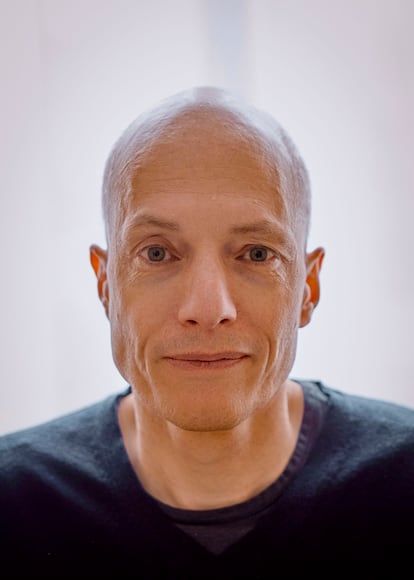
Alain de Botton, 56, welcomes EL PAIS in a home undergoing renovation. He gives meticulous instructions to the builders with a smile. He explains that his former partner lives four doors down. Both of their buildings stick out among the Victorian homes in their London neighborhood of Camden. He says he’s finishing work on another home in Mallorca. He fell in love with the Spanish island 15 years ago. “It will be strange to live there. I’ve never spent time by a tree,” he says. “But I’m getting ready for the journey.” In the foyer, there are vases of flowers. Also, a Seneca quote carved into stone: “What need is there to weep over parts of life? The whole of it calls for tears.” He sees me reading it and offers an interpretation: “If your expectations are realistic, you won’t need to cry.”
Question. Are you prepared for the worst?
Answer. No one is. But if you get to 56, you know the ups and downs of life. That’s why at this age, we like flowers.
Q. Flowers?
A. They speak to a moment of plenty. Young people aren’t satisfied with that moment alone.
Q. At 23 years old, you sold two million copies of Essays in Love. What did you know about the subject back then?
A. A 23-year-old person knows something that people of 56 have probably forgotten. Technical experience grows, but not the emotional. Love was new, extraordinary and intense.
Q. Twenty-one years later, you wrote The True Hard Work of Love.
A. I had learned about the perversion of love. We get into relationships that work against us. It is the story of Adam and Eve: they’re in paradise, yet they make their lives miserable.
Q. Why is that?
A. Perhaps it can only be understood through psychoanalysis. The way in which we love always goes back to the way we were loved as children. The same way we don’t remember how we learned to talk, we learn the language of love unconsciously, and that echoes. Imagine your parents scolded you all the time. What do you do if you break a glass? You keep quiet. Imagine that you no longer want to have sex, and you keep quiet so that no one gets mad.
Q. The protagonist in your book keeps quiet until he explodes.
A. I identify with that. I understand those who go quiet and those who get mad.
Q. Were you a silent child?
A. Yes. I didn’t like rough-and-tumble games or the company of boys. I preferred to sit with the girls and play dolls. From the age of eight until my teenage years, I lived in boarding schools. It was a difficult experience. I had a military education, a holdover from the British Empire that taught children to be little soldiers. To not cry or communicate emotions.
Q. What did you learn?
A. Patience. I was waiting to be rescued. Also, to care for the place where I live. And to protect my freedom, I don’t want anyone to tell me what to do.
Q. What rescued you?
A. I survived. Curiosity kept me alive.
Q. What interested you?
A. I saw that my parents weren’t happy. Individually, and also together. And I didn’t understand why. My father was born in Alexandria. He came from a Sephardic family that had fled Spain. When he had to leave Egypt, he went to Switzerland and met my mother. That’s where I grew up. They worked in finance. They were professionally successful, but at home they lived in a state of torment and anxiety. That could be why I became used to holding my tongue. Also, to self-analysis. It was a survival tactic. I needed to understand what made me sad, to try to avoid it.
Q. As a writer, you venture into philosophy, art, architecture —
A. Everything can help us understand ourselves better. That’s why we founded the School of Life, my business. There are 50 of us teaching people how to look at the world. The idea came to me after reading Pierre Hadot, who studied the philosophical schools and realized that the Platonic Academy, Aristotle’s Lyceum and The Garden of Epicurus were businesses. That appealed to the entrepreneur in me. It was a desire to make what interests me into a community, since the writer is a solitary being. We founded the school in Bloomsbury, between a kebab shop and a hair salon.
Q. Is the street a university?
A. Of course. I grew up in a snobby world in which knowledge is limited to the great universities. And… I don’t think that’s healthy. The university does not own knowledge. In Cambridge, I supposedly got one of the best educations the United Kingdom can offer. It was terrible. I was an idiot at the beginning and an idiot at the end. I didn’t learn anything that helped me to question the world. I had to do it on my own. Academia carries a poison: it doesn’t challenge you to think anything without having read 1,000 books about what other people think.
Q. Is philosophy self-awareness?
A. It is many things. The Greek translation of the word, “love of knowledge,” is interpretable. If you ask a taxi driver, their response will be something similar. But if you ask the question at Oxford University, the response will derail you and will be completely abstract. I get letters from young people who are excited to study philosophy. They think they will learn to live, think and love. I warn them that they’re not going to learn that.
Q. Do you criticize intellectualism?
A. Wisdom does not require a specific vocabulary. My parents did not raise me on their own. They hired a nanny who was a key part of my life. She didn’t have much formal education, but she was intelligent and lovable. She was the most important adult in my childhood. A friend once told me, “You write books that your father and your nanny could understand.” She was the queen of asking why. In the United Kingdom, T.S. Eliot said that culture must be preserved by the elite. Perhaps because I grew up in Switzerland, I don’t believe in that. Switzerland is a wealthy but dignified society.
Q. It has its contradictions. It stays neutral and banks money, no questions asked.
A. Outwardly, the Swiss are boring. But they value security, right up until they cut the rope. You cannot live surrounded by high mountains without being affected by them.
Q. Why do you live in London?
A. Because of the English. By the time I was 12, I’d had enough of French. French culture is narrow. They are at odds with the modern world.
Q. You’ve become a psychotherapist.
A. I trained for four years at the University of London, after getting psychoanalysis myself for a decade, five times a week.
Q. How did psychoanalysis change you?
A. You open doors and closets. It laid the way to my becoming a psychotherapist. If you don’t know yourself, you can’t know, or help, anyone else. Now I have clients.
Q. You call them clients?
A. Psychoanalysis has patients. Psychotherapy, clients.
Q. Who can pay for psychoanalysis five times a week for 10 years?
A. It’s a luxury, but not in NW3 [the postal code of his London neighborhood]. [Sigmund] Freud lived here. A psychoanalyst lives in every other house. I know because the three analysts I went to all lived within a few minutes of one another.
Q. How did you decide which therapist worked for you?
A. Therapy is an art, not a science. With one, I understood my inner landscape. I centered myself. And they gave me the confidence to try becoming a therapist. As a child, I had a very sparse emotional education.
Q. Have you been better with your own children?
A. Probably, but I can’t bear my children suffering. I think I haven’t prepared them for the world. We have gone from having a demanding childhood to overprotecting our kids.
Q. You link beauty to the good life.
A. In German Switzerland, design is key. Think of the company Vitra or Peter Zumthor. That simple architecture defends an idea of beauty for all. Everything is beautiful: schools, the station, the hospital. And everything is well-made.
Q. Was your house beautiful?
A. Yes. We lived in a flat that had an exposed concrete floor. Raw, simple, but I felt it to be solid. The building had a bomb shelter where my sister and I played. I think that’s where I developed my love for materials. Later on in England, everything seemed frail to me. That could be why I have dedicated myself to building simple houses, to bring something of my childhood to this country.
Q. Do you make your living as a developer?
A. To a large extent. I have built modern housing, and I have learned to appreciate tradition, updating it. I am not interested in perpetuating it.
Q. You’ve said that people should begin relationships by explaining where their madness lies. Where is yours?
A. I’m like the sea: deep down I’m calm, but on the surface I’m very turbulent. I often wonder why everything affects me so deeply. I experience everything at a level ten when I should probably experience it at a six. Intensity is a form of madness. I’m extreme even in love. My madness shows itself because I’m drawn to difficult situations, suffering, and complicated people who don’t give me exactly what I think I need: calm.
Q. Are you sure you’re looking for peace?
A. Perhaps not. But peace is where I want to live.
Q. Your house is very orderly.
A. We decorate our homes not as we are, but as we wish to be. Think of the painter Agnes Martin. She was a schizophrenic and tormented woman. In contrast, her canvases are pure order. Their power comes from not being calm paintings. They are paintings that are trying to create calm. That’s what makes them so moving.
Q. You make mutually exclusive arguments: either polyamory or boredom. Either safe sex or excitement.
A. The mind has a natural temptation to break itself. Naomi Klein has written that babies imagine two mothers: one good and one bad. When they are frustrated, they kill the bad mother. When content, they embrace the good one. Until they realize that the mother is one: sometimes good, other times not. Maturity brings with it a certain kind of depression, that of reality. But that is in the medium term. I am still an extreme person, but I seek the middle position through humor.
Q. Can humor be used as a way of not feeling?
A. Without a doubt. To cover up something painful.
Q. You have written that marriage is a prank we play on the person we supposedly love.
A. Bringing anyone deeply into one’s world is to torment them. To wound is to be wounded. It is easier to be a good friend. If they deceive you… you let them go. In love, we should do what good friends do: not take anything for granted. “How wonderful, my partner didn’t make me cry today.” Getting married is choosing someone to suffer with.
Q. Why do we do it?
A. Fear of being alone? The hardest thing about being single is that you never stop thinking about love. It’s the same as when you have no money: you never think about anything else.
Q. You are separated.
A. That’s why. Love steals so much time. You have dates and… I don’t know how it works in Spain, but in a city like London, you only meet people through apps, and that makes contact difficult, because there are too many possibilities. A young woman gets, in an hour, more than 200 match requests. The amount of work she has to do to rule out those offers requires time. Before, when you met someone who interested you, you put effort into it. Getting to know, understand, and love someone is an effort. Not a blessing.
Q. Is there skill in loving?
A. Of course: listening, asking for forgiveness. You don’t have to agree. But you do have to listen. That should be taught in primary school.
Q. Do you listen?
A. In love, a good part of dialogue is defensive. “I didn’t say that. I don’t agree.” That is poison to a relationship. We live in sophisticated societies, but we don’t learn how to utilize the basic tools of love.
Q. You wrote that alcohol and Christianity were the great European narcotics.
A. I am interested in the great void that religion has left. Religions did a lot of good things: build communities, search for beauty. The seriousness of art and architecture is due to religion. Today, art is confusing. Why? Because religion has disappeared. We no longer know what it is to form part of a group. I wonder what can spiritually inspire us. The figure of Jesus Christ set an example by avoiding a simple “yes” or “no” and offering a third way. The ancient Greeks avoided extremes.
Q. But they had slaves…
A. Every era of the world, and in every era of a person, there are lessons that teach us something. Studying history should mean studying the position of the spirit in the evolution of humanity. Today we know more, but are we wiser? In Greece, they read less, but they reflected more. We lack their clarity.
Q. Michel de Montaigne wrote that in friendship, joyfulness is more important than intelligence.
A. Intelligence is the openness to experience. A good friend tells the truth. If someone says, “I had a sexual fantasy,” and you respond with “You had what?” no one will ever tell you anything. Helping others to explore themselves is what a psychotherapist does, in a friendly way. With some people, listening is one of life’s pleasures. With others, you feel that they have no room left to listen to other people’s complications. It is difficult to have friends. I have three. Two men and one woman. They are all interested in introspection. And they all have a mixture of darkness and humor.
Q. Why are you so interested in darkness?
A. That’s what we are, right? It’s the media’s game: famous people are fascinating. And when they die… it turns out they weren’t, that they were unorganized, treated their family poorly… The story of the fall from perfection is a very unrealistic game that many people play.
Q. You’ve said that your priority has been more to enjoy than to tell the truth.
A. That’s why I became a writer. There is more freedom in writing than talking. Any dialogue departs from trying to please the other.
Q. How much love should one have for themself?
A. It’s possible that love is not the right word. How about generosity? Tolerance? Love yourself is the American message. No, I am content with being joyful. There comes a moment in which self-love becomes indulgence. A little bit of dissatisfaction is important. Human beings are lazy creatures: we don’t think until there’s a problem. In the lives of artists, there are periods of intense creativity. It’s often related to working through a problem. And there are periods during which nothing happens. If you think about The Beatles, between 19 and 28 years of age, they produced some of the best songs in the world. And then?
Q. Did Paul McCartney have fewer problems than John Lennon?
A. The album that caused the breakup, Let It Be, tells us something about human nature. We have moments of communion with life and others… of isolation. Isn’t that so? I have seen it with friends. When problems arise, they become better friends: more humble, better able to listen. That said, some problems destroy people.
Q. A strict routine or comfortable life?
A. [Arthur] Schopenhauer and [Friedrich] Nietzsche venerated discomfort, but [Gustave] Flaubert advocated living as a bourgeois to create as an artist.
Q. Did Marcel Proust change your life?
A. Very much so. Proust’s work tells you, “Art is not a dream, it is an awakening.” And also, “I’ve worked hard, you can too. Try it again.”
Sign up for our weekly newsletter to get more English-language news coverage from EL PAÍS USA Edition
Bad Bunny
Jorge Pérez Gallego, Astrophysicist: ‘A Total Eclipse Creates An Energy Similar To A Big Concert, To The Feeling Of Celebrating A Goal’


From producing the official live broadcast of the 2024 total solar eclipse for all of the United States to being able to experience the next one in his home country — the only place in the world where it can be seen with certainty — Spanish astrophysicist Jorge Pérez Gallego believes that, with barely two weeks to go, it is crucial to emphasize the feelings and emotions that “this natural event, of an unimaginable magnitude if you haven’t seen it before,” provokes. Looking ahead to August 12, he feels obliged to share key information and his personal experience with top-tier eclipses.
He stresses the need to move into the path of totality. Being nearby isn’t enough. A few tenths or hundredths short of 100% means missing what makes the phenomenon extraordinary, he tells EL PAÍS by video call. Pérez Gallego (Terrassa, Barcelona, 45) is the director of Education, Outreach, and Communications at the U.S. National Solar Observatory. With a Ph.D. in astronomy and a Master’s degree in fine arts, he combines two perspectives that lead him to champion art as a complementary way to communicate how Spain will experience this total eclipse — in 31 of the country’s provinces, another one won’t be seen until the year 2180.
Question. Three weeks after winning the World Cup, Spain will again experience a mass celebration with this eclipse. Can we expect it to leave a comparable mark?
Answer. Yes. It turns out we’ve now won the World Cup twice in 16 years. A total eclipse, if you don’t travel from where you live, on average you would have to wait between 300 and 400 years for it to happen again. In other words, it’s normally, with luck, a once-in-a-lifetime event for a person. People will remember where they were and who they were with during the eclipse, similar to how we remember the day of the September 11 attacks, a tragedy that also marked us. This time, though, the memory will be positive. It will raise a lot of questions, especially among many children. How those questions are answered will also shape their lives. It can plant a seed that sprouts in many directions, generating vocations in science, but also in art, the humanities, and philosophy.
I’d bet money that it will also turn adults who aren’t astronomy fans into new eclipse chasers — true addicts who travel the world to experience those feelings again.
Q. To what extent does seeing a total eclipse make us feel things we haven’t felt before?
A. Well, rather than “see,” I prefer the word “experience,” because what happens involves more senses than sight alone. There’s not just the visual factor. When the sky darkens, you’ll notice a sharp drop in temperature that can, in turn, create air currents. And if you’re out in nature, you’ll hear animals fall silent. All of that will happen even if clouds or a mountain prevent you from directly seeing the phenomenon where you are.
And if nothing blocks your view, you will see the strangest Sun of your life: it will have grown dark and a white corona will have appeared around it. You’ll also be able to see stars or planets very close to it — things we can’t normally see because the blinding brightness of the solar disk hides them.
Q. You’re giving us a massive spoiler about the eclipse. What if, in the end, the experience doesn’t live up to the expectations you’re setting for us?
A. It doesn’t matter if I spoil it. Even so, I think most people won’t be prepared to experience it. I wasn’t prepared — and I’m an astrophysicist. I knew what was going to happen and understood its scientific significance. I knew the theory inside and out, but suddenly, the moment it happens, there’s a very personal element to it. It’s something that goes beyond what science can explain and depends on your background: your education, cultural influences, and everything you’ve experienced up to that point.
Some people will shout, some will cry, some will start thinking of relatives they can no longer share it with, some will feel hopeful about the future. The spectrum of emotions an eclipse can sow in humans is as broad as the number of people on earth.
Q. What do you say to those who think it won’t be that big a deal?
A. Look, the first thing I tell them is: “Maybe, maybe, but give yourself a chance because it’s the only one you’ll ever have in your life.” Then I tell them about my personal experience and share the information I think is most relevant, and I hope that helps them make a decision about what they want to do. If they don’t want to watch it, well, there will always be people with different interests — like those who preferred to go for a walk during the World Cup final — and that’s perfectly fine with me.
Q. What information do you give to those who are unsure?
A. The first thing I tell them is that a 99.99% eclipse has nothing to do with a total eclipse. That remaining 0.01% may seem small, but it’s the difference between day and night. Literally. It’s not a metaphor — it’s just that the Sun is so bright that, if the eclipse is partial, even if it’s very deep — the small portion that remains still shines very brightly, enough for it to still be daytime. Even though an instrument might measure a decrease in brightness, we can’t perceive it with the naked eye. Only during a 100% eclipse does it truly get dark, even if it’s brief and strange. Only at that moment can you take off your protective glasses and see what’s always hidden.
So, if someone is in a place that will experience a 99.9% partial eclipse and asks me, “Is it worth driving half an hour to get into the path of totality?” the answer is yes.
Q. And about your personal experience of the 2017 and 2024 eclipses in the U.S., what would you highlight, for better and worse?
A. The best was being able to see the 2017 eclipse with my two best friends in the middle of the state of Oregon. The three of us being astronomers, and knowing the phenomenon, made us feel very different things; I remember we talked about it at length. The worst was the several-hour traffic jam when, after the eclipse, we began the return trip.
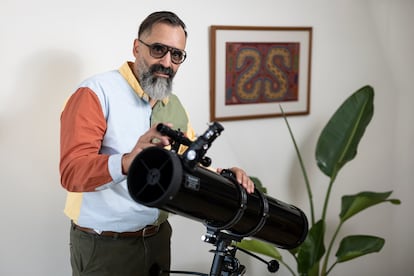
Q. Three astronomers, enjoying that unique experience in the midst of a natural setting. You must have got some spectacular photos of the eclipse…
A. Well, no. We’re there to experience it, which is what I recommend to people, especially if it’s their first total eclipse. If you’re not an expert in astrophotography, don’t try to take pictures of it: just enjoy how it makes you feel, without anything getting in the way. It’s just like how many people go to a Bad Bunny concert and feel the need to document it.
Q. In that case, how is a total eclipse similar to a concert?
A. They can be compared — as long as you experience the eclipse in company, of course. Then an energy is created similar to that at a concert by your favorite artist, or to the feeling of celebrating a goal. You feel part of a group experiencing something; you pick up the energy of those who are sharing it with you. And I, without judging those who want to record it, prefer to be present there without a camera stealing part of my experience. With a cellphone it won’t look good; it won’t resemble those professional photos that fascinate us of a total eclipse, with the solar corona and Baily’s beads.
One thing I can recommend is leaving a camera recording your reactions and forgetting about it. My favorite video from the 2017 eclipse is of a child, captured on camera at a public viewing, who has an incredible reaction. Whenever I show it in a talk, someone says: “I want to see it, I want to feel something like that.”
Q. That child is like the Keyne Yamal of eclipses.
A. Uh, yes, it’s a bit like seeing Lamine Yamal’s brother. The child’s reaction motivates people more to want to see a total eclipse than the astronomical photo of the phenomenon itself.
Q. How will you spend eclipse day?
A. After so many years in the U.S., I will finally be able to see a total eclipse in the country where I was born, with many of the people I love and with whom I became myself. Professionally, I’m also fortunate that the Institute of Astrophysics of the Canary Islands has recruited me for the NATE project, which will study the solar corona — taking advantage of the unique conditions of a total eclipse — and will do outreach about this phenomenon in depopulated areas of Spain. We’ll be in Palencia and several villages in the province during those days. When an eclipse approaches, everyone pays attention to the Sun and listens to us. For solar physicists, it’s like Christmas Day.
Q. Will you feel like a child on Christmas Day on August 12?
A. More like Santa Claus. Because on eclipse day, it’s the astronomers who bring the gifts.
Sign up for our weekly newsletter to get more English-language news coverage from EL PAÍS USA Edition


Hemos Descubierto La Nueva Versión De La BB Cream Superventas De Erborian, Pero Con El ‘glow’ Perfecto Para Verano

F1 star announces engagement with gorgeous proposal pictures
Última Hora De La Entrada De Inmigrantes A Ceuta, En Directo | Las Autoridades Ceutíes Cifran En 88 Los Fallecidos Que Están En La Morgue
The last cigarette by the sea Murcia faces a major anti-smoking revolution

Un Tangle Teezer De Viaje: El Cepillo De Pelo Perfecto Para Tu Neceser De Vacaciones

How To Get A Tourist Rental Licence In Andalusia (Spain) – Step-By-Step Guide 2025


-
Costa Calida2 weeks ago
The last cigarette by the sea Murcia faces a major anti-smoking revolution
-
 Amazon1 week ago
Un Tangle Teezer De Viaje: El Cepillo De Pelo Perfecto Para Tu Neceser De Vacaciones
-
 New Developments2 weeks ago
How To Get A Tourist Rental Licence In Andalusia (Spain) – Step-By-Step Guide 2025
-

 Latest1 week ago
Can Spanish Property Owners Cut Off Utilities To Squatters?
-
Columnists2 weeks ago
Do you have a dog? We’ve dog-sitters who love caring for dogs
-
barcelona el prat2 weeks ago
Passengers’ terror as British Airways flight to Barcelona declares mid-air emergency
-

 ChatGPT2 weeks ago
Food-Related Scams Are Flooding Social Media With Hyper-Realistic AI-Generated Videos
-

 New Developments1 week ago
Luxury Villas For Sale, Estepona – ProjectL1