
America
The US Library Of Congress Opens Up To The Americas

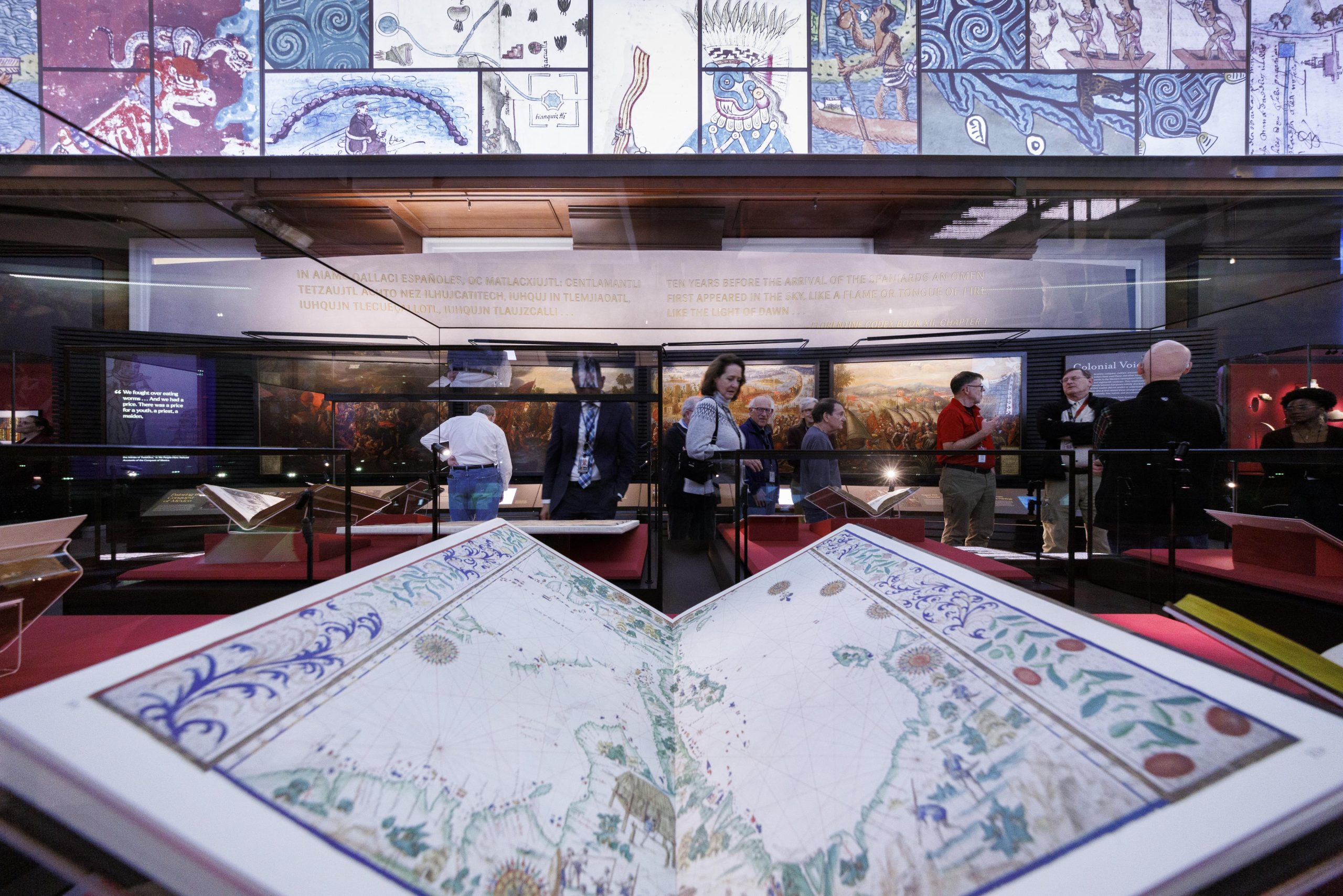
The Library of Congress in Washington offers a new journey through space and time starting this month. It begins at the end of a gallery that tells the history of the United States from its founding in 1776, a history that now marks 250 years. The following rooms, on the second floor of the imposing Jefferson building, take visitors through the indigenous civilizations of the American continent through an extraordinary collection of archaeological objects, paintings, and bibliographic gems.
The gallery’s contents include items from Mesoamerica (a historical region encompassing parts of modern-day Mexico, Guatemala, El Salvador, Belize, Honduras, Costa Rica and Nicaragua), the Caribbean, and the Andes. The earliest artifacts on display are three-thousand-year-old jade stones called chalchihuitl in Nahuatl; yax tun, in Maya; and dzeque, in Mixtec. And the timeline reaches all the way to the present.
The institution — the largest library in the world — brings together these treasures in a new permanent exhibition about the “Voices of the Early Americas.” The exhibition occupies what was once the reading room for Africa and the Middle East, and around 80% of it comes from the donation of 4,000 objects made to the institution by real estate developer and philanthropist Jay I. Kislak (1922-2018), according to an estimate by Stephanie Stillo, head of the Rare Books and Special Collections division.
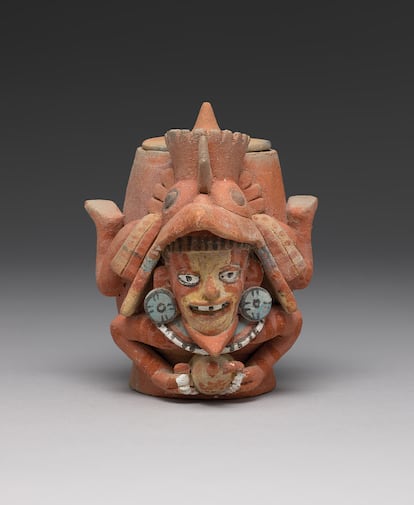
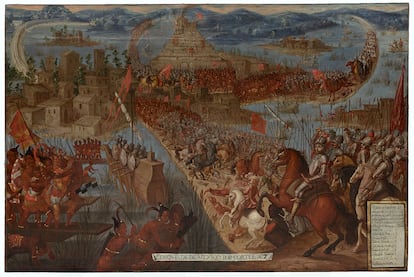
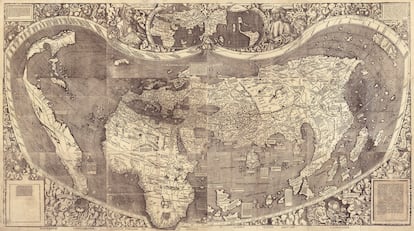
Four years ago, a foundation named after the businessman from Florida donated $10 million to the Library of Congress for the development of the new space. The result is a museographic display that showcases everything from Waldseemüller’s map (1507), the oldest known document featuring the word “America,” to a series of Taíno carvings, and the Huexotzinco Codex, from 1531. There are high-definition screens that put those early stories into context; and the restoration of a series of late 17th-century paintings depicting the Spanish conquest is presented.
Matthew Robb, Mesoamerica specialist at the Library of Congress, considers the presentation a “new beginning” in the institution’s relationship with the “study of the Americas.”
“It’s a long story,” he explains to EL PAÍS in the newly opened rooms. “If we go back to the origins of the library, we see that the first book collectors in what is now the United States wanted to know more about the history of other regions of the continent. That is especially relevant now that we are celebrating the 250th anniversary: ideas around independence from empires were topics of great importance, shared throughout the Western Hemisphere. For example, they were interested in the Aztec legacy of New Spain as a means to distinguish themselves from Europe, and as part of a different history.”
To underline this idea, Robb recalls that in the sculptural frieze of the great rotunda of the Capitol, a review of the milestones of the young nation, there is an Aztec sunstone in the scene depicting the meeting between Hernán Cortés and Moctezuma in 1509.
The new tour begins in a room with a large circular display case that holds pieces such as sophisticated Olmec ceramics from thirty centuries ago, a seated woman found at a site in Jalisco, or the so-called Tortuguero box, one of the highlights of the exhibition; a wooden artifact with hieroglyphic inscriptions that tell the story of a Maya dynasty.
A panel warns that the “voices of the early Americas” used to title the new presentation combine those of indigenous peoples who navigated “worlds profoundly transformed in their own terms, claiming and affirming their capacity to decide over their own lives” with those of Europeans, who “created books, letters, maps, and paintings to justify, debate, and describe the subjugation of those peoples,” with the certainty that “language was always a companion of the empire.”
Another panel in that first space reads (like the rest, in English) as a kind of justification, in which curators give examples of how words traveled through time, geography, and culture to make it possible to hear those voices in their own language. Thus, the description in Nahuatl of a mid-16th-century codex says: “Ten years before the arrival of the Spanish, an omen appeared for the first time in the sky: something like a flame or tongue of fire, like the light of dawn (In aiamo oallic españoles, oc matlacxiuht:centlamantli tetzauhtl achtoc nez ilhuicactich, ihuqqui in tlemjaoatl, ihuqquin tlecuecallotl, ihuqquin tlaujzcalli)”.
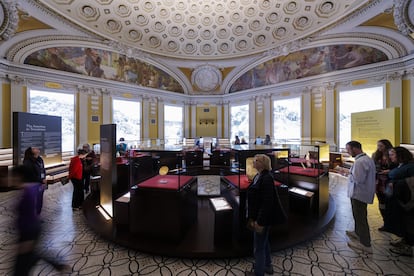
The transition between the first and second rooms is marked by the arrival of the Spanish, with their laws, maps, dictionaries, and projects for the Christianization of the indigenous people and the extraction of resources from the New World in places like Cerro Potosí, in present-day Bolivia. Those riches (“80% of the world’s silver”) are reported in a copy of the Crónica del Perú (1553) by Pedro de Cieza León.
The story then moves on to the efforts of the colonies in the 18th and 19th centuries to understand their past as a tool to “articulate new national identities” on the road toward independence. And it focuses on the Spanish translation of the Popol Vuh, a touchstone of Quiché Maya mythology. Proof of its cultural impact is a gouache on paper that Diego Rivera made, drawing inspiration from the story of the twin gods Hunahpú and Ixbalanqué.
At the end of the tour, the voices of about 10 contemporary poets can be heard reciting their verses in Maya, Nahuatl, Mapuche, Zapotec, and Quechua, alongside images from the Chiapas Photography Project, which has been documenting indigenous lives in that Mexican state since the 1990s through the eyes of photographers from those communities. Closing the narrative of the new space with this dual proposal serves to “emphasize that these are living cultures, that have a past, in whose context they must be seen, but also a future,” according to librarian Catalina Gómez, in charge of the PALABRA archive.
It is a project that brings together nearly a thousand original sound recordings by Portuguese-Hispanic writers of the 20th and 21st centuries, reading excerpts from their works. Among them are the verses of Acatlán, by the Nahua poet Ateri Miyahuatl. They say: “Lágrimas brotan / miedo que traga /deseo que ahoga / tengo a mi pueblo en la punta de la lengua / lo sé de memoria / y no lo recuerdo”. (Tears spring / fear that swallows / desire that drowns / I have my people on the tip of my tongue / I know it by heart / and I don’t remember it.”
Sign up for our weekly newsletter to get more English-language news coverage from EL PAÍS USA Edition









Amazon
‘I Received A Fly Killer Lamp Instead Of A Nintendo Switch’: The Growing Problems With Amazon Deliveries In Mexico

America
The Longest-Living Fisherman Of Robinson Crusoe Island: ‘They’ll Have To Take Me Out Of My Boat In A Coffin’

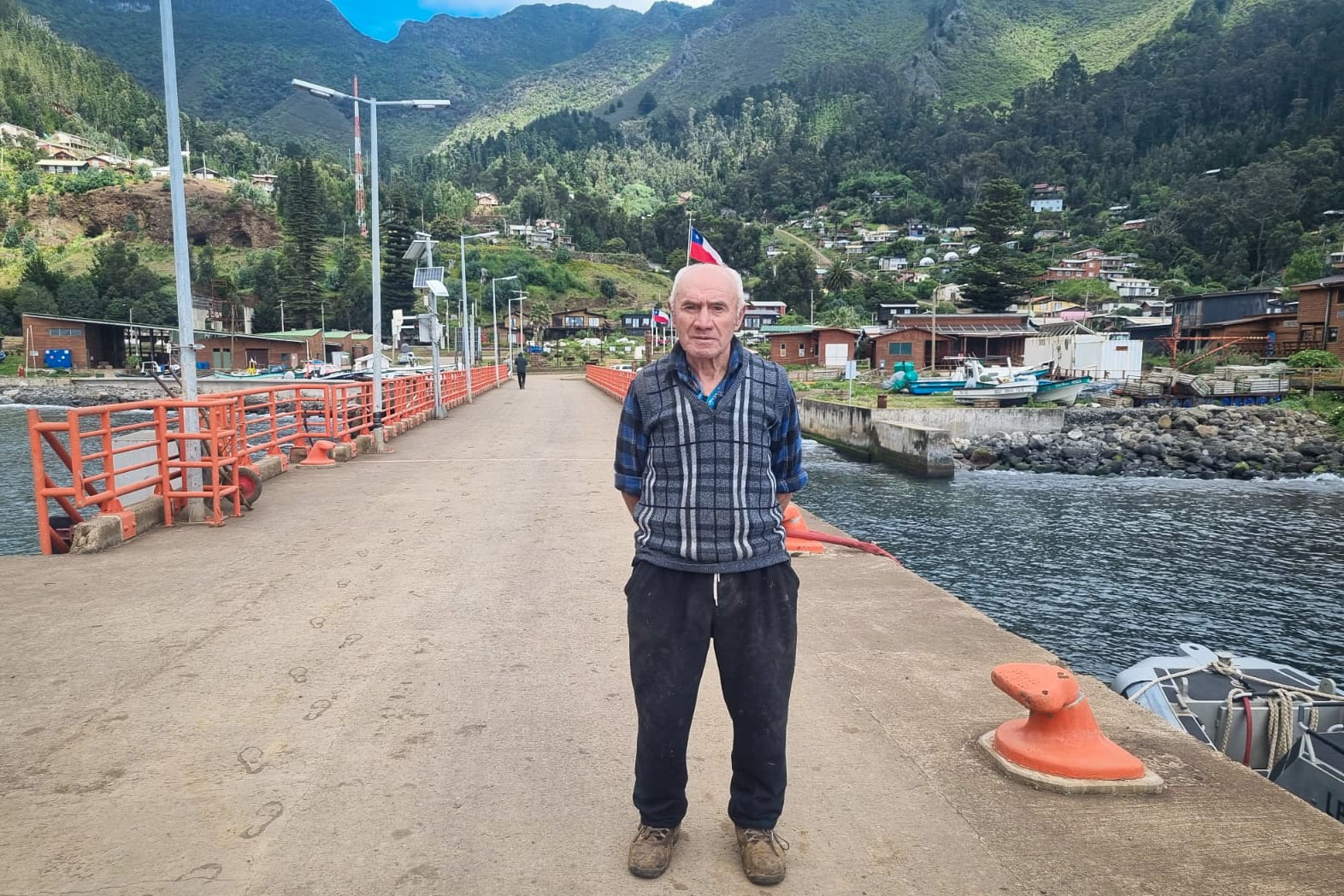
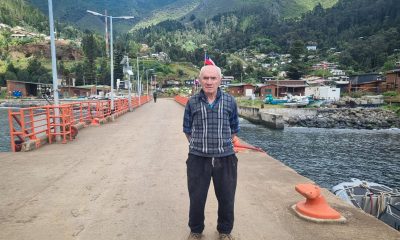
Under an intense sun and strong winds, Wilson González Celedón, 83, and his nephew Alberto Vergara Recabarren, 57, stand on the dock of Robinson Crusoe Island and push out the Lunajo II, the eight-meter (26-ft) boat in which they go out every morning in search of lobsters. They have worked together for more than two decades now, and both have a unique history within the Juan Fernández archipelago. This is one of the most isolated populated areas in Chile: it is located almost 700 kilometers (435 miles) from the mainland, and requires 36 hours of arduous navigation from the Valparaíso region to get here.
González is the longest-living fisherman in the archipelago. Vergara, meanwhile, was the first archipelago resident found alive—though in extremely serious condition—during the early hours of February 27, 2010, when a tsunami devastated part of the island region. “I am considered the first survivor,” he says as he introduces himself with a smile, although his memories are as distressing as they are devastating.
González was born on the island Más a Tierra, which in 1966 was renamed Robinson Crusoe by the Chilean state, in tribute to the 1719 novel of the same name by Daniel Defoe, inspired by the story of Alexander Selkirk, a Scottish sailor who lived there as a castaway between 1704 and 1709. He started working at 11 years old, when he started going fishing with his older brother, and by 13 he was a boat captain. “I didn’t waste my time,” says Wilson. He says he can’t imagine his life any other way than on a boat. “It’s just that I’m fascinated by the sea,” he points out.
He remembers that he only tried once to be a grocery store vendor, but it lasted barely a week. “I was more bored than a dog in a boat; there was nothing to do,” he recalls. This feeling is understandable given his experience, since he also spent 23 seasons fishing for lobsters in the Desventuradas Islands, located about 700 km (434 miles) from the archipelago, off Caldera, in the Atacama region, northern Chile: it took him two and a half nights to get there and he brought drinking water in galvanized jars.
Vergara, meanwhile, began his fishing career when he was about to turn 19. It was González who went to pick him up in Valparaíso, where he was living with his parents. His nephew grew up on the mainland, but spent almost every summer in Juan Fernández since his entire maternal family is from there: his mother Luz, who died in 2004; his grandparents, his cousins, his uncles Wilson and Luisa. “Since I was a child, I wanted to live here, but as a child I couldn’t make my own decisions. That’s why, as soon as I could, I came,” Alberto says.
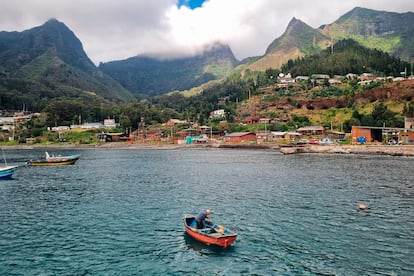
He remembers perfectly the day in 1989 when his uncle Wilson said to him: “Do you want to go work in the Desventurada Islands?” That’s how his career at sea began, and they boarded the ship Carlos Darwin together. “It was the first time I was away from my house for so long, because the season lasts nine months,” Alberto says. He spent three lobster seasons in northern Chile: 1989, 1990, and 1991.
Like his uncle, Alberto has a passion for being a fisherman. “I’m no good for anything else. I used to work on a truck in Valparaíso, but the abusive way people get treated, especially when they’re new, was too much to take. Besides, teamwork didn’t exist.” González is the one who taught him lobster fishing and acted, his nephew admits, like a teacher. Together they spend up to 15 hours a day on the high seas. “We get along well,” says González, although both admit that, in almost 25 years, they’ve had a few brushes in the solitude of sailing. “That will always happen, because not everything can be rosy. Sometimes he has one opinion and I have another,” says Vergara. “It’s just like a marriage,” his uncle adds with a laugh.
In all the years they’ve been together, Alberto has left Lunajo about three times — the name comes from González’s children being named Luisa, Nadia, and Jonathan — to try his luck on other boats on the island. He did it “to cool off a bit,” but admits that as soon as he stepped on the first new boat, he felt uncomfortable. “You start to notice flaws that aren’t on the boat you worked on so many years. You’re nervous, bouncy, and honestly, you just don’t get used to it,” he says while his uncle watches him closely. “I’ve worked with several fishermen [there are 288 in the Juan Fernández archipelago] and not all are the same,” Vergara continues. And he explains that his uncle Wilson’s generation “teaches the good practices of old fishermen and the stories they tell are very different from those told now.”
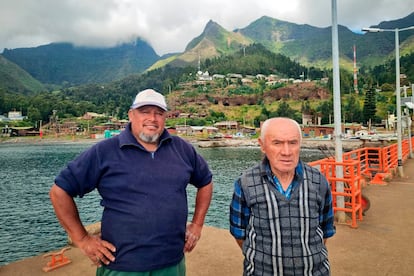
González takes the opportunity to explain the routine of those old fishermen: “The first thing we do in the morning is have breakfast, but inside the boat. Then we prepare the bait [for the lobsters]. In the middle of his story, there’s something Wilson wants to highlight: “As I was saying, I’m fascinated by the sea. But I’m very respectful of the sea, because there are people who make reckless mistakes and that only leaves behind sadness.”
Since 2015, the lobster fishery in the archipelago—on the islands of Robinson Crusoe, Santa Clara, and Alejandro Selkirk—has had international certification from the Marine Stewardship Council, an eco-label that guarantees it is a sustainable fishery.
Nearly a farewell
On the night of February 26, 2010, the yellow house owned by Wilson González and his wife Luisa, located halfway up Robinson Crusoe Island, was the meeting place for a family barbecue and, of course, they also fried some fish. Alberto was one of the diners and he went home to his own house, located a few meters further down, facing the coast, shortly before midnight. The next day, as always, and very early in the morning, he would go out with his uncle to fish for lobsters. “I didn’t want him to leave, because we were having a good time,” González recalls.
At 3:34 a.m. on February 27, a devastating 8.8 earthquake occurred on the mainland, causing a tsunami in the regions of El Maule and Biobío, but also in Juan Fernández, without its 1,150 inhabitants ever being alerted by national authorities. González managed to receive a call from a sister-in-law from Valparaíso: “She said we should be very careful, because there was an earthquake. And no one knew here.”
Alberto remembers that that night, when he got home, he turned on the TV for a while to watch the Viña del Mar International Song Festival. “Suddenly I saw a stain, something black coming,” he still says with some fear in his voice. “I heard some screams, but who would have imagined what happened next.”
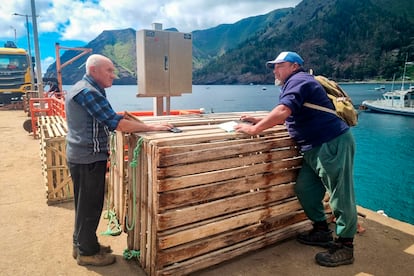
What happened was devastating. “Water entered my house, I broke my head against a beam, and the water carried me in about 100 or 200 meters (328 to 656 ft). It was dark, I couldn’t see anything, the only thing I could make out from afar were the school’s cypresses [the school was destroyed by the tsunami]. I started pinching myself, to see if it was a dream, while floating holding onto two sticks. The water was full of gasoline and oil. Then another wave caught me, and it threw me far away, another 200 meters beyond the pier.”
The waters only reached the door of González’s family’s home, located further up the hill. Desperate, Wilson remembers running down to check on his nephew, but when he arrived, he saw the house had disappeared. A harrowing search on the island began, while Alberto, after spending more than an hour in a sea full of debris, couldn’t take it anymore: “I had already given myself up. I told God: ‘I don’t want any more. If you’re going to send another wave, let it come with a stick and blow my head off at once.’”
The tsunami caused the death of 10 people in Juan Fernández, while six remain missing to this day. Alberto was the first resident to be found alive after the waves threw him onto the shore. That’s how he was found on the sand by a group of fishermen: “Is anyone there?” they called out. “Here,” Alberto replied and then fainted. He was taken in a van to the Juan Fernández health center, where his uncle finally found him. He was completely bloodied, his body swollen with salt, and had a broken leg. “He didn’t look very good, but he was alive. I was overjoyed,” González recalls.
Alberto spent five months hospitalized in two hospitals in Valparaíso, and upon his return to the island in July 2010, he was cared for by Wilson. “My uncle is like a second father, I’ve always told him,” he says. It was a difficult time in which he struggled to sleep because if he closed his eyes he could see himself underwater with the rubble hitting him. His kidneys were poisoned with salt, and the swelling in his body was such that he couldn’t fit in a wheelchair.
Despite those nightmares, Alberto just wanted to go out fishing again. A new boat was waiting for him, built after the tsunami, the Lunajo ll. “We came back in October 2010. At first it was hard for me, because of the images playing over in my mind. But the return was also exciting,” he recalls. “I couldn’t work at anything else,” he reiterates, standing on the dock. His uncle Wilson agrees, and after seven decades as a fisherman, he assures: “They’ll have to take me out of my boat in a coffin.”
Sign up for our weekly newsletter to get more English-language news coverage from EL PAÍS USA Edition
America
Costa Rica Niega El Ingreso A Francesca Albanese, Relatora De La ONU: “Nunca Me Había Sentido Tan Humillada”


Kimi Antonelli wants Verstappen as a teammate and asks Mercedes for permission.

Black Friday 2026, En Directo: Las Mejores Ofertas De Amazon Y Otras Tiendas, Minuto A Minuto

Cierre De Campaña De Las Elecciones Generales Del 29-N, En Directo | Sánchez Carga Contra El PP Y Vox Por Intentar Deshumanizarle Y Convertir Las Elecciones En Un Referéndum Contra él


-

 New Developments4 weeks ago
Luxury Villas For Sale, Estepona – ProjectL1
-

 New Developments3 weeks ago
The San Roque Club – Townhouses For Sale
-
costa blanca live music4 weeks ago
Beatles tribute: The Liverpool Band returns to Orihuela Costa
-

 New Developments4 weeks ago
Stylish 3-Bedroom Apartment With Panoramic Sea Views – Benalmádena
-
countryside4 weeks ago
Rural revival: Five Almeria villages make moving inland easier and more enticing
-

 %3 days ago
Black Friday Shock As Just 6% Of Deals Pass OCU’s Genuine Bargain Test
-
Eating out in Gibraltar4 weeks ago
Young woman left horrified after Gibraltar restaurant receipt carries shocking racist slur
-

 America4 weeks ago
Así Ha Sido La Primera Jornada Del World In Progress 2026: Del Anuncio De Sánchez De Ayudas Para Las Víctimas De Urda A La Reivindicación De Rebeca Grynspan Del Papel De La ONU