
Andres Iniesta
From The Bernabéu To Greenland: 10 Iconic And Unique Football Stadiums

It all began on the shores of the English Channel. John Gillard remembers himself at just 11 years old, walking along the path that led away from the sea, through a sea of blue and white shirts, scarves, and flags, to the austere and venerable Goldstone Ground, in the heart of the town of Hove. In that century-old stadium, demolished in 1997 and now replaced by a shopping center, Brighton & Hove Albion, the legendary Seagulls, the pride of Sussex, the team of Gary Stevens and Gordon Smith, played their matches.
Gillard, a graduate in modern history, designer, writer, and creative writing workshop coordinator, was infected there by the football bug, a persistent affliction that, in subsequent years, has taken him all over the world. As he explains in the introduction to his book, The World Atlas of Football Stadiums (published in Spain by Cinco Tintas), professional obligations and sports tourism have taken Gillard from the floating pitch of Koh Panyee, in a Thai fishing village, to the futsal courts of the Rio de Janeiro favelas, the spectacular grandstand of Sydney’s Accor Stadium, and the new Santiago Bernabéu, with its unusual retractable pitch system.

The author concludes that no two stadiums are alike, that football is palpable in every one of these venues, and that each one “offers something unique and surprising,” related to its surroundings, its architecture, its tradition, or “the richness of its fans’ experience.” The book, to which writers Joseph O’Sullivan and Neel Shelat also contributed, includes descriptions and images of up to 1,000 iconic stadiums across five continents, including some as picturesque as La Bombonera in San Cristóbal, located on a tobacco plantation in the shadow of the Sierra del Rosario mountains in Cuba; the almost always packed Mobolaji Johnson Arena on Lagos Island in Nigeria; and the futuristic Glass House in Dunedin, New Zealand. With Gillard and his team as guides, readers travel a transoceanic route through Europe, Asia, Africa, and the Americas in 10 stops, from the most imposing and technologically advanced stadiums to the most peculiar, historic, and peripheral ones. In the words of the book’s author, “it is possible that a particular stadium may awaken your curiosity to the point that you decide to visit it, or even travel across an entire country jumping from one stadium to another, soaking up its culture along the way.”

Pier 5 (Brooklyn, New York)
The United States is one of the three host countries for this summer’s World Cup, with matches scheduled in historic venues like Seattle’s Lumen Field, Santa Clara’s Levi’s Stadium, and Miami Gardens’ Hard Rock Stadium. But the future of soccer — the kind that might allow the United States to emerge as a global power in the medium term — is slowly being forged in places like this: the public pitch on the Brooklyn piers, amid pleasure boats, the cries of seagulls, and the bustle of dockworkers, in the shadow of the Manhattan skyline. Aside from the school and corporate leagues held at Pier 5 between March and November, you can sign up on the Brooklyn Bridge Park website, pay an access fee that varies depending on availability, and simply play soccer.

León Stadium (Guanajuato, Mexico)
Colloquially known as Nou Camp, due to its obvious resemblance to FC Barcelona’s home, the stadium of the fourth most-populated city in Mexico, León de los Aldama, belongs to the Pachuca Group and has a capacity for more than 31,000 spectators. Here, the England national team was brought to its knees in an epic 1970 World Cup quarter-final against West Germany (as Gillard recalls, the English manager, Alf Ramsey, decided to substitute Bobby Charlton when they were winning 2-0 so that he would be fresh for the semi-final against Italy, and they ended up losing 2-3, after succumbing to an irresistible surge from Germany that dismantled them in just 20 minutes) and here, Club León — the Esperanzas de Guanajuato or Panzas Verdes — have celebrated 17 of their 19 national titles, including the surprising league title of 1992. It is not the Azteca Stadium nor the Olympic University Stadium of Mexico City, but it is one of the most beautiful and prestigious stadiums in North America.

Maracanã (Rio de Janeiro, Brazil)
Brazilian stadiums are in a league of their own, due to their colossal dimensions and the passion that fills their stands. There are colossi like the Mané Garrincha in Brasília, the Aderaldo Plácido Castelo in Fortaleza, the Morumbi in São Paulo, and the Mineirão in Belo Horizonte, all enormous, even though successive renovations have reduced their capacity. But the largest of them all, and the mecca of Brazilian football, is the Periodista Mario Filho stadium, better known as Maracanã after the populous neighborhood in which it is located. For Gillard, this stadium is exceptional because of its setting, nestled between the Atlantic beaches and the fertile hills of Rio, and because of the overwhelming proximity of Christ the Redeemer atop Corcovado Mountain, the 30-meter-high Art Deco statue that “watches over it like a guardian angel.” Also because it was, of course, the site of one of the most famous matches in football history: the 1950 World Cup final, in which Juan Alberto Schiaffino’s Uruguay were considered easy prey for the Brazilian constellation of stars, only to triumph with a goal that sent chills down the spines of 178,000 spectators. And because it is home to Rio’s two main teams, Flamengo and Fluminense, fierce rivals but, despite everything, brothers, united by a stadium that exudes sporting mystique from every pore.

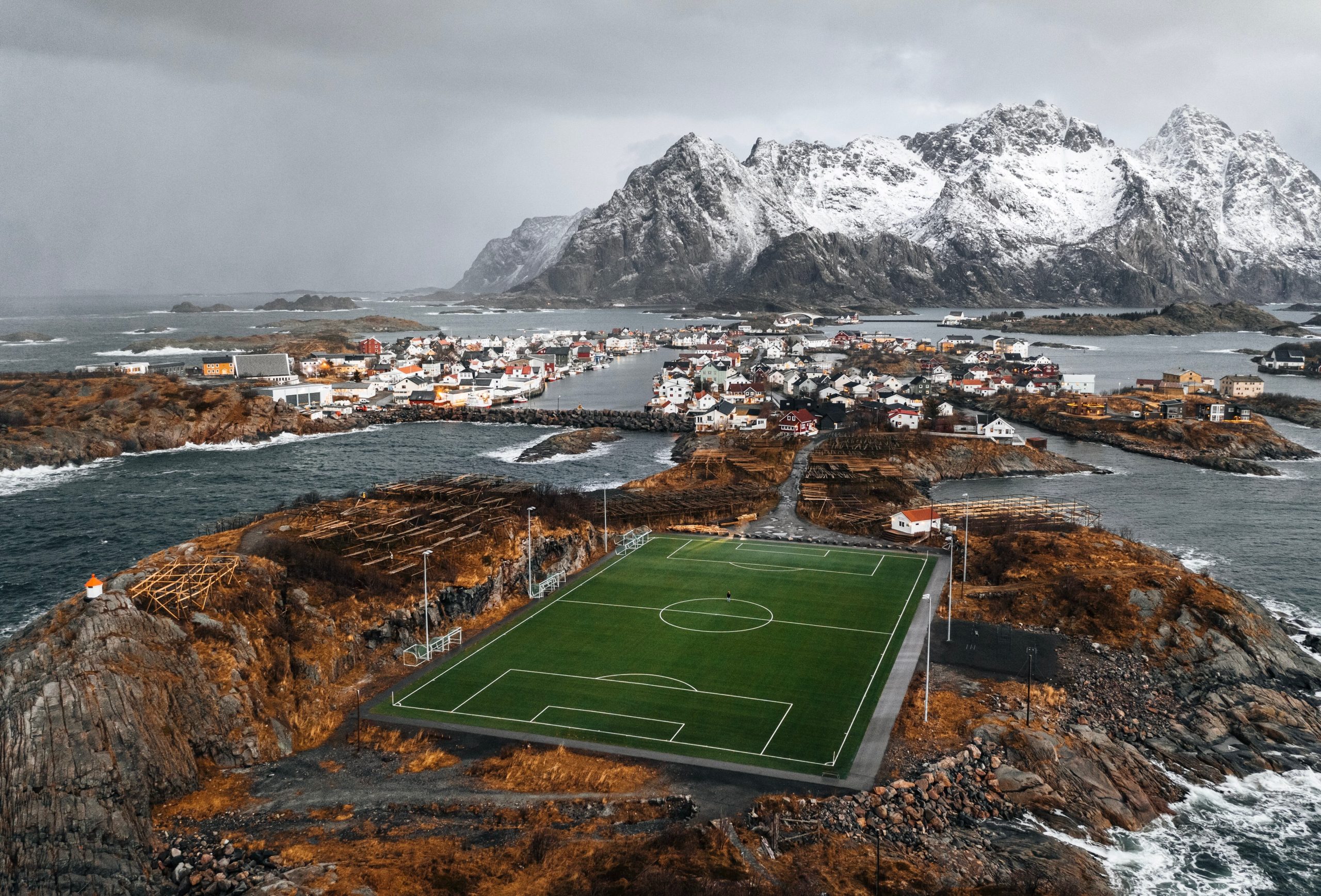
Hennigsvaer Stadium (Norway)
Another kind of soccer is possible. And it’s played, far from the multimillion-dollar spotlight of metropolitan soccer, in places like this pitch on the island of Hellandsoya, in the Lofoten archipelago, beyond the Arctic Circle. In this place of stark beauty, with white sand beaches where swimming is only possible for a couple of weeks a year, Gillard has featured what he considers one of the most beautiful stadiums in the world. To get there, as the British writer explains, you have to “cross bridges and tunnels, wait by the roadside for the infrequent local buses, and walk over bedrock.” Once you’ve completed the journey, upon arriving at a fishing port of about 400 inhabitants “that houses a contemporary art gallery where there used to be a caviar factory,” you can’t help but be amazed to see that someone has created something so beautiful on a rugged bed of petrified lava so that the locals can play soccer under the midnight sun or the Northern Lights.

Qeqertarsuaq (Greenland)
Also highly valued in the exotic category is this Greenlandic stadium surrounded by icebergs, right on the migration route of humpback whales, which frequently surface beyond the ice floes during matches. Despite its rugged appearance, it is a semi-professional pitch, where the Qeqertarsuaq team, G-44, one of the 16 that regularly compete in the Greenlandic Championship, plays its matches.

Stadio Diego Armando Maradona (Naples, Italy)
Fans of a certain age will remember that this multi-purpose stadium in Naples’ Fuorigrotta district was always called San Paolo, in honor of the apostle and one of the city’s main basilicas. But no saint can compete with the secular idolatry generated in Naples by the Argentinian Diego Armando Maradona, who established his headquarters in this stadium between 1984 and 1991, shifting the center of gravity of Italian soccer from the north to the south during those glorious years. Napoli fans continue to pay homage to the man who, for the first time in history, put the Campania club on par with Piedmontese, Lombard, and Roman teams. And they do so, above all, in this stadium famous for the roar and vibrant colors of its stands, starting with the legendary Curva B, which, match after match, boasts of erupting “like a bomb” the moment their team steps onto the pitch. It may not be the most beautiful stadium in Italy, but it is certainly among the most genuine and passionate, a coliseum animated, according to Gillard, by the tribal enthusiasm of “us versus them” so characteristic of a city that has often felt isolated from the rest of the nation, clinging to its own traditions and historical inertia. “It’s no wonder,” Gillard concludes, “that other fans know it as the cauldron of hatred.” Both the city of Naples and soccer have reasons that reason cannot comprehend.

Jean-Bouin and Parc des Princes (Paris, France)
Although the Vélodrome in Marseille and the Gérard Houllier in Lyon are, each in their own way, masterpieces of contemporary design, no snapshot of French soccer would be complete without starting with these twin stadiums on the outskirts of Paris. Separated by a four-lane avenue, the homes of the multi-billion-dollar PSG and the much more modest FC Versailles are an ode to neo-brutalist avant-garde, to the merciless power of soccer, and to the austere beauty of concrete behemoths. The Jean-Bouin opened in 1925 and has been renovated and expanded twice, most recently in 2011, when its striking Art Deco-inspired metal mesh was completed. Its illustrious neighbor has stood there since 1897 and consolidated its current appearance in 2016, when it was last remodeled, following expansions in the 1930s and 1960s and a complete reconstruction in 1972, led by architect Roger Taillibert.

Estadio Santiago Bernabéu (Madrid, Spain)
What does Gillard think of the new Bernabéu, the attempt to provide Madrid with a landmark building of international renown to rival the Sagrada Familia or the Taj Mahal? To begin with, he says that from afar it looks more like a spaceship than the sardine can its detractors perceive it to be. Once inside, according to the author, it’s an imposing “cathedral of football” that forces players leaving the tunnel to tilt their heads back to appreciate the intimidating grandeur of the stadium they’re in. A behemoth with a capacity of 83,000 spectators, a retractable roof equipped with weather sensors, that retractable pitch everyone’s talking about, and a 360-degree video scoreboard. For Gillard, it’s “a stage worthy of the most successful club in football history.” The author also praises examples of excellence in Spanish sports architecture such as the new San Mamés, the pilot version of the future Nou Camp, and the Metropolitano, which he describes as “one of the most modern stadiums in Europe.”

Sükrü Saracoglu Stadium (Istanbul, Turkey)
The authors of the World Atlas of Football Stadiums are captivated by the richness and diversity of Turkish soccer. In particular, they admire the fertile and fierce rivalry between the three major teams (Besiktas, Galatasaray, and Fenerbahçe) of Istanbul, that megalopolis of 15 million inhabitants that lives and breathes soccer and consumes it with unbridled passion. Of the three local stadiums, Fenerbahçe’s home ground is perhaps the most striking, due to its location between the city’s busiest thoroughfare and the shores of the Sea of Marmara. Inaugurated in 1908 and with a capacity of over 47,000 spectators, this stadium was last renovated in 2006 and today presents an appearance somewhere between the melancholic grandeur of its origins and the understated efficiency of contemporary sports architecture.

DHL Stadium (Cape Town, South Africa)
There are plenty of reasons to enjoy sports tourism in sub-Saharan Africa. You can choose from stadiums in Tanzania, Senegal, Nigeria, or Ethiopia, and in all of them you’ll find boundless passion, striking settings, and local color. But the continent’s greatest stadiums are in South Africa, which hosted the World Cup in 2010. There you’ll find the FNB Stadium in Nasrec, Johannesburg, the astonishing bowl covered in turned wood (as Gillard describes it) where Andrés Iniesta scored a goal for the ages. And 745 miles away, at the other end of the country, is the DHL Stadium in Cape Town, home to Ajax Cape Town, the younger sibling of Ajax Amsterdam and the pride of the Parow suburb. The stadium in the former colonial city sits at the foot of the bucolic Signal Hill and on the shores of the South Atlantic, with the rugged Table Mountain looming over the north stand. Gillard points out that, alongside the new venue, inaugurated in 2009 and with a capacity for 55,000 spectators, the previous version of the stadium, dating from 1897, is preserved: “It is a strange image, seeing the old and the new resting next to each other.”
Sign up for our weekly newsletter to get more English-language news coverage from EL PAÍS USA Edition













Ojen & The Julio Iglesias Museum That’s Still On Hold

Bad Name At Estepona’s Louie Louie

E

Dinero En Efectivo Guardado En Casa Y La Devolución De Los Gastos Del PSOE: La Expareja De Koldo Protagoniza La Cuarta Jornada Por El ‘caso Mascarillas’

Última Hora De La Guerra De Estados Unidos E Israel Contra Irán, En Directo | EE UU Asegura Que Dos De Sus Buques Militares Han Cruzado Ormuz Para Desminar El Estrecho E Irán Lo Niega

Mercedes F1 star Kimi Antonelli feeling the pressure after Italian heartbreak


-
 Caso Koldo4 weeks ago
Dinero En Efectivo Guardado En Casa Y La Devolución De Los Gastos Del PSOE: La Expareja De Koldo Protagoniza La Cuarta Jornada Por El ‘caso Mascarillas’
-
 Ataque contra Irán4 weeks ago
Última Hora De La Guerra De Estados Unidos E Israel Contra Irán, En Directo | EE UU Asegura Que Dos De Sus Buques Militares Han Cruzado Ormuz Para Desminar El Estrecho E Irán Lo Niega
-
 Uncategorized4 weeks ago
Mercedes F1 star Kimi Antonelli feeling the pressure after Italian heartbreak
-
DGT4 weeks ago
DGT launches week-long speed crackdown on Spanish roads
-

 New Developments3 weeks ago
How To Get A Tourist Rental Licence In Andalusia (Spain) – Step-By-Step Guide 2025
-

 Andalucia4 weeks ago
La Policía Detiene A Un Hombre En Córdoba Por El Asesinato De Su Pareja
-

 Uncategorized3 weeks ago
Max Verstappen Nurburgring LIVE: NLS5 Schedule, start times and free live streams
-

 %4 weeks ago
Young Engineers Hold STEM Day Workshop