
%
From Car Rallies To Car Tours!


Classic & Sportscar Club. Credit: Ian Giles
Until a few years ago, if you wanted to go on an organised car tour abroad it meant competing in a rally. Whether a navigational or a timed speed event, it was expensive, difficult to get into and your car would need specialist preparation, and safety equipment. Oh, and, most important, you would need a trained co-pilot cum navigator who would also function as an office manager, tour operator, timekeeper and all-round planner! And, he maybe needed to perform an F1 style tyre change in the middle of nowhere when called upon to do so by his often recalcitrant driver. And who gets all the glory ? – Well, it’s not the navigator!
But now, all that has changed! Non-competitive car ‘Tours’ are the order of the day and are well organised by such people as The Classic & Sportscar Club and Iberian Motoring Events to name only two.

In fact, IME have just released information on their next 5-day tour called the ‘Tour of the Three Parques‘ which will take place, starting from the Mijas area, on October 12th.
The event will take in three mountain ranges including the Alpujarras and the Sierra Nevadas and will include a two-night stop in the fabulous city that is Granada, full of amazing tapas bars and restaurantes.
No particulars skills are necessary and the organisers provide simple, easy to use, professional roadbooks to ensure everyone finds their way. No timing is used other than the importance of making it to dinner in the evenings!
One can imagine the stunning scenery, panoramic views and quiet, traffic-free roads making driving relaxing and enjoyable. Something that can’t be done in much of Europe and especially not in the UK.
Hotels, dinners, breakfasts and more are included for an astonishingly low entry fee of €620pp + IVA assuming two people sharing. If you’d like to try something different, contact IME through their website www.iberianmotoringevents.com.
These events are open to all and are great fun.

Whilst talking of tours, the Classic & Sportscar Club arrange at least one, one-day event every month and in May their run (or tour) started near Estepona and took in beautiful places and roads around Casares, Gaucin, Cortes de la Frontera and Ronda before finishing with a super lunch at El Papillon beach club in Elviria, near Marbella.
In June the CSCC are organising a classic and sportscar run on Sarurday the 6th that will start near Marbella and skirt the Lakes of El Chorro before finishing with lunch at the fabulous ‘Yikoi’ Asian restaurant near Marbella where quite a special feast will be laid on for all participants. Already a large entry has been received with a variety of stunning motorcars – too many to mention. Places are still available so do please contact the organisers directly at csccspain@gmail.com or see their website for more details which is www.csccspain.com.
The ‘Cars and Coffee’ meetings organised by the club once a month have been a huge success but there needs to be a break for the summer high season. So, the last Cars and Coffee will be on Sunday, June 28th based at YANX American Diner in Centro Plaza, Puerto Banus from 10.00am until 1.00pm. These terrific social gatherings over coffee and great cars will recommence in October. Watch this space for the date!
Lastly , the CSCC has revived it’s mid-summer party and this year it will be at the hotel Tamisa Golf on the old Coin Road in Mijas Costa. Set for Saturday, June 27th with dining and dancing under the stars, tables laid up around the pool, in this most beautiful location and with live music and a full four-course dinner with wines for only €65pp. Contact the Club direct to book.
Thats about it for this month save to remind you that the F1 World Championship continues this weekend at the iconic Monaco street circuit. Mercedes seem to be the team in front at this time but development of these cars continues at a pace with both McLaren and Ferrari snapping at their heels and ready to pounce. It should be a terrific Grand Prix!
See you again here in July!














A Spanish summer is hard to beat. Long, late hot evenings, gorgeous sunsets with cocktails and al fresco dining. Its what makes life in Spain so special. But you have to take the rough with the smooth, as the heat also invites one of the country’s most frustrating and unhygienic seasonal pests. The common housefly.
The hotter it is, the faster food spoils, creating a breeding paradise for insects. Not only are they unbelievably annoying, they are also a health hazard, acting as vectors for diseases like salmonella, dysentery, and cholera.
To tackle the problem early on you can use a classic home remedy. It takes less than a minute to assemble, costs next to nothing, and offers a chemical-free way to protect your living spaces all season long.
How to build the classic plastic bottle fly trap
The plastic bottle fly trap works on a basic mechanical principle. Flies are drawn down into the structure by an enticing scent but are naturally unable to find the small opening to fly back out. To build, follow these three quick steps –
Take a clean plastic bottle and cut it roughly 10 centimetres below the cap, right where the plastic begins to widen.
Turn the top section upside down so the neck points downward like a funnel, and place it directly inside the bottom base. Leave a small gap of clear space between the mouth of the inverted funnel and the bottom of the bottle.
Secure the two pieces together by wrapping adhesive tape completely around the top rim. This keeps the structure stable and seals any tiny side gaps that a fly could use to crawl out.
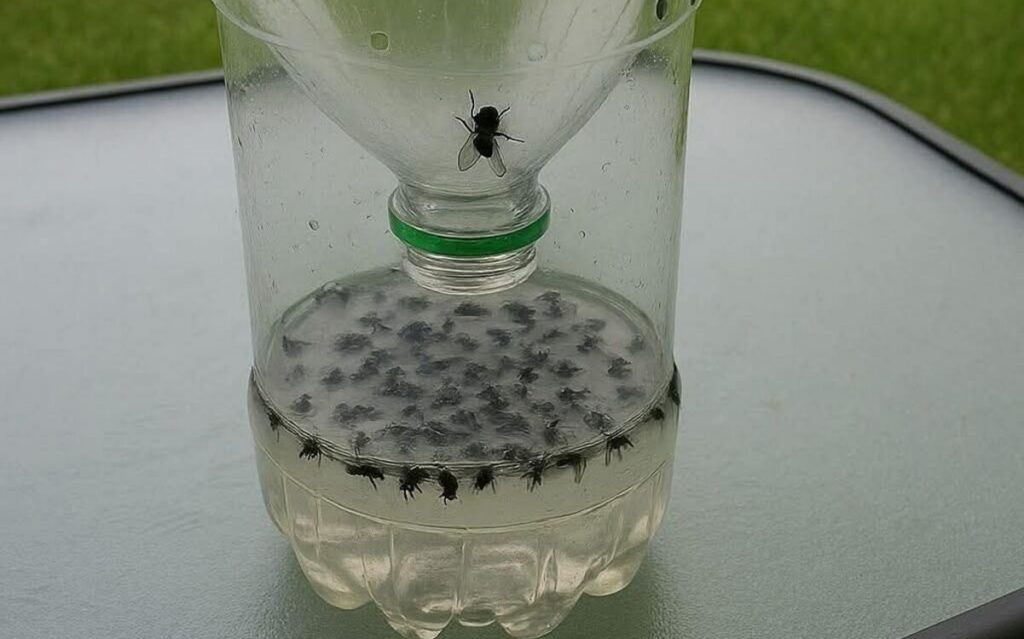
Credit:Zîî Noôu/FB
The right indoor and outdoor bait recipes for success
While many online guides suggest a blanket mixture of water, sugar, and vinegar, using the wrong recipe inside your home can backfire. Large houseflies have entirely different preferences than tiny fruit flies, so matching your bait to the location is key.
Best bait for outdoor terraces and gardens
If you are placing your trap out on a patio, courtyard, or balcony, use a mixture of water, sugar, and vinegar. The sweet, fermenting aroma is incredibly effective at pulling pests away from your outdoor dining table. Because of the sharp, pungent scent, this specific mixture is strictly recommended for well-ventilated outdoor areas.
Best bait for kitchens and indoor spaces
Avoid using vinegar indoors. Large houseflies are often naturally repelled by it, and the smell can quickly become overwhelming inside a house. Instead, fill your indoor trap with warm water and plenty of dissolved sugar. To supercharge this indoor mix, drop in a small piece of overripe fruit (like a slice of banana or melon) or a pinch of baking yeast. This creates a mild, low-odour fermentation process that houseflies find irresistible.
Easy natural alternatives using everyday items
Sticky homemade fly paper
You can easily create your own chemical-free fly ribbons. Cut strips out of a brown paper bag, punch a hole at the top of each, and thread a string through for hanging. In a saucepan over medium heat, warm equal parts water and sugar with three tablespoons of honey, stirring until it forms a thick, sticky glaze. Coat the paper strips in the mixture and hang them up in problem areas where insects tend to gather.
The diluted vinegar barrier spray
Because houseflies actively avoid the scent of vinegar, it makes a terrible trap bait, but an exceptional defensive barrier. To use it indoors without creating an overwhelming smell in your living areas, mix equal parts vinegar and water in a spray bottle. Instead of misting the air, spray it strictly onto targeted entry points—like exterior window frames, door tracks, and the inside base of household bins. The scent quickly fades for humans as it dries, but it remains strong enough to disorient flies and stop them from crossing into your home.
Potted aromatic plants that act as natural deterrents
Utilizing the power of aromatic plants is a stylish way to help move them along. These plants add beautiful decorative value to Spanish windowsills and balconies and also have natural essential oils doubling up as insect repellents.
Citronella and mint – Citronella is the ultimate defender for outdoor terraces. Indoors, potted peppermint is incredibly hardy, easy to maintain on a windowsill, and releases a sharp mentholated fragrance that flies actively avoid.
Basil and sage – Broad-leaved basil varieties are perfect for kitchen counters, producing an aroma that disrupts a fly’s sensitive sense of smell. Sage releases strong essential oils that create a highly unattractive environment for flying insects.
Bay leaves – Bay leaves naturally contain organic compounds called cineole and eugenol, which are scientifically proven insect deterrents. You can place dried bay leaves inside your pantry cupboards or scatter them on windowsills to amplify the protective effect.
Top tip. To make your live plants work effectively as natural deterrents, remember to gently rustle or brush their leaves occasionally. This physical action breaks the plant’s oil glands and releases the defensive aromas into the air.
Combined with daily kitchen hygiene, wiping surfaces down, and emptying your household bins frequently, these natural tricks will help your Spanish summer stay peaceful and fly-free.

El Nasdaq Baja Un 4,18% En Una Sesión Marcada Por La Debilidad De Las Tecnológicas

How Social Media Platforms Keep Students Hooked: Notifications During School Hours And Paid ‘teen Ambassadors’

Inside The Most LUXURIOUS Apartment Building In Spain!
In The Final Stretch Of Colombia’s Presidential Campaign, Undecided Voters Are In High Demand

How To Get A Tourist Rental Licence In Andalusia (Spain) – Step-By-Step Guide 2025
Spain heatwave 2026: When the next extreme temperatures could hit and which areas may suffer most


-
Abelardo de la Espriella2 weeks ago
In The Final Stretch Of Colombia’s Presidential Campaign, Undecided Voters Are In High Demand
-
 New Developments3 weeks ago
How To Get A Tourist Rental Licence In Andalusia (Spain) – Step-By-Step Guide 2025
-
aemet3 weeks ago
Spain heatwave 2026: When the next extreme temperatures could hit and which areas may suffer most
-

 Bad Bunny2 weeks ago
Luis Rafael Sánchez: ‘Republicans Can’t Stand The Idea Of Puerto Rico Becoming A US State’
-
Competiciones4 weeks ago
E
-
Costa Blanca North4 weeks ago
Marina Alta business awards celebrate ALE-HOP success and Alzheimer’s care innovation
-
Foreign demand4 weeks ago
Has foreign demand for Spanish property peaked? Latest figures suggest so
-

 Álvaro Arbeloa4 weeks ago
E