
Barcelona
Junts Endurece Su Oposición Y Propone Al Parlament Reprobar A Salvador Illa

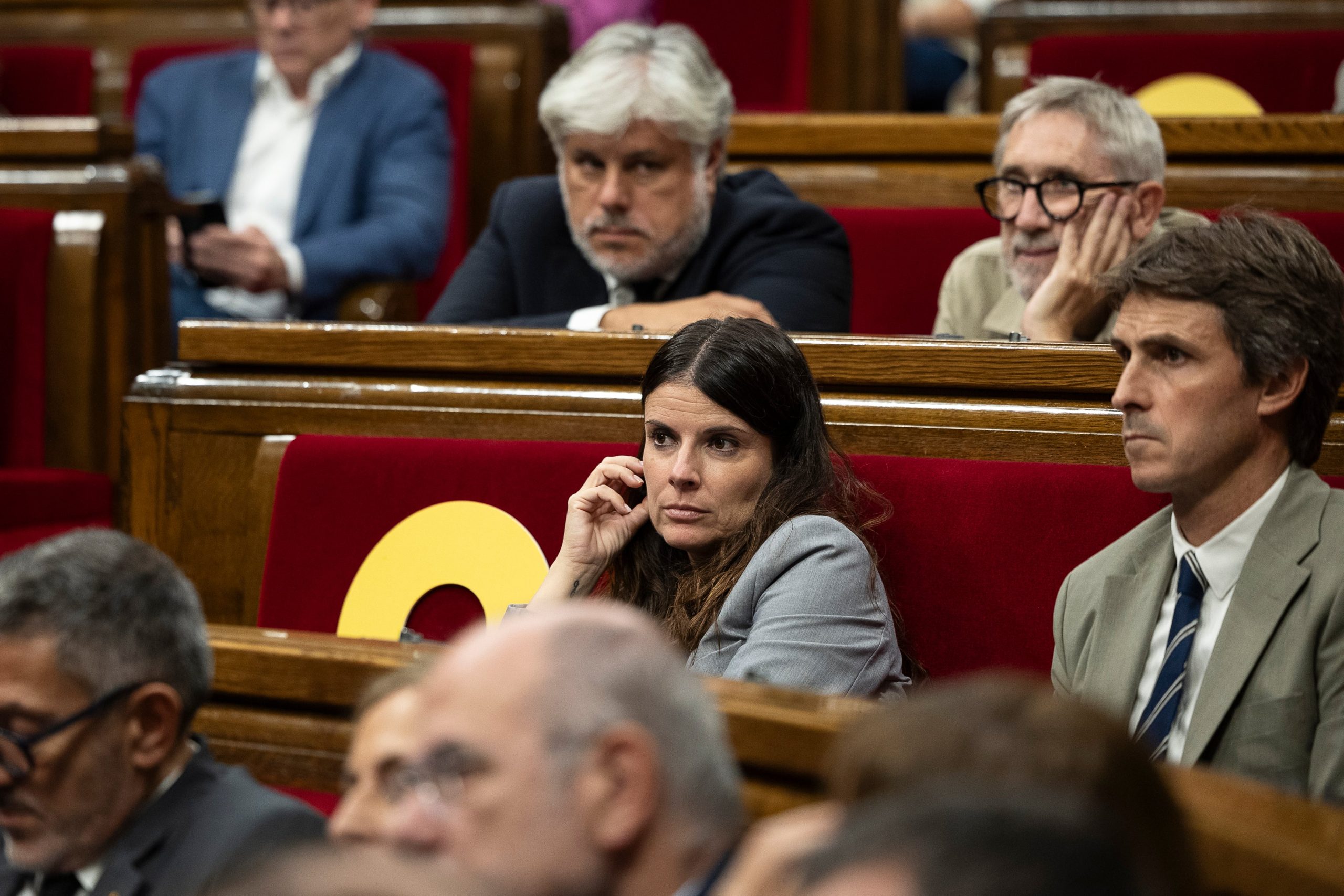
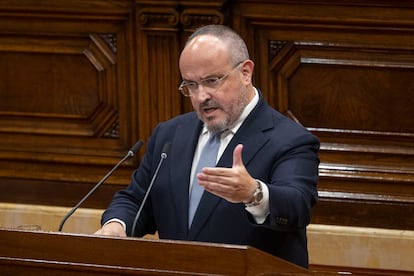
Junts per Catalunya ha comenzado este miércoles el turno de los grupos parlamentarios en el Debate de Política General en el Parlament anunciado una medida inédita: presentar una propuesta de resolución para reprobar a Salvador Illa al considerar que pilota la Generalitat con “desgobierno” e “incompetencia” y “sumisión a Madrid y al PSOE”. “Usted es el peor presidente de la Cataluña moderna. No sirve para defender a Cataluña. No se la cree: la está hundiendo”, ha afirmado Mònica Sales, presidenta de Junts, que ha endurecido su posición contra el Govern y ha retado a Esquerra y Comuns a posicionarse. Los dos socios se han mostrado críticos con Illa: ERC le ha recriminado el incumplimiento de la convención para resolver el conflicto político, que figuraba en los pactos de investidura, y Comuns que llega tarde a resolver el problema de vivienda, Rodalies o de la educación. La reprobación no prosperará: Oriol Junqueras, líder de ERC, ha adelantado que están en contra.
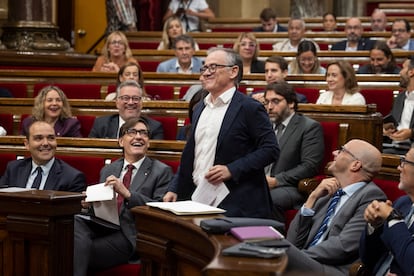
Illa ha rebatido las quejas de sus socios y de Junts y PP, que la han acusado a la par de someterse al PSOE y al Gobierno. Y ha encajado con filosofía y sorna la propuesta de reprobación. “No se cómo tomarla”, ha deslizado recordando que en el debate de políitica general de 2022 Junts, que formaba entonces parte del Govern, anunció una moción de confianza contra el entonces president Pere Aragonès. La líder de Junts ha sostenido que son muy conscientes del paso que dan es “excepcional”. “No es reprobar a un miembro más del Govern. Comuns y ERC tienen la oportunidad de rectificar. No valdrán excusas, valdrán los votos”, ha esgrimido recitando incumplimientos que conciernen a ERC. “Usted es la voz del PSOE”, le ha espetado a Illa. “Un vendedor de slógans. De traspaso integral de Rodalies, nada; de IRPF, nada; de financiación singular, nada, de selecciones catalanes, nada”, ha señalado la diputada, que ha deplorado que Illa fie la resolución de sus problemas al año 2030.
Sales no ha aclarado cual será su voto en los decretos de emergencia habitacional en el Congreso y su opinión sobre los dos fondos de vivienda anunciados este martes por Illa, pero sí ha recalcado que se opone a las recetas de Comuns y que, a su juicio, han creado el problema de vivienda. “Han fracasado el modelo de Barcelona y quieren exportarlo a Cataluña. Ninguna persona vulnerable tiene que ser desahuciada. Defenderlos sí, pero no a costa de los pequeños propietarios”, ha afirmado. Con un debate que se celebra la víspera del noveno aniversario del 1-0, Sales ha reprochado a Illa su oposición al derecho de autodeterminación. “Usted que habla tanto de democracia, el 1-0 estaba al lado de las porras y no de las urnas”.
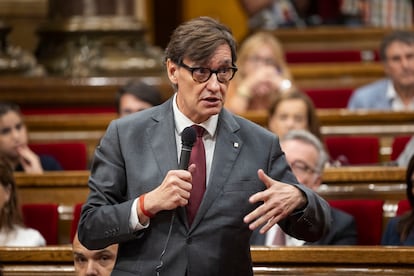
Tras calificar de “exagerado” el diagnóstico, Illa ha afirmado que es mejor dejar la dignidad “de un lado” y que la historia “ya le juzgará”. “ERC y Comuns han dado un sentido de país que me gustaría que ustedes tuvieran”, le ha recriminado el president, que ha invitado a Junts a ser constructivo y a sumarse a varias iniciativas como el pacto de país en educación, al pacto por la lengua, que hagan aportaciones al modelo de financiación. Illa ha aprovechado su debate con Junts para presentar una proposición del Parlament que elevará al Congreso para modificar los artículos 563, 564 y 565 del Código Penal para agravar las penas por tenencia de armas prohibidas, la tenencia de armas de fuego sin permiso o licencia y por la exhición de armas.
Posteriormente ha sido el turno de Esquerra. El presidente del grupo, Josep María Jové, ha cargado contra el Ejecutivo por su falta de “ambición nacional” y le ha instado a cumplir todos los compromisos pendientes del pacto de investidura. Para los republicanos, hay problemas en el “liderazgo” y la “gestión” en el Govern reflejados en educación o Rodalies. “Cumpla, president. Y en aquello que no depende de usted, haga cumplir al Gobierno del PSOE. Plántese si hace falta. Nunca como ahora, el PSC había tenido tanta capacidad de influencia sobre el PSOE, y lo debe hacer valer”, le ha pedido.
Jové también ha instado a Illa a que “lidere un país”, no que busque que “Cataluña lidere España”. “Aun existe un conflicto de soberanía y sin resolverlo no podremos encarar los retos que tenemos”, ha insistido, refiriéndose así a que aún no se ha abierto una de las carpetas del pacto de investidura: la la convención para resolver el conflicto político. En la réplica, Illa le ha reiterado que cumplirá los acuerdos.“Estamos aproximadamente a la mitad de mandato y tenemos casi la mitad de los acuerdos ya cumplidos y trabajando en el resto de ellos”, ha dicho el president a Jové. El jefe de filas de ERC le había afeado en su intervención que valorara la amnistía como “punto final del conflicto político”. “La amnistía, punto de partida, no punto de llegada para, en el mundo del ámbito de la política, dirimir las cuestiones políticas”, le ha rebatido el jefe del Govern.
Comuns ha marcado distancias con Illa, al que ha acusado de sostener una presidencia “basada en anuncios y en dejar el trabajo a medias”. La líder de la formación, Jéssica Albiach, ha puesto en duda de nuevo las propuestas del Ejecutivo en materia de vivienda, y lamentado que la compra compartida anunciada por Illa el martes “no regula el mercado”, sino que facilita la compra “a precio de mercado”. Albiach también ha criticado el retraso en la puesta en marcha de la unidad antidesahucios y del cuerpo de inspectores, así como el bajo número de sanciones. “Ser rentista no es una profesión”, ha resumido. Illa le ha reconocido que el despliegue de la política sancionadora -“ha costado ponerlo en marcha”, admitido el socialista- y ha asegurado que hay 630 diligencias abiertas y sanciones “contundentes” en algunos casos.
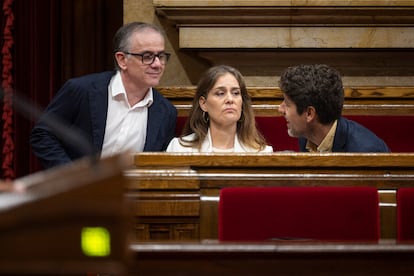
La dirigente de los Comuns también ha reclamado avances en la renta garantizada y ha reprochado al Govern su política ambiental: “Habla en verde, pero actúa en gris; le gusta el asfalto”, ha afirmado, tras cuestionar de nuevo la intención de ampliar el aeropuerto de El Prat. En materia de seguridad, Albiach ha reclamado además el cese del jefe de información de Mossos, Carles Hernández, por defender la infiltración de policías en asambleas.
El popular Alejandro Fernández ha comparado a Illa con el Papa por su tendencia a separar “el demonio y el bien”, y ha acusado al president de querer “salvar el mundo” sin ser capaz de “organizar unas oposiciones de maestros o de controlar los jabalíes de Collserola”. “Usted se encuentra más cómodo haciendo de pontífice que de presidente de la Generalitat porque así puede sermonear sin hacerse responsable de la realidad”, le ha espetado.Fernández ha contrapuesto a la gestión del Govern una alternativa centrada en recuperar las “tres emes” de los servicios públicos —“maestros, médicos y Mossos”—, una expresión que utilizó el expresident Pasqual Maragall y ha lamentado que estos colectivos estén “desprotegidos” bajo el mandato de los socialistas. Su propuesta la ha resumido en una receta con seis ingredientes: una rebaja fiscal, mayor protección de los propietarios de vivienda; tolerancia cero frente a la multirreincidencia; autoridad del profesor en educación, una inmigración “legal y ordenada” y el apoyo a infraestructuras como el aeropuerto, el puerto y las carreteras.










Barcelona
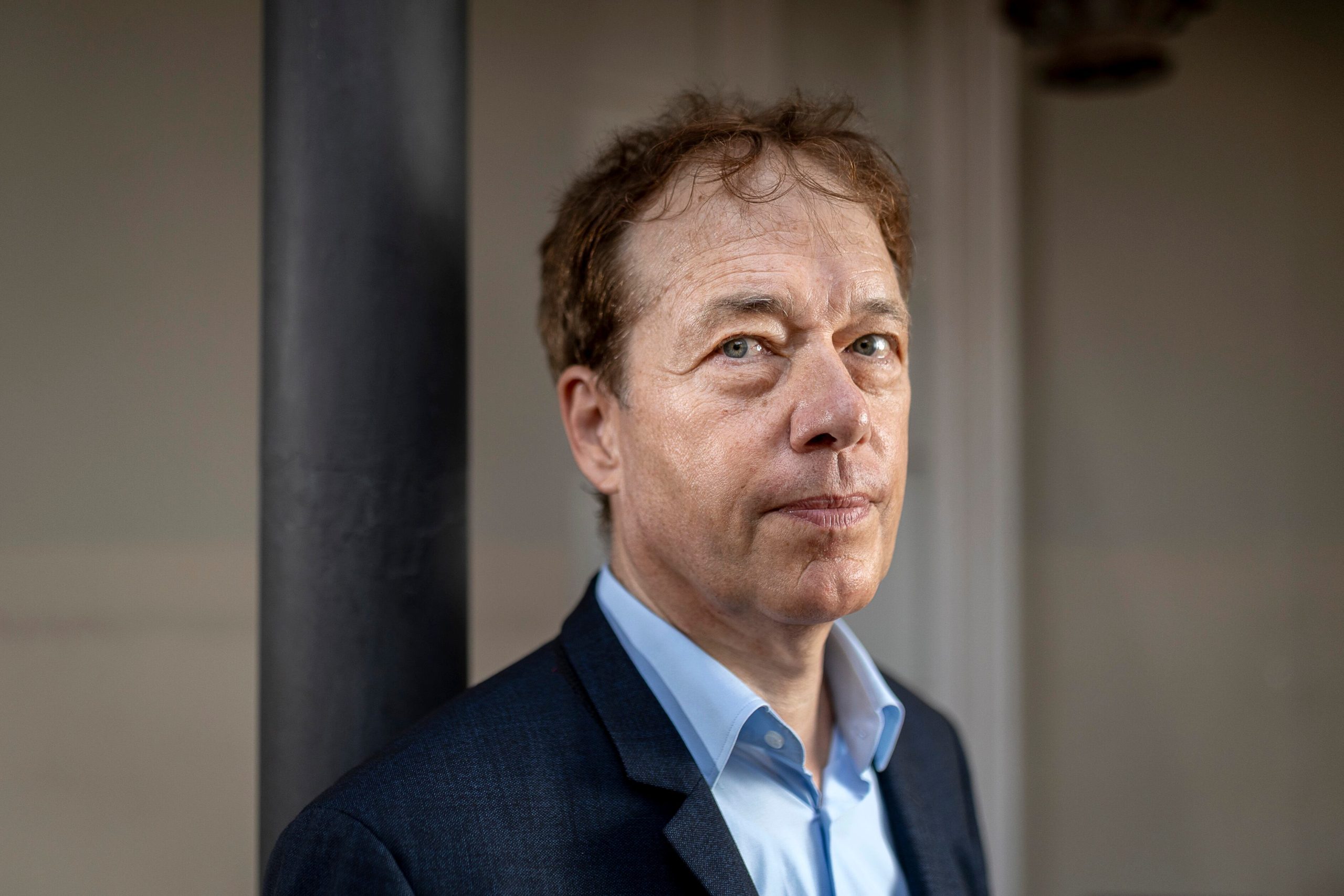
Brett Christophers, Economic Geographer: ‘In Contemporary Capitalism, The Right To Housing Does Not Exist’


A merchant named Robert Keyne showed up crestfallen before the General Court of Massachusetts in Puritan Boston in 1639. His offense: trying to sell at the highest possible price and buy at the lowest possible price, putting his profits above the interests of the community. The judges showed no mercy: they fined him £200 for a practice they described as “extremely wicked and corrupt” and for having embraced “false principles.” Yet those are the same principles that now seem completely natural to us and structure our entire lives.
This is one of the episodes with which historian Sven Beckert, 61, opens his monumental work Capitalism: A Global History, published in English in 2025 and now translated into Spanish. Through a multitude of historical figures, events and data gathered on his travels to Barbados, China and Europe, Beckert traces a long and intricate 1,400-page history —not to worry, 400 of those pages are notes— to demonstrate his thesis: that capitalism is not innate to human beings nor part of our character, but a form of economic organization that arose in particular places and then spread until it conquered everything, even our desires.
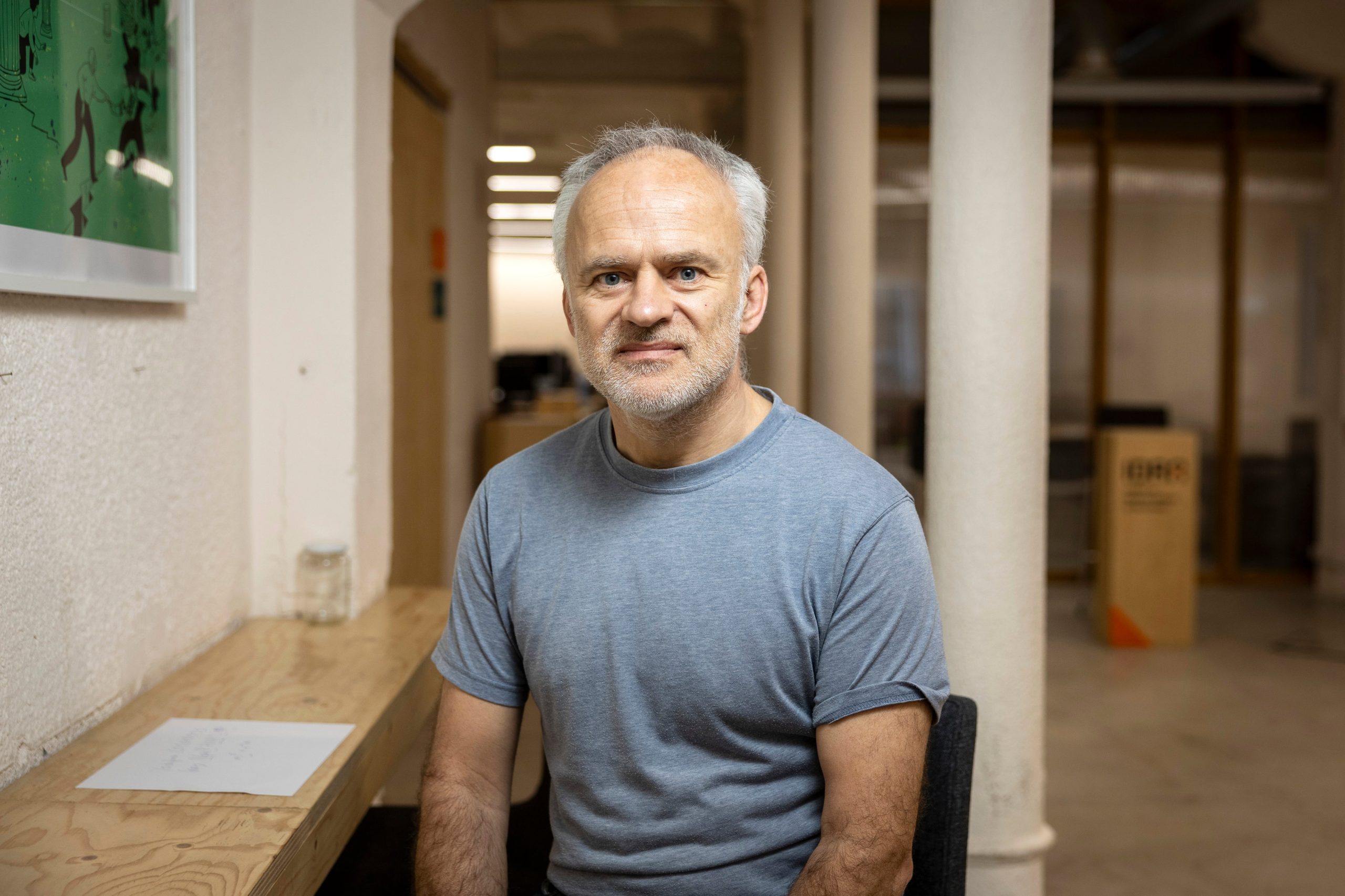
Beckert, who is the Laird Bell Professor of History at Harvard University and has a PhD from Columbia, has received numerous awards for his studies of capitalism, and he wrote this volume after investigating its darker aspects in The Empire of Cotton and Slavery’s Capitalism. He speaks quickly to convey everything that he knows while making an effort to be didactic: “It’s hard to explain what capitalism is; it’s like explaining the sea to a fish or air to a human,” he said in a Barcelona bar earlier this month before heading to Madrid to participate in two talks. We do not see capitalism, but it exists and connects unlikely places. And it has been that way since its beginnings: just as the phone that recorded the interview was designed in California and probably assembled in a clandestine workshop in China, so in the 17th century the Ceylon diamonds and Venetian glass enjoyed by Potosí’s elites were paid for with silver that came from the Cerro Rico mountain in modern-day Bolivia, where one in four miners died: they called it the “mountain that eats men.”
Question: Your book reaches back a thousand years. Did capitalism begin then?
Answer: No, the societies we recognize as capitalist emerged perhaps about 500 years ago. But the capitalist logic —this weird, bizarre novel way of thinking about economic matters and organizing economic life — you can find traces of this logic a thousand years ago. Small communities of merchants in the Islamic world, in China, in India, in Europe and in Africa organized their lives differently from the rest of the planet, where most people were either subsistence peasants, or there were tributary regimes like European feudalism, where some feudal orders, some religious authority forced people to part with some of the surplus of what they produced. The capitalist logic of these merchants’ lives was then very marginal, but today it structures our entire existence.
Q. Wasn’t there a capitalist logic earlier, among Phoenician traders, Greek colonists or Roman imperialism?
A. You can find precursors earlier, yes, but I start around the year 1000 because that is when it intensifies as merchant communities emerge. Almost all economic life on the planet was organized differently. Capitalism was a true revolution. And because it was such a drastic departure, it encountered tremendous resistance: feudal lords didn’t want to share the ability to exploit the peasants with some upstart merchant. and peasants also sought to protect their subsistence and family economies. Because of those resistances, capitalism unfolded very slowly.
Q. You see the sugar plantations of 16th-century Barbados as one of the first clearly capitalist societies. What were they like?
A. For the first time these merchants could organize all of economic life along this logic because they violently dominated everything: They took the land, they imported the labor from Africa as enslaved workers. And that enabled them to build a society in which all inputs, all outputs were commodified, in which production was entirely for the market. We must understand that capitalism is not natural; in fact it is very strange, and once we see it as strange, we need to explain it.
Q. Adam Smith spoke of the invisible hand, Karl Marx of the means of production and Max Weber of religious ethics. How do you define it?
A. These three authors and many others said very important things about capitalism, and the book definitely draws upon their insights. I see them all as as very insightful observers of the capitalism of the time in which they wrote. But today we’re looking at capitalism that is very different from the capitalism of the 1780s or 1850s or 1900s, because for example, today the most dynamic parts of the capitalist economy are not to be found in Europe or North America but in various parts of Asia, so we cannot write a Eurocentric history of capitalism today. I try to understand capitalism from a global perspective because, from the outset, it is global. For me, the core of capitalism is the accumulation of capital: privately owned capital is invested productively to produce more capital, which leads you to turn inputs and products into commodities. There are many differences between a 16th-century Barbados plantation, 19th-century Catalonia’s textile industry, 1950s Detroit or 2026 Shenzhen. But they all share this fundamental logic.
Q. If it is a spontaneous logic that appears in different places, can we say it has an ideology, as we assume communism or anarchism do?
A. Fundamentally it is an economic logic. I do think there is also an ideology in capitalism, but the specifics of this ideology change a great deal over time. One could say liberalism is closely linked to capitalism, but liberalism is recent —from the 17th and 18th centuries— and capitalism existed before it.
Q. In the ideological battle, the equation “capitalism equals democracy” was as useful to some as “capitalism equals conservatism” is to others.
A. To begin with, I think capitalism is not conservative; I actually think it’s the most impactful revolution that hit the world in the past thousand years and is in a permanent state of revolution. On the other hand, what we see historically is that capitalism is undogmatic: it can exist under a wide variety of political regimes—monarchical rule, imperial rule, liberal democratic regimes, fascist regimes—and today we see some of the most dynamic capitalist societies are in deeply authoritarian regimes. There was a time when capitalism without slavery was unimaginable. This adaptability and diversity show that the world we live in today will not be permanent; it is just one moment in this long history of capitalism. We are in a complicated moment, and we need to think of it in a long historical framework. You can think more creatively about the present by understanding the the changes that happened.
Q. Why do you say capitalism is alien to human affairs?
A. Because the goal is not subsistence or human relationships but accumulation in order to produce more capital. This is a fundamentally new way of thinking that creates new organizational forms. The rich become rich, but in a different way, and ordinary people produce for their subsistence, but differently: through wages.
Q. Walter Benjamin wrote in Capitalism as Religion that it is a cult without a dogma. Do you agree?
A. It’s a very good insight. All human societies tend to naturalize their forms of organization: feudal lords thought this order was God given. We do the same; we see capital as a kind of god that governs us. A god that tells us what to do in the present—in politics they say “the economy” needs this or that—but we forget that it is something produced by humans. The people matter in history, it’s not just like abstract processes that somehow come down upon us.
Q. A former managing director of the International Monetary Fund, Rodrigo Rato, explained the 2008 crisis with: “It’s the market, my friend.”
A. The market seems natural, but all markets are institutions that are politically, socially, even culturally constituted. For example, fruit, fish and meat markets in Europe 500 years ago, where some sold what they had and others bought what they needed and there was competition, seem like the ideal market Adam Smith described. But even then only those authorized by the Church could sell, and the Church also decided when and where. It was politically constituted. The same happens with the large markets that control the entire economy. So thinking of the market as [Rato] does is not very interesting to me. Corruption shows that the market is actually very political.

Q. At what point in the history of capitalism are we today?
A. Change in capitalism is continuous: every year we produce more, there is more accumulation, and that continues today. But capitalism is also an institutional order, and these institutional orders can be relatively stable for a relatively long time. Postwar Keynesianism was stable until the 1970s, when neoliberalism rose. Today I believe neoliberalism is coming to an end because of economic problems: because of absurd levels of social inequality, the effects of the 2008 crisis and political reasons. Not only due to pressure from the left, but especially because of attacks from the populist right that is emerging everywhere.
Q. Will people like Trump finish off neoliberalism?
A. Imagine someone 10 years ago talking about tariffs! That was odd —like being Catholic and not believing in the Virgin Mary— it was impossible to imagine capitalism without free trade. Today, the president of the United States and other political powers think that more protectionism is better. Nationalizing commodity chains is now common, though totally at odds with neoliberalism. And the neoliberal order emphasized the aspects of freedom and democracy in capitalism, which are now under attack by authoritarian regimes.
Q. Is the future of capitalism authoritarian?
A. We are closing borders and becoming more protectionist, and we know how this ends because it ended in warfare the last time it happened. That seems like the future, but I also believe that at the moment neoliberal capitalism is coming to an end there is an opportunity to think about new futures. We cannot return to the past, to 2005 —which seems to be what U.S. Democrats are limited to trying to do— but we can envision a new institutional order.
Q. In The Dispossessed, Ursula K. Le Guin used science fiction to imagine a society freed from capitalism. Will that remain only a utopia?
A. I can’t predict the future, but I do think we are entering a new institutional order within capitalism. It is very creative and has weathered all its crises, including the most brutal one, in 1929. Capitalism has been predicted to be dead many times in its history, but history shows it is highly adaptive. On the other hand, it is a historical process that was born and, as a process, it must end one day—assuming we survive to see it.
Q. Could it destroy us?
A. Perpetual growth and accumulation are not side effects of capitalism but its essence. Nature is not a state of perpetual growth; it is a state of limits. Here there is a collision, and it is very worrying.
Q. Your earlier books, The Empire of Cotton and Slavery’s Capitalism, show how this economic model has been responsible for the greatest increases in production and, at the same time, for the greatest atrocities. How can that be?
A. Capitalism has produced the largest increase in human productivity and the greatest growth; everything around us relates to it, but it is also violent dispossession, colonialism, slavery… All this happened because at certain moments growth found that path. For example, capitalism had difficulty implementing itself in European countryside because of resistance from peasants and lords. But when it reached the Americas it encountered societies that could not resist, that were conquered or died of disease. Enslaved labor was imported from Africa and so there you could re-imagine the society along this new kind of logic without any constraints on it. The market was imposed by force.
Q. Today there is talk of techno-fascist capitalism. It is also conquering new territories, like data, something unthinkable 15 years ago. What frontiers remain to be conquered?
A. Capitalism is in constant revolution and expansion: geographically but also into new spheres of life. Our grandmothers probably cooked all their meals at home; today much of our food is commercialized. Data is a new frontier: almost everything is commodified. Twenty years ago no one would have imagined that cat videos you like to watch would have commercial value. Surprise: you can make money from that. It’s unpredictable what will be commercialized next. Capitalism commodifies experiences, desires, culture; your private car can be an Uber, your home an Airbnb. You can see it here in Barcelona and in many cities worldwide: tourism is a form of capitalist expansion.
Q. What would the Puritan judges of Massachusetts think today about Elon Musk’s fortune?
A. They would see it as a completely unethical way of organizing life. We think it makes sense; that people want ever more money and can get it; that perhaps they are geniuses for achieving it. But those judges would condemn it.
Sign up for our weekly newsletter to get more English-language news coverage from EL PAÍS USA Edition
Barcelona
IN VIDS: Barcelona Hit By Sudden Flash Flood Chaos As Homes Are Breached And Firefighters Rescue Woman And Baby


 BARCELONA has been plunged into chaos by sudden flash floods that swept away a vehicle containing a woman and a baby and forced the closure of major transport networks. The

Spain Banned Circus Lions And Tigers, But Other Animals Are Still Performing

Spain’s Traffic-Light Revolution Hits A Roadblock

Tennessee Governor Halts Executions After Christa Pike Survives Two Lethal Injections

Detenido Un Hombre Por La Muerte De Una Mujer De 47 Años En El Distrito De Arganzuela De Madrid

F1 Qualifying Today: Azerbaijan Grand Prix schedule, times and TV channel

British Actress Naomi Watts Attacks Ageism In Hollywood As She Picks Up Prestigious Donostia Award At San Sebastian Film Festival


-
 Arganzuela2 weeks ago
Detenido Un Hombre Por La Muerte De Una Mujer De 47 Años En El Distrito De Arganzuela De Madrid
-
 Uncategorized7 days ago
F1 Qualifying Today: Azerbaijan Grand Prix schedule, times and TV channel
-
 basque country2 weeks ago
British Actress Naomi Watts Attacks Ageism In Hollywood As She Picks Up Prestigious Donostia Award At San Sebastian Film Festival
-

 Uncategorized2 weeks ago
Heartbreaking Instagram post reveals death of F1 star
-
 Claudia Sheinbaum2 weeks ago
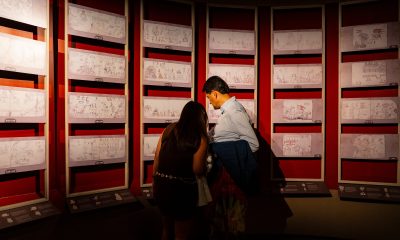
The Azcatitlan Codex Returns To Mexico From Europe After Nearly Two Centuries
-

 %2 weeks ago
Mallorca Property Overrun By Wild Goats
-
Best airlines2 weeks ago
Spanish airline Vueling named Europe’s best low-cost carrier for 2026
-

 Austin1 week ago
Venezuelan Migrant Shot By ICE In Austin Cites Lack Of Medical Care: ‘How Are They Going To Leave The Bullet In There?’