
ElPais
The Uncertainty Of Families Of The 280,000 People Missing In The War Between Russia And Ukraine: ‘They Must Live With Silence’

At least 280,000 people are missing due to the war between Russia and Ukraine, according to the vast list maintained by the International Committee of the Red Cross (ICRC). It includes Ukrainians and Russians, without distinction, and the true figure is likely higher because the list contains only requests registered with the organization. The vast majority are soldiers. Although many have probably died, some parents and wives still set a meal at an empty chair and leave their rooms unchanged in case the person suddenly returns home. They carry a pain psychologists call ambiguous loss.
“There was no news of him for a long time. Later the men in his regiment said an explosion tore him to pieces. My friend wouldn’t accept it, a mother’s heart couldn’t accept it; he was her son, anything could have happened with so much smoke,” a woman in her seventies told this newspaper after asking for more support for relatives of those missing in the conflict at a campaign event for the opposition Yabloko party.
“He had married recently. He was a troubled boy, but an angel came into the family. My friend eventually accepted that her son had been blown to pieces, and that angel, his young wife, had to go from place to place to sort out his paperwork,” the woman lamented, asking to speak anonymously for fear of the authorities.
The Ukrainian Commissioner for Persons Missing under Special Circumstances estimated in spring that 90,000 of the country’s citizens were unaccounted for, including military personnel and civilians. The Russian government does not publish figures for its nationals.
Relatives come daily to the ICRC offices in Moscow searching for their loved ones. Sadness covers their faces. “Unfortunately, the number of missing increases month by month,” Wilhelm Odde, head in Russia of the ICRC’s Protection and Restoring Family Links unit, said in his office during a meeting in September. “And all the relatives are left with is the absence of their loved one.”
This is the phenomenon of ambiguous loss, coined by researcher Pauline Boss in the 1970s. “They must live with silence, with no element of reality to hold on to in order to accept or reject their [loved one’s] death. They harbor hope that the person is alive, but at the same time they can see that they are not, because they are not here. Being alive also implies being present, having a voice, but they must live with silence. This creates very difficult situations for families,” Odde said.
An ICRC staffer had just received a set of parents. The missing serviceman was “very young.” Their case is one of the most common: “They have been looking for their son since 2023. His death has not been confirmed and they refuse to give up. They think that if they have not received the body, he is not dead; he could be in hiding. They came from a very remote region of Russia. After so long they no longer cry, they only nod with that sad look,” she said.
Some households are plunged into solitude. “I spoke with a grandfather who has been searching for his grandson for two years,” another worker recounted. “He is about 90 and lives alone. He told me he wakes up and his grandson’s things are still hanging there. His clothes, his cologne, everything is intact”
“One day he found his poems; no one in the family knew he wrote poetry. He read them to me; I couldn’t help but cry. He told me he looks out the window and sees people returning from work; he imagines his grandson returning too,” she recalled.
Others refuse to accept the loss even after forensic analysis. Recently, “a woman came. She had official information about her son’s death, she even buried the remains, but she is certain they are not his,” another ICRC employee said.
“I don’t feel like he’s dead; I feel like he’s alive” is another phrase that some parents repeat to deny reality. For example, one woman said that a friend of hers had dreamed that her son was at sea, and another resorted to telepathic experiences — one of the tricks used by scammers.
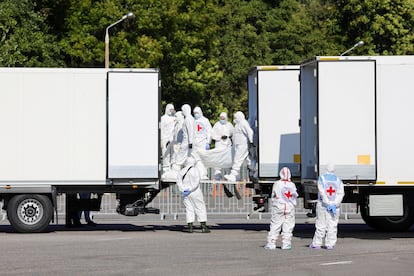
“The calls are constant, the phone never stops ringing,” said Lucile Marbeau, head of communications for the International Red Cross delegation in Moscow. “Our work is guided by the principle of not creating false hopes for families. We never promise to find the person. That complicates our work, but the guiding idea is always the families, not causing them more pain than they are already in.”
Nevertheless, any small detail can reactivate that hope. “That hope is stronger than any protocol we may have,” another ICRC worker told this newspaper.
Family disagreements make the disappearance even more painful. “We have many cases of elderly mothers who do not accept that the son has died, but the wives do, and that causes many family disputes. The mother considers the wife a traitor, thinks she was only after money, but the woman simply accepted the death. There is nothing wrong with that; she moved on, but the mother cannot, because she is his mother,” another worker said.
A wound for future generations
The International Red Cross never informs families of deaths; that is the responsibility of the authorities. The role of the offices in Ukraine and Russia is to collect families’ requests and cross-check them with available information from both sides. “Given that this is an international armed conflict, it goes without saying that communication between the two parties is not easy. This is where the ICRC’s role as a neutral intermediary is crucial,” Odde said.
The organization has been able to inform only 18,400 families that their loved ones, both civilian and military, are alive since the invasion of Ukraine began in 2022. Messages from prisoners of war are a key “proof of life.” The ICRC has been involved in exchanging about 38,400 personal messages.
At the same time, the Russian Red Cross, an organization completely independent from the ICRC, provides psychological support to families through a large support center.
“Is the person alive or dead? That is what the ICRC calls the right to know,” Odde stressed. “This right to know the whereabouts of a missing relative is enshrined in international humanitarian law.” Both Ukraine and Russia are signatories to the Geneva Conventions and are obliged to inform families of their missing relatives.
“If the person has died,” Odde continued, “their relatives need official confirmation for many reasons, from receiving financial compensation to being able to begin grieving.”
Russian families can receive up to 14 million rubles, more than $155,000, in compensation in some cases. This includes a federal payment of five million rubles plus other regional bonuses, military insurance, and other social benefits.
Verification of bodies is carried out by the side of the deceased, although it is not always possible to recover remains. “There are relatives who have been searching for their loved ones with no answer for four years. They never give up; I do not know any family that has completely surrendered,” the head of the ICRC office in Moscow said.
The tragedy can remain present for decades. “It is something that accompanies the family, something that endures generation after generation, reminding them that the grandfather left one day. And that leaves a mark,” Odde said.
Sign up for our weekly newsletter to get more English-language news coverage from EL PAÍS USA Edition








Christa Pike, 50, has been hospitalized for almost a week after receiving two injections that allegedly contained lethal pentobarbital. On Tuesday, her lawyers said she had regained consciousness and speech, though her prognosis remains uncertain. The state of Tennessee had attempted to execute her for the 1995 murder of a fellow student, but Pike survived and was taken to hospital. If she stabilizes and is discharged, the state could send her back to death row and try to execute her again.
There is still no official account of what happened last Wednesday afternoon when the execution was briefly halted before the Supreme Court authorized it hours later, but experts say the pentobarbital may have leaked into the tissues around the vein, causing injuries that authorities have not yet confirmed. Because of what occurred during the failed execution, and the medical care required to save her life, Pike’s case raises ethical dilemmas about the obligations of the doctors and caregivers treating her and about the state’s responsibility for her condition.
Dr. Arthur Caplan, a bioethics expert and emeritus professor of medicine at New York University, says there is “no place for doctors, nurses, or any health worker in executions.” “That violates their oath not to cause harm. An execution is not intended to benefit the person,” he adds.
Caplan argues that even when a doctor’s presence at an execution is presented as a way to reduce suffering, there is a boundary between punishment and medicine. “Doctors have no role in executions. Even when someone says, ‘Well, if better-prepared doctors had been present, this execution wouldn’t have gone wrong’ — you don’t need doctors, you need better-trained executioners,” he says.
“Some argue that in parts of the world doctors help terminally ill people end their lives. But remember that is meant to relieve the suffering of someone who is dying. The patient is the focus. An execution is something the judicial system seeks to carry out,” Caplan explains.
Pike was sentenced to death 30 years ago for the murder of Colleen Slemmer, a 19-year-old fellow student, when Pike was 18. On September 30, after last-minute appeals that delayed the execution for several hours, she was given two injections of pentobarbital and, because she remained alive, was taken to a Nashville hospital. Over the weekend, her lawyers said she was unconscious and on a ventilator.

Caplan says the question of who legally represents a person who cannot communicate is fundamental. If there is no designated decision-maker to represent and defend her interests, a court must appoint someone. “I don’t think it should be the state of Tennessee, the prison warden, or any official involved in the execution attempt” who decides what care she should receive, he argues.
“Another question is who is in charge of her care. Doctors, absent other instructions, will try to improve her condition. But she may have a mother or other relative who wants to intervene and say, ‘I don’t want that. Let her die. She will be left with disabilities and I don’t think she would want to live like that,’” the expert adds.
Stephen Ferrell, one of Pike’s defense lawyers, said Pike signed a power of attorney naming someone else to make her medical decisions, according to The Associated Press.
The dilemma has precedents in cases of inmates with mental illnesses who do not understand they will be executed, Caplan notes. “Doctors have encountered situations where psychiatrists and psychologists treat someone on death row who has severe schizophrenia or many other mental health issues, and some have refused to restore that person’s competence to be executed so they cannot be put to death,” he explains.
Until the extent of Pike’s injuries — both physical and cognitive — after the failed execution is clear, it will not be known whether the defense will raise this kind of argument. It is also not yet known what steps the state of Tennessee will take in Pike’s case.

“Lending the prestige of medicine to execution”
The American Medical Association has declared it ethically incompatible for a physician to participate in a legally authorized execution because the profession is “dedicated to preserving life when there is hope of doing so.”
Caplan says the presence of healthcare personnel amounts to “lending the prestige of medicine to the execution,” giving the impression that “it is more humane because it is supervised by doctors.”
However, the presence of doctors does not by itself guarantee humane treatment. “We know that throughout history there have been doctors who participated in torture. The presence of doctors does not make things better,” he says.
Dr. Joel Zivot, an anesthesiologist and critical care physician who advised Pike’s lawyers, wrote in an essay in The New York Times over the weekend that authorities have “tried to make executions appear like medicine,” with stretchers, intravenous lines and cardiac monitors, but that it is a “sinister impersonation of the medical profession” without consent or therapeutic purpose.
The Tennessee Department of Correction has said that all protocol steps were followed.
“We have laws, judges and courts so society does not descend to the level of brutality of its criminals,” Caplan adds. “We try to set punishments that have a rationale and objectives, such as rehabilitation, deterrence — preventing others from doing what she did — or, in some cases, retribution, that you will pay for what you have done. But we also try to remain, so to speak, civilized and mindful of the ethical need for punishment not to reproduce the same cruelty as that of the criminals.” Pike’s case shows that this is not always achieved.
Sign up for our weekly newsletter to get more English-language news coverage from EL PAÍS USA Edition
Arnold Schwarzenegger
The Electoral Cost Of Trump’s Remarks That Iran Could ‘take Out’ LA Or San Diego

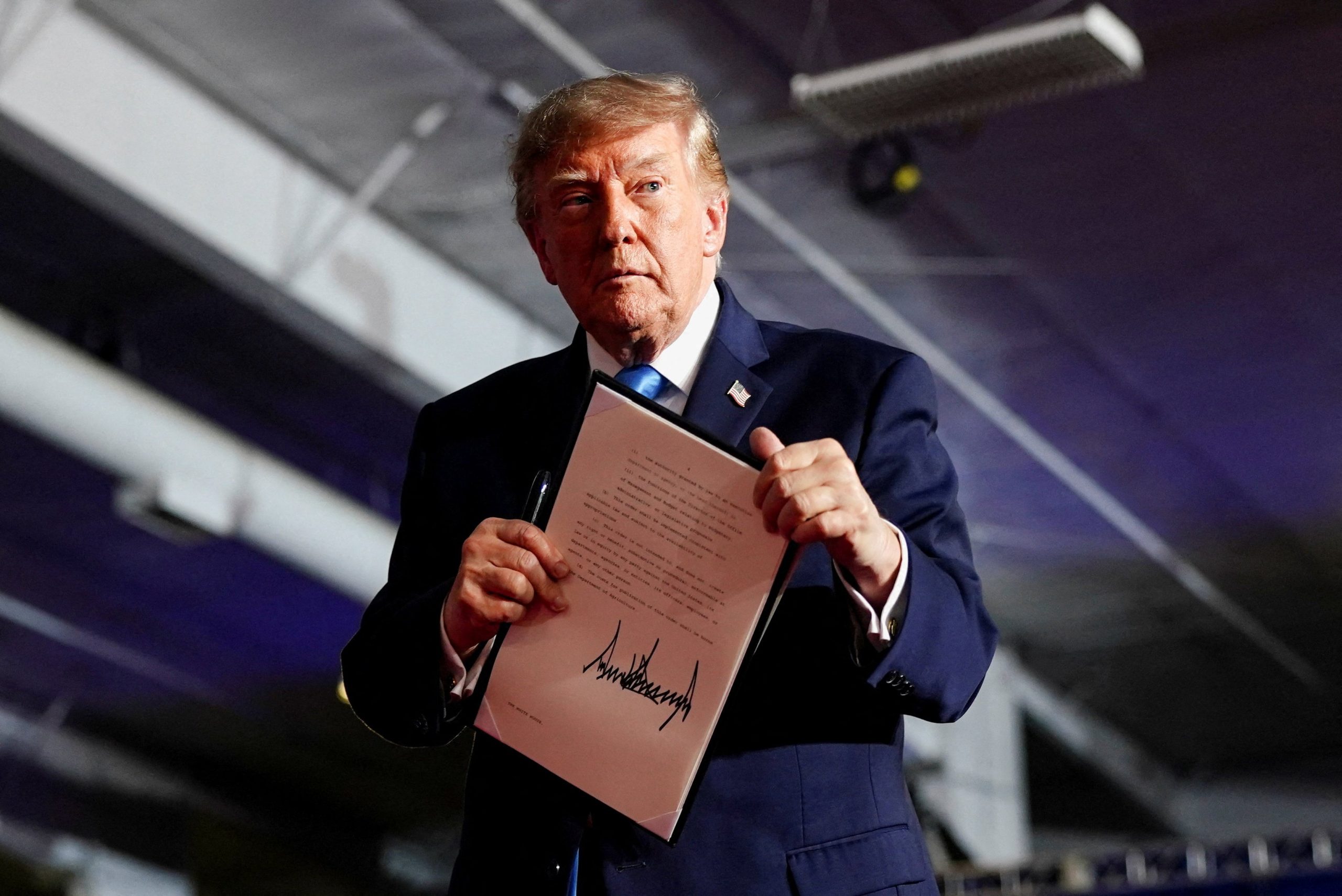
President Donald Trump said it without weighing the possible electoral consequences for Republican candidates in California, less than a month before the midterm elections. Far from generating laughter or support for his war with Iran, his comments have raised concern and could affect the vote in a state governed by Democrats since 2011. During a rally in Nebraska on Monday, the president said Iran could “take out” Los Angeles or San Diego, two of the largest cities in the United States, calling it a “small price” to pay to eliminate what he says is the threat posed by the Iranian regime.
As part of his campaign tour across the country to support Republican candidates —generally in places where a Republican victory is more likely, since in tighter races Trump could be more a liability than a boost— the president moved awkwardly from urging turnout in the midterms on November 3 to talking about war with Iran and the “small price” it represents “to keep the world safe.”
Polls show it will be difficult for Republicans to hold narrow control of both chambers of Congress, and Trump’s Nebraska speech seems unlikely to help them. “They could take out a city. Let them take — Let them take out Los Angeles. Let them take out San Diego. That’s — this is a very small price to pay, and it’s going to be over with very soon. It’s essentially almost over with,” Trump said of a war that has stretched for more than seven months without any clear signs of ending.
There is a fairly recent precedent for the threat Iran could pose to California. In March, Californians were alarmed after a report from the Federal Bureau of Investigation warned that the Iranian regime might be planning drone attacks against the state in retaliation for U.S. military actions on its territory. Both the federal government and Governor Gavin Newsom then said there was no imminent threat to California.
Trump’s recent remarks also appeared framed by rising oil prices and, consequently, higher gasoline and other fuel costs in the United States, driven by the conflict in a region crucial to crude transport. That “small price” Californians are paying, in particular, is actually very high: this week a gallon of gasoline sold for $6.37 —and in some places even $9— about 46% above the national average, according to AAA. The difficult economic situation, with the cost of living, health insurance and housing at the forefront, is voters’ top concern, according to various polls.
Ballots began arriving this week in the mailboxes of thousands of Californians.
“It complicates their campaigns”
Miguel Tinker Salas, professor emeritus of History and Chicano Studies at Pomona College east of Los Angeles, says Trump’s comments could have consequences for Republican candidates in California before the polls close. “It complicates their campaigns; it makes the political landscape harder for them,” the professor says.
In California, Republican hopefuls are running for governor, the state attorney general’s office and other key positions, as well as seats in the House of Representatives. For many of them it is an uphill race in a Democratic stronghold, and even more so after the recent redistricting pushed by Governor Gavin Newsom to favor his party’s contenders, part of a nationwide battle. In that context, Tinker Salas believes Trump’s Nebraska remarks will end up hurting his own candidates.
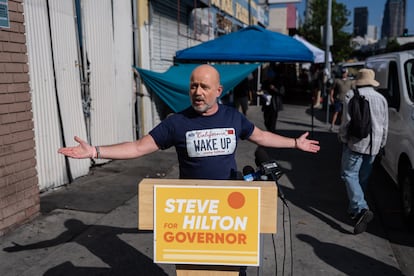
One of those most affected may be Steve Hilton, a British-born former political strategist for David Cameron’s Conservative Party before Brexit who became a conservative commentator on Fox News, and is now the Republican candidate for governor. So far, Hilton has not commented on the controversy. Since Arnold Schwarzenegger left office after two consecutive terms from 2003 to 2011, no other Republican has won that post.
“California hasn’t elected a Republican in many years. There was an opening with Hilton, in a way, because he was not only the opposition candidate but the anti-establishment opponent who had committed many failures. But as the campaign has unfolded he has lost support, and his closeness to Trump increases that loss,” Tinker Salas said.
Trump is very present in the race. He has officially endorsed Hilton, and a network of donors aligned with the president, from various parts of the country, continues to funnel resources into his campaign. The president’s strategy is not limited to the governorship: at the Republican convention ahead of the midterms he even said people should vote as if his name were on the ballot and promised a $5,000 payment to all American adults if his party retains control of the House of Representatives.
Hilton’s disadvantage
Hilton has fallen behind in the polls. One of the most recent surveys, conducted by the Institute of Governmental Studies at the University of California, Berkeley, shows the Democratic candidate, Xavier Becerra, has increased his lead: 58% of respondents said they would vote for him, compared with 33% who favored the Republican. The gap widened by seven percentage points from the previous measurement.
In that same poll, about 44% said their main concern was “reducing the cost of living,” while 37% identified “fighting the policies of the Trump administration” as their priority. Not even polls commissioned by Hilton’s campaign work in his favor. The latest, published this week, puts Becerra six points ahead: 45.7% to Hilton’s 40.1%.
Becerra has joined Democratic leaders —including Los Angeles Mayor Karen Bass and San Diego Mayor Todd Gloria— in criticizing Trump’s remarks. “Thirteen million Californians call LA and San Diego counties home. Their lives are not a ‘small price to pay’ or a punchline for Donald Trump,” he wrote Monday night on his X account. Responses to the post were divided.
Thirteen million Californians call LA and San Diego counties home. Their lives are not a “small price to pay” or a punchline for Donald Trump. https://t.co/TG23f6b5XF
— Xavier Becerra (@XavierBecerra) October 6, 2026
Some users commented under the post that California Republicans who once voted for Trump may now be “disappointed.” Others downplayed the president’s words, calling them a “joke,” and argued that a doctored video of the Nebraska rally was being spread. The latter reflects voters’ sometimes selective distrust of what they see on social media.
The president’s remarks also drew no laughter from Governor Gavin Newsom, one of the Democrats who most often confronts him and who is about to leave office after two consecutive terms, and is being discussed as a possible presidential candidate in 2028. Newsom called the president “deranged and dangerous” and said he had even ordered the State Threat Assessment Center to actively monitor the situation “in case foreign actors interpret the president’s remarks as an invitation to attack California.”
Professor Tinker Salas was also troubled by the crowd’s reaction during Trump’s rally. After the president said Iran “could take out a city,” some attendees responded with a “yesss.” Others applauded when he added that the targets could be Los Angeles or San Diego.
“It reflects a cynical attitude, it reflects information manipulation. But what is most worrying is how the message was received by the people behind Trump,” the professor says. “You can expect any foolishness from Trump, but people applauded. We are in a critical situation regarding the social fabric of this country.”
Reported by Patricia Vélez Santiago.
Sign up for our weekly newsletter to get more English-language news coverage from EL PAÍS USA Edition



16 fotos
Youths across the country have been called out for a day of demonstrations to protest the decline of the education system, the lack of opportunities, and teachers’ pay


Muere Maricarmen, La Mujer Que Encendió La Lucha Contra Los Desahucios En España

Spain Payslip Change Coming In January 2027

Doctors Strike In Spain Postponed Due To Snap Election But Unions Issue Warning


-

 Uncategorized2 weeks ago
F1 Qualifying Today: Azerbaijan Grand Prix schedule, times and TV channel
-

 %2 weeks ago
Is Your Supermarket Kefir Really Kefir? Spanish Study Raises A Surprising Question
-

 Uncategorized1 week ago
F1 Bahrain Grand Prix will be live and FREE on TV this weekend
-
Latest2 weeks ago
‘It’s The Law Of The Jungle’: Pensioner’s Eviction Exposes Spain’s Housing Crisis
-
Barter system2 weeks ago
British drug dealer swaps cocaine for Pokémon cards in bizarre barter deal
-

 Cody Gakpo2 weeks ago
Xavi Y Klopp Se Reparten Puntos En Su Debut Como Seleccionadores
-

 ElPais2 weeks ago
Gael García Bernal: ‘The Common Good Is No Longer A Political Slogan. Democracy And The Use Of Power Are Almost Like A Reality Show’
-

 Acapulco2 weeks ago
Acapulco Shuts Down Amid Fear Of Hurricane Polo: ‘Three Days Not Knowing What’s Going To Happen’