
ElPais
Evan Gershkovich, WSJ Reporter Jailed By Putin: ‘They Didn’t Break Me As A Human Being’

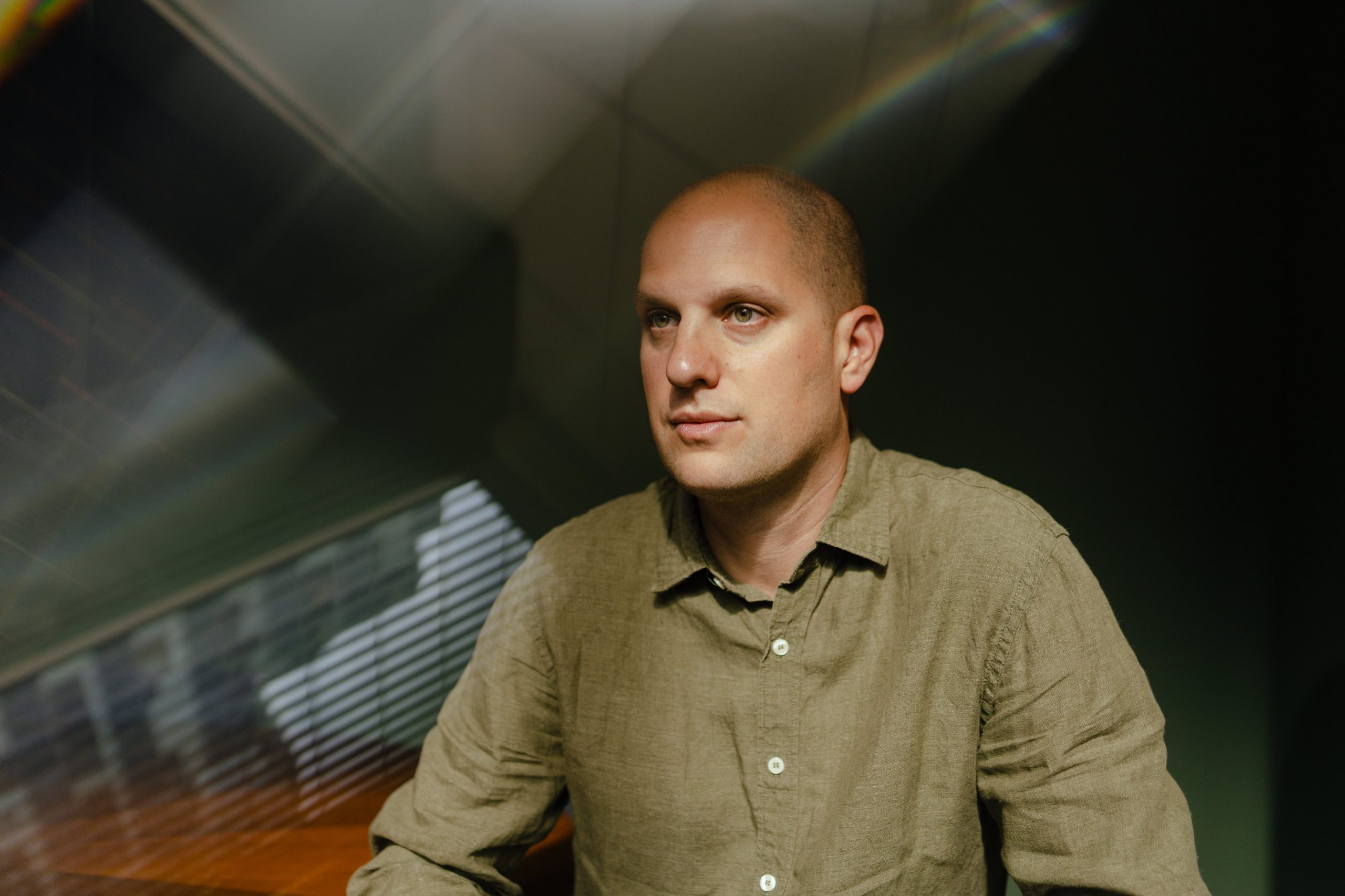
Evan Gershkovich does not conceal the fact that he would rather be on the other side of the table. “Your job as an interviewer is much more fun than mine,” admits the journalist who has had to get used to being the center of the story. His ordeal began on March 29, 2023. The then–Moscow correspondent for The Wall Street Journal was detained that day on charges of espionage. He spent 16 months in prison before being freed in the largest prisoner swap between Russia and the West since the Cold War. The exchange, in which the governments of the United States and Germany were heavily involved, had the makings of a spy movie.
Since then he has had time to recover and to write This Cursed Beautiful Land, the book in which he recounts his ordeal. Gershkovich, the son of Russian immigrants, was raised in New Jersey but traveled to Russia in 2017 in search of his roots and an exciting career in journalism. He made friends there and enjoyed his investigative work until Vladimir Putin’s slide into authoritarianism made reporting increasingly difficult and forced many people in his circle to leave the country. “The party’s over,” is the chapter’s title. The next major twist came with a set-up by a source that led to his arrest in Yekaterinburg, deep in the Urals.
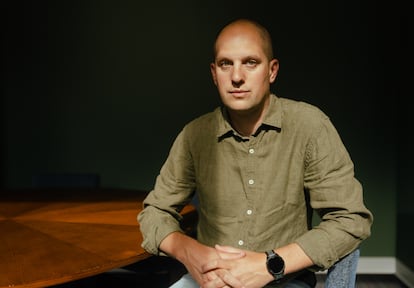
Gershkovich, 34, met EL PAÍS at the New York offices of Penguin Random House, the publisher of the book. Prison did not make him renounce his work. “Life feels heightened when you’re chasing a story. In those moments there’s an excitement that makes everything else seem boring.” It also did not worsen his view of the country that jailed him. He bristles when told that the tone of the book is surprisingly upbeat. “I’m not going to make up that they strung me up with a rope by my feet and look how miserable it was,” he replies, somewhat irritated.
In recent years, Gershkovich says he has found a balance between his two selves: Evan, the kid who grew up in New Jersey, and Vanya—the name he answered to in prison—who was so immersed in the Russian language that when the U.S. ambassador visited him he struggled to find words in English.
Question. It is an obvious question, but in your case unavoidable. How are you?
Answer. Very well. It took me about the same time I was in [prison] to get back to life. The beginning was quite difficult. I saw a psychiatrist who specializes in post-traumatic stress disorder. I had certain symptoms. I had difficulty sleeping. Certain things might trigger me. Short temper, a fuse, that kind of thing. But with time, it’s getting better. Writing the book also helped—it’s therapy in a way too: you’re looking at an event, staring at it straight on, processing it. At first the hardest part is realizing you’ve forgotten what normal felt like. You don’t feel well and it’s really hard to remember what normal is because it’s not like in normal life you always feel good. You’re searching for what normal is and that takes a long time. But I’m doing really well.
Q. In the book you provide many details about what happened to you, but you don’t explain how it affected you. How have those 491 days in prison changed your relationship with Russia and your work as a journalist?
A. Actually, nothing’s really changed. I feel like the same exact person. I think my relationship to journalism hasn’t changed whatsoever, and my relationship to Russia hasn’t changed at all. The last time they’d taken a foreign correspondent hostage on fabricated espionage charges was 40 years before that under the Soviet Union. We didn’t think something like this would happen. But that hasn’t changed my view of the country. The Russian state was already on a certain path.

Q. It’s striking how you describe your time in prison in quite a positive way. You talk about the camaraderie you found there and recount genuinely funny moments, like when you cook and say it reminds you of the film Goodfellas. Have you considered whether you experienced something like Stockholm syndrome?
A. No, definitely not. The thing that I tried to describe is how I was treated compared to others. It’s something that recurs in Russia’s history: they are very careful about who they torture and mangle and murder. Ukrainian journalist Victoria Roshchina was captured in occupied territory, taken to Russia and murdered. She was sent back to her family without any teeth in a body bag. So that’s just the reality of it. I tried to describe the experience as accurately as possible. It is not pleasant to be in a tiny room with another person and not be able to leave. The conditions were good compared with other prisoners, but the Russian prison system is very harsh. I describe the panic attacks I suffered. But you get used to things. Humans are incredibly adaptable.
Q. Aside from the conditions, your account of the experience seems fairly optimistic. At one point you say it helped you deepen your understanding of Russia.
A. What I tried to convey in the book is that they didn’t break me as a human being; they didn’t torture me or make my life miserable. If those things had happened, the book would be different. As for my relationship with Russia, the book describes a big bad Russian state that is torturing and maiming Ukrainians, that started imperialistic wars that it shouldn’t have started. But at the same time, I am Russian. I’m not gonna go write off an entire people and say, look at this horrible group of people. I belong to them as well. It would be ridiculous for me, after being arrested, to say that I hate Russians; that would be self-hating. When you read a Gulag memoir, it can be the most miserable experience in human existence and then at the same time be decent: people bake birthday cakes, write poetry, fall in love and form families in the Gulags. Compared with that, my experience was like a five-star resort.
Q. Why do you think you coped well with the experience?
A. For several reasons. First, I’m from a Russian background, so I speak the language; I knew I could communicate with inmates, guards and FSB investigators [the Russian intelligence agency]. Also, I’m blessed with a sense of humor. That’s really lucky and important because if you take everything really seriously all the time, you’re not going to handle it well. Finally, I had worked as a reporter in Russia for five and a half years before, so I knew the system. When I went to court, I wasn’t shocked that the judge wasn’t listening to rational arguments—something that, for example, wouldn’t happen to a tourist who is set up and framed with drugs. From the start I had no expectation of receiving a fair trial.

Q. You say you were treated better because they knew you would one day be released and write this book.
A. Yes, because I would be writing about it. I assume that’s why they weren’t stringing me up by my feet and electrocuting me. But also because they knew that detaining a foreign correspondent from The Wall Street Journal would provoke a huge worldwide uproar, something they needed to pressure for a prisoner swap.
Q. What degree of responsibility do you see in Russian society, which remains inert in the face of the war in Ukraine?
A. It’s really hard to do polling in Russia. We can try as best we can but it seems to me it’s sort of like 15 percent are really for the war, 15 percent are really against the war, and then 70 percent are just sort of ‘please leave me alone.’ It’s a society that never catches a break: it’s the Tsarist period, it’s the Soviet period, and we have a little blip in the 90s, and now Putin’s here, and he’s been here for 26 years. From the outside, it’s easy to say they are complicit or that they’re not rising up and stopping what’s happening. But they face the risk of ending up in prison. Like a historian I know, sentenced to eight years for writing about war crimes in Bucha. The logical reaction, if you want to preserve something like a normal life, is to keep your head down.
Q. Opposition leader Alexei Navalny was expected to be part of the prisoner swap that freed you, but six months earlier he was killed in a Siberian prison. Do you think Putin never intended to free him?
A. There was a lot of debate—people saying the swap should have been carried out more quickly so perhaps he would still be alive. It’s impossible to know for sure, but I think they would have killed him anyway. I think his death sentence was basically written.
Q. For posing a danger to the regime.
A. I don’t know if he truly was a danger, but I think they clearly saw it that way. Why would they kill him otherwise?
Q. How did you experience the moral debate surrounding the swap?
A. I fully understand the debate. Each country approaches this issue differently. The United States has considered since the time of Thomas Jefferson, in the early 19th century, that every U.S. citizen is as important as every other U.S. citizen, and we will do everything in our power to get them back.
Q. But by becoming a bargaining chip, it creates incentives to capture more people to be used in future swaps.
A. That’s true. And the Russians are smart. The swap happened the way they wanted it to. They got their guy [Vadim Krasikov] back from Germany who killed a person on a state-assigned mission. And they got away with it in the sense that there was no sanctions imposed on them. You feel guilty that the person is free because of you. But I see two aspects. First, I’m glad we have that policy because thanks to it I’m free. And second, I agree with the idea behind it. It’s positive that journalists, opponents and human rights activists are free. It’s a statement of principles in a world where we’re shifting away from liberal and free values, and where an autocratic axis is emerging. It’s something to be proud of.
Q. In the book you say that when you returned to Washington and wanted to meet some officials, they were afraid of being seen with you amid the cuts led by Elon Musk. You suggest that reminded you of things you experienced in Russia. Do you see a parallel with the administration of Donald Trump?
A. I think there are more similarities with Viktor Orbán’s Hungary than with Russia. I was frightened when Trump called the FBI directly to investigate alleged voter fraud in Georgia in 2020. Calling a national intelligence agency and ordering it to do something is dangerous. You see some parallelisms, but I think it’s too simplistic and crude to say, ‘oh, it’s like Russia.’ You need to analyze how certain countries become more authoritarian. We should not look at just big bad Russia, but also what lessons we can learn for ourselves about how institutions function.
Q. You have followed him for years—what do you think is Putin’s true driving force?
A. I think what’s moved him at different points has been very different, but I think it’s more interesting to think about what moves him now. What drives him now, at 73 and after 26 years in power, is his desire to see himself in the pantheon of Russian leaders and in history. He thinks in terms of empire and trying to expand the empire. He didn’t use to be this way in the first four or eight years. He would talk about Russia’s security and Russia’s interests. One of my favorite quotes was spoken by Foreign Minister Sergey Lavrov. When asked how Putin could have planned the war without much of the Russian establishment knowing, he replied: ‘He has three advisors: Ivan the Terrible, Peter the Great and Catherine the Great.’
Sign up for our weekly newsletter to get more English-language news coverage from EL PAÍS USA Edition






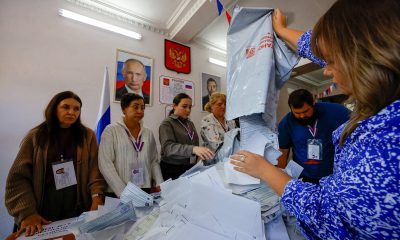


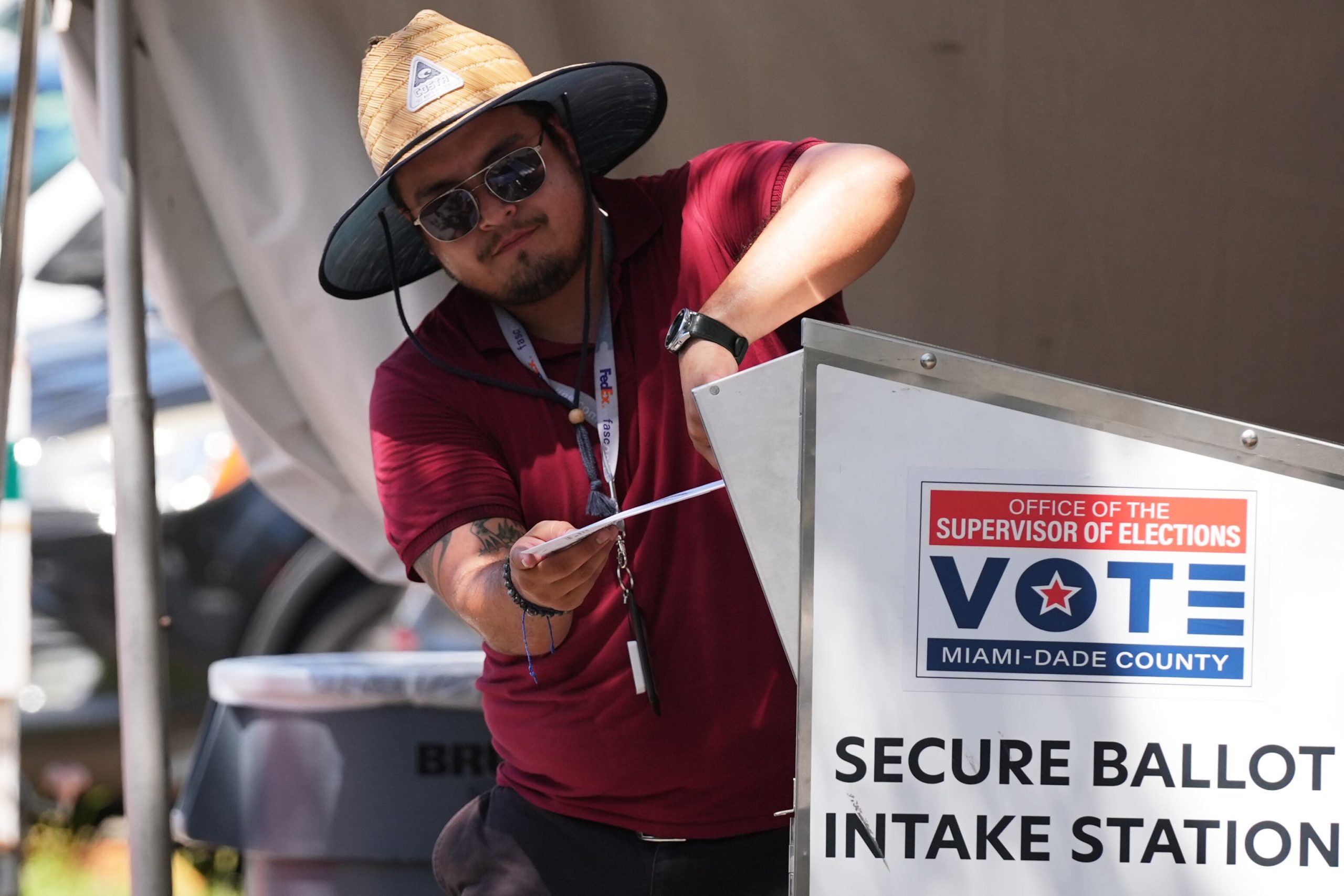
The Trump administration’s immigration policy and the state of the economy are prompting a shift of Latino voters back toward the Democrats. Although many remain undecided, a new poll shows that in the November midterms, Democratic congressional candidates will receive between six and 10 percentage points more of the Hispanic vote compared with Kamala Harris’s 2024 results. By contrast, Republicans would lose five points of the votes Trump won among this electorate. On November 3, all seats in the House of Representatives and one-third of the Senate are up for election, as well as 36 governorships.
That is what the poll conducted by BSP Research and Shaw & Co. for the American Business Immigration Coalition (ABIC) and American Families United (AFU) between September 4 and September 6 reveals, using a sample of 1,353 registered Latino voters in Arizona, Florida, Georgia, North Carolina, Ohio, Pennsylvania and Texas.
According to the survey, in House voting intentions the Republican Party would only hold the same level of support it received in 2024 in the state of Georgia, at 25%, although Democrats would gain three points to reach 63%. In Texas, Republicans would fall one point while Democrats would rise three. In Pennsylvania, the shift compared with the 2024 presidential election is larger: the Democratic Party would increase by 10 points to reach 60% of the Latino vote; the recovery is due to a drop experienced by the Republican Party in that state, which would lose 11 percentage points, falling from 37% to 26%.
Although favorable to Democrats, the Latino vote remains volatile, since neither political party commands overwhelming support: 39% have an unfavorable view of the Democrats in Congress, while 63% have an unfavorable view of the Republicans.
The Democrats’ recovery of part of the historic support they lost among Hispanics in the 2024 elections is driven by the community’s discontent with the state of the economy and with the president’s aggressive anti-immigration agenda.
Latino voters surprised in the last elections by contributing to Trump’s victory. Among Hispanic men, he obtained a majority over his Democratic rival for the first time.
Latinos trusted him to improve their economic situation and secure the border. The first has not been achieved, because the cost of living has soared—partly due to the war in Iran and rising fuel prices; as for the second, the border is secure, but the prevailing perception is that immigration policy has gone too far.
“Immigration is once again becoming a major issue for Latinos. And yes, we believe this is significantly harming Republicans in the current elections,” explained Matt Barreto, who oversaw the survey. “Many of them—as we’ve seen in the polls—say they have a personal connection to someone who is undocumented. They know someone [detained or deported], whether in their family or in their close community; likely even in their own church,” he added.
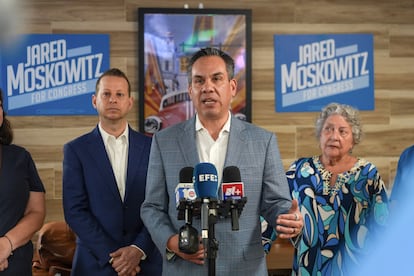
The poll shows that the majority of Latinos, including those who identify as Republicans, believe the Trump administration’s immigration policy—with the criminalization of migrants who had previously resided here legally, and the mass deportations—has gone too far. Sixty-three percent of Latinos in key states say treatment of immigrants is “one of my main concerns” for 2026, and 59% support creating a pathway to legal status for undocumented immigrants with family members who are U.S. citizens. Sixty-four percent of Latino Republicans, 68% of independents and 85% of Democrats say they will vote for candidates who prioritize legal status and work permits over mass deportations.
Letter to Trump
The poll’s findings were released during the launch of the Committee of 100’s Unity Campaign, through which more than 200 Hispanic leaders—among them elected officials and representatives of the business, religious, civil rights and community sectors—urge President Trump and congressional leaders to grant work permits and legal protections to long-standing undocumented immigrants.
“We may be MAGA supporters, progressives, or somewhere in between,” they wrote in a new letter to President Trump and congressional leaders. “We are all united in demanding that both Republicans and Democrats in Washington offer long-term solutions for undocumented immigrants who have been here for many years—many of whom have worked, paid taxes and contributed to our communities, families and workplaces for decades—solutions that allow them to live and work legally and without fear.”
Signatories of the letter include Democratic members of Congress such as Representative Delia Ramirez of Illinois and Representatives Sylvia Garcia and Veronica Escobar of Texas, and Republicans such as Florida state senator Ileana Garcia, founder of the group Latinas for Trump.
“Hispanic voters are fed up,” said Massey Villarreal, CEO of Precision Task Group and co-chair of the Committee of 100. “We are losing our workforce because of these deportations. Since January, we have lost 200,000 immigrant workers each month. Simply put, there is no way to sustain our economy without the long-standing immigrants who made our prosperity possible,” he said.
Leaders of several Latino and immigrant organizations, including LULAC, NALEO, UnidosUS, the National Hispanic Christian Leadership Conference and America’s Voice, joined the initiative.
Representative Sylvia Garcia criticized that the immigration issue is out of control and emphasized that the poll shows “the disconnect” with citizens, which “lies in the fact that Washington is not doing anything aimed at finding a real solution.” The congresswoman advocated passing the American Dream and Promise Act, which would open a pathway to legalize beneficiaries of DACA and TPS (Temporary Protected Status), programs that have been rescinded by the government.
Sign up for our weekly newsletter to get more English-language news coverage from EL PAÍS USA Edition
Baja California
US Treasury Targets ‘Mayito Flaco’ Network, Including Baja California Governor’s Ex-Husband


The U.S. Department of the Treasury struck on Tuesday at the criminal network led by Ismael Zambada Sicairos, alias Mayito Flaco, leader of a criminal organization operating in Sinaloa, Durango and Baja California, among other regions of Mexico. The son of longtime Sinaloa cartel boss Ismael Mayo Zambada, Sicairos appears as a person of interest to the U.S. government, which has sanctioned a total of 21 individuals, as well as 25 companies linked to the network.
Among the 21 individuals, in addition to the organization’s leadership, is Carlos Torres, the former husband of Baja California governor Marina del Pilar Ávila, of Mexico’s governing party Morena. Torres and Ávila have been at the center of one of the great controversies in the country’s public life since last year. In May, the governor and her then-husband announced that the United States had canceled their visas. Rumors about Torres’ ties to organized crime began to emerge in the media. At the end of the year, Del Pilar announced her separation from Torres. In January, Televisa’s N+ Focus reported that the Attorney General’s Office (FGR) was investigating Torres for alleged links to organized crime, a situation that was later confirmed.
After their separation, Ávila and Torres tried to cushion the blow. Torres said that “it is not an investigation based on facts.” For her part, the governor pointed out that “Carlos has already issued a position. I am convinced that the Attorney General’s Office is an extremely serious institution that is going to carry out an in-depth investigation and the facts will be clarified.” The US Treasury statement now contends that “this Sinaloa Cartel-enabled narco-corruption has reached the highest levels of the Baja California state government. At the center of this narco-corruption scheme is the ex-husband of the Governor of Baja California, Carlos Torres, and his brother Luis Torres.”
The OFAC accuses Carlos Torres of using “his political influence to facilitate cartel activities and protect the Sinaloa Cartel from government and law enforcement intervention in Baja California.” The agency says that Torres has an alliance with Juan José Ponce Félix, alias El Ruso, the strongman of Mayito Flaco in Mexicali, a city east of Tijuana and one of the strongholds of his criminal group in Baja California. In addition, it says that Torres received payments from the criminal group through Pedro Mendivil, former director of Public Security of Mexicali, arrested in July for crimes of forced disappearance, vehicle theft and criminal association. Mendivil was later released.
U.S. authorities also link Torres to Rafael Buenrostro Marín, a former Customs official assigned to Chihuahua and former legislative advisor to the Baja California state government. The Treasury places Buenrostro near another of the leaders of the Mayito Flaco faction, Jose Angel Rivera Zazueta, alias Don Flaco, arrested last week in Mexico City. At the time, the authorities said that Zazueta is viewed as a coordinator and financier of an organization dedicated to the transfer of chemical precursors from China to Mexico and the United States.
Following the publication of the OFAC statement, the Mexican government’s Financial Intelligence Unit announced that it will include “the subjects included in OFAC’s designation,” including Torres, “to the Blocked Persons List (LPB), as a preventive measure of an administrative nature.”
Beyond Torres, El Ruso, Zazueta and Sicairos himself, the OFAC statement describes for the first time in detail some of the most important circles of the organization. For example, it establishes the criminal leader’s close circle, made up of the Mendoza Uriarte brothers, Jorge Luis and Francisco, workers that Sicairos inherited from his father. Jorge Luis, alias Güero Chompas, “is now the head of security for Los Mayos,” according to the agency. Also included in that group is Hildegardo Gastelum García, alias Aldo, “one of Mayito Flaco’s most trusted advisors, as well as a significant narcotics trafficker, and the owner of a Culiacan-based hotel business who uses his illicit revenue streams to finance Los Mayos’ war against the Chapitos.”
The aforementioned war refers to the conflict between the two groups following the arrest of Mayo Zambada in July 2024 in Culiacán, after the sons of his old partner, Joaquín “El Chapo” Guzmán, betrayed him and handed him over to U.S. authorities. That movement opened an unbridgeable rift between the two families – Los Mayos and Los Chapitos – and their influential groups, which has left thousands of people murdered and disappeared in the state since then. Until now, the group hardest hit in the war seemed to be Los Chapitos, also besieged by the authorities. The arrests of members of the opposing group in recent times have also increased, although the war does not seem to be ending.
Sign up for our weekly newsletter to get more English-language news coverage from EL PAÍS USA Edition
Austin
Federal Government Files Assault Charges Against Wilber Garcés, The Migrant Shot By An ICE Agent In Austin



Will Spanish Rental Law Demand 12-Month Compensation?

New Writing Club In Los Alcazares Invites Beginners To Join Creative Group

Los Alcazares To Host Solidarity Walk Against Cancer This October

Detenido Un Hombre Por La Muerte De Una Mujer De 47 Años En El Distrito De Arganzuela De Madrid

F1 Qualifying Today: Azerbaijan Grand Prix schedule, times and TV channel

The Azcatitlan Codex Returns To Mexico From Europe After Nearly Two Centuries


-
 Arganzuela2 weeks ago
Detenido Un Hombre Por La Muerte De Una Mujer De 47 Años En El Distrito De Arganzuela De Madrid
-
 Uncategorized6 days ago
F1 Qualifying Today: Azerbaijan Grand Prix schedule, times and TV channel
-
 Claudia Sheinbaum2 weeks ago
The Azcatitlan Codex Returns To Mexico From Europe After Nearly Two Centuries
-

 basque country1 week ago
British Actress Naomi Watts Attacks Ageism In Hollywood As She Picks Up Prestigious Donostia Award At San Sebastian Film Festival
-

 Uncategorized2 weeks ago
Heartbreaking Instagram post reveals death of F1 star
-
Best airlines2 weeks ago
Spanish airline Vueling named Europe’s best low-cost carrier for 2026
-

 %2 weeks ago
Mallorca Property Overrun By Wild Goats
-
2026 wildfires2 weeks ago
Spain’s wildfire toll revealed as almost 300,000 hectares go up in flames