
Donald Trump
Ukraine, At An Impasse: Besieged By Putin And Abandoned By Trump

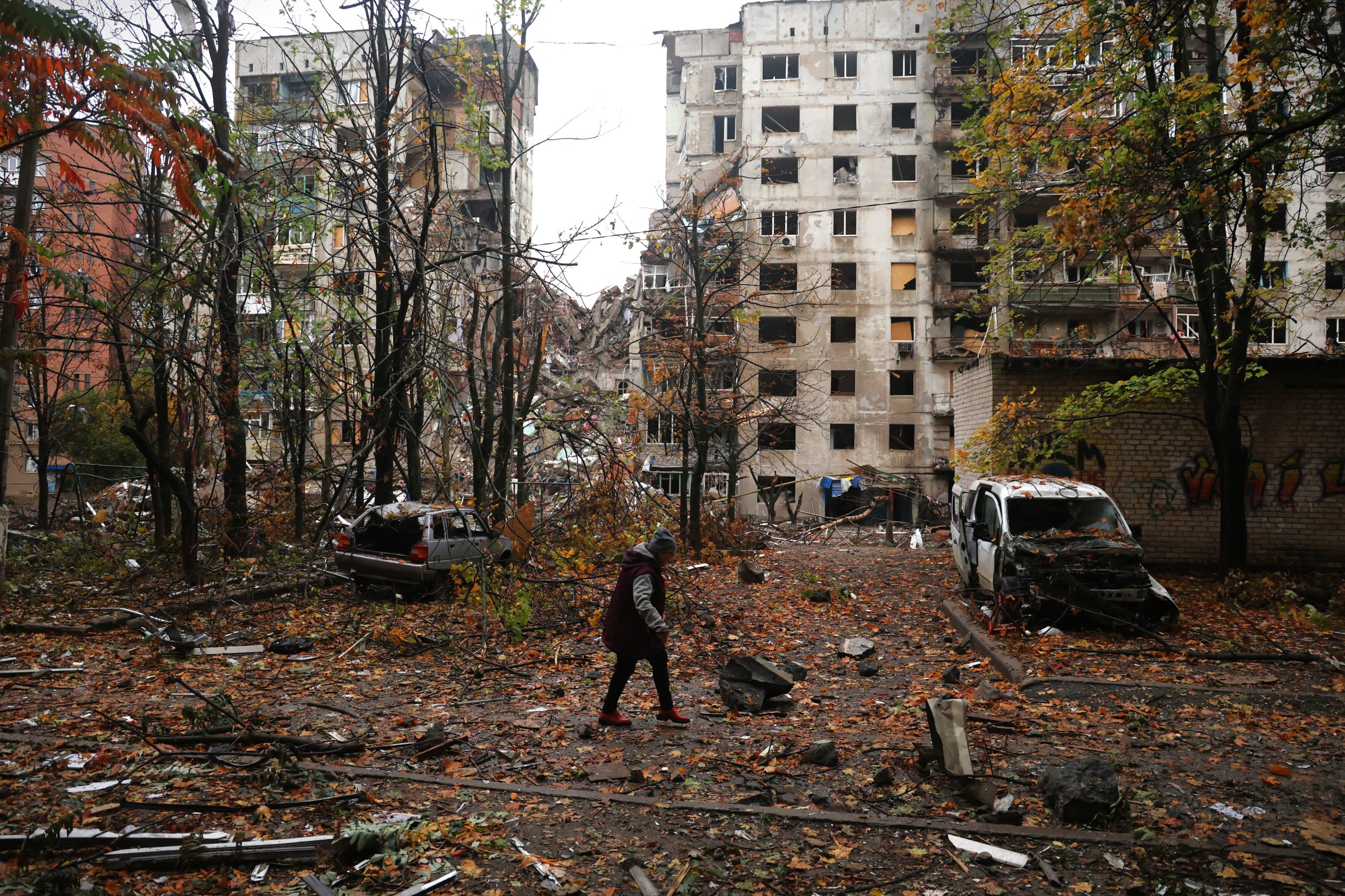
Dawn breaks under rainfall in Kramatorsk, a Ukrainian stronghold under Russian threat on the eastern front. What makes it harder for drones to fly becomes an opportunity for Russian infantry to try to gain ground. These are, in any case, small skirmishes. EL PAÍS reports this from a military command post in Kramatorsk based on images captured by drones on October 15. The front line shows hardly any change and the war is stuck in a complex tangle as the fifth anniversary of the full-scale invasion approaches. Kyiv has also recently suffered serious setbacks: at home, with attacks across around 20 of its regions, and internationally, the blow represented by the United States’ overt alignment with Russia.
Beyond the Kremlin’s imperial posturing, decisions in boardrooms and on international markets are also pushing Ukraine further away from a just and lasting peace — the kind frequently discussed in diplomatic forums and meetings. President Volodymyr Zelenskiy has accused his allies of not doing enough, especially after several ballistic missile attacks on his country last week about which Kyiv was not warned, as often happens. Behind this is published reporting that the United States could stop sharing intelligence with Kyiv. Added to that was a partial outage of Starlink, Elon Musk’s company, whose terminals are essential to the Ukrainian military, in what Zelenskiy called a “planned operation.”
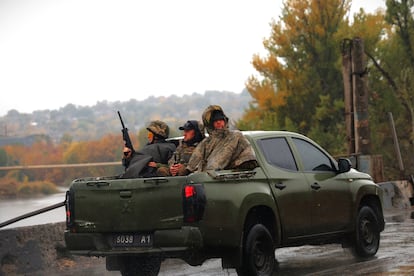
Zelenskiy does not hide the fact that he feels betrayed by U.S. President Donald Trump at a time when relations between them have again soured. The U.S. and Russian leaders recently signed an agreement to release hundreds of thousands of barrels of diesel despite sanctions on Moscow. Beyond his outrage, Zelenskiy cannot openly confront Washington despite Trump’s repeated slights — whether because of the latter’s closeness to Vladimir Putin or because of the way the Republican belittles him and Ukraine. On October 17, responding to journalists via WhatsApp, he said he expected new meetings with U.S. negotiators to try again for an energy truce. But he is clear that Putin “wants our destruction. Surrender is not enough for him.”
Zelenskiy, in any case, is trying to keep his composure. After the U.S. president’s announcement of an “energy ceasefire” on October 11 — which never really existed because Moscow rejected it — Kyiv resumed strikes on Russian refineries. That further irritated Trump in a kind of vicious circle. “We Ukrainians have dignity,” Zelenskiy said on October 16 in Brussels. In a jab at the Republican magnate, he praised Europeans as “real leaders” who have stood by Ukraine “from the very beginning of this war.”
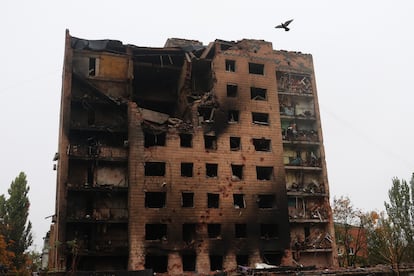
Meanwhile, ordinary citizens are bearing the brunt. Life in the country’s major cities, such as Kyiv, the capital, and Kharkiv, the second-largest city, remains disrupted by constant attacks that local air defenses fail to repel. Cuts to basic services are commonplace and nothing suggests conditions will improve.
Moscow’s main objective now is to shut off water, electricity, and gas as a new winter approaches. The attempt to ensure that attacks would spare energy infrastructure was nothing more than a mirage that few believed in when, as on previous occasions, Trump’s empty diplomatic gestures came to nothing at the first sign of trouble.
Bad weather, good weather
From a bunker in Kramatorsk filled with screens where Ukrainian troops watch the battle unfold in real time, orders are issued to those on the ground. Sitting in a chair like those used for long hours of gaming and wearing a tracksuit, Roman, a 42-year-old deputy battalion commander, admits his country is having a hard time.
He enlisted shortly after Moscow launched a military operation in 2014 to occupy part of Ukraine’s Donbas region, a precursor to the blow of the full-scale invasion of February 2022. Adverse weather hampers drones, he explains, but “helps Russian infantry to advance on land. This weather is ultimately worse because the Russians have more personnel and resources than we do and we cannot push them back. They move slowly, but they move,” he says.
In four months it will be five years since the Kremlin launched its invasion. A trip through different regions of eastern and southern Ukraine is a reality check that helps explain the pessimism and fatigue among the population, although each person views the conflict through their own lens. The number of bombed gas stations keeps growing, as do the miles of roads and streets covered with netting to try to blunt the impact of Russian drones. There are stretches in Kherson, in the south, where there is evidence of Russian airstrikes almost every 50 meters — some with the wreckage of a vehicle nearby — that underline the measure’s limited usefulness and how they barely stop the smallest devices.
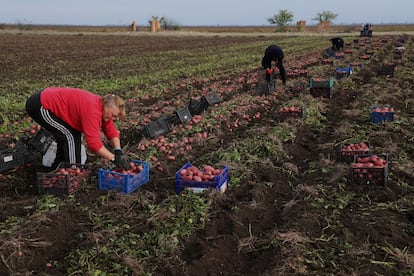
Not far from there, in the village of Sahaidachne, Natalia leads a crew of half a dozen women busy harvesting potatoes. The 42-year-old spent seven months under Russian occupation in Zmiivka on the banks of the Dnipro River. She recalls that there they had everything needed for a decent life — working the land and even with young people still in the town. In November 2022, after Ukrainian forces expelled the occupiers from the area, she ended up settled in this new village. “We don’t have money to move again,” she says resignedly, despite a recent incident when a drone landed next to the house where she now lives with her husband. She believes Moscow should return all occupied territory to Kyiv.
A little farther north, in Nyva Trudova, a small village in the Dnipropetrovsk region, three workers from an agricultural and livestock company share dinner. The oldest, Oleksi, 60, does not hide his hostility toward Zelenskiy, whom he considers “corrupt,” like those around him. He thinks Ukraine will not recover the roughly 20% of the country that Russia still occupies. For that reason, he believes a peace deal should be signed now and that Moscow should keep that territory, because otherwise, he says, it will continue to gain more ground.
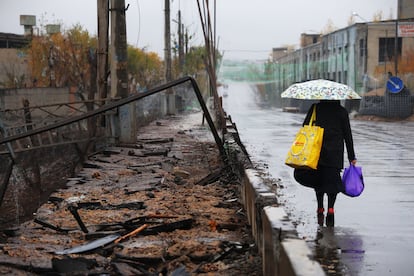
Against the noise from Washington, Kyiv’s allies — especially in the European Union — have been unable to impose sanctions on Moscow that would prevent the military aggression from reaching its current extent. Zelenskiy conducts frequent rounds of talks and constant foreign visits, such as last week’s trips to London and Brussels, but Kyiv still lacks the weaponry and financing required to stop Moscow’s offensive, particularly its ballistic missiles and jet-powered drones. All this is unfolding amid an expanding hybrid war deployed by the Kremlin, whose tentacles increasingly reach across Europe.
In the underground command center in Kramatorsk, Roman puffs on an electronic cigarette as he recounts that during nighttime operations Russians camouflage themselves with special clothing so they are not detected from the air as heat sources. In the background, despite the rain, artillery thunders and air-raid sirens go off in the streets. On one of the televisions, the soldier shows footage captured that very morning by the camera of one of those unmanned aerial vehicles as it drops its bomb on an invading soldier trying to advance his position in the area. Minutes later, another device — this one classified as a surveillance drone — confirms the death. But it’s just one.
These unmanned systems have become the main protagonists of the armament revolution this conflict represents for both sides. Some are small, flying only a few thousand meters and carrying a kilo of explosives, while others have ranges and speeds that are difficult to counter. New drones — increasingly sophisticated alongside ballistic missiles and aerial bombs — allow Moscow to extend the front line and keep all of Ukraine permanently on edge. At the same time, surprising advances in Ukrainian industry, despite having less funding and resources, allow Kyiv to strike targets over 2,000 kilometers (1,240 miles) inside enemy territory.
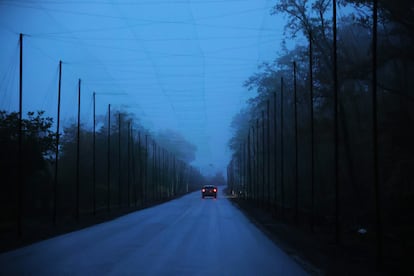
Underground, Roman, despite the small trickle of Russian uniforms visible from the drones, knows there are thousands still trying to advance and take Kramatorsk, increasingly destroyed and deserted. This city is the largest under Kyiv’s authority in Donetsk region, of which Russia occupies about 70%. Putin will not renounce it. For that reason, Roman and the others fear that, as with Bakhmut and other nearby towns, Kramatorsk could end up falling.
Meanwhile, Natalia continues working in her potato field. She says her dog is unfazed by Ukrainian drones but hides when they are Russian. That gives this woman peace of mind and confidence. She says she has an official certificate of internal displacement but has not received from the government the money due to her after losing her home. She opens her phone and shows it, destroyed. “Why do we deserve this war?” she asks.
Sign up for our weekly newsletterto get more English-language news coverage from EL PAÍS USA Edition











Donald Trump
Cambridge Analytica, 10 Years On: Meta Still Struggles To Shake Off The Specter Of Political Interference


2016 was a pivotal year in the 21st century. In June, Britons voted in a referendum to leave the European Union. In November, U.S. voters elected Donald Trump as president, a figure widely regarded as a bad joke by both Democrats and establishment Republicans. Both events marked the beginning of a far-right wave that, a decade later, continues to sweep across much of the world. And both were aided, perhaps decisively, by a small London-based political consultancy: Cambridge Analytica. The company collected data from 87 million Facebook users without their consent and used it to create personalized political propaganda to boost the campaigns for Trump and Brexit, among others.
It was the first warning that the vast amount of information platforms collect about users through their likes, interactions and browsing histories can be used not only to sell them products, but also to manipulate them psychologically and try to influence how they vote.
A decade later, the shadow of Facebook and Cambridge Analytica still looms large. The issue returned to the spotlight last week, fueled both by the record fine imposed on Meta and the elections taking place around the world.
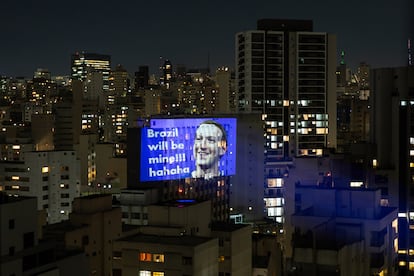
In Brazil, the Superior Electoral Court spent last week sparring with Mark Zuckerberg’s company in an effort to make it demonstrate that the algorithms of Instagram and Facebook treat equally the two candidates competing in Sunday’s presidential runoff: Luiz Inácio Lula da Silva, of the left-wing Workers’ Party (PT), and Flávio Bolsonaro, of the right-wing Liberal Party. In recent weeks, the Brazilian government has accused Meta’s platforms of giving preferential treatment to the Bolsonaro campaign.
Brasília complains that Lula’s account was temporarily suspended, that his rival’s content was being promoted and distributed more widely than his own, and even that images generated by Meta’s artificial-intelligence tool appear less sharp when depicting Lula than when depicting Bolsonaro. Similar biases were also reported in WhatsApp searches. Meta, for its part, has blamed technical errors, although a group of employees allegedly acknowledged that the problems in every case were detrimental to Lula’s campaign.
The shadow of Cambridge Analytica
As it happened, while Brasília was locked in that dispute with the technology giant, a court in New Mexico on Wednesday ordered Meta to pay a record fine of around $25 billion for violating privacy laws, on top of the $5 billion it had already paid to the Federal Trade Commission (FTC).
This year, Meta has also suffered a string of legal setbacks on another major front: the impact of social media on minors. These have included additional fines and a settlement with 52 state attorneys general, under which the company agreed to pay up to $18 billion in exchange for the withdrawal of their lawsuit.
That issue — the mental health of young people exposed to social media platforms — has dominated the debate about the societal influence of Big Tech. But in an election year for countries such as the United States, which will hold its midterm elections in November, Spain and Israel, it is worth remembering what Cambridge Analytica revealed about how social networks can be used to influence elections.
“We used Facebook to harvest data from millions of people and build models that appealed to their preferences and private demons,” Christopher Wylie, an analyst at Cambridge Analytica and the whistleblower who exposed the scandal to the world, told EL PAÍS. Wylie was one of the main architects of the digital machinery that propelled the early far right of the 21st century in both the United Kingdom and the United States.

“We played with a nation’s psychology,” said the young Canadian engineer. How did they extract so much value from Facebook data? Users’ likes, posts and comments were used to build psychological profiles. Cambridge Analytica did so using five traits: openness, extroversion, conscientiousness, agreeableness and neuroticism. From there, the consultancy grouped those profiles into categories. The next step was to use that information on each individual to allow political parties to send different ads to different potential voters, tailoring the message, whether more emotional, inflammatory, or informative, according to what was known about them. In this way, the impact could be far greater than that of a generic advertisement.
The scandal led to inquiries in both the British Parliament and the U.S. Senate. “The Electoral Commission described the pernicious nature of micro-targeted political adverts: ‘Only the voter, the campaigner and the platform know who has been targeted with which messages. Only the company and the campaigner know why a voter was targeted and how much was spent on a particular campaign,’” stated a 2019 House of Commons report on disinformation and fake news. The report concluded that Zuckerberg’s company had acted in “bad faith” and described social media platforms as “digital gangsters.”
Backlash and rollback
The Facebook–Cambridge Analytica scandal was huge. The British consultancy collapsed; Mark Zuckerberg faced his first hearings before investigative committees. And social networks responded.
“Platforms took action,” explains Carmela Ríos, a journalist who specializes in social networks and disinformation. “I think we won in that sense, because we gained transparency and that also forced social networks to act. It was after that that Facebook decided to open its political ad library, for example, and launched CrowdTangle [the free tool to detect the spread of hate speech].”
That period did not last long. When Elon Musk bought Twitter in 2022, the rollback began. The billionaire fired content moderators at the newly rebranded X, which shifted toward community moderation, a model that Meta later adopted on its own platforms. Algorithms became more influential, and researchers and journalists were no longer given access to information about how the platforms operate.
“Now social networks act with great opacity,” says Ríos. “What little we know about them does not come from their willingness to disclose but from legal obligation.”
In recent years, new methods have been developed to exploit people’s digital footprints for political ends. In the U.S., Trump advisers used geofencing (a marketing practice that exploits cellphone location data) to detect people attending Catholic or evangelical churches on Sundays in key states for the 2020 presidential election. Just as retailers track customers’ phones in stores to offer personalized ads, the organization CatholicVote identified 200,000 Catholics in Wisconsin who had attended Mass at least three times in the previous 90 days and, by cross-referencing IP addresses with other databases, found they had not registered to vote.
The legacy of Facebook and Cambridge Analytica is still with us. Brad Parscale, the digital strategist who designed Trump’s micro-targeted advertising campaign in 2016, joined the team of advisers to Israeli Prime Minister Benjamin Netanyahu last year. He was tasked with winning over Generation Z across all platforms and ensuring that ChatGPT returns information favorable to Netanyahu’s cause. A decade later, Cambridge Analytica’s influence can still be felt.
Sign up for our weekly newsletter to get more English-language news coverage from EL PAÍS USA Editio
Aranceles
Audi Trasladará A Su Futura Planta En EE UU Toda La Producción Europea De Grandes Todocaminos



Madrid Woman Awarded €35,000 In Landmark Case After Partner’s Botched Vasectomy Leaves Her Unexpectedly Pregnant

Muere Walter Koenig, El Chekov Original De ‘Star Trek’

El Torero Roca Rey, Expedientado Por El Ruido De Su Fiesta De Cumpleaños Y Por Lanzar Cohetes Sin Permiso


-

 Uncategorized4 weeks ago
F1 Bahrain Grand Prix will be live and FREE on TV this weekend
-

 New Developments4 weeks ago
How To Get A Tourist Rental Licence In Andalusia (Spain) – Step-By-Step Guide 2025
-

 New Developments3 weeks ago
Luxury Villas For Sale, Estepona – ProjectL1
-
Blackout preparedness4 weeks ago
Brussels takes action against Spain over failure to update blackout plan
-
EU3 weeks ago
EU nicotine crackdown sparks warning that ex-smokers could be driven back to cigarettes
-

 Uncategorized4 weeks ago
Lewis Hamilton F1 wish could come true as stunning plans for new track revealed
-
 Housing access / crisis / affordability3 weeks ago
Radical Housing Decrees Defeated As Snap Election Talk Grows
-
British tourists arrested in Magaluf3 weeks ago
British tourists arrested after taxi driver left bloodied in Magaluf