
ElPais
Italian Justice Reopens Case Of Pier Paolo Pasolini’s Murder, 51 Years After His Death

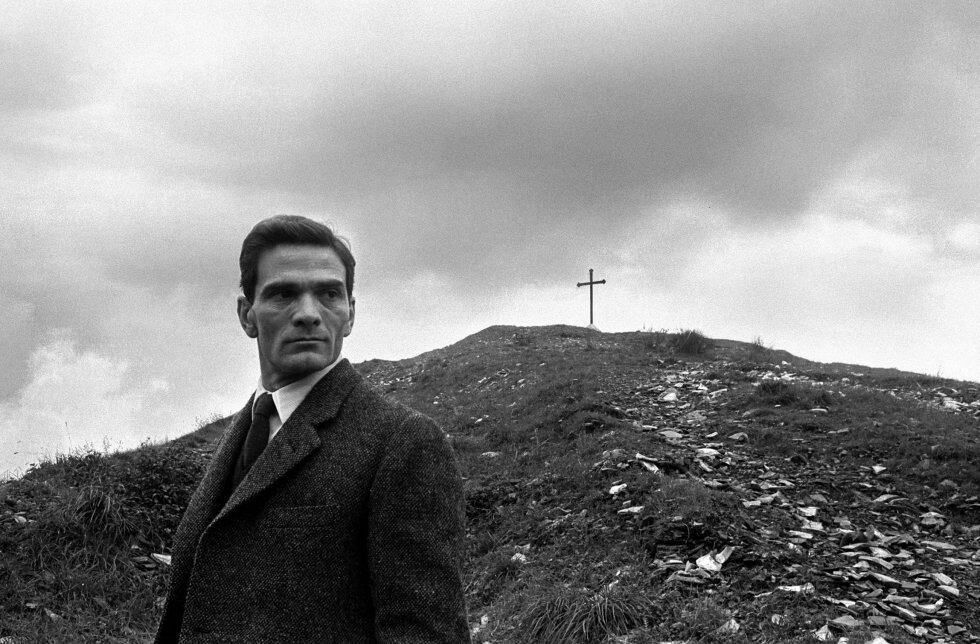
Italy continues to seek the truth about the death of writer and filmmaker Pier Paolo Pasolini, as almost no one believes the official account of his murder, which took place 51 years ago, in the early morning hours of November 2, 1975, in a vacant lot in Ostia, on the outskirts of Rome. The very verdict that convicted the 17-year-old who confessed to the murder, Pino Pelosi, already cast doubt on whether he acted alone, and since then there have been numerous hypotheses and attempts to reopen the case. The most recent efforts have come from Rome attorney Stefano Maccioni, who has been investigating the crime for years, has published books detailing his findings, and previously succeeded in getting the prosecutor’s office to reopen the case in 2010 and 2023 — though it was subsequently closed again on both occasions without reaching any conclusive findings. Maccioni has now tried again, filing a complaint a year ago, and the Rome District Attorney’s Office has agreed to reopen the case.
This time Maccioni has produced previously unknown testimony, which Italian media say comes from a retired member of the security forces who has previously unseen information about the initial investigation. The fact is that the inquiry and the trial were handled quickly: six months after the crime Pelosi was sentenced to nine years and seven months in prison, although the judge clearly indicated that the investigation should continue: “The court considers that the case file overwhelmingly shows evidence that Pelosi was not alone that night.”
The accused died in 2017 at 59 and took the secret to the grave. After leaving prison he wrote books and gave interviews offering contradictory accounts. On several occasions he said that the crime was actually carried out by three or four people who appeared at the scene and later threatened him if he spoke.

Pelosi was arrested a few miles away while driving the director’s car in the wrong direction. His account at the trial was that he refused to engage in a sexual relationship; Pasolini became aggressive, and he knocked him down by hitting him with a board. Pelosi then panicked, got into the writer’s car to flee, and as he drove away, he accidentally ran him over. The whole incident could be reduced to a sexual encounter and a fight that ended badly. But the truth is that the context of those years offers more complex perspectives.
The attorney, who in the past represented one of Pasolini’s cousins, Guido Mazzon, is now acting on behalf of the Lazio Region Journalists’ Association, film director David Grieco, and writer Giovanni Giovannetti. In this new effort to reopen the case, he is pursuing several lines of inquiry. On the one hand, he notes that new information has emerged from recordings made by the public television network RAI at that time and that a thorough review of the information gathered so far “leads to a single conclusion: it is not certain that Pelosi was alone on the evening of the murder, so it is essential to establish who was with him that evening.”
As Maccioni has been pointing out in recent years, he has focused on what Pasolini was doing in the months before his death: the film Salò, released posthumously, and the book Petróleo, which he left unfinished and which was published years later. He also refers to articles published in the days after the crime that provide clues.
The thesis linking the crime to Pasolini’s activities is already known and points to shadowy plots from Italy’s Years of Lead and the so-called “strategy of tension” involving violent neo‑fascist groups. Petróleo dealt with political and mafia plots involving ENI, the Italian hydrocarbons giant, and the suspicious 1962 plane crash that killed its president, Enrico Mattei, another Italian mystery. Pasolini was also among the first to denounce, in his articles for Corriere della Sera, the connections between power and destabilization operations by intelligence services. One hypothesis is that Pelosi was used as bait to lure him to the Idroscalo di Ostia — a remote spot he sometimes visited with casual partners — to set up an ambush.
The lead concerning his last film is based on the theft of some reels at the Cinecittà Studios and the possibility that Pasolini went to Ostia for a mysterious meeting to recover them, especially since it emerged that members of the Banda della Magliana, the Roman criminal group that at the time was linked to the dirtiest operations of the intelligence services, took part in the celluloid theft. No one ever believed Pelosi acted alone, but it was not possible to go further. Prominent reporter Oriana Fallaci wrote an article days after the crime with testimony pointing to the presence of other people.
The first investigation prompted by Maccioni relied on DNA from three individuals found on Pasolini’s clothes, which could not be identified. The data were compared with 30 people who had appeared in the inquiries, but all the tests were negative. In other words, someone else was at the murder scene, but who they were remains unknown. “As has been clear for almost 18 years, the judicial truth that attributed sole responsibility to Pelosi has been swept away in recent years by the scientific evidence we requested,” Maccioni explained.
“We trust that the Public Prosecutor’s Office in Rome will finally be able to provide the answers we have been seeking for far too many years,” the lawyer said. “At the same time, we urge all those who have chosen to remain silent about what they know until now, to come forward and speak.”
Sign up for our weekly newsletter to get more English-language news coverage from EL PAÍS USA Edition


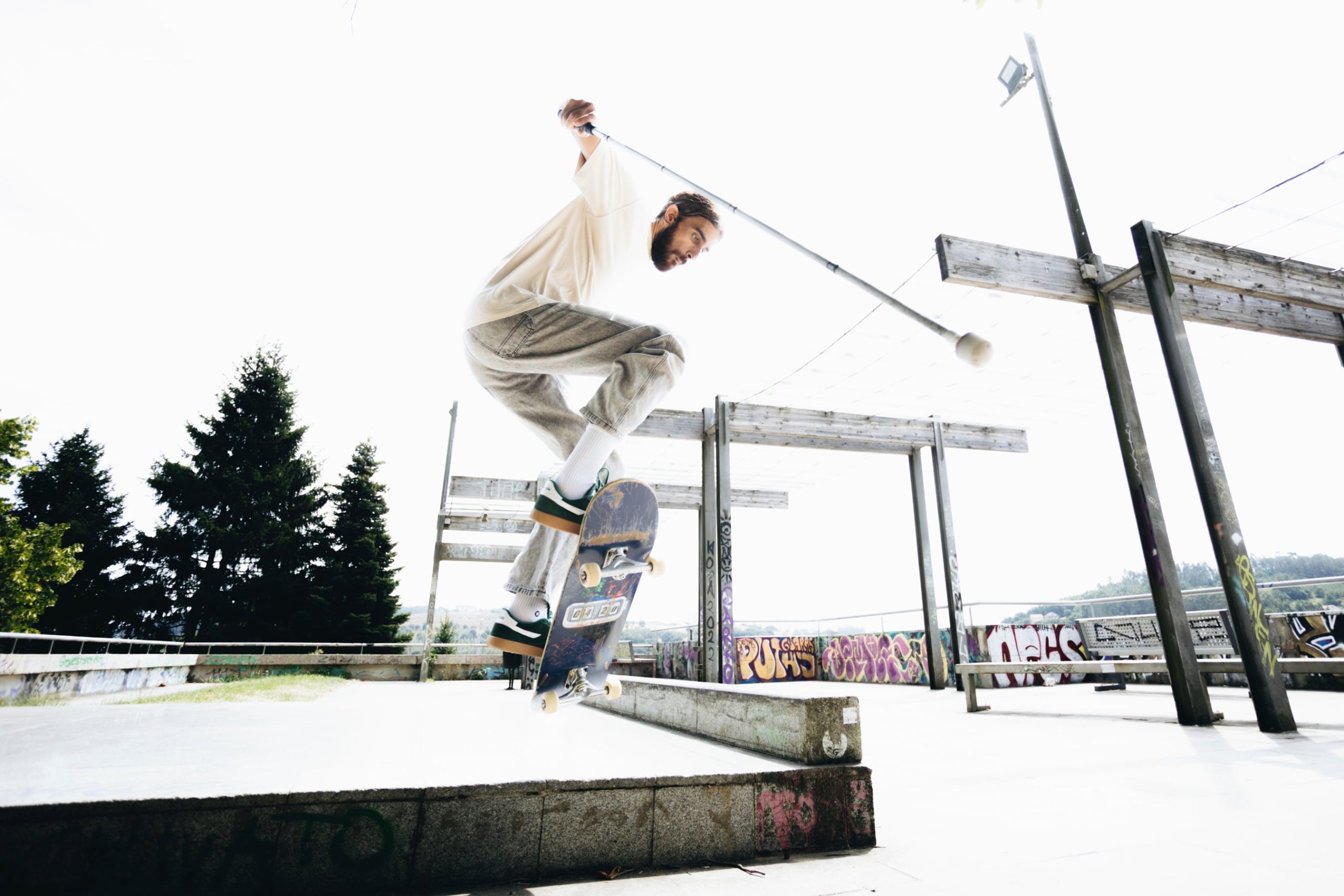
When Marcelo Lusardi went out to celebrate St. John’s Eve in the summer of 2016 with his skater friends in Spain’s northwestern region of Galicia, he never imagined how his life would soon change. While watching the bonfires on the beach, he realized something was clouding his vision, a kind of haze filling his right eye. In the weeks that followed the same thing happened to his left eye. Marcelo gradually went blind because of a rare disease, Leber’s hereditary optic neuropathy (LHON). He can see certain lights but, for practical purposes, he is blind. After 10 years, his story is considered one of the most inspiring in urban sports.
Lusardi, born 28 years ago in the capital of Argentina, Buenos Aires, has two major hobbies: skating and playing the electric guitar. As he was losing his sight, Marcelo would sometimes go down to the square with his instrument and a small Marshall amplifier. He wasn’t skating anymore. One day, already blind, a friend urged him to get back on the board for a spin. “I thought I was going to fall and that it was dangerous. But I agreed. And of course I fell,” he recalls as he does warm-ups before his skate session. He met us at the skatepark behind the regional parliament of Galicia in the city of Santiago de Compostela. He’s eager to finish soon so he can show two mates his new Telecaster guitar.
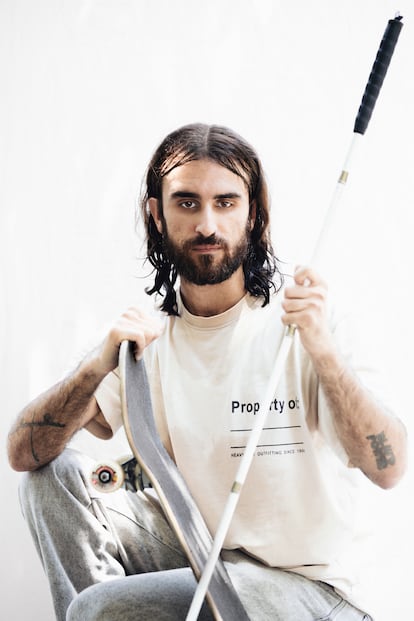
He returned to skating a few months after losing his sight. He’d skated since childhood but had to relearn almost from scratch. He mounts the board in the only viable way, with a cane in hand, and before attempting any trick he maps the spot with the cane’s wheel. “I never go alone to a new spot; always with someone who can see and warn me about things I might miss: curbs, handrails, changes in the surface… details I need to skate. I touch everything with the cane, with my feet, with my hands. I feel the material, the height of the curbs, the type of ground,” he explains. “Any information I can gather is useful to me.”
Eventually Lusardi threw himself off the top of a quarter pipe again, did flips, manuals and even jumped stairs. He began posting his feats on social media under the username The Blind Rider. One challenge he accomplished? “Getting back to doing an ollie to manual [jumping and landing on only the back wheels]. It’s something that’s very frightening when you’re blind and you can’t control well when you’re on the curb. It’s a sensation of flying without seeing,” he replies. “But it was also a challenge to learn Braille at 18.”
The surprise and admiration he provoked has translated into massive engagement. Someone very special shared his videos: the legend Tony Hawk, widely regarded as the greatest skater in history. “I really want to meet him someday and thank him from the bottom of my heart. When I saw it I almost cried, man,” he says.
Tattooed on his arm is his account logo: a skate and a white cane crossed to form an X. He now has more than 125,000 followers on Instagram. Many clothing and skate brands send him gear. He is an ambassador for the paraskate competition at O Marisquiño, the urban sports festival in Vigo that also hosts the World Cup Skateboarding event. It was a tough decision: “Ten years ago, when it all started, they had already asked me to participate as a solo exhibition. I’d been a fan of O Marisquiño since I was a kid and it intimidated me a lot. I advised them to hold an adapted skate competition, with people taking part with different disabilities, not just me there in the middle. They listened and I think it turned out really cool. I’ve been able to meet incredible people with very striking stories.” The competition offers the same prize money as the regular skate event.
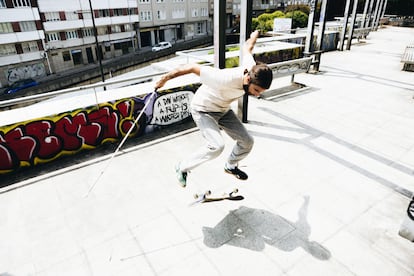
In the world of skateboarding there is a debate about whether it should be included in the Olympic Games. One argument against it is how hard it is to judge. Lusardi has clear ideas about it. “I would love to see paraskate included too. There would be bigger sponsors, of course, but also more role models. When something like this happens to you you don’t know who to look up to, what to do or how to handle it. The role models I had were incredible people skating with one leg, but no blind skaters. Greater exposure helps you see that many problems have solutions or can be managed,” he reflects.
Not all tricks are coming off today: some look good in photos taken just before he falls, but Lusardi insists on repeating them even after the shot is taken: “Out of skater pride I have to do them properly.” One thing making it difficult are pebbles: small stones he can’t see that suddenly slow his board. People in the square sweep them away to help. There’s a striking moment in each of Lusardi’s falls. Rather than lifting him or treating him paternalistically, his friends cheer him on to keep trying.
Lusardi is defined by self-sufficiency. He works during the week and lives independently. “What I struggled with the most was cooking with flames. It’s pretty intimidating, but I make lentils that are amazing,” he laughs. He is an example of someone who overcomes adversity. The media have always treated him as a story of personal triumph. Does he feel comfortable with that? “Yes and no. I feel more like a survivor than someone who has overcome things in an epic sense. For me it’s more ‘I survived adversity’ than anything else.”
“I came out of a very dark place and today I’m happy and I do what I like,” he says. Which fears has he beaten and which still beat him? “I’ve won in the sense that I know I’m capable of much more than I thought; I’ve been pushing the limit upward and I’ve proven things to myself I never imagined. What still intimidates me is that, at my level, what I have to attempt now is very risky.” One trick he wants to conquer is the flip off a stair set. “I feel like it’s going to be the trick of my life. It’s a battle I have pending with myself.”
Some people write to him because they find him inspiring and others even ask for photos. “There were moments when it felt very crazy. I was a normal kid, not outstanding at anything. Suddenly standing out at something was intense. What stressed me the most were the numbers: I felt the pressure to make the most of the moment, to push it because a lot of people were watching me,” he reflects. “I contribute to the message that people shouldn’t obsess over the limits they think they have. They aren’t as solid as we believe; many barriers can be broken. It gives me peace to know that what I do serves more than just me.”
He has always said he wouldn’t change his process. “I wish I could see again, obviously. But going blind has given me so much that, strange as it may sound, I wouldn’t change my past. It has given me another way of looking at the world, it has made me value what skate, music and the people close to me bring.” Asked about gene therapies or Neuralink, he is concise: “No way I’m putting a chip in my head.”
There comes a moment when Lusardi speaks solemnly: “I have a very strong feeling: since I surpassed myself, returned to skating and became happy again, I feel that if I had died at that moment I would have left this world in peace.” His story is that of someone who became an example without seeking it. He simply looked for a reason to get up every day. “I went blind at 18 and since then I am at peace with what I was dealt.”
He finishes the day drenched in sweat and with his list of tricks completed. He changes his T-shirt and puts on sunglasses. He grabs his phone quickly. Fer and Alex are waiting to play guitar.
Sign up for our weekly newsletter to get more English-language news coverage from EL PAÍS USA Edition
Adamuz
Spain’s Transportation Minister Steps Down Over Train Crash To Try To Save The Socialist Campaign Ahead Of Elections

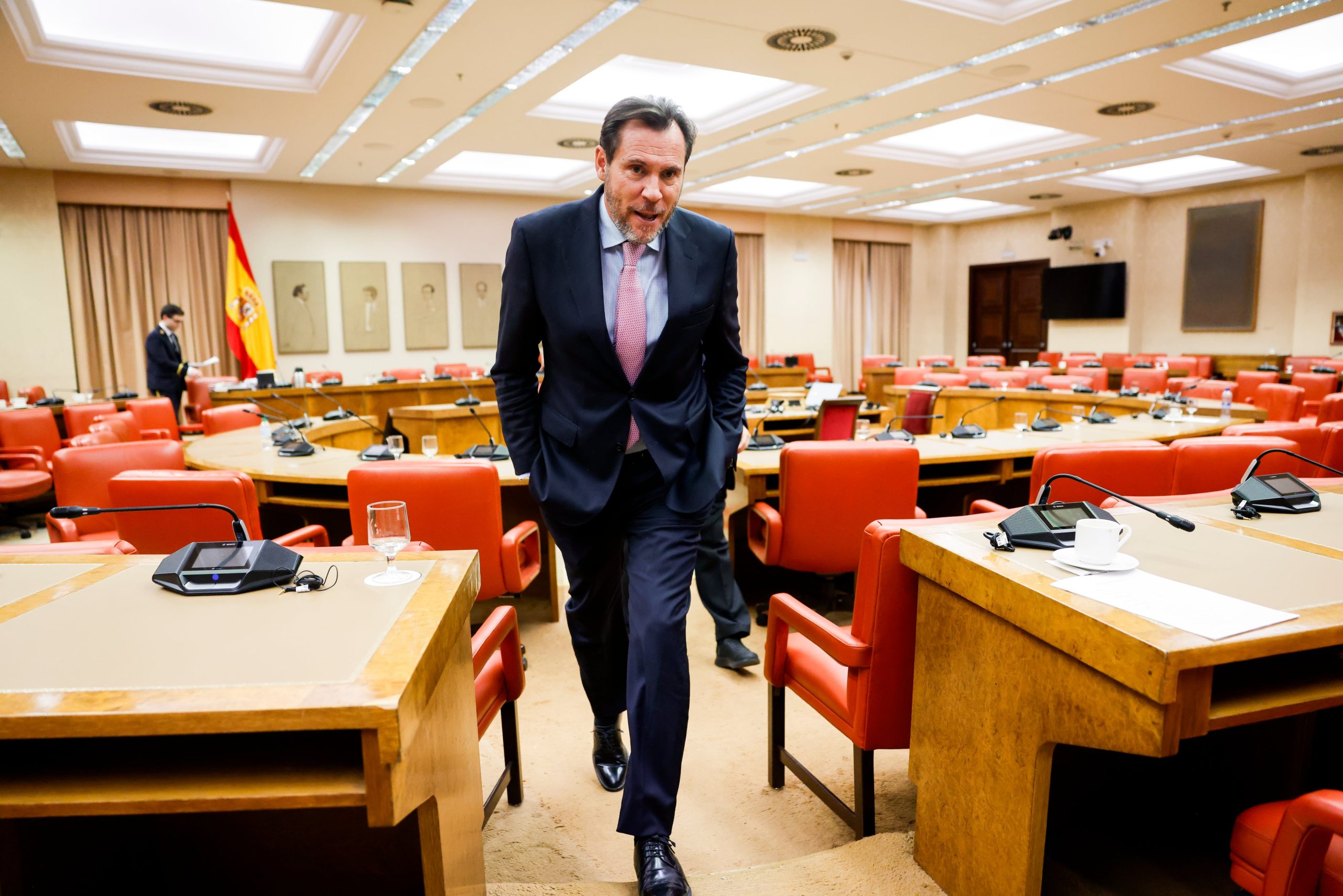
Óscar Puente finally decided to resign and leave frontline politics to try to save the Spanish Socialist Party (PSOE)’s election campaign, which was badly damaged after the second fatal high-speed rail accident in nine months. This is the interpretation most widely held within the government and the PSOE. Puente himself pointed to that idea: “No one is bigger than their organization. My ego has never been greater than my party.”
Spain is holding a snap general election on November 29. Prime Minister Pedro Sánchez, who is running for re-election, brought the date forward following a wave of social protest over the affordability of housing, itself sparked by the eviction of an elderly woman from her home.
But the train crash in Toledo province, which killed 69 people and came just nine months after a similar accident on the same high-speed line, has eroded support for the leftist government. The pre-campaign, which had been going well for the Socialists until Wednesday of last week, has taken a radical turn in which the mainstream conservative People’s Party (PP) and the far-right Vox increasingly seem convinced they have a landslide victory within reach.
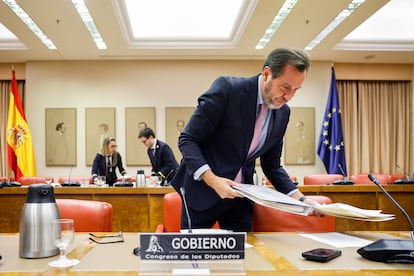
Those who had sought the resignation of Puente, who was in charge of the transportation portfolio during both accidents immediately welcomed the decision. “It cannot be that nothing happens after two fatal accidents in nine months,” said one minister.
Puente ultimately resigned after presenting a package of measures to improve transportation safety and enduring a gruelling parliamentary hearing. The railroad industry is denouncing a lack of investment and staff. The railway system, once a source of pride and a symbol of modernization thanks to its commitment to high-speed rail, faces an undeniable problem of wear and tear. Earlier this year Puente acknowledged a €30 billion ($35 billion) investment shortfall in rail and the need to renew up to 500 trains in the coming years.
Those who thought Puente should stay praised his decision to step down but were simultaneously concerned that this could now direct all the public anger at Sánchez, who reportedly learned of Puente’s resignation only minutes beforehand and had no chance to stop it. However, the prevailing feeling in the government is that this step could re-energize the campaign and revive a political left that has been very dispirited in recent days.
“Puente has stood up, provided solutions and then stepped aside. Out of dignity. Out of respect for the victims and for the progressive project. That shows not all politicians and not all parties are the same,” said the prime minister shortly after, endorsing the idea that Puente had tried to save the PSOE’s campaign ahead of November 29.
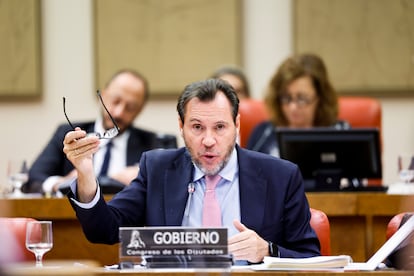
Demands for Puente’s resignation had been loud among the political right. As he did so, Puente also noted that nobody resigned when the PP was in government during some of Spain’s worst tragedies, including the train crash in Galicia in 2013 and the flash flooding in Valencia.
Asked why he didn’t resign on day one, Puente argued he wanted to do it after investigating the accident, finding where the problems were, proposing solutions and finally giving explanations before Congress.
Sign up for our weekly newsletter to get more English-language news coverage from EL PAÍS USA Edition



Italian Justice Reopens Case Of Pier Paolo Pasolini’s Murder, 51 Years After His Death

Marcelo Lusardi, The Blind Skater Taking Social Media By Storm

Spain’s Transportation Minister Steps Down Over Train Crash To Try To Save The Socialist Campaign Ahead Of Elections


-

 Arabia Saudí4 weeks ago
Un Ataque De Los Hutíes Contra El Aeropuerto De Riad Causa Al Menos 12 Muertos Y Más De 300 Heridos
-
DGT3 weeks ago
Viral video in Spain sparks fury over drivers who ‘have no idea how to drive’
-

 %4 weeks ago
Spain Payslip Change Coming In January 2027
-
 America4 weeks ago
Un Tirador Mata A Ocho Personas En Una Vivienda En Pensilvania
-
 House prices4 weeks ago
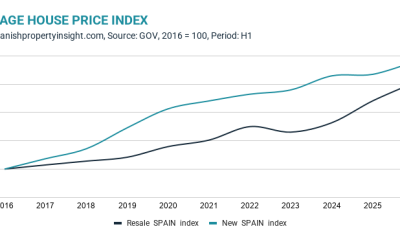
Spanish House Prices Rise 9pc But Market Growth Stalls In H1 2026
-
Costa Blanca North4 weeks ago
Jávea opens historic lighthouse to the public with a new whale-watching viewpoint
-

 America4 weeks ago
Trump Llega A Un Acuerdo Con Putin Para Que Rusia Libere Miles De Barriles De Diésel En Los Mercados Mundiales
-

 Uncategorized3 weeks ago
Williams F1 driver caught up in four-car pit lane pileup