
ElPais
Italian Justice Reopens Case Of Pier Paolo Pasolini’s Murder, 51 Years After His Death

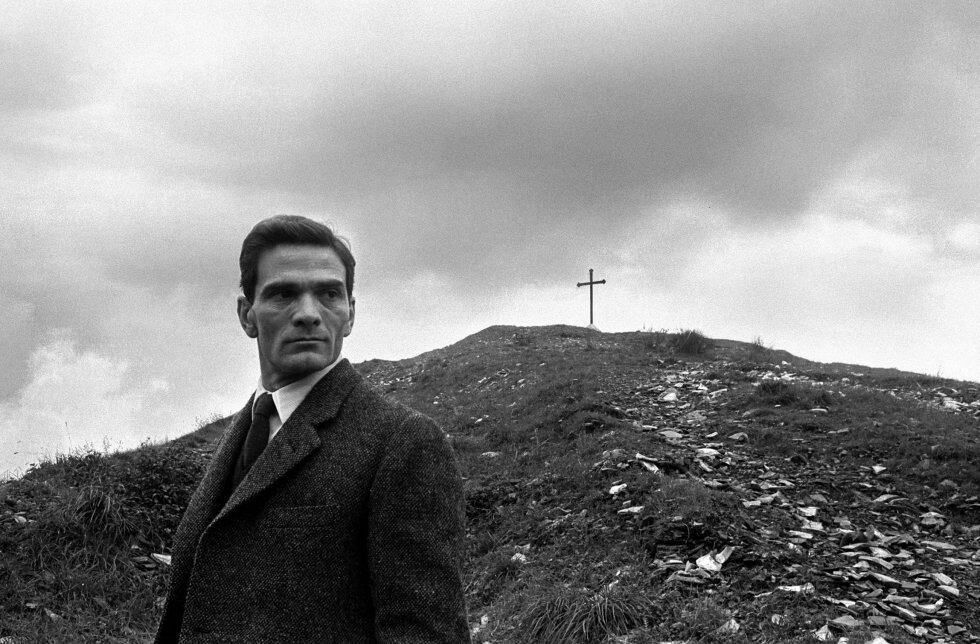
Italy continues to seek the truth about the death of writer and filmmaker Pier Paolo Pasolini, as almost no one believes the official account of his murder, which took place 51 years ago, in the early morning hours of November 2, 1975, in a vacant lot in Ostia, on the outskirts of Rome. The very verdict that convicted the 17-year-old who confessed to the murder, Pino Pelosi, already cast doubt on whether he acted alone, and since then there have been numerous hypotheses and attempts to reopen the case. The most recent efforts have come from Rome attorney Stefano Maccioni, who has been investigating the crime for years, has published books detailing his findings, and previously succeeded in getting the prosecutor’s office to reopen the case in 2010 and 2023 — though it was subsequently closed again on both occasions without reaching any conclusive findings. Maccioni has now tried again, filing a complaint a year ago, and the Rome District Attorney’s Office has agreed to reopen the case.
This time Maccioni has produced previously unknown testimony, which Italian media say comes from a retired member of the security forces who has previously unseen information about the initial investigation. The fact is that the inquiry and the trial were handled quickly: six months after the crime Pelosi was sentenced to nine years and seven months in prison, although the judge clearly indicated that the investigation should continue: “The court considers that the case file overwhelmingly shows evidence that Pelosi was not alone that night.”
The accused died in 2017 at 59 and took the secret to the grave. After leaving prison he wrote books and gave interviews offering contradictory accounts. On several occasions he said that the crime was actually carried out by three or four people who appeared at the scene and later threatened him if he spoke.

Pelosi was arrested a few miles away while driving the director’s car in the wrong direction. His account at the trial was that he refused to engage in a sexual relationship; Pasolini became aggressive, and he knocked him down by hitting him with a board. Pelosi then panicked, got into the writer’s car to flee, and as he drove away, he accidentally ran him over. The whole incident could be reduced to a sexual encounter and a fight that ended badly. But the truth is that the context of those years offers more complex perspectives.
The attorney, who in the past represented one of Pasolini’s cousins, Guido Mazzon, is now acting on behalf of the Lazio Region Journalists’ Association, film director David Grieco, and writer Giovanni Giovannetti. In this new effort to reopen the case, he is pursuing several lines of inquiry. On the one hand, he notes that new information has emerged from recordings made by the public television network RAI at that time and that a thorough review of the information gathered so far “leads to a single conclusion: it is not certain that Pelosi was alone on the evening of the murder, so it is essential to establish who was with him that evening.”
As Maccioni has been pointing out in recent years, he has focused on what Pasolini was doing in the months before his death: the film Salò, released posthumously, and the book Petróleo, which he left unfinished and which was published years later. He also refers to articles published in the days after the crime that provide clues.
The thesis linking the crime to Pasolini’s activities is already known and points to shadowy plots from Italy’s Years of Lead and the so-called “strategy of tension” involving violent neo‑fascist groups. Petróleo dealt with political and mafia plots involving ENI, the Italian hydrocarbons giant, and the suspicious 1962 plane crash that killed its president, Enrico Mattei, another Italian mystery. Pasolini was also among the first to denounce, in his articles for Corriere della Sera, the connections between power and destabilization operations by intelligence services. One hypothesis is that Pelosi was used as bait to lure him to the Idroscalo di Ostia — a remote spot he sometimes visited with casual partners — to set up an ambush.
The lead concerning his last film is based on the theft of some reels at the Cinecittà Studios and the possibility that Pasolini went to Ostia for a mysterious meeting to recover them, especially since it emerged that members of the Banda della Magliana, the Roman criminal group that at the time was linked to the dirtiest operations of the intelligence services, took part in the celluloid theft. No one ever believed Pelosi acted alone, but it was not possible to go further. Prominent reporter Oriana Fallaci wrote an article days after the crime with testimony pointing to the presence of other people.
The first investigation prompted by Maccioni relied on DNA from three individuals found on Pasolini’s clothes, which could not be identified. The data were compared with 30 people who had appeared in the inquiries, but all the tests were negative. In other words, someone else was at the murder scene, but who they were remains unknown. “As has been clear for almost 18 years, the judicial truth that attributed sole responsibility to Pelosi has been swept away in recent years by the scientific evidence we requested,” Maccioni explained.
“We trust that the Public Prosecutor’s Office in Rome will finally be able to provide the answers we have been seeking for far too many years,” the lawyer said. “At the same time, we urge all those who have chosen to remain silent about what they know until now, to come forward and speak.”
Sign up for our weekly newsletter to get more English-language news coverage from EL PAÍS USA Edition

Adamuz
Spain’s Transportation Minister Steps Down Over Train Crash To Try To Save The Socialist Campaign Ahead Of Elections


Óscar Puente finally decided to resign and leave frontline politics to try to save the Spanish Socialist Party (PSOE)’s election campaign, which was badly damaged after the second fatal high-speed rail accident in nine months. This is the interpretation most widely held within the government and the PSOE. Puente himself pointed to that idea: “No one is bigger than their organization. My ego has never been greater than my party.”
Spain is holding a snap general election on November 29. Prime Minister Pedro Sánchez, who is running for re-election, brought the date forward following a wave of social protest over the affordability of housing, itself sparked by the eviction of an elderly woman from her home.
But the train crash in Toledo province, which killed 69 people and came just nine months after a similar accident on the same high-speed line, has eroded support for the leftist government. The pre-campaign, which had been going well for the Socialists until Wednesday of last week, has taken a radical turn in which the mainstream conservative People’s Party (PP) and the far-right Vox increasingly seem convinced they have a landslide victory within reach.

Those who had sought the resignation of Puente, who was in charge of the transportation portfolio during both accidents immediately welcomed the decision. “It cannot be that nothing happens after two fatal accidents in nine months,” said one minister.
Puente ultimately resigned after presenting a package of measures to improve transportation safety and enduring a gruelling parliamentary hearing. The railroad industry is denouncing a lack of investment and staff. The railway system, once a source of pride and a symbol of modernization thanks to its commitment to high-speed rail, faces an undeniable problem of wear and tear. Earlier this year Puente acknowledged a €30 billion ($35 billion) investment shortfall in rail and the need to renew up to 500 trains in the coming years.
Those who thought Puente should stay praised his decision to step down but were simultaneously concerned that this could now direct all the public anger at Sánchez, who reportedly learned of Puente’s resignation only minutes beforehand and had no chance to stop it. However, the prevailing feeling in the government is that this step could re-energize the campaign and revive a political left that has been very dispirited in recent days.
“Puente has stood up, provided solutions and then stepped aside. Out of dignity. Out of respect for the victims and for the progressive project. That shows not all politicians and not all parties are the same,” said the prime minister shortly after, endorsing the idea that Puente had tried to save the PSOE’s campaign ahead of November 29.
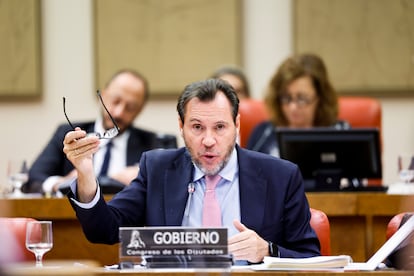
Demands for Puente’s resignation had been loud among the political right. As he did so, Puente also noted that nobody resigned when the PP was in government during some of Spain’s worst tragedies, including the train crash in Galicia in 2013 and the flash flooding in Valencia.
Asked why he didn’t resign on day one, Puente argued he wanted to do it after investigating the accident, finding where the problems were, proposing solutions and finally giving explanations before Congress.
Sign up for our weekly newsletter to get more English-language news coverage from EL PAÍS USA Edition

christies
Pop Culture Up For Auction: The Booming Multimillion-Dollar Business Of Selling Celebrities’ Personal Belongings

Few stars manage to keep shining after their death, and of all of them Marilyn Monroe is perhaps the one who continues to inspire the greatest fascination. That enduring appeal is reflected in the success of auctions featuring all manner of items connected to her life. Almost everything associated with Monroe has been sold, and just when it seemed there was nothing left to auction off, a set of frying pans, a compact of rouge and a bra surfaced, all fetching astonishing sums at the auction organized by Julien’s Auctions in Los Angeles last June to mark the centenary of the late actress’s birth.
While Monroe may be the most emblematic, she is just one example of how the market for celebrities’ personal belongings is booming, attracting devoted fans with the means to spend tens of thousands of dollars on everything from something as mundane as a coffee maker, such as David Lynch’s, which sold for $35,000 in June 2025, to one-of-a-kind items such as the script for the penultimate episode of Friends that belonged to Matthew Perry and was sold for $75,000 this summer at a charity auction benefiting the actor’s namesake foundation, which focuses on recovery from substance abuse.
Within its Popular Culture category, the legendary Christie’s, whose origins date back to 1766, has sold such iconic pieces as Eric Clapton’s Blackie guitar and the original script of Breakfast at Tiffany’s, once owned by Audrey Hepburn. Among its most notable achievements in recent years was the sale of what remains the most expensive work of 20th-century art, Andy Warhol’s portrait of Marilyn Monroe, Shot Sage Blue Marilyn, which fetched $195 million in 2022. Although this was a work of art rather than a personal belonging, the staggering price nevertheless reflects the enduring fascination certain figures continue to inspire.

María García Yelo, CEO of Christie’s in Spain, attributes the success of items linked to the worlds of film, music and entertainment to their ability to provide “a tangible connection to the people and moments that have shaped popular culture.” She offers an anecdote that illustrates their “emotional power”:
“During the 2006 auction of Princess Margaret’s belongings, an elderly woman arrived with money her husband had given her for their wedding anniversary, intent on buying one of the pieces,” she recalls. “Although she was outbid again and again, she did not give up until she finally managed to acquire an umbrella that had belonged to Princess Margaret. By then, many in the room already knew of her story and her deep admiration for the princess. When the hammer fell in her favor, the room broke into applause.”
Among items associated with royal families, jewelry attracts particular interest because it combines history, luxury and celebrity. And some of the buyers are well-known celebrities themselves. For example, Elizabeth Taylor and Joan Collins bid on pieces owned by Wallis Simpson in the late 1980s.
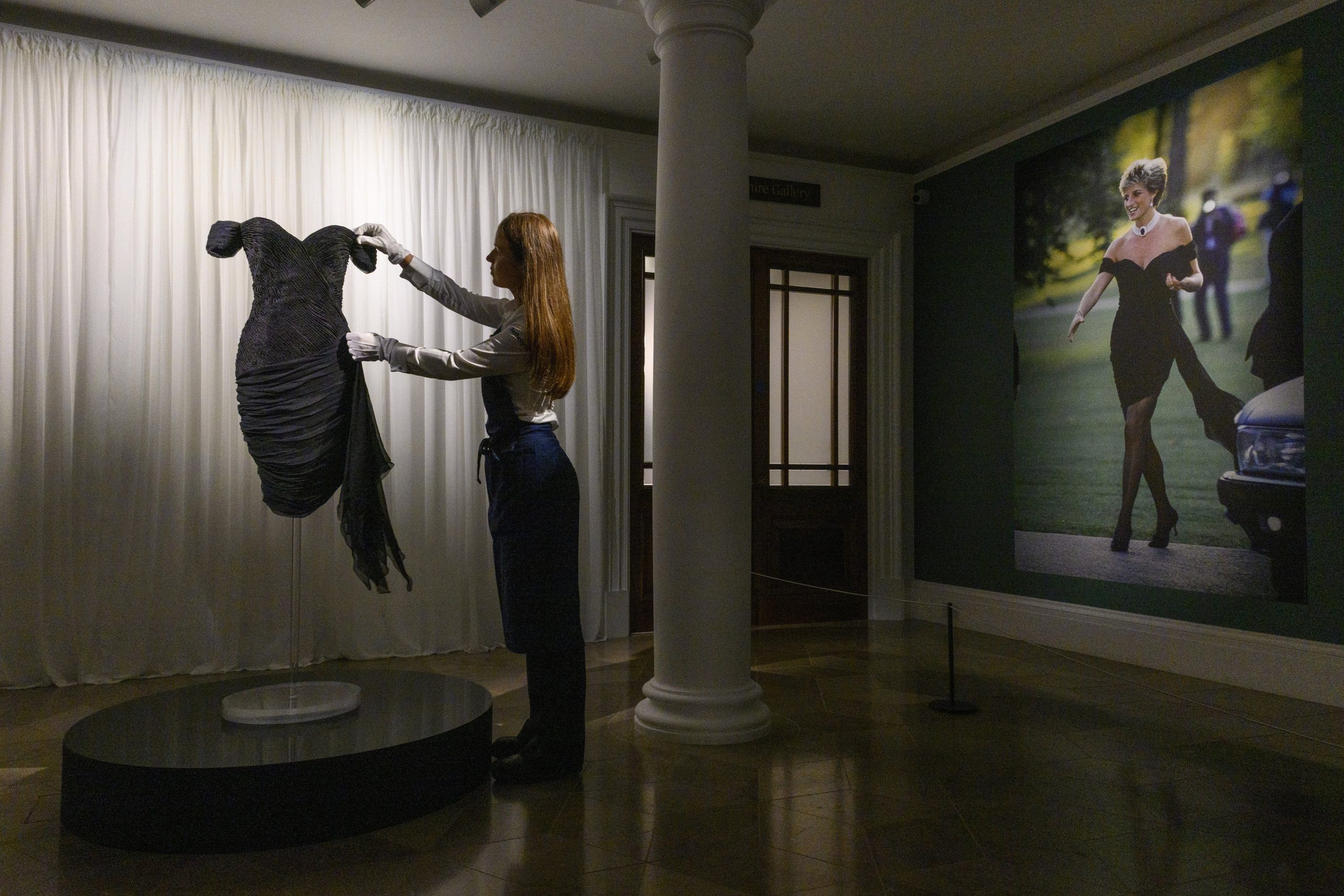
More recently, Kim Kardashian paid £163,800 (about $198,000 at the time) at a Sotheby’s auction in 2023 to acquire the late Princess Diana’s Attallah Cross, a diamond-and-amethyst pendant that the reality TV star has since worn on several occasions. On December 9, Sotheby’s will auction the iconic “revenge dress” worn by Princess Diana, which is expected to fetch between €130,000 and €258,000 ($145,000 and $288,000).

“A piece with a documented history, or one that belonged to a prominent figure, carries added value that goes beyond its material worth,” explains Alfonso Mato Yllera, CEO of Ansorena, one of Spain’s most emblematic jewelry houses and also a specialist in auctions. (The company recently made headlines after being tasked with appraising jewelry seized from former Spanish prime minister José Luis Rodríguez Zapatero.)
“That provenance captures the interest of collectors and the general public alike, generates greater anticipation and often drives the final price well above the initial estimate. That is why we take such care with the research and documentation of each story,” he adds.
Everyday objects from extraordinary lives
The eclectic catalogs of auction houses specializing in popular culture, such as Heritage Auctions, the aforementioned Julien’s Auctions and Profiles in History, reflect the growing demand for celebrity memorabilia.
Journalist María Estévez, who has lived in Los Angeles for two decades and is the author of Esto es Hollywood (This Is Hollywood), traces the origins of the business to the landmark sale conducted by Metro-Goldwyn-Mayer in the 1970s, when the studio disposed of thousands of items used in its films. In fact, pieces from that sale can still be found at some specialist auction houses today.
Estévez, who believes these auctions have expanded dramatically over the past 20 years, also points to the 2017 sale organized by the heirs of Debbie Reynolds and Carrie Fisher, both of whom died in 2016 and were passionate collectors of Hollywood memorabilia. The collection, comprising more than 1,500 items and larger than the holdings of many museums, included such iconic pieces as Carrie Fisher’s director’s chair from Return of the Jedi (1983) and one of Reynolds’s dresses from Singin’ in the Rain (1952).
Today, sales are no longer limited to movie props or belongings of major stars. Virtually any personal object with even a tenuous connection to a celebrity can find a buyer. Freddie Mercury’s mustache comb, which sold for nearly $189,000; writer Joan Didion’s collection of pebbles and seashells, which fetched $7,000; and Kurt Cobain’s cardigan, which sold for $334,000, are just a few examples. The closer an item comes to a celebrity’s private life, the greater its value tends to be, a phenomenon that becomes even more pronounced when the celebrity died young.
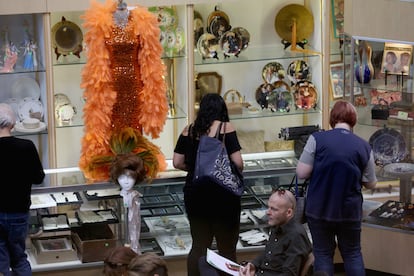
Although one might assume that, in a globalized world, the market is fairly homogeneous, Darren Julien, CEO of Julien’s Auctions, revealed in an interview with Arts & Collections that different regions often have distinct tastes.
“You’ll sometimes see certain celebrities sell well in France; certain bidders come out of Germany,” he said. “Usually Asia and Russia like western pop culture. When we did Cher’s auction, most of the bidders came out of the United States and the U.K. But each celebrity is different. You can’t really tell, sometimes, until you make the announcement.”
He continued: “When we did the Michael Jackson auction, we toured it to China and Japan, because he is hugely popular in Asia. Even though he is popular all over the world, China and Japan just have a huge infatuation with Michael Jackson.”
In a separate interview with The New Yorker, the auctioneer also touched on the moral dilemmas surrounding particularly sensitive sales. He recalled declining to sell a record that John Lennon had signed for Mark David Chapman, the man who later killed him. He chose not to handle the sale, although another company eventually auctioned the item for $1.5 million. He also revealed that he withdrew the bed in which Michael Jackson died from one of his auction catalogs at the request of the singer’s family. What he did sell, however, were Truman Capote’s ashes.
Behind every sale, especially when it involves objects of major historical significance, intense public interest or exceptional rarity, there are months of preparation. Specialists must verify an item’s authenticity and determine its starting price. But how does an object end up in the hands of an auction house in the first place?
There is no single answer. In the case of Christie’s, María García Yelo explains that “the objects featured in our catalogs usually come through clients, collectors and families with whom we have built long-standing relationships and who trust Christie’s to bring their pieces to the global market.”

In the case of companies that only auction celebrity memorabilia, commercial relationships are often built not only with consignors but sometimes with the celebrities themselves. As the sector has become more visible, auction houses also receive tips and direct offers from potential sellers. Some of the items included in Julien’s Auctions’ 2024 sale of Kurt Cobain memorabilia, for example, came from a fellow patient at the late musician’s rehabilitation clinic. Active searches and scouting efforts in all sorts of places are also common.
In addition, until relatively recently, auctions of personal belongings were generally associated with a celebrity’s death, a divorce or financial hardship. That perception has changed, and auctions of possessions belonging to living celebrities are now commonplace. Indeed, the founder of Julien’s Auctions has emphasized this point. As he explained in his interview with The New Yorker, he actively encourages stars to recognize the financial potential of these sales:
“We encourage, we educate them: ‘When you get done with the concert, put the jeans, the shirt, the shoes in a bag with the date and the city to put in the archives, because that could be $10,000, $20,000, $30,000,” he said. “It’s like printing money for a lot of these celebrities.”
Estévez links the success of pop-culture auctions to the rise of modern fandom. In recent years, partly due to the false sense of closeness that social media creates between celebrities and their audiences, fan communities have become highly visible, and not always for positive reasons.
“Feeding fandom is part of what has created this craze for collecting pieces from actors, characters, films… There are so many fandoms that you have to enter that world to understand why those prices are paid,” the journalist says.
“There is a lot of business built around these objects; it is not just collectors buying them, it does not work only that way,” says Estévez, adding that some buyers acquire items with the intention of reselling them later once their value has increased. There are even companies dedicated solely to this kind of trading.
There is no doubt that this market generates significant sums of money, particularly in the United States, which accounts for the bulk of sales and remains the epicenter of mass-market pop culture. Yet, viewed in the broader context of the auction industry, celebrity memorabilia is not the category that generates the highest revenues. It can, however, serve as a gateway for new buyers.
García Yelo puts it this way: “While the sale of items linked to famous cultural figures usually generates considerable media attention, it does not reach the highest figures at auction, unlike 20th- and 21st-century art or exceptional, rare jewels. Nonetheless, these sales play an important role that transcends their economic results: they attract a broader — often younger — audience and introduce new collectors to the world of auctions and collecting.”
Sign up for our weekly newsletter to get more English-language news coverage from EL PAÍS USA Edition

Italian Justice Reopens Case Of Pier Paolo Pasolini’s Murder, 51 Years After His Death

Spain’s Transportation Minister Steps Down Over Train Crash To Try To Save The Socialist Campaign Ahead Of Elections

Hannah Murray: The Familiar Voice Winning Hearts On The Costa Del Sol


-

 Arabia Saudí4 weeks ago
Un Ataque De Los Hutíes Contra El Aeropuerto De Riad Causa Al Menos 12 Muertos Y Más De 300 Heridos
-
DGT3 weeks ago
Viral video in Spain sparks fury over drivers who ‘have no idea how to drive’
-

 %4 weeks ago
Spain Payslip Change Coming In January 2027
-

 America4 weeks ago
Un Tirador Mata A Ocho Personas En Una Vivienda En Pensilvania
-
 House prices4 weeks ago
Spanish House Prices Rise 9pc But Market Growth Stalls In H1 2026
-
Costa Blanca North4 weeks ago
Jávea opens historic lighthouse to the public with a new whale-watching viewpoint
-

 America4 weeks ago
Trump Llega A Un Acuerdo Con Putin Para Que Rusia Libere Miles De Barriles De Diésel En Los Mercados Mundiales
-

 %4 weeks ago
Concrete Balcony Slabs Collapse Onto Marbella Street