
House prices
Spanish House Prices Rise 9pc But Market Growth Stalls In H1 2026

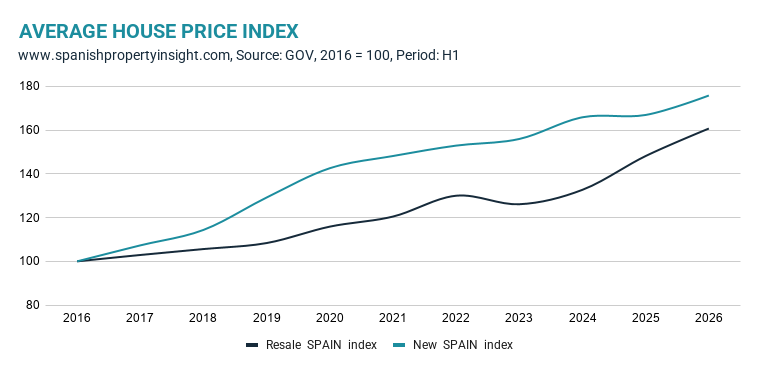
Spanish house prices continue to climb, but the total value of sales has barely increased despite the market more than doubling in size over the last decade. Are buyers finally reaching their limits?
Spanish house prices continued climbing in the first half of 2026, but the total value of homes sold barely increased. The latest figures from the Ministry of Housing suggest a market increasingly constrained by affordability, with prices still rising strongly even as sales lose momentum.
The latest figures from Spain’s Ministry of Housing show the average price of a residential property sold in the first half of 2026 reached €225,493, up 9% compared to the same period last year. New homes averaged €300,910, whilst resale properties averaged €217,956.
The figures confirm that house prices are still rising strongly, particularly in the resale market, despite signs that demand is beginning to cool.
House prices have risen by more than 50% in a decade
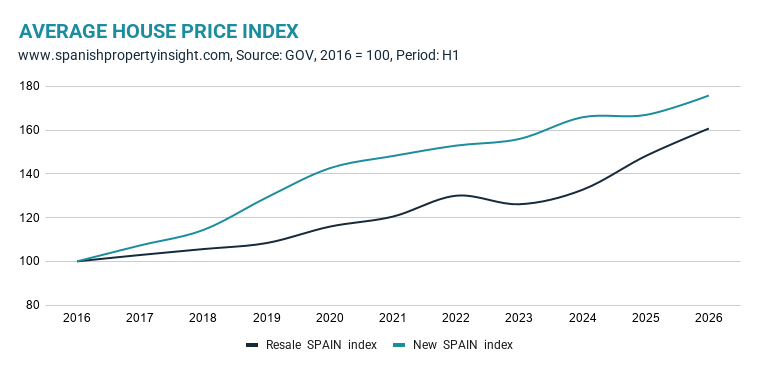
Over the last ten years, the average price of all homes sold has increased by 51%, with new-build prices rising 76% and resale prices 61%.
One interesting development is the narrowing gap between new and resale prices. In 2024, new homes sold for an average of 58% more than resale properties. By H1 2026, that premium had fallen to 38%.
One possible explanation is that buyers are increasingly being priced out of new developments and forced to compete for existing homes. With demand outstripping supply and household budgets stretched, buyers may be paying more for resale properties because they have little choice. Most would probably prefer a new home if they could afford one, but the market doesn’t always offer what buyers want at a price they can pay.
Market value stalls despite rising prices
The total value of residential property transactions in Spain reached €38.7 billion in H1 2026, compared to €38.4 billion a year earlier. That’s an increase of just 0.6%, despite average prices rising by 9%.
Over the last decade, the market has more than doubled in value, from €15 billion in H1 2016 to almost €39 billion today. But the latest figures suggest that growth is running out of steam.
If prices are rising by 9% whilst the total value of transactions is virtually unchanged, the implication is that fewer homes are changing hands, or that the mix of properties sold has shifted towards cheaper homes, or both.
Higher prices are clearly making homes less affordable, whilst rising borrowing costs and political uncertainty may also be weighing on demand.
What does this mean for buyers and sellers?
The Spanish housing market appears to be moving into a new phase. Prices are still rising strongly, supported by a chronic shortage of supply, but transaction values suggest buyers are increasingly struggling to keep up.
For sellers, this may be a good time to consider going to market whilst prices remain high, rather than waiting for demand to weaken further. For buyers, there is little sign of a price correction just yet, but the slowdown in market activity could eventually improve their negotiating position.
The key question for the second half of 2026 is whether sales can stabilise without a significant correction in prices. For now, the market looks more like a slowdown than a slump.
Are you thinking of selling your property in Spain?
Whether you are thinking of selling or simply want to understand the market around one of your most valuable assets, an SPI personalised market report gives you unique, expert insight into your local market segment and what it means for you, so you can make informed decisions. Fill in this form to find out more.













Lollapalooza Chile 2027: Charli XCX, Travis Scott And The Killers Headline The Lineup Of Artists For The Festival

Spanish House Prices Rise 9pc But Market Growth Stalls In H1 2026

Egypt Steps Up Persecution Of Independent Media With Arrest And Alleged Torture Of Six Journalists From An Investigative Outlet


-

 Uncategorized2 weeks ago
F1 Qualifying Today: Azerbaijan Grand Prix schedule, times and TV channel
-

 %2 weeks ago
Is Your Supermarket Kefir Really Kefir? Spanish Study Raises A Surprising Question
-

 Uncategorized1 week ago
F1 Bahrain Grand Prix will be live and FREE on TV this weekend
-
Barter system2 weeks ago
British drug dealer swaps cocaine for Pokémon cards in bizarre barter deal
-

 Cody Gakpo2 weeks ago
Xavi Y Klopp Se Reparten Puntos En Su Debut Como Seleccionadores
-

 Canada2 weeks ago
East Coast Braces For Early-Season Nor’easter
-

 Latest2 weeks ago
Living Alone Becomes A Real Luxury In Spain With Rents Triple Cost Of Flat-Share In Major Cities
-

 Ayuntamiento Barcelona2 weeks ago
Barcelona Dispara La Tasa Turística A Los Cruceristas De Paso: Pagarán 30 Euros Al Día En 2030