
california
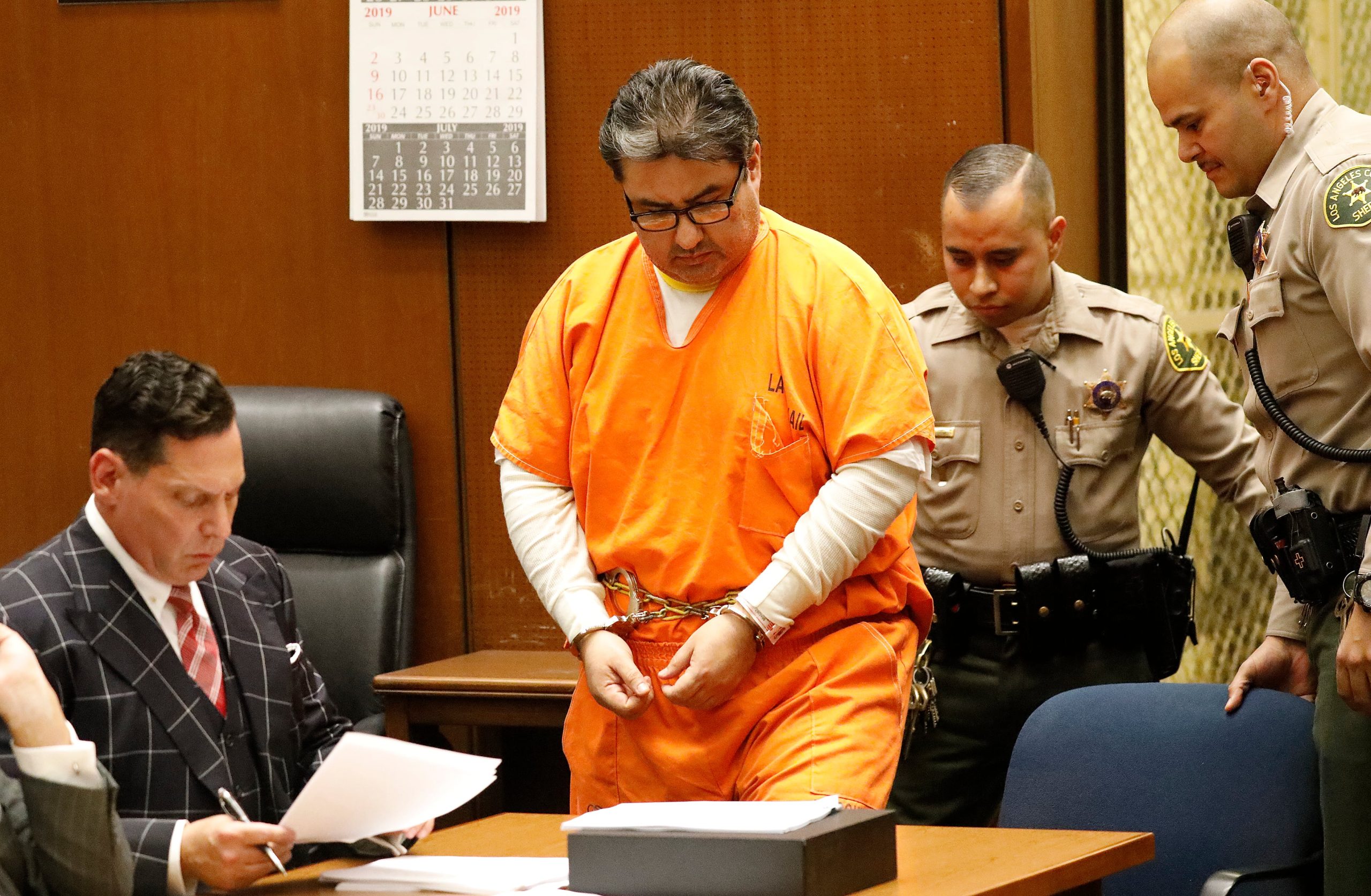
Between Confessing His Sins In Court And Striking Another Deal With Prosecutors: The Dilemma Facing Naasón Joaquín, Leader Of La Luz Del Mundo In The US







california
Kyle Eastwood, Son Of Clint Eastwood: ‘My Father Has Played Many Tough Guys, But He Is Not As Tough As He Seems’

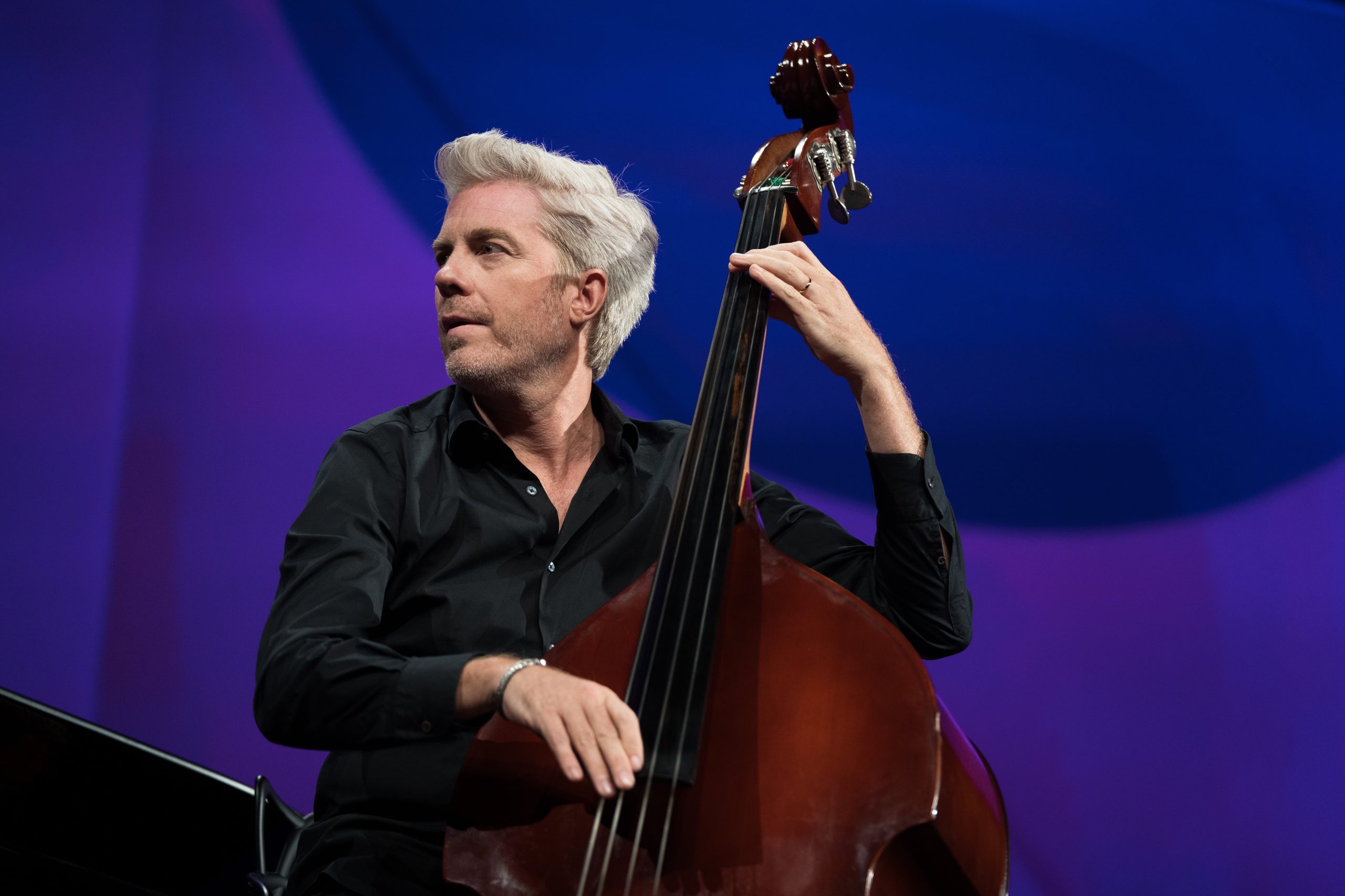
Kyle Eastwood was only nine when he went to his first concert, but he remembers it as if it were yesterday. In late summer 1977, his father, the actor and director Clint Eastwood, took him to Monterey to see the legendary Count Basie Orchestra. That night Joe Williams, the guest star, sang classics such as The Heat’s On, Cherry and Things Ain’t What They Used to Be. The Eastwoods watched the second half of the show from the backstage area and later greeted Basie and Williams. “I was struck by Count and Joe’s stage presence. They had an indescribable energy,” Eastwood, 58, says in a telephone interview with EL PAÍS from his home in Paris, where he has lived for more than a decade.
At around the same age, Clint Eastwood’s eldest son made his first forays into acting. He played his father’s son in the western The Outlaw Josey Wales (1976) and an orphan in Bronco Billy (1980), and had roles in Honkytonk Man (1982) and The Bridges of Madison County (1995). “I always liked movies, but I also liked music.” As a child he did his homework listening to Duke Ellington, Miles Davis, Chet Baker, Stan Getz and Dave Brubeck. “Basically I listened to my parents’ jazz and blues records. I grew up in the 1970s, so I had the radio on all day: a bit of Johnny Cash, R&B, funk, rock…”.
He spent his childhood between a Spanish Colonial–style house in the small town of Carmel and the vast Rising River ranch, once owned by Bing Crosby. The Eastwoods did not live in Los Angeles, but the family patriarch taught his children to love movies. On weekends they watched classic films from the 1930s and 1940s. “My favorites were the ones with Cary Grant and James Cagney,” he recalls. His father also encouraged him to keep exploring his curiosity about music. He taught him piano and introduced him to Ella Fitzgerald, Dizzy Gillespie, Stan Getz, Art Pepper and Sarah Vaughan, among others. “My father has played many tough guys, but he is not as tough as he looks on screen. He really enjoyed his work and taught us to do what we love. He instilled in us a sense of commitment and dedication to our craft.”
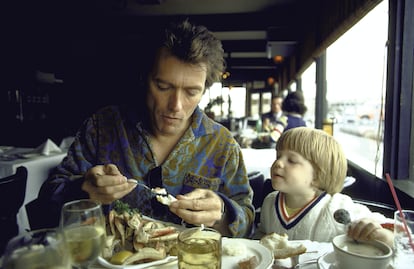
Kyle used to visit his father’s film sets and spent a lot of time with the composer and arranger Lennie Niehaus, who scored major films such as Unforgiven, Bird, The Bridges of Madison County and Midnight in the Garden of Good and Evil. He studied film intending to become a director, but eventually realized his path was music. He started on piano, then moved to guitar, bass, and finally the double bass.
At 23, after turning down a tempting offer from the U.S. pop market, he formed his own jazz group, the West Quintet, and seven years later, in 1998, released the record that made him internationally known: From There to Here. That album, featuring collaborations with Joni Mitchell, trumpeter Mark Isham and drummer Peter Erskine, earned critical acclaim and established his name. “At times in my life I felt tensions because of the last name I carry. Sometimes people have preconceived notions about who you are and what you do. They form an idea before they meet you. I’d like to think that now they listen to my music and judge me on that.”
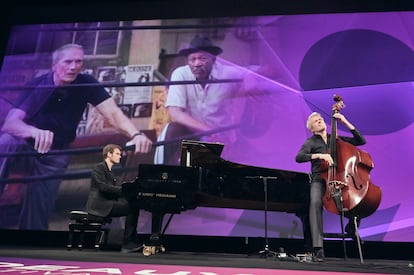
Six of his seven siblings work in the film industry. He is the only one who makes his living through music, but he has never completely broken with the family’s “vocation.” He has collaborated on the composition and arrangements for seven of his father’s films: The Rookie (1990), Mystic River (2003), Million Dollar Baby (2004), Flags of Our Fathers (2006), Letters from Iwo Jima (2006), Gran Torino (2008) and Invictus (2009). On Sunday November 15 he performed with his quintet as part of the Madrid International Jazz Festival. In his show, titled Eastwood by Eastwood, he reinterpreted in jazz key the film scores from his father’s filmography written by Ennio Morricone, Lalo Schifrin, John Williams, Lennie Niehaus, and himself.

He has played in Spain many times and knows the country well. “I listen to a lot of flamenco. I wrote a song called Andalucía. I like Paco de Lucía. I saw him play many times and had the pleasure of opening for him a couple of times a long time ago. Once in Italy and once in France,” he says. Told that on his visit to Madrid he might run into Woody Allen, another Hollywood star enamored of jazz, who is filming a movie in the Spanish capital, he replies: “Is he filming again? In Spain? I didn’t know. Years ago I saw him play with his band in New York, but I don’t know him personally.”
Kyle has long been removed from the Hollywood ecosystem in which he grew up. “Hollywood has changed a lot in recent years. As a child I met Bette Davis and Gregory Peck, the last stars of the golden age of cinema. Many of those people are gone. There’s nothing left of that golden Hollywood. For better or worse, the film industry today is different,” he says. This summer he announced that his father, 96, was retiring after seven decades in front of and behind the camera. “He’s happy. He’s worked a lot all his life and now he’s relaxed. He’s taking time to be with family and enjoy life.”
Clint Eastwood, who served as mayor of Carmel in the 1980s, has long been associated with the Republican Party. He voted for Nixon in the late 1960s. In the 1970s he became very critical of Nixon’s foreign policy, especially the management of the Vietnam War, which ended the lives of thousands of Americans and millions of Vietnamese. In the early 2000s the actor and director showed support for the Democrats because of their environmental policies, but later he was harsh toward Barack Obama. “When someone doesn’t do their job, they should be removed,” he said at the 2012 Republican Convention. In the 2016 election he backed Donald Trump. He later said: “I approve of some things he has done these past years, but I wish he would behave more courteously, without tweeting or insulting people. Personally, I’d prefer he didn’t stoop to that level.”
His son is a bit more critical of Trump. “Things are going so badly in my country that I hope there will be change in the coming years for the good of everyone. What’s happening is frightening,” he admits. But he does not want to talk much about politics. He says it’s not his favorite topic and that today people are more afraid to speak out publicly because words are being used as “weapons.” “But if you ask for my opinion, I’ll tell you. Right now politics is a depressing thing, and not only in the United States. It’s happening in many countries.”
He condemns the actions of ICE, the controversial agency responsible for enforcing immigration laws in his country. “I grew up in California, so I have many Hispanic friends. My wife is of Mexican and Spanish descent. I speak a little Spanish. U.S. immigration laws need reform, but what we are seeing with ICE is very sad,” he says about the raids and deportations. Would he play for the president if invited to the White House? “I probably wouldn’t. I don’t think so… I wouldn’t play for him. I’m not a big fan of this administration.”
Sign up for our weekly newsletter to get more English-language news coverage from EL PAÍS USA Edition
california
‘Endeavour,’ The First Space Shuttle To Be Seen In A Museum, Finds Permanent Home In Los Angeles

Fifteen years have passed since the Endeavour last watched sunrises from space. After 25 missions over 19 years, it was in May 2011 that the famed space shuttle began its final flight and separated from its longtime companion, the International Space Station. It was its final major flight, but not its last. After landing in Florida, the shuttle was, curiously, flown by airplane to Los Angeles, California. It has spent the intervening years under wraps. Now, at last, it will be exhibited to the public.
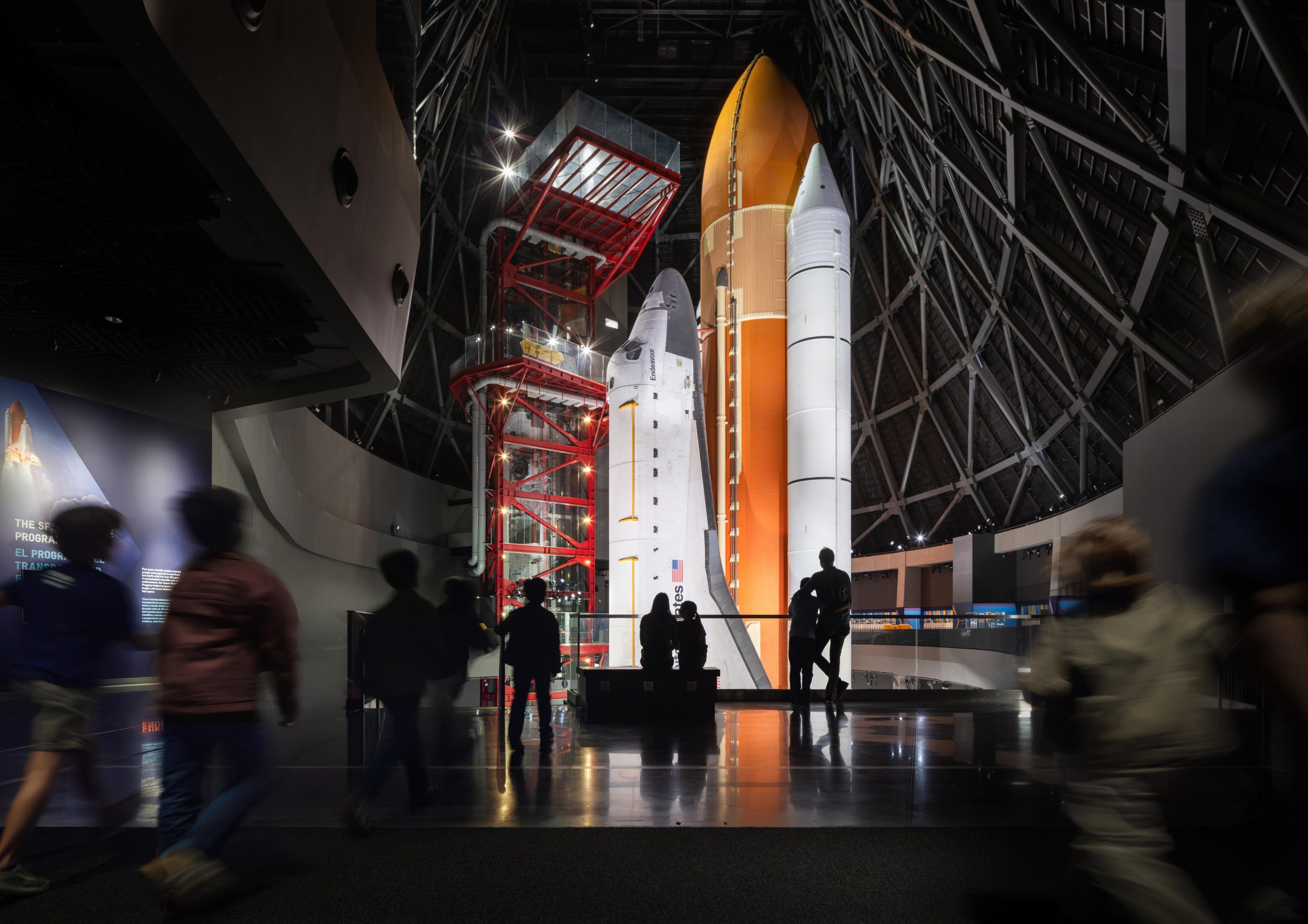
The California Science Center (CSC) is showing the Endeavour in all its glory. It is a milestone for Los Angeles and notable because the CSC becomes the first museum in the world where a space shuttle can be viewed. After arriving in October 2012 and being moved from the airport along barely two miles of streets in a complex operation lasting several hours, 14 years later the Endeavour is finally on public display. On November 13, the ribbon will be cut to give a second life to the ship that succeeded the Challenger.
A couple of weeks earlier, museum officials and state authorities came to view the shuttle, already in place, and to present it to the press. Among them was then–California governor Gavin Newsom, in one of his last public acts before finishing his double term, shortly before being succeeded by fellow Democrat Xavier Becerra. Newsom said he was amazed by the Endeavour, and he congratulated and posed for photos with technicians, museum officials, and Lynda Oschin, the widow of Samuel Oschin — the businessman and philanthropist who gives his name to the CSC’s new wing, built for the occasion — and president of the family foundation. The Oschin family have been the $450 million-project’s main donors.
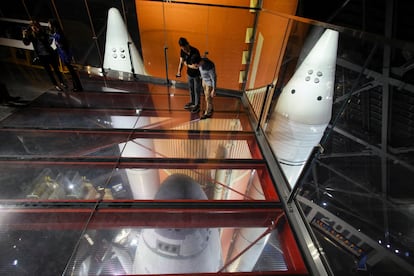
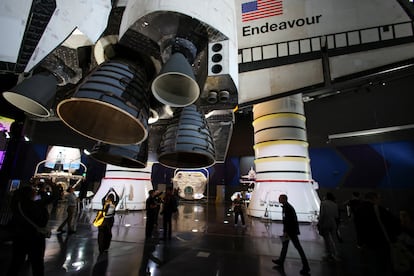
Entering that new area, visitors find themselves at mid-height beside the imposing, fully restored orbiter. To reach it they can take stairs (regular or escalator), an elevator… or a tubular slide built through the core of the museum that is the fastest route. Having descended, they can see its engines, its turbines, the base of the whole structure, and separately the cockpit interior. Then they take an elevator that rises to a height equivalent to a 20-storey building in a matter of seconds to view the top of the Endeavour. It is unsuitable for those who suffer from vertigo — it is fast and transparent.
Beside the orbiter sits an immense orange tank, known as the ET (for external tank), which has been repaired for the exhibition, as Rosemary Garista, the center’s community programs manager, explains. “It contained the liquid fuel and the boosters, but it is empty now. It was missing some pieces, so we fully restored it,” she told EL PAÍS. The tank is the last ET-94 built to propel these ships into space.
Garista and the rest of the more than 300 staff members (some state employees, some museum employees) were excited to finally be able to show the craft to the world. They were also pleased that it would become a tourist draw that would encourage visitors to the museum’s other two wings, which display some of the machines that helped build those spacecraft, as well as various aircraft, including a Boeing with a simulated flight from Los Angeles to Seoul. Guides expect a flood of visitors and insist tickets be reserved in advance.
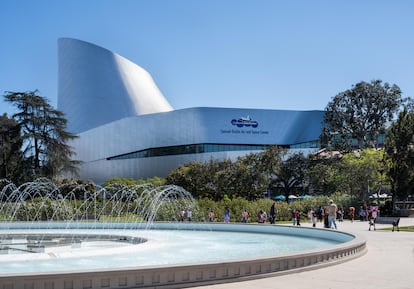
The entire new wing — which is dark and austere on the inside, with the Endeavour taking center stage — took over a decade to build. Those in charge say that while transporting the spacecraft from Houston, Texas, to this location was a major challenge, constructing the building (with grants and funding; in fact, $35 million remains to be paid, for which they are seeking donations) was no less so. Now, it can be seen from the rest of the city as a sort of wide metal chimney gleaming in an elevated area. The museum shares space with the newly opened Lucas Museum of Narrative Art, which opened in late September, and the century-old Memorial Coliseum — currently undergoing renovations — which will host the opening ceremony of the Los Angeles Olympic Games in the summer of 2028.
During his visit to the museum, Newsom expressed pride that the ship had been built in California and that it had returned there as a final destination to be seen by millions of people. “California has never been a state that waits for the future. We build it. We’re a state of dreamers and doers, where world-class engineers and scientists are leading the way in aerospace innovation. That’s the California spirit — investing in what’s next, pushing the limits of what’s possible, and proving once again that the future happens here first,” he said.
Never one to shy from the spotlight, Newsom rode the slide down to the base of the new wing, which has been named the Samuel Oschin Air and Space Center. It covers up to 200,000 square feet, doubling the museum’s exhibition space, its president Jeffrey N. Rudolph said in presenting it, while explaining it will feature 100 new artifacts and another 100 interactive experiences. “Today, that 1992 dream is now reality,” he said.
Ken Phillips, the museum’s exhibitions director, told the audience emotionally that he had worked at the museum for 37 years and after all the waiting could not believe the day had finally come for the world to see the Endeavour and its new home: “It’s inspiring; I hope it will be transformative, but above all, it’s an invitation — because we hope that people who haven’t had this experience will be convinced and surprised to discover that there’s a place for them in this technologically advanced society we’re moving toward.”
Sign up for our weekly newsletter to get more English-language news coverage from EL PAÍS USA Edition
America
Thomas Markle Se Corta La Pulsera Electrónica De Vigilancia Y La Jueza Decide Meterlo En Prisión Sin Fianza
Spain’s railway chaos deepens as minimum services ignored and fresh strike threatens

Spain’s Railway Chaos Deepens As Minimum Services Ignored And Fresh Strike Threatens
Dogs on the loose: Two AP-7 incidents raise Costa del Sol safety concerns


-

 New Developments3 weeks ago
Luxury Villas For Sale, Estepona – ProjectL1
-
Age Concern Marbella - San Pedro3 weeks ago
Halloween lunch sells out as 51 join Marbella get-together
-

 New Developments3 weeks ago
How To Get A Tourist Rental Licence In Andalusia (Spain) – Step-By-Step Guide 2025
-

 %3 weeks ago
Spain Orders Replacement Of Eight Million Gas Meters: New Rules, Costs And Deadlines
-

 New Developments2 weeks ago
The San Roque Club – Townhouses For Sale
-
Barcelona riots3 weeks ago
Looting and street violence hit Barcelona as El Corte Inglés customers are trapped
-
countryside3 weeks ago
Rural revival: Five Almeria villages make moving inland easier and more enticing
-

 New Developments4 weeks ago
Inside The Most LUXURIOUS Apartment Building In Spain!