Connect with us

%

Bomb Scare In Greece

Published

on

bomb-scare-in-greece

Cruise ship evacuated after bomb threat sparks major security alert in Greece Credit: Wikipedia

An Israel-bound cruise ship was evacuated at a Greek island port after an anonymous bomb threat sparked an extensive security operation, leaving more than 1,500 passengers and crew waiting for the all-clear.

The incident unfolded on Tuesday, November 3, when Greek authorities received a warning claiming an explosive device had been attached to the hull of the Crown Iris, which was docked at the port of Syros in the Aegean Sea.

The Panama-flagged vessel, operated by Israeli company Mano Maritime, was preparing to depart for Haifa in northern Israel when the threat was reported.

A total of 940 passengers and 597 crew members were on board, prompting an immediate security response.

Passengers forced to leave cruise ship

Authorities ordered passengers and crew to disembark while specialists began inspecting the vessel.

The operation involved Greek Coast Guard personnel, an explosives-detection dog and a private diver, who helped investigate the possibility of a device being attached to the ship’s hull.

A specialist Coast Guard diving unit was also deployed to carry out further checks.

Initial inspections found no suspicious objects or evidence of explosives. However, authorities continued with additional security procedures before allowing the vessel to resume its journey.

Passengers were left waiting ashore during the operation, with some reportedly taking shelter in a nearby hotel.

According to accounts from passengers reported by Israeli media, crew members distributed water and chairs to those waiting, while elderly travellers and families with children were accommodated indoors.

Despite the disruption, passengers reportedly remained calm as they awaited confirmation that it was safe to return.

Full search finds no explosives

A subsequent, more comprehensive inspection of the Crown Iris also failed to uncover any suspicious devices.

Passengers and crew were subsequently permitted to return aboard, with the ship expected to continue its journey to Haifa.

Greek authorities have not publicly identified the person responsible for the anonymous warning, and no confirmed link has been established between the cruise ship incident and other security alerts reported across Europe.

Wave of bomb threats disrupts European travel

The cruise ship scare came amid an unusual series of bomb threats affecting passenger transport across Europe on Tuesday.

At least seven commercial flights travelling to destinations in Poland, Italy, Spain and Bulgaria were targeted by similar warnings, triggering aircraft inspections, diversions and temporary disruption at airports.

Among the incidents was a Ryanair service travelling from Manchester to Murcia in southern Spain, which underwent security checks after a bomb threat was reported.

A flight from Dublin to Rome was also escorted by Italian Air Force fighter jets before landing safely, while another aircraft travelling from London Heathrow to Warsaw was diverted to a nearby airport.

Authorities inspected the affected aircraft, but no explosives were discovered. Investigators have yet to establish who made the threats or whether the incidents were connected.

The unusual concentration of security alerts has raised questions about potential coordinated disruption, although officials have cautioned against drawing conclusions before investigations are completed.

%

Meet Rescued Horses In Coin

Published

on

meet-rescued-horses-in-coin

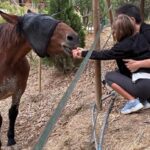
Picture a horse nuzzling your hand in search of a carrot, or a table covered in ribbons, glitter and handmade stars. Saturday, November 14 brings two wonderful reasons to visit an animal sanctuary and help animals that were once given up on.

Two events, one lovely Saturday

Todos los Caballos del Mundo or “All the Horses in the World”, is hosting a guided visit for all the family and a Christmas crafts workshop on the same morning at Ctra. de Borrajo, s/n, 29120 Alhaurin el Grande, Malaga

This guided visit runs entirely in English, from 10:30am to 12:30. You can wander the paddocks, hear the animals’ stories and meet the people who look after them with children are very welcome.

Entry is by donation: €10 for adults and €5 for children under 12, and under-threes go free. All of it goes towards the animals’ care. Please bring carrots for the horses and leave pets at home so the residents stay calm.

Limited spaces are available so you need to book at todosloscaballosdelmundo.com. Go to the “Visits” section and select 14 November.

Make your own Christmas decorations

Prefer something creative? The sanctuary’s Christmas workshop, is a morning of festive crafting surrounded by nature and animals. Organisers promise personalised ornaments and some surprises. Think stars, snowflakes, Christmas trees and reindeers. No experience is needed, only a willingness to have fun.

Tickets cost €30 per person, and is open to everyone so friends, couples and families can all join in. Everyone takes home their own handmade creations, which makes this a lovely way to get ahead on tree decorations or gifts.

Capacity is also limited for this event. To reserve, send a WhatsApp message on 660 092 092.

The sisters behind the sanctuary

Sisters Concordia and Virginia Marquez Garcia founded the charity roughly two decades ago, after moving to Malaga and finding horses abandoned and mistreated. Today it cares for hundreds of animals, including donkeys, dogs and cats, many of them rescued from neglect or illness. It is one of the country’s largest equine sanctuaries.

Can’t make it? You can still help

Anyone unable to attend has other ways to lend a hand. The sanctuary welcomes donations of food, blankets, towels and other useful items. Volunteers are always appreciated, and following and sharing @todosloscaballosdelmundo on social media helps spread the word.

Whichever event you choose, you will leave with a warm feeling, and perhaps a new four-legged friend to sponsor. For more information visit the charity website or social media channels.

Continue Reading

%

Another Day Of Commuter Train Chaos

Published

on

another-day-of-commuter-train-chaos

Cercanias commuter train broken down again on the Fuengirola line.

Repeated breakdowns raise questions over investment (or a lack of), reliability and whether a change of government could make a difference. Costa del Sol citizens are at the end of their tether.

Passengers travelling between Malaga and Fuengirola faced another day of disruption and waiting on Thursday, November 5, after a technical fault on a Cercanías (commuter) train caused widespread delays, cancellations and overcrowding.

The latest problems affected the C1 line, with passengers reporting waits of up to an hour at Plaza Mayor. Some trains were running late, while passengers reported smoke and an unusual smell around the wheels of a train at La Colina in Torremolinos. Some services were cancelled and others required passengers to change trains.

According to Málaga Hoy’s report on the latest Cercanías disruption, the problems also affected the C2 service between Malaga and Alora.

A difficult week for Malaga commuters

Thursday’s disruption followed three consecutive days of problems reported across the network, with delays, cancelled services and compulsory changes of train.

On Sunday, November 1, around 20 passengers were left stranded after a technical failure stopped the last train travelling towards Fuengirola. Renfe eventually arranged taxis to take them home. EWN previously reported the late-night breakdown which left Malaga passengers stranded.

The following night, a man died after being struck by a train near Torreblanca, forcing the suspension of services between Benalmadena and Fuengirola. This was a separate and tragic incident, rather than a mechanical failure. Even more operational problems followed on Tuesday and Wednesday, before Thursday’s technical fault brought another round of passenger complaints.

Spanish newspaper El Español counted 37 service disruption notices on Thursday alone, covering delays, cancellations, partial interruptions and a compulsory passenger transfer. Renfe attributed the latest C1 problems to a technical fault affecting one train, while the C2 experienced separate difficulties.

Why the Fuengirola railway is significant

The 32-kilometre C1 connects Malaga city with the airport, Torremolinos, Benalmadena and Fuengirola. It is an essential transport link for residents commuting to work, tourists travelling between resorts and airport passengers avoiding increasingly congested roads.

Renfe’s 2025 passenger figures show that Malaga’s two Cercanías lines carried 15.54 million passengers last year, with the bulk of demand concentrated on the C1. At some points, passenger numbers reach 150 per cent of available seating capacity.

Renfe plans to invest €66.7 million in seven new high-capacity trains for the Fuengirola route, expected to enter service from 2028. A further €40 million is earmarked for a new maintenance workshop.

Meanwhile, Adif has been working on a project to add 2.8 kilometres of double track between Malaga Airport and Campamento Benitez, helping to address infrastructure limitations that restrict how frequently trains can run.

Could we do with a change?

Responsibility for Spain’s state railway network ultimately falls on the national government through the Transport Ministry, Adif and Renfe. A change of administration in Madrid could therefore bring different investment priorities, management decisions and expectations for service improvements.

However, replacing the government would not automatically solve the railway’s problems. The infrastructure limitations, maintenance requirements and growing passenger numbers would still need to be addressed. For thousands of people who depend on the C1 every day, the promised new trains and infrastructure improvements offer some hope, but they will not arrive overnight.

Whether under the present administration or a future government, the question remains the same: how can a railway serving one of Spain’s busiest coastal areas provide a service passengers can actually rely on?

Continue Reading

%

‘An Insult To Italian Culture’: Chef Fired After Refusing To Put Pineapple On Pizza

Published

on

‘an-insult-to-italian-culture’:-chef-fired-after-refusing-to-put-pineapple-on-pizza

Management said the topping was not the only problem. Photo credit: Emma’sPics/Shutterstock

There are some things Italians take very seriously: their coffee, their pasta, their nonna, their olive oil and, apparently, the right of a pizza to remain pineapple-free. One Italian chef was so opposed to the tropical topping that he refused to make it for customers, even after his boss asked him repeatedly.

Davide Tamburella, who worked at La Costa Restaurant and Bar in Brisbane, Australia, considered putting pineapple on pizza an insult to his Italian culture. His refusal to prepare ham and pineapple pizzas for a private function became one of several issues raised by management before he was dismissed in May. The dispute has since reached Australia’s Fair Work Commission, turning one of the world’s most divisive pizza toppings into an employment case. 

A pizza topping that crossed a line

This was not Tamburella’s first disagreement with his employer over pineapple. According to the commission’s findings, it was the third time in four years that he had refused to put the fruit on pizzas. On an earlier occasion, he had reportedly asked his boss to look into how important it was to Italians not to put pineapple on pizza. When the request came up again, he maintained that instructions from management did not have to be followed if they offended his culture.

His employer, Elliot Ingram, had a rather different concern: customers had ordered the pizzas, and the restaurant was expected to serve them. The function was reportedly worth more than AU$15,000, making the disagreement considerably more expensive than a heated debate over dinner. La Costa was in Queensland, Australia’s pineapple-growing heartland, where the fruit is big business. The state produces Australia’s commercially grown pineapples, so the chef had found himself defending Italian culinary tradition in the middle of pineapple country. 

The dispute was about more than pizza

Management said the topping was not the only problem. The complaints raised before Tamburella’s dismissal also included his use of inappropriate language, his communication style and what was described as growing frustration in the workplace. He had also injured his right hand after striking a metal handrail at work in April, fracturing bones in two places. Tamburella argued that the injury had played a part in his dismissal, alongside the dispute over the pizzas.

He was dismissed on May 20, around a fortnight after a meeting with management. The restaurant’s managing director later said there was more to the dispute than pineapple on pizza. That is worth remembering before imagining an entire restaurant throwing its hands up because one chef refused to reach for a tin of pineapple. 

Chef loses challenge over dismissal

Tamburella took his case to Australia’s Fair Work Commission, arguing that his dismissal was unfair. The commission rejected his application in a decision released on November 3. However, it did not rule that the restaurant was right to dismiss him over the pineapple dispute. His application had been lodged outside the legal time limit, and Commissioner Jennifer Hunt found there were no exceptional circumstances to justify accepting it late. The commission therefore did not determine the substantive fairness of the dismissal. 

The consequences extended beyond the kitchen. Tamburella had been pursuing an employer-sponsored permanent residency visa, a process he had reportedly spent more than three years working towards. After his dismissal, the restaurant ended its sponsorship, leaving him needing to find another employer if he wanted to pursue that route.

La Costa itself closed in July after its lease expired, with the owner citing high operating costs. Tamburella has since found work as head chef at another Brisbane Italian restaurant. In a final twist, pineapple is not on that restaurant’s menu. The chef may have lost his job and his first legal challenge, but at least his new kitchen appears to share his position on the great pineapple debate. Whether that is culinary principle or simply a very specific recruitment requirement is another question

Continue Reading

Trending

Copyright © 2017 Spanish Property & News