
Latest
EU Issues Ultimatum To Spain Over Non-Resident Property Tax


Esme Fox – esme@thelocal.es
Published: 4 May, 2026 CET. Updated: Mon 4 May 2026 15:08 CET

Brussels has again called out Madrid for taxing second home owners in Spain unfairly, giving them two months to take action or face litigation from the European Court of Justice.
Please sign up or log in to continue reading
More
Comments
See Also



Housing politics
Politics Destroys Barcelona’s Rental Market—despite Rents Going Nowhere For 20 Years

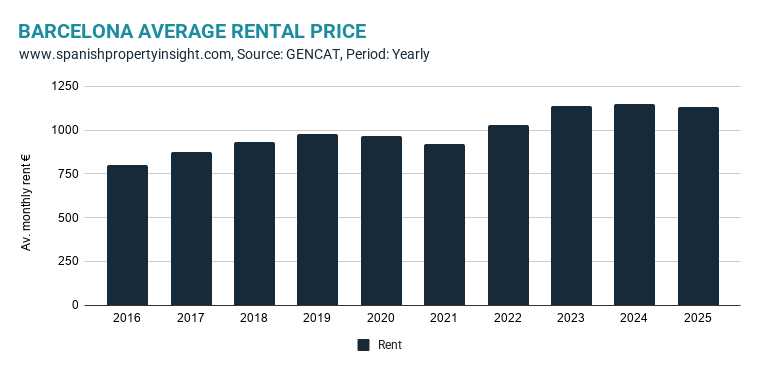
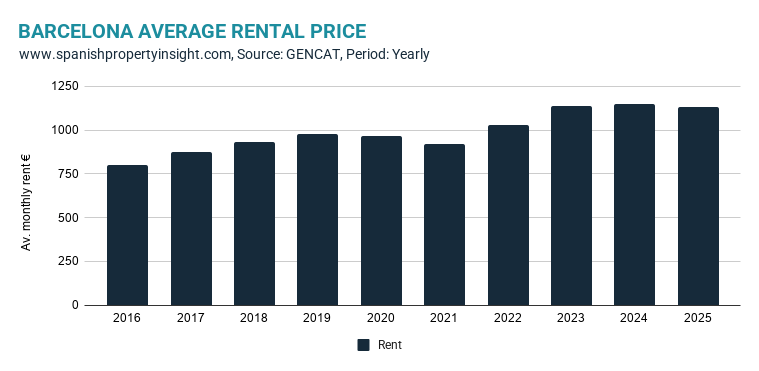
Barcelona’s latest rental data shows how politicians and housing activists have crippled the rental market with price controls, even though rents have barely risen in real terms for nearly two decades.
The latest figures from the Catalan government’s INCASÒL agency give us a full-year view of 2025, the first complete year under rent controls introduced in Q1 2024. And a clear pattern is emerging—one that goes far beyond the headline spin about “stable” or slightly falling rents.
Officially, the average rent in Barcelona was €1,134 in 2025, down just 1.1% year-on-year. But adjusted for inflation, rents are barely higher than they were in 2008—up just 1.8% in real terms over nearly 20 years.
In €/sqm terms, rents actually rose 3.3% year-on-year to €16.67, while in real terms they are slightly below 2008 levels. So much for the narrative of runaway rents.
A market signal that no longer means anything
Of course official rents are stable. That’s what rent controls are designed to do. Prices in registered contracts are no longer a market signal—they are an administrative outcome, dictated by politicians, bureaucrats, and housing activists.
The problem is that the market itself is disappearing.
Just 30,789 new rental contracts were signed in 2025, down 6.4% year-on-year and dramatically below recent peaks. Compared to 2021 the market has shrunk by more than half.
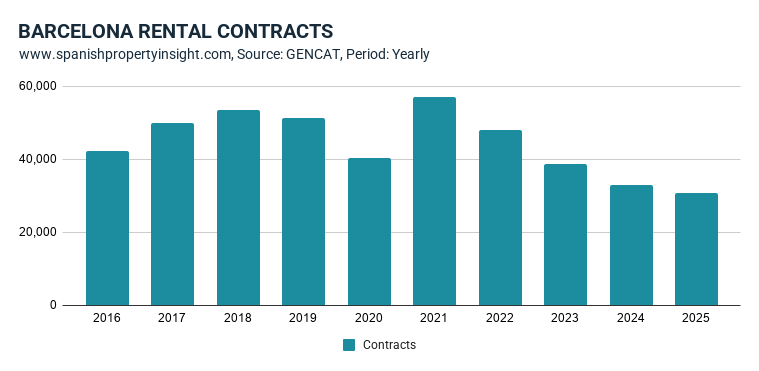
But the real divergence has happened since 2022. While asking prices have surged, contracts have collapsed. Supply is being choked off.
Rising asking prices and a widening gap
While official rents stagnate, asking prices continue to climb. In 2025, asking rents reached €23.75/sqm, up 8.6% year-on-year and nearly 58% above 2008 levels.
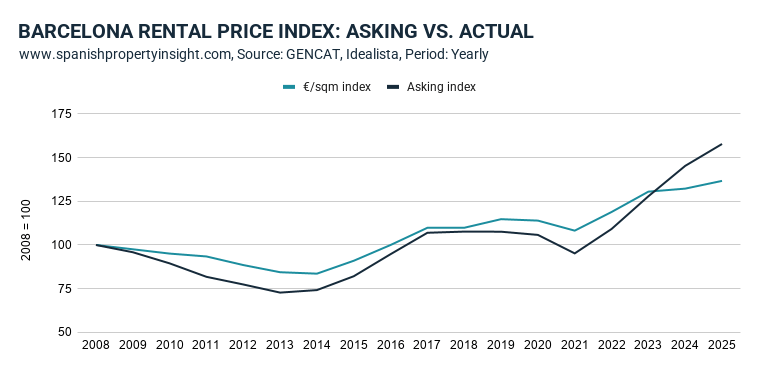
This growing gap between declared contract prices and asking prices is a clear warning sign. It suggests the official data is becoming less reliable as a reflection of real market conditions.
The most obvious explanation? A growing black economy, with tenants paying part of the rent under the table—off the books and invisible in the statistics.
Fewer homes, tougher access, worse outcomes
What’s happening on the ground is simple. There are fewer rental homes available, landlords are becoming more selective, and access to housing is getting harder.
A shrinking pool of “perfect” tenants—high-income, stable, low-risk—are benefiting from capped rents. They could afford market rates anyway, but now pay less.
Everyone else loses. Young families, migrants, the self-employed, and anyone without a flawless financial profile are increasingly shut out. If landlords are forced to rent below market rates, they minimise risk. They don’t take chances.
And many landlords are simply leaving the market altogether.
The myth of the rent crisis
What makes this policy particularly hard to justify is the longer-term context.
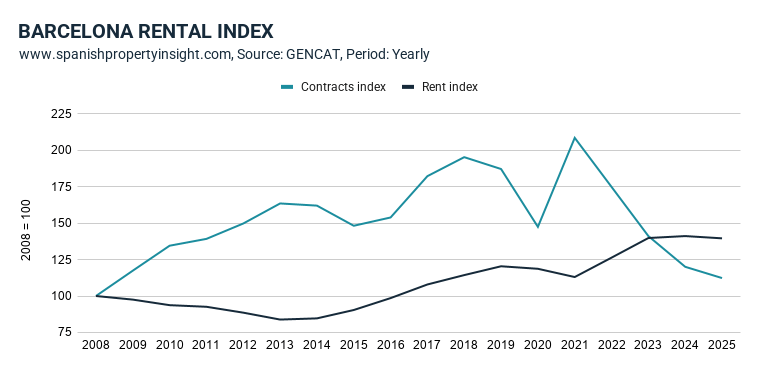
Rental prices in Barcelona fell by 16% between 2008 and 2013 as the financial crisis crushed demand. Supply exceeded demand, and prices adjusted—without any need for rent controls.
That part of the story is quietly ignored.
Instead, housing activists focus on the rebound from the 2013 trough, presenting it as evidence of runaway rents. But that “surge” was largely a return to normality after an extraordinary collapse.
Since then, prices have been driven by fundamentals: economic growth, tourism, and strong population increases fuelled by immigration—from affluent digital nomads to lower-income workers sharing accommodation.
Demand rose. Supply didn’t keep up. Prices responded accordingly. That’s how markets work.
From housing market to rationing system
Rent controls don’t change those fundamentals. They simply distort the outcome.
By capping rents, the government has turned Barcelona’s rental market into a rationing system—where access depends less on willingness to pay and more on luck, timing, and profile.
Some sitting tenants benefit. A small group of high-quality applicants win. But the market as a whole shrinks, and access collapses.
All pain, little gain
The bottom line is stark. After nearly 20 years of flat real rents, Barcelona didn’t need rent controls to “fix” a pricing problem. Yet politicians imposed them anyway—and in doing so have damaged the market they claim to protect.
Official rents may look stable. But supply is collapsing, asking prices are rising, and the gap between the two is widening fast.
Behind the headline numbers lies a simple reality: fewer homes, fewer contracts, and fewer chances to rent.
If you search for a rental in Barcelona today, the reality hits immediately. Idealista—the biggest portal—shows around 2,500 flats available, roughly half the 5,000 on offer at the end of last year before the latest round of housing intervention. And even that overstates the situation. Many listings are little more than bait to generate leads—enquire and you’ll be told it’s already gone, but you can join a waiting list. In practice, there are hardly any homes to rent. Finding a place to call home in Barcelona today feels less like a property search and more like an endurance test that punishes the least well-off the most.

What Do Paintings Really Mean?
EU Issues Ultimatum To Spain Over Non-Resident Property Tax
E
Brussels warns Spain that migrants regularised under controversial scheme will be deported back to Spain if they try to move to other EU countries
Murcia unveils monument marking 175th anniversary of Burial of the Sardine
Easter on the Costa del Sol: a time of renewal


-
eu response to spain migration policy4 weeks ago
Brussels warns Spain that migrants regularised under controversial scheme will be deported back to Spain if they try to move to other EU countries
-
Costa Calida4 weeks ago
Murcia unveils monument marking 175th anniversary of Burial of the Sardine
-
Costa del Sol3 weeks ago
Easter on the Costa del Sol: a time of renewal
-

 Caso Koldo3 weeks ago
Dinero En Efectivo Guardado En Casa Y La Devolución De Los Gastos Del PSOE: La Expareja De Koldo Protagoniza La Cuarta Jornada Por El ‘caso Mascarillas’
-

 Ataque contra Irán3 weeks ago
Última Hora De La Guerra De Estados Unidos E Israel Contra Irán, En Directo | EE UU Asegura Que Dos De Sus Buques Militares Han Cruzado Ormuz Para Desminar El Estrecho E Irán Lo Niega
-
Fish Counters Being Removed4 weeks ago
Mercadona removes fish counters: T9 format brings shift to pre-packaged seafood
-

 New Developments3 weeks ago
Inside The Most LUXURIOUS Apartment Building In Spain!
-
Calais4 weeks ago
One dead and 13 injured as train collides with truck in northern France
Join the conversation in our comments section below. Share your own views and experience and if you have a question or suggestion for our journalists then email us at news@thelocal.es.
Please keep comments civil, constructive and on topic – and make sure to read our terms of use before getting involved.
Please log in here to leave a comment.