
Andy Warhol
Fatboy Slim And His Disperse Dance Floor Memories: ‘I Had To Google Myself So Many Times To Check If Something Happened’

“Before I play, I always go and hide somewhere and look out through the curtain. Just for five minutes, I look at the vibe, how drunk they are and how old they are.” Weeks before taking the stage at the Icónica Santalucía Sevilla music festival, British musician and DJ Fatboy Slim — real name Norman Cook (London, 62 years old) — is sharing these words in a video call from his home in Brighton. He is aware of the fact that his relationship with fans is long-lasting, his four-decade career almost free of any dramatic ups and downs. What most concerns the author of Better Living Through Chemistry was that the concert was planned for Tuesday “and they might have to get up for work the next day,” he says, the comment redolent of the light-hearted approach to life that has always characterized him — and that, at the moment, he has no intention of letting go of.
What Cook doesn’t know on the call was that, thanks to the likes of Mikel Oyarzábal, Lamine Yamal and Pau Cubarsí, among others, he would be playing after the most challenging opening act there is: a World Cup semifinal featuring his host country. When the match was confirmed, it became clear he would have to start his show at least a half hour later than originally planned. Not that this was likely a source of irritation, given his historic relationship with the sport. He is a fervent devotee, and even a shareholder of the club team in the city he’s made his home for nearly the past three decades. In 2004, the stadium in which Brighton & Hove Albion play was baptized for the space of a game as Palookaville, the name of the fourth (and final) Fatboy Slim album, which he had recently released. Today, the stadium carries the name of a credit card company, which speaks to how things have changed.
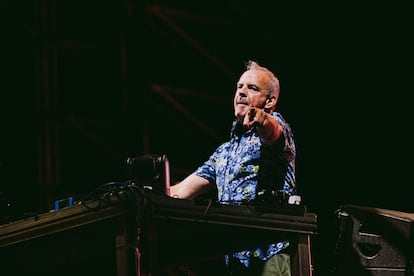
Partway through the second half of the World Cup game, Cook peeked out from the stage at the scene, and what he saw was nearly 8,000 people, most of them wearing the ubiquitous Spanish national team jersey, waving red-and-yellow flags, with their faces painted, caught up in a euphoria that soon, he would be tasked with managing. If he didn’t find a way to feed into the wave of happiness occasioned by the Spanish team’s victory, it was going to be bad. Just five minutes after the referee signaled the end of the game — all the better to seize the moment — the Brit leaped onstage, bounding about in shorts and a Hawaiian shirt, ready to celebrate with everything good he has brought us since the end of the last century via the idea of blending rock with electronica through the figure of the DJ, explicitly focused on the dance floor, stripped of any messianic posturing, cutting down the distance between the performer and the crowd. Along with artists like Chemical Brothers, Basement Jaxx and Propellerheads, Fatboy Slim, more than any guitar-based band, brought new life to rock.
“Sometimes I think, ‘Should I be doing this at my age?’ And then I look up at the crowd and I see how much fun they’re having, and I look at how much fun I’m having, and I think, ‘Pff,’” he confesses. “During lockdown, I had 14 months of not doing my job, and there was like, this black hole of nothing, and I decided to cherish every moment. I realized how lucky I am to do this job, so I don’t take it for granted, ever. I’m determined to wring as much as I can out of whatever time I have left,” he says. Later, during his festival performance, this seemed like a premonition. The first half-hour of the show was staggering, with the Fatboy Slim hits that marked an era ringing out with their classic rock samples, like Nirvana’s Smells Like Teen Spirit, and snatches of hip hop, like Run DMC’s It’s Tricky. There was also a remix of the classic House of Pain track Jump Around, a song that one way or another seems to pop up during every edition of the Icónica festival, now in its sixth year.

On the Jumbotrons, the mood revolved around a homage to the greats of the 20th century. Visuals shifted from Andy Warhol to David Bowie, featuring Iggy Pop and James Brown. There were also winks at digital culture’s user experience, simulating programming shots from MS-DOS (a former Microsoft operating system) — sure to cause the older attendees to break out in a cold sweat — and those vertical data cascades that became pop iconography thanks to The Matrix films. Every 10 minutes, Greta Thunberg appeared on screens, more or less out of the blue, followed by the Spanish national team. Madness.
Cook, who carried no microphone, but did have a pair of headphones that remained unused, communicated with the crowd via playback, moving his lips to the rhythm of a few motivational messages (asking us just once to put our phones away — because he’s smart, but not a smart-ass) whenever the wide-angle camera mounted on the console showed his sweaty face. Sometimes, he’d just jump or honk a horn — or even two, one in each hand.
He stopped drinking years ago. “I mean, there have been points in my career where my accountant advised me I should get a proper job because there’s bills to be paid. And yeah, there’ve been times in my life when I got sober and I definitely had a little think of, ‘Who are you and what are you doing?,’” he says. “I mean, every time people say that, I reinvent myself. Things that I’m doing fall apart and I have to start again. And every time I start again, I think, ‘Well, you got lucky with [his past musical projects] the Housemartins, you got lucky with Beats International, you got lucky with Freak Power.’ Luckily, Fatboy Slim seems quite enduring.”
This year, he published the book It Ain’t Over… ‘Til the Fatboy Sings, a volume of over 300 pages in which he traverses his four-decade-plus career. But he’s no fan of living life in the rearview mirror. “The problem with nostalgia is you kind of assume that something is finished and you’re looking back. There are so many anniversaries,” he says. Indeed, for the book, Cook went through his archives in search of key moments from a career in which, aside from hits like The Rockafeller Skank, has seen him produce for bands like Blur and The Beautiful South, and remix others, like Cornershop and A Tribe Called Quest. He performed at the closing ceremony for the 2012 London Olympic Games. He has had his own event on Brighton Beach for two decades, and was one of the closest artists in witnessing the death that took place at the 1999 Woodstock that has become known for fire and violence. “I had to Google myself so many times to check if something happened,” he says of the process of producing the book he never thought he’d write. Nor did he ever think that he’d ever get the rights to a sample from Satisfaction: “We gave up about 15 years ago on the Rolling Stones ever allowing us to put it out. We put out the single and it was beautiful, but I wouldn’t describe it as important. It’s just part of a lovely story that unfolds.”
When that resulting song, Satisfaction Skank, played in the final lap of the 100-minute Seville concert, the track crested, Slim nodded his head and moved in large steps that, two decades ago, might have been leaps. He observed the crowd, a true melting pot of generations, this time openly. And he deployed Praise You at the exact kind of moment of communal catharsis between public and artist to which the man has dedicated his life.
“When you’re playing, you’ve got nothing else to do apart from look at the crowd,” he says. “The older you get, the more you just become in tune. For me, DJing has always been about communication with the crowd. They talk to me and I talk to them. And if you keep that conversation up, then you, you always understand what’s going on. I’m aware that if I took a year off, I might lose the thread of the conversation. I’ve always had something to say, but I still always have something to learn.”
He’s asked whether the dance floor has changed much since he got his start. “Different drugs,” he replies. “The basis of the dance floor is always the same. It’s always young people who wanna get high and get laid. When everybody was doing ecstasy, it was very loved-up, hands in the air and hugging strangers. And then in the cocaine years, it got a little bit more gnarly, frantic. Then ketamine, people just don’t really move, they just like, stand there and nod. But the basic purpose of a dance floor comes from prehistoric times — human beings who want to get together, who want to escape from their boring or difficult lives. That will never change. And I think that’s why I can still do it at my age, because that has stayed constant.”
The lights go out in Plaza de España. Strains play from The Blue Danube, which has been offered to dance floors around the world for 150 years. And if the world still exists in another 150, it’s possible that more than one Fatboy Slim song will enjoy the same kind of longevity. As an artist, he is eternal.
Sign up for our weekly newsletter to get more English-language news coverage from EL PAÍS USA Edition

Spanish Wildfires Intrude On Holidaying Foreign Visitors

Fuengirola Resident Nets €1m On Scratchcard

Stylish 3-Bedroom Apartment With Panoramic Sea Views – Benalmádena
Axarquia wildfire cause emergency response across Archez, Competa and Canillas de Albaida

El Escurreplatos De Dos Niveles Que Libera Espacio En La Cocina Está Rebajado Más De Un 50%

Watch The Bizarre ‘Joker’ Stunt That Disrupted Pamplona’s Bull Run


-
andulacia wildfires1 week ago
Axarquia wildfire cause emergency response across Archez, Competa and Canillas de Albaida
-
 Amazon1 week ago
El Escurreplatos De Dos Niveles Que Libera Espacio En La Cocina Está Rebajado Más De Un 50%
-
 %2 weeks ago
Watch The Bizarre ‘Joker’ Stunt That Disrupted Pamplona’s Bull Run
-
House prices1 week ago
Buyers are pushing back against high house prices in Spain
-

 Audiencia Nacional1 week ago
La Directora De La Guardia Civil Y Su Jefe Operativo Declaran Como Imputados En La Audiencia Nacional Por El ‘caso Leire Díez’
-

 España1 week ago
Lotería Nacional: Comprobar Sorteo Del Jueves 16 De Julio
-
Are dogs allowed on trains in SPain1 week ago
Renfe opens all trains to dogs weighing up to 40 kg
-

 Uncategorized1 week ago
F1 press conference shut down over Red Bull driver transfer rumours