
Cyril Ramaphosa
From Being Unemployed To Hunting Migrants In South Africa: The Movement That Has Turned Foreigners Into Scapegoats

In the township of Katlehong — an area with a reputation for being dangerous, located south-east of Johannesburg — a worker leans a heavy iron bar against the door of an old, rusty Maersk container. Meanwhile, his colleague welds it to another bar, using a machine that sends a shower of sparks flying.
Arms crossed and in silence, Biranu Hajiso watches. A 36-year-old Ethiopian merchant, he’s the owner of the metal box that, until just a few days ago, operated as a spaza shop — one of the small corner stores selling basic goods, which abound in South Africa’s urban settlements.
Illuminated by the last rays of a pink winter sunset, Hajiso isn’t merely having a door sealed: he’s also closing a chapter in his life, as he has decided to shut down the business. He doesn’t know for how long.
“It’s the third time my shop has been looted,” he laments. “At least, this way, they won’t be able to get back inside.” He still doesn’t know if he will return to Ethiopia, or if he will hold out until the wave of xenophobic violence passes. Anti-immigrant sentiment has gripped South Africa in recent months… and, for now, it shows no signs of abating.
Around the container, there’s hardly any sign of activity left. In front of Hajiso’s shop, trash, scraps of merchandise and broken bottles are piled up. On the parallel street, a barbershop bears the marks of another riot: the interior is in disarray, empty, with only a hairstyling sign hanging crookedly from a single thumbtack. A few feet away, another vandalized shop still reeks of burnt rubber.
The scene in Katlehong encapsulates the climate that has taken hold in numerous working-class neighborhoods across South Africa since the anti-immigration movement — March & March — launched a campaign to expel African foreigners from the country. Their main targets are citizens of Zimbabwe, Lesotho, Mozambique, and Malawi — the neighboring countries from which most migrant laborers come — but their reach has also expanded to include refugees and asylum seekers, such as Congolese, Ethiopians, and Somalis, who have been in South Africa for years, even decades. In some cases, those being targeted have already obtained citizenship.
According to Loren Landau, a professor at Oxford University and one of the leading experts on migration in southern Africa, this isn’t simply a movement against immigration. In his view, the phenomenon reflects the accumulated frustration of a segment of the population that feels that the state has failed to deliver on the promises made after the end of apartheid. The protestors have been projecting their discontent on immigrants, who have become a visible target. “[There’s] enormous frustration with a state that has spent years failing to address very real problems. Immigration has become the vehicle through which that frustration [is channeled],” he explains.
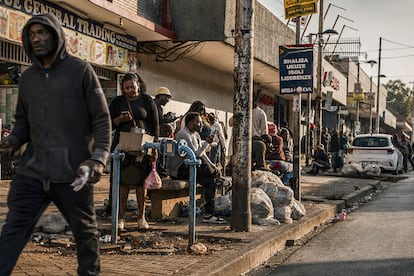
South Africa is the most unequal country in the world, according to the World Bank. It has an official unemployment rate exceeding 30%, an economy that has been virtually stagnant for a decade, high crime rates, as well as deteriorating public services. This cocktail has fueled deep social discontent, which movements like March & March have channeled against immigration.
This dissatisfaction erupted on June 30, the deadline that March & March had given the government to expel undocumented immigrants. That day, thousands of people demonstrated in cities across the country. Since then, the protests have evolved into door-to-door campaigns: groups of residents go through neighborhoods looking for people whom they consider to be foreigners, demanding that they prove their immigration status, or ordering them to get out of South Africa.
At the forefront of the movement is Jacinta Ngobese-Zuma, a former radio presenter who was virtually unknown just a year ago. She has now become the public face of March & March. The organization, which originated in Durban, has spread thanks to intense activity on social media and a constellation of groups that share a common message: closing borders, accelerating deportations, reserving jobs and priority access to public services for South Africans, and demanding that the government enforce immigration laws more strictly. In any case, the migrant population in South Africa constitutes barely 4% of the country’s 63 million inhabitants.
Ngobese-Zuma — who has not responded to this newspaper’s interview requests — denies that her movement is xenophobic. She maintains that its actions are directed against undocumented immigrants… but the victims of the attacks also include refugees, asylum seekers, permanent residents and even naturalized South African citizens. “Very few people can distinguish who has papers and who doesn’t. Suspicion ends up being based on language, accent, or physical appearance,” Landau explains.
The impact of these marches has been so serious that the government itself has been forced to intervene on several occasions. President Cyril Ramaphosa has promised to reinforce the borders, but insists that only the state can enforce immigration law. His message, however, has not stopped neighborhood patrols or door-to-door campaigns.
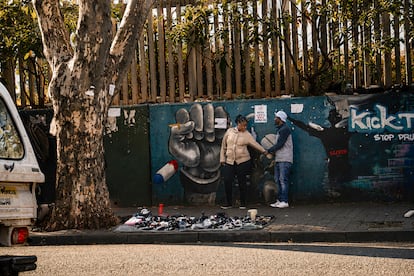
Fear, aggression and threats are the visible consequences of this xenophobic campaign, about which many questions remain unanswered. One such question is the relationship between March & March and uMkhonto weSizwe (MKP), a political party founded by former president Jacob Zuma. Although MKP leaders and members have participated in several demonstrations — and even though the party has publicly supported some of its demands — there is no evidence that the political organization controls or finances the citizen movement.
“There are many suspicions, but there’s very little evidence,” Landau summarizes. It remains unclear how March & March is financed. Ngobese-Zuma denies receiving financial support from political parties or businesses. And, for now, there’s no publicly available information that reveals the movement’s financial structure. What is clear, however, is that both groups share spheres of influence.
Yeshelen Govender is a lawyer and spokesperson for Siyafana Sonke, a coalition of more than 100 civil society organizations fighting xenophobia. He points out that many of the protests are concentrated in the province of KwaZulu-Natal and in townships in the province of Gauteng. These are areas where, during the apartheid era, Zulu workers arrived to work in Johannesburg’s mines. Many of the housing compounds — originally designed for Black migrant laborers — remain important spaces for community organizing. And some of them are within Jacob Zuma’s former strongholds, areas where MKP achieved some of its best results in the 2024 elections. “This doesn’t mean that MKP created March & March,” Govender clarifies, “but it does mean that some of the social and territorial networks that the movement is mobilizing today already existed in the past.”
For Landau, perhaps the most important question is not who funds March & March, but rather why it has found such a strong following. “If this organization were to disappear tomorrow, another would emerge,” he laments.
“I’d rather lose money than my life”
While politicians, analysts and activists debate the causes of the phenomenon, those living in the eye of the storm are beginning to make much more immediate decisions. They’re closing their businesses, fleeing, or going into hiding.
Biranu Hajiso opted for the first choice in Katlehong, welding shut the door of his shop. And so has Kwame (who doesn’t give his last name), a Ghanaian shopkeeper who has lived in the Johannesburg neighborhood of Yeoville for 10 years. He has decided to close his tailoring shop.
“I don’t want to wait until the same thing that happened to others happens to me,” he explains. “I’d rather lose money than lose my life.”
George, a Zimbabwean from the same neighborhood, admits that he has never experienced anything like this. “Until now, I had always considered Johannesburg a tough city… but it was open to anyone who wanted to work,” he sighs. Today, he avoids certain streets and tries to get home before nightfall.
Fear no longer distinguishes between undocumented immigrants and those with papers. On Monday, July 14, six hairdressers with refugee status were attacked in a Durban market. Two of them had to be hospitalized, according to Bishop Raphael Bahebwa.
Landau believes that this fear will persist until the state regains control of the situation. “Once people start thinking that certain groups can be blamed for all the problems, it becomes very difficult to reverse course,” he explains. “And, when that idea takes hold, the difference between having papers and not having them ceases to matter.”
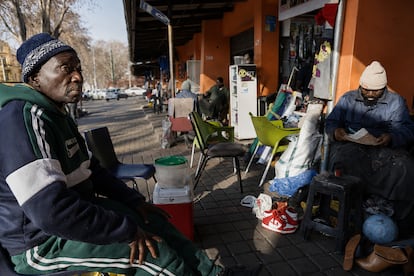
No one knows how long a movement like March & March can last. Government promises haven’t stopped neighborhood patrols or door-to-door harassment. For Govender, the campaign has opened a political space that will be difficult to close in the short term, as various political actors will try to capitalize on this discontent in the lead-up to the municipal elections in November. And it’s still impossible to gauge to what extent March & March will eventually become a political force in its own right, or whether it will continue functioning as a social pressure movement.
While this debate continues, Hajisu gets back into his old pickup truck. The two workers pack up the welding machine and tools. The container door has been sealed with two thick iron bars. “I don’t know how much longer I can last here,” the Ethiopian shrugs, before leaving. In theory, the March & March campaign is directed against undocumented immigrants. But the door that has just been welded shut belongs to a man who has all his papers in order.
Translated by Avik Jain Chatlani
Sign up for our weekly newsletter to get more English-language news coverage from EL PAÍS USA Edition


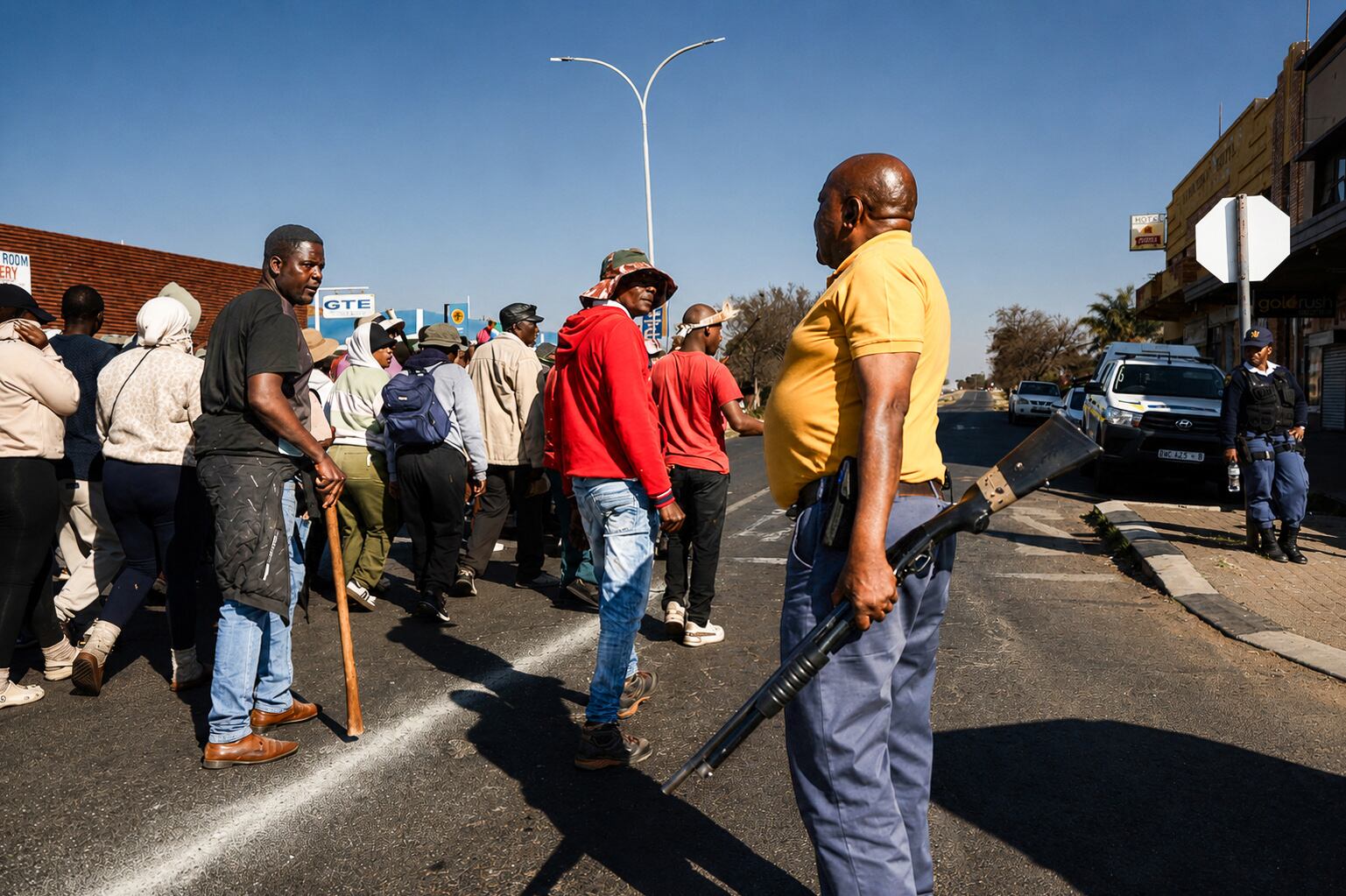
The chants are perceived as a distant murmur. They filter through the low-rise houses of Katlehong, a working-class neighborhood in eastern Johannesburg, South Africa. Gradually, a hundred or so people come into view, waving wooden sticks in the air. Brandishing South African flags, they dance and chant slogans in Zulu against illegal immigration.
A man with a megaphone rallies the crowd. Before they reach her, a young woman — with her hair gathered in a cascade of fine braids — hurriedly closes the door of her house, a humble, single-story structure protected by metal bars.
On the first Thursday of protests by South Africa’s anti-immigration groups, the demonstrators are scouring the neighborhood for undocumented immigrants. They’ve vowed to take to the streets every week to pressure President Cyril Ramaphosa’s administration to expel all undocumented immigrants from the country. This comes after months of marches, threats and attacks against foreigners. Similar demonstrations are taking place in neighborhoods and cities across the country, with Durban and Johannesburg as the main centers.
However, things are different compared to what happened on June 30, when thousands of people (according to estimates in the South African press) took to the streets. That was after their ultimatum — which these groups issued to the government — had expired. On Thursday, July 9, on the other hand, the day ended without major disturbances or large gatherings. Rather, the small, scattered demonstrations drew groups of around 50 to barely over 100 people.
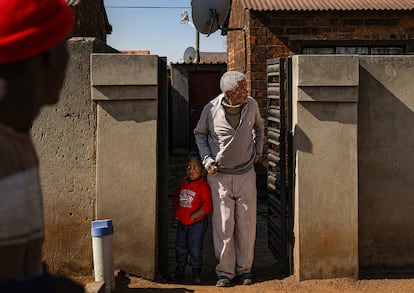
The objective seems to have changed: it’s no longer simply about demonstrating, but rather about undertaking what have come to be known as “door-to-door” campaigns. That is, going house to house to find foreign citizens and urge them — sometimes politely, sometimes forcefully — to leave the country. And, unlike other episodes of racial tension in the country’s history, the protagonists of these protests are, for the most part, Black South African citizens who are targeting Black immigrants.
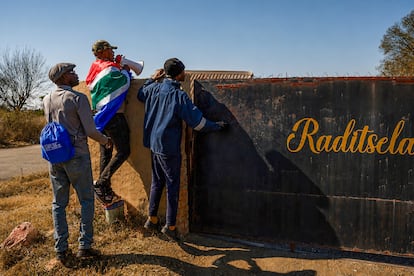
In the township of Katlehong, the march stops in front of a vacant lot surrounded by a concrete wall. Several old buses are barely visible. A neighbor warns: “Sothos from Lesotho live here!” Then, three men climb the low wall and peer over; others begin banging on the large metal gate with their sticks, while the rest chant slogans. No one responds from inside. After several tense minutes, the march continues. “There are definitely people inside,” a straggler protests, as the rest keep walking.
“The idea isn’t to hurt anyone,” insists Patrick Dube, a neighborhood representative, as he marches alongside the others. “We want them to go back to their country, get their papers in order and return legally.” Dube argues that the violence that occurred during other similar protests was due to people who “misinterpreted” the movement and took the law into their own hands.
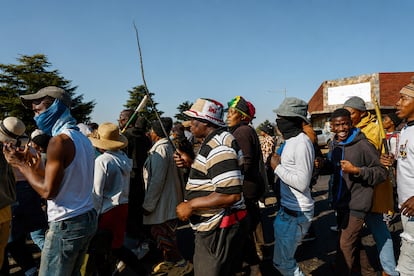
However, there have been so many cases in which South African citizens have forced immigrants to show their papers — or have even evicted them from their homes under the pretext of their irregular status — that numerous public officials, including President Cyril Ramaphosa himself, have had to reiterate that, under South African law, immigration control duties are strictly to be carried out by the authorities.
Ramaphosa has acknowledged that there’s a problem with irregular immigration and has promised to tighten its enforcement. But, at the same time, he has condemned vigilantism and insisted that citizens cannot replace the state.
The main driving force behind the campaign is Jacinta Ngobese-Zuma. She’s the leader of a movement called March & March, which collaborates with other anti-immigration organizations. On social media, their message has spread like wildfire. They’re demanding that the government strengthen border controls, expedite the deportation of undocumented immigrants, and reserve access to employment and public services for South Africans. Ngobese-Zuma has managed to unite popular discontent over issues such as unemployment (exceeding 30%), corruption and high crime rates by blaming immigrants, even though they represent only 4% of the approximately 63 million people living in the country.
During a rally held on Thursday, July 9, in Durban, Ngobese-Zuma insisted that the demonstrations will continue every Thursday until the government takes action. “The government has been asleep on the job for too long. If we had a government that was responsive and listened to what the people want, then we wouldn’t have the problem of being on the streets today,” she says. The leader, moreover, rejects the notion that her movement is xenophobic.
While the marches continue to spread through different neighborhoods, the number of people choosing to leave South Africa is also increasing. The Malawian government reported this past Thursday that more than 38,000 of its citizens have returned from South Africa in recent weeks for safety reasons. Zimbabwean authorities, for their part, estimate that more than 60,000 people have returned since the start of the crisis.
Like in Katlehong, marches are taking place in other areas of Johannesburg, but these aren’t as peaceful. The tension has erupted into violence in Dunnottar, a town in the eastern part of the Johannesburg metropolitan area, home to a large community of Ethiopian, Somali, Pakistani and Bangladeshi immigrants, some of whom run small grocery stores selling imported goods
On July 9, the pavement of a central street was littered with broken glass after about 50 protesters attacked foreign-owned businesses with stones and bottles. The shopkeepers defended themselves, leading to a pitched battle that ended with police intervention. Among the migrants, three suffered minor injuries and went to the police station to file a report. This is according to Ali Hussein, a Bangladeshi who owns a neighborhood supermarket. He says he has lived in the country for almost 20 years: his wife and children are South African, while he himself holds a South African passport.
“They say we come to take their jobs, but we provide work for South Africans and offer a service to the community with our businesses,” he laments. A young South African man who was also present (and who preferred not to give his name) confirmed this: “I work for a foreigner and I think what’s happening is a disgrace.”
Meanwhile, the 50 or so enraged citizens eye the immigrants suspiciously from across the road, barely 70 feet away. Some are armed with sticks, broom handles and even leather whips. The police, positioned between the two groups, have deployed eight vehicles, a truck and a dozen officers. Still, the rioters are undeterred.
After a while, the group sets off again, shouting slogans in Zulu against the merchants, which Hussein understands. “They’re insulting our mothers,” he says. For a few minutes, it seems like the situation might spiral out of control again: the group advances toward the police cordon, continuing to chant slogans and dance. That is, until the head of the operation pulls out a shotgun from one of the vehicles, confronts several protesters and orders them to turn around. Finally, the march continues down the street.
Similar scenes unfolded this past Thursday in other parts of the country, such as in the townships of Soweto and Alexandra, where — according to Reuters — protesters dragged people from their homes, accused them of being undocumented and handed them over to the police.
Back in the township of Katlehong, many residents watched the march from behind their fences. Some filmed with their phones. Others applauded enthusiastically when the group stopped in front of another house where, they said, a foreigner lived. Behind the fence, a tiny barbershop made of corrugated metal sheets was also visible. “We neighbors know where the immigrants live; people warn us,” Dube explains.
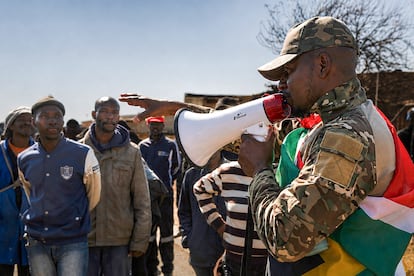
The ritual repeats itself. The man with the megaphone rallies the crowd. Several people bang on the fence with their sticks. No one comes out. Dube maintains that the problem isn’t just the immigrants, but also the companies that — according to him — hire them in order to get away with paying lower wages. “We’ll have to go and talk to them, too,” he says. “Maybe next Thursday, at the next demonstration.”
A few feet away, Dube and a neighbor knock on the door of another house. This time, a woman answers, claiming to be South African. They ask her to report any undocumented immigrants in the neighborhood if she knows of them. She nods silently and shuts the door.
“We just want the law to be enforced,” says Dube, at the end of the march. But in Dunnottar, Hussein points to the broken windows of his supermarket and responds: “I already obey the law.” Between these two statements lies one of the major tensions currently gripping South Africa — a tension that, for now, shows no sign of being resolved.
Sign up for our weekly newsletter to get more English-language news coverage from EL PAÍS USA Edition

Stylish 3-Bedroom Apartment With Panoramic Sea Views – Benalmádena

Lewis Hamilton could win F1 title at dream track as shock season finale replacement emerges
Última Hora De Los Incendios Forestales, En Directo | La UME Da Por Contenidos Todos Los Frentes De Los Incendios De Madrid Y Ávila, Aunque Mantienen Activas Varias Cabezas
Spain is about to get a rare six planet show and most people won’t even know it’s happening
Axarquia wildfire cause emergency response across Archez, Competa and Canillas de Albaida

El Escurreplatos De Dos Niveles Que Libera Espacio En La Cocina Está Rebajado Más De Un 50%


-
News from Spain2 weeks ago
Spain is about to get a rare six planet show and most people won’t even know it’s happening
-
andulacia wildfires1 week ago
Axarquia wildfire cause emergency response across Archez, Competa and Canillas de Albaida
-
 Amazon1 week ago
El Escurreplatos De Dos Niveles Que Libera Espacio En La Cocina Está Rebajado Más De Un 50%
-

 %2 weeks ago
Watch The Bizarre ‘Joker’ Stunt That Disrupted Pamplona’s Bull Run
-
House prices1 week ago
Buyers are pushing back against high house prices in Spain
-

 Audiencia Nacional1 week ago
La Directora De La Guardia Civil Y Su Jefe Operativo Declaran Como Imputados En La Audiencia Nacional Por El ‘caso Leire Díez’
-

 España1 week ago
Lotería Nacional: Comprobar Sorteo Del Jueves 16 De Julio
-
Are dogs allowed on trains in SPain1 week ago
Renfe opens all trains to dogs weighing up to 40 kg