Connect with us

%

Concrete Falls From Los Boliches Railway Bridge

Published

on

concrete-falls-from-los-boliches-railway-bridge

Falling to rack and ruin in Fuengirola. Credit: EWN

Fuengirola residents demand action as railway bridge deteriorates despite repeated warnings.

Residents in Fuengirola are increasingly concerned about the condition of railway infrastructure after another incident involving falling concrete from the elevated railway structure near Los Boliches station on Tuesday, November 10.

An elderly local woman was walking close to the station when pieces of concrete reportedly began falling from the structure above her. Concerned that somebody could be seriously injured, she immediately contacted the emergency services.

Police vehicles and two fire engines arrived within minutes. Firefighters subsequently removed fallen concrete and other loose material from the structure in an attempt to reduce the danger to pedestrians and passing traffic.

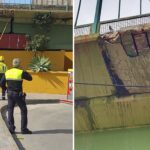
Photographs taken at the scene show a substantial area of damaged concrete, with sections of reinforcing metal exposed and visible deterioration around the affected area. A hole approximately one metre long was also reported in the concrete structure supporting the railway.

The incident has once again raised questions about the maintenance of the coastal railway, particularly as the central government, who is legally responsible in this case, have reportedly been warned about the problem previously. Today, nothing but a strip of police tape warns of the danger of falling concrete.

Adif warned but concerns continue

According to information provided by another concerned resident, both Fuengirola Local Police and the town hall have notified Adif, the state-owned company responsible for Spain’s railway infrastructure, about the deterioration. However, the local Malaga government says that despite these notifications, the situation has not been properly addressed.

The latest emergency response involved firefighters removing loose material, but residents want to know whether a comprehensive structural inspection has been carried out and when permanent repairs will take place.

There were also initial concerns about whether trains should continue running while firefighters dealt with the situation. Services were reportedly allowed to continue, with Renfe ordering trains to reduce their speed when passing the affected section.

In a previous incident, a pedestrian narrowly avoided being struck when a piece of concrete fell from the elevated railway structure at Los Boliches station. Firefighters attended and Local Police recorded a formal statement.

Read the earlier report: Crumbling railway: Fuengirola pedestrian narrowly avoids falling concrete at Los Boliches Station.

The recurrence of falling concrete in the same station area, following the earlier incident, raises fresh questions about what action was taken after the first warning.

Costa del Sol infrastructure under scrutiny

Concerns about deteriorating infrastructure are not limited to Fuengirola. Several Costa del Sol mayors have been publicly demanding improvements to transport links and greater investment in infrastructure.

Mijas mayor Ana Mata recently criticised the lack of progress, saying that the area had effectively been left with infrastructure dating back to the 1980s.

Speaking at a mobility forum in Malaga on November 12, she said: “En materia de infraestructuras, nos hemos quedado en los años 80.” (In terms of infrastructure, we’re stuck in the 80s). Her comments reflected growing frustration about the pressure on roads and public transport as the population of the Costa del Sol has increased.

Estepona mayor José María García Urbano has also repeatedly called for improvements to the A-7, including better access arrangements and investment in the busy coastal road.

For residents, the concern is increasingly about whether essential infrastructure is being maintained sufficiently, rather than simply whether new projects are being delivered. Many locals now complain how it looks like it is all going to “rack and ruin.”

Railway disasters increase public concern

The latest Fuengirola incident comes at a particularly sensitive time for Spain’s railway network. The January Adamuz disaster, which claimed 46 lives, and the October 28 collision near Urda, which killed 69 people, have shaken public confidence in railway safety.

The consequences have extended to the highest levels of the Transport Ministry. Óscar Puente resigned as Transport Minister on November 3, accepting political responsibility for the Urda disaster. Adif president Luis Pedro Marco de la Peña subsequently resigned. The tragedies have also prompted renewed demands from railway workers for greater investment in maintenance and improved safety procedures.

Although there is no suggestion that the damage at Los Boliches is connected to either railway disaster, the latest incident has added to public anxiety about the condition of the country’s transport infrastructure.

For the resident who raised the alarm in Fuengirola, the concern is straightforward: people should not have to walk beneath a railway structure fearing that pieces of concrete could fall on them.

With previous warnings reportedly already passed to Adif, residents now want answers about inspections, repairs and who is ultimately responsible for ensuring that the structure is safe.

How many more warnings will it take before something is done?

%

Dog Biscuits Containing Cannabis Expose €600,000 Illegal Laboratory In Barcelona

Published

on

dog-biscuits-containing-cannabis-expose-e600,000-illegal-laboratory-in-barcelona

Officers also immobilised around 1,750 litres of oils. Photo credit: Guardia Civil

Dog owners buying treats and oils for their pets would hardly expect them to lead police to an industrial cannabis laboratory. But biscuits containing cannabis derivatives, found during inspections of specialist shops in Barcelona province, helped uncover a business producing and selling thousands of products, with narcotic substances worth more than €600,000.

The Guardia Civil dismantled the laboratory in La Llagosta in an operation announced on November 12. Two people are being investigated on suspicion of drug trafficking: the company’s owner and the chemical engineer who ran the laboratory. No arrests have been reported.

Following the Crumbs

The investigation began in July 2025, when officers inspected specialist cannabis-growing shops, known as grow shops, across Barcelona province. During those checks, they found biscuits and oils for animals containing cannabidiol, or CBD, supplied by a company based in La Llagosta.

The products prompted further enquiries into their origin and the business behind them. Investigators traced the supplier to two industrial units. One was used to store goods and prepare customer orders, while the second contained production areas and laboratories where oils were extracted and cannabis resin made, weighed, labelled and packaged.

More than €600,000 in drugs seized

The scale of the operation became clear when officers searched the premises. They seized 11.5 kilos of hashish, almost seven kilos of marijuana buds and more than 133 litres of cannabis oil, packed into 17,657 bottles. Thousands of vaping products and refills were also found. Laboratory testing by the National Institute of Toxicology and Forensic Sciences identified cannabis and cannabis resin, as well as psychotropic substances including hexahydrocannabinol (HHC) and H4-CBD.

The Guardia Civil said these substances are subject to controls and authorisations and cannot be sold freely as consumer products. The discovery does not make every CBD product illegal. Investigators focused on the substances identified in this case and the authorisations required to manufacture and sell them legally.  Officers also immobilised around 1,750 litres of oils intended for manufacturing, more than 705 litres of cannabis cosmetics and 416.2 kilos of plant material.

Seeds, CBD tea packaging, dog biscuits and machinery used to extract oils and make resin were among the other items secured. The estimated retail value of the substances identified as narcotics exceeds €600,000. That figure relates to the controlled substances, rather than the total value of every product and item found at the premises.

Orders were sold online

Customers placed orders through the company’s website. Once payment had been received, the logistics unit prepared and dispatched the goods. If an item was out of stock, it could be made at the company’s own laboratory. According to investigators, the owner managed the business from Thailand, while the chemical engineer oversaw the laboratory, including product formulations, composition and quality and safety checks. The company is believed to have been selling these substances since 2018.

The investigation was carried out by the Guardia Civil’s Manresa unit, with support from its Fiscal and Border Patrol and SEPRONA, the nature protection service. The case and seized materials have been placed before the Civil and Investigation Section of the Court of First Instance in Mollet del Vallès. The investigation remains ongoing.

Continue Reading

%

Deadly Rabies Case Confirmed After Dog Enters Spain From Abroad

Published

on

deadly-rabies-case-confirmed-after-dog-enters-spain-from-abroad

The dog’s vaccination status was unknown when it entered Spanish territory. Photo credit: tsyklon/Shutterstock

A rabies infection is not something anyone wants to discover in their neighbourhood. Once symptoms develop, the disease is almost always fatal, making prompt treatment after exposure essential. For dog and cat owners in Ceuta, the latest confirmed case is another reminder of why keeping vaccinations up to date matters, particularly in a city bordering a country where rabies is still present.

The latest infection involved a dog that crossed from Morocco into Ceuta on October 28. Fortunately, it was spotted at the Tarajal border crossing and captured less than 30 minutes later, before it could come into contact with residents or other animals. The infection was confirmed on November 12 by Spain’s National Centre for Microbiology at the Carlos III Health Institute. 

Dog showed worrying symptoms after crossing border

The dog’s vaccination status was unknown when it entered Spanish territory. Guardia Civil officers spotted it near the border and alerted the animal collection service, which managed to capture it shortly afterwards.

Its condition was already extremely poor. The animal was severely emaciated, had a limp in one leg and displayed continuous, frantic running behaviour. Given these symptoms and its arrival from a rabies-endemic area, veterinary authorities suspected infection and decided to euthanise it immediately.

Laboratory tests subsequently confirmed rabies using immunofluorescence and PCR, which detect the presence of the virus. One important detail is that the dog remained under continuous surveillance following its capture. Authorities confirmed that it had no contact with people or other animals, meaning no human or animal exposures have been identified in connection with this case. 

Second rabies case recorded in Ceuta this year

Unlike mainland Spain, where terrestrial rabies has been eradicated, Morocco continues to report infections in both animals and humans. The country’s National Office for Food Safety (ONSSA) identifies rabies as an endemic disease found across much of its territory, with dogs acting as the main reservoir of infection. 

The scale of the problem remains significant. According to the World Health Organisation, 451 human rabies cases were documented in Morocco between 2000 and 2022, averaging around 20 deaths annually. Animal infections are also regularly reported, with stray dogs representing a major source of transmission. 

Why pet owners need to take rabies seriously

Although Spain and its islands have been free of terrestrial rabies since 1978, imported cases continue to occur occasionally in Ceuta and Melilla because of their proximity to countries where the disease remains present. The Ministry of Agriculture stresses that vaccination is one of the most important tools for preventing the spread of rabies. In Ceuta, annual rabies vaccination is compulsory for dogs, cats and ferrets, and owners must keep their animals’ vaccination records up to date.

The disease affects the central nervous system of mammals and can spread to humans through the saliva of an infected animal, usually following a bite or scratch.  Once clinical symptoms appear, rabies is virtually always fatal. Anyone bitten or scratched by an animal suspected of carrying rabies should wash the wound thoroughly with soap and running water for at least 15 minutes before seeking urgent medical attention. Preventive treatment can stop the disease developing if administered promptly. Dogs, cats and ferrets in Ceuta must be vaccinated against rabies annually, with owners required to keep their animals’ vaccinations up to date.

Continue Reading

%

Fed Up With Cramped Economy Seats? These Five Airlines Offer A Better Way To Fly

Published

on

fed-up-with-cramped-economy-seats?-these-five-airlines-offer-a-better-way-to-fly

Five carriers have been recognised in the 2026 World Airline Awards. Photo credit: Photofex_AUT/Shutterstock

Anyone who has spent hours squeezed into an economy seat on a long-haul flight knows how uncomfortable travelling can become. Business class might offer a welcome escape, but with prices often beyond the reach of ordinary holidaymakers, premium economy is an increasingly attractive alternative.

Offering more legroom, wider seats and better onboard services, it promises a more comfortable journey without the full cost of business class. But which airlines actually deliver an upgrade worth paying for? Five carriers have been recognised in the 2026 World Airline Awards by aviation rating organisation Skytrax, with EVA Air taking first place, followed by Emirates, Singapore Airlines, Cathay Pacific and Virgin Atlantic.

EVA Air takes the top spot

Taiwanese airline EVA Air claimed first place, drawing on decades of experience since becoming the first airline to introduce premium economy in 1992.

Its Boeing 777-300ER aircraft offer 38 inches (96.5cm) of seat pitch, compared with approximately 31 to 33 inches (78.7 to 83.8cm) in standard economy. Passengers also benefit from wider seats, additional recline and upgraded onboard amenities.

Emirates and Singapore Airlines

Emirates secured second place, taking the top award for its premium economy seats and onboard catering. Passengers receive leather seats, adjustable headrests, calf and footrests, larger entertainment screens and upgraded meals. Its newer Airbus A350 cabins also feature wireless charging and 4K entertainment screens, although these facilities are not available across the entire fleet.

Singapore Airlines came third, offering approximately 38 inches (96.5cm) of seat pitch, wider seats and additional recline. Passengers also receive priority boarding, calf and footrests, and an upgraded dining experience. Its Book the Cook service allows travellers to pre-order dishes from a selection of chef-inspired meals.

Cathay Pacific and Virgin Atlantic

Hong Kong-based Cathay Pacific took fourth place. Its premium economy cabins offer up to 40 inches (101.6cm) of seat pitch, adjustable leg rests and additional recline. Passengers also receive priority boarding, extra baggage allowance and upgraded meals. Selected refurbished aircraft feature redesigned seats and larger entertainment screens.

Virgin Atlantic completed the top five, offering priority check-in and boarding, two checked bags of up to 23kg each, and an improved onboard dining experience. Passengers are also welcomed with sparkling wine, while meals are served with a restaurant-style approach. Seat dimensions vary between aircraft, so checking the configuration before booking is advisable.

Is premium economy worth the extra cost?

The biggest drawback is the price. Premium economy can cost hundreds of euros more than a standard economy ticket, and the difference between airlines can be substantial. Travel expert Katy Nastro, from flight-tracking app Flighty, told the BBC that upgrades with some airlines can approach €690 per flight segment.

However, buying an economy ticket first and checking for discounted upgrade offers later can sometimes be considerably cheaper. The aircraft operating the route is another important consideration. Airlines often have different premium economy configurations across their fleets, meaning passengers could pay extra without receiving the newest seats or facilities. For overnight flights and particularly long journeys, the additional space and ability to recline more comfortably may justify the expense. For shorter trips, however, the money might be better spent elsewhere.

Continue Reading

Trending

Copyright © 2017 Spanish Property & News