There are three versions of Saint John’s Book of the Apocalypse, a text that never loses relevance and now seems to presage the impacts of artificial intelligence (AI).
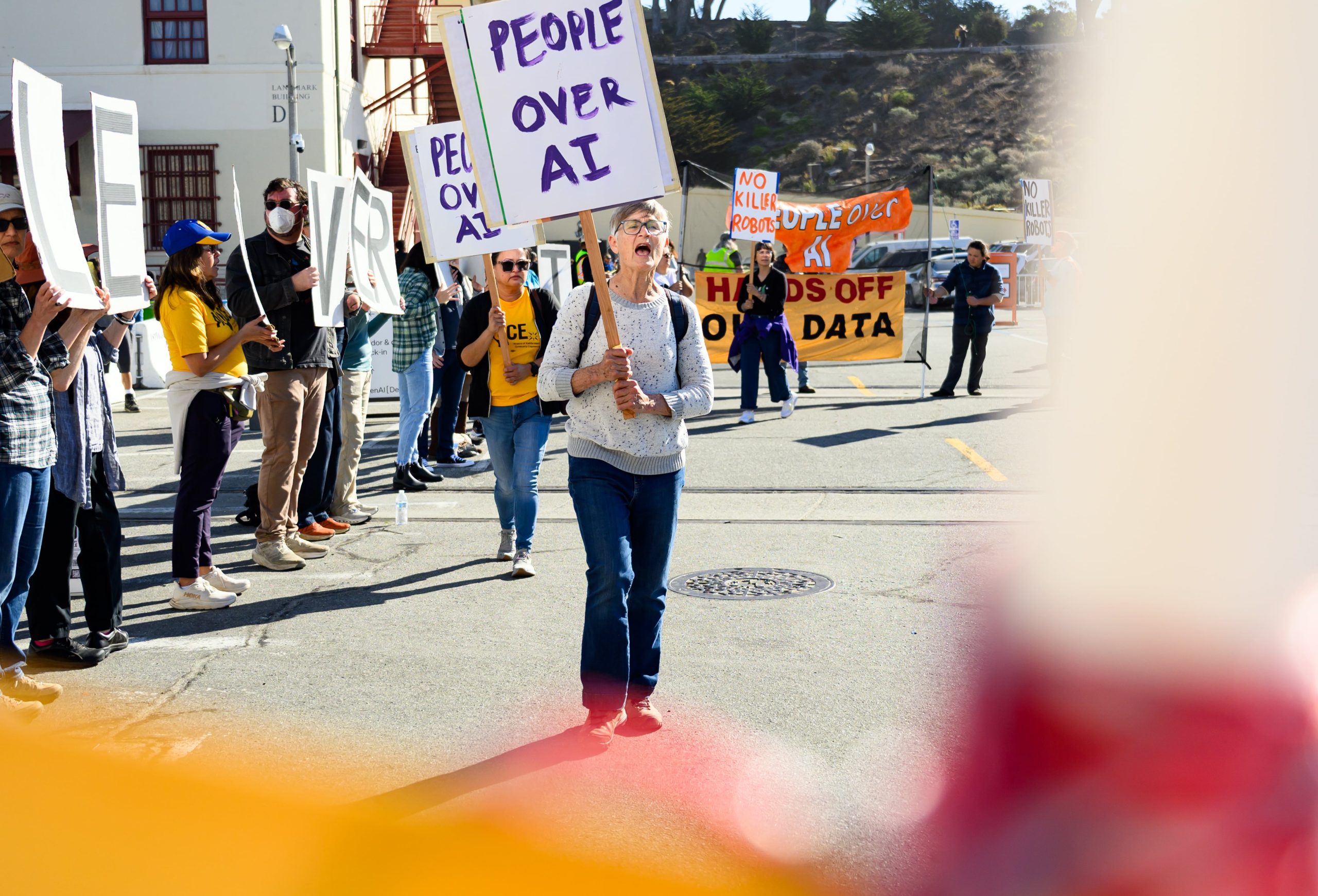
One: the recent and terrifying prospect of death raining down from swarms of autonomous, AI-driven killer machines, in a reprise of Stanley Kubrick’s 2001.
Two: a sector whose impossible expectations are inflating the mother of all financial bubbles to levels that make the Great Recession and its grapes of wrath look tame.
And three: the end of work — a brutal reconversion and, at worst, the disappearance of millions of jobs, for the first time disproportionately affecting the best-educated, potentially pushing the global economy toward depression, unprecedented levels of inequality and a blend of technofatalism, resentment and rage (something that is already happening, by the way, but magnified a thousandfold).
Utopias and dystopias are storytelling machines. They spit out punchy headlines, fin-de-siècle lyrical flourishes and syllables swollen like storm clouds. But they often prevent us from seeing what is really happening: those hyperbolic visions serve vested interests. Most of these fears are being inoculated by the companies themselves or by the governments that shield them, who are thinking about power and the bottom line.
Manuel Castells, a Spanish sociologist, scholar of the information society and former minister, says that fear of AI “is legitimate and, to some extent, logical, because the risks are real,” but he told this newspaper that it is “suspicious” that the sector’s own companies “are the ones sowing those fears in the paperwork they file for their initial public offerings on the stock market: scaring people is one of the ways to make a fortune.”
“And it is even more suspicious that China, which is replicating frontier innovations in six months, does not seem to show the slightest fear of this supposed armageddon led by uncontrolled AI,” he adds by phone, fresh from a trip to China, dismantling the first of those nightmare scenarios.
Wall Street also downplays the financial crisis theory, the second catastrophic risk: “No, there is no bubble,” financial sources say tersely; “companies are investing exorbitant sums and at some point a bubble will emerge, as happens with all disruptive innovations, but for now both projected profits and actual revenues are solid.”
Markets are even pricing in lower valuations than they otherwise would to allow for the possibility that some of these companies may fail, the same sources stress. It may be that the AI moguls are pushing up yields on debt and thus helping to incubate the next crisis. They are piling up mountains of debt to develop the technology, including data centers that suck huge amounts of water and energy. But wars, inflation and central bank activism explain that spike in interest rates much more than artificial intelligence does.
When debunking those two possible catastrophes, you must pepper your sentences with conditionals so that reality and its accelerations do not run over articles like this one. But the end of work, the third rider of the supposed apocalypse, resembles Kipling’s poem If. It is full of shades of gray, threatening predictions, grim accounts — and, again, vested interests — with little or no support so far from that old relic called data, those dull official figures. Is AI going to eliminate millions of jobs?
For fans of short answers: in one word, no. Or better, in a concise phrase: at least in the short term, no. The long answer includes plenty of nuances. It depends on how fast AI becomes widespread and how companies and governments act. The halting and ambiguous answers about the labor market’s impact, in short, appear in the string of paragraphs that follow, with half a dozen authoritative voices starting from this point.
Impact of AI
Employment figures across the OECD are at historic highs, but workers are jittery. Surveys clearly show more fear than during the Great Crisis nearly 20 years ago, which wiped out millions of jobs. The International Monetary Fund estimates that AI’s impact will be felt in 60% of Western jobs. The major AI companies go further and, once again, wave the specter of those fears. Anthropic claims that in the West, unemployment could reach 10%, even 20%, by 2030.
Those figures have been common for years in countries like Spain, but they are typical of a depression elsewhere: there is a Japanese film, Battle Royale, that begins with social unrest when the unemployment rate reaches 15%. Bill Gates, Microsoft’s founder, says that in a world where AI delivers on its promises, people would not be necessary for the majority of tasks. And Sam Altman, of OpenAI, warns there could be “a significant labor disruption” as companies adapt.
The prevailing mantra is that white-collar jobs — held by the most skilled workers — are the ones most at risk. That is a new feature, compared with earlier technological revolutions. Also, recent graduates are the ones who will feel it most: the entry door to the job market is narrowing for young people.
But those claims ought to be seasoned with data, and there are not yet figures that back them up: AI created one million jobs in the past year and destroyed about 200,000, according to official U.S. statistics. A Stanford University study analyzing hundreds of thousands of job postings in 41 countries finds that companies that use AI most have increased employment by 3.3%. Some problems are detected here and there — in consulting, among programmers — but they remain more anecdotal than categorical. Not even in the most mature markets, such as the U.S., is there evidence that that narrative has begun to take on the cold charisma of statistics.
The labor apocalypse, then, is postponed for now. Machines may ultimately leave millions without a paycheck, but it is most likely not going to happen now. The steam engine took four decades to settle in: this time it will be faster, but we may still be talking about years; no one dares to set deadlines for that horizon. Yet the narrative has rooted so deeply in our societies’ psyche that we can ask economists, sociologists, technologists and even philosophers why, when a narrative sinks in so deeply, it risks becoming a self-fulfilling prophecy.
The economists consulted are not exactly optimistic, but they avoid the darkest tones: to date we see computers and AI everywhere except in competitiveness statistics. Simon Johnson, Nobel laureate in Economics, tells EL PAÍS from the Massachusetts Institute of Technology (MIT) that the effects will eventually be felt, but admits that for now the impact is more qualitative (task reorganization) than quantitative (layoffs). And that the consequences will depend on public policies: “In the end, the mix of AI and robotization will cause job losses, but the future is less bleak than it seems if the public sector and companies focus on continuously upskilling the workforce,” as some Nordic countries already do. “There is nothing inevitable about AI, although it is true that the decisions the tech sector is making are not exactly encouraging,” Johnson adds.
Juliet Schor, from Boston College, predicts that rather than mass layoffs we will see “reductions in hours worked” and “four-day workweeks.” And another Nobel laureate, Daron Acemoglu, sees dangers beyond employment on the inequality front — one of the economic maladies of our time: across the West corporate profits have been eating into labor’s share of income, and Acemoglu expects those numbers to worsen, with serious effects on middle-class discontent and the fragile health of democracies. A kind of existential crisis in which the risk, beyond some sci‑fi arguments, is that we become overly submissive to AI’s demands and that undermines the rule of law.
With Donald Trump and Elon Musk, we have already seen a kind of preview, with a tech magnate embedded in the White House and a billionaire president ready to help Silicon Valley in whatever it needs with the support of working‑class voters at the ballot box.
Adaptation
If economic history is any guide, the arrival of a new technology has never reduced overall demand for labor. There are no technological apocalypses: some jobs disappear, others are created and, above all, many of the tasks that workers perform change, forcing them to adapt, retrain and educate themselves to stay afloat in a sort of occupational Darwinism. That happened during the Industrial Revolution, with automation, with the arrival of computing and, more recently, with the last wave of new technologies straddling the last century and this one. Total employment and the economy continued to grow. But history does not always repeat itself: seven out of 10 Americans believe AI will make finding a job harder than ever, and one in three fears millions of layoffs.
The most advanced AI models are moving at full speed. Even mathematicians are scared. Yet in some professions once thought finished (radiologists, legal assistants) there is more work than ever before. “And still Westerners are sounding the ‘wolf is coming’ alarm. The Chinese do not, because they are optimistic about their future. But European and American societies believe we face a massive reallocation of resources that will cause political convulsions,” Castells sums up.
It is curious: Karl Marx dreamed of a society where machines did the heavy lifting and allowed humans to “hunt in the morning, fish in the afternoon and do literary criticism after dinner.” The liberal John Maynard Keynes hoped for something very similar. Just when that might come to pass, fear paralyzes us: pop historian Yuval Noah Harari warns of the emergence of a “useless class” and the danger of nihilism; according to that narrative, the dystopia is not a future of Terminator‑style robots but of depressed humans.
Philosopher Daniel Innerarity forecasts a thorny transition similar to the Industrial Revolution, or perhaps to the early‑century technological revolution: “In some respects more radical, in others more promising, when low‑value tasks are automated, allowing resources to be reassigned to more productive, more creative tasks.” “The key will be regulating that transition so people are not left behind: it is not about halting this technology, but about introducing the right incentives to raise the value of work and avoid excessive automation,” Innerarity concludes.
AI is fiercely new, but those debates have resurfaced with every technological revolution. Automation and robotization have already hit the most routine work (in German car factories, for example) and produced polarization (in the U.S. Rust Belt, for example). Brad DeLong, from Berkeley, explains in his books that the previous wave already removed strong hands and the most automatable part of intellectual work, and he bets that AI will leave us with smiles (service‑sector jobs, for example) and roles to ensure human oversight of AI.
In Germany, robotization did not destroy jobs: there were no widespread layoffs, but there were more difficulties for young people looking for jobs. That is again the canary in the coal mine: rather than looking at aggregate unemployment rates, experts favor monitoring entry flows, especially among young people and in the most exposed occupations. There, the consequences could be serious, in the disruption of early‑career trajectories for recent graduates.
Andrés Monroy, a Princeton professor, says forecasting has always been a high‑risk profession, but it is even harder with a technology that is advancing exponentially. “One should treat excessively pessimistic biases with skepticism; earlier waves wiped out elevator operators and doormen and the world kept turning.” “But it is wise to take what is coming seriously, because it will affect all professions, all sectors, every one of us: AI will create and destroy jobs, but above all it will change the labor market from top to bottom,” this researcher adds.
Monroy points to the emperor with no clothes: “The greatest risk is that the AI economic model is overly centralized in a handful of companies. Excessive dependence on a tool we do not own is very dangerous,” he reflects. “Big U.S. companies are calling for regulation, but beware, because what they really want is to eliminate open‑source options — the model China favors — so they can keep the whole pie,” he warns.
Extreme scenarios, in short, have fully entered the story we tell about AI. Job collapse has not yet arrived, but the experts consulted agree on the state’s obligation to create safety nets. Among policy tools, some advocate slowing the change: China urges its companies to adopt AI without laying off employees, for example. The debate also includes the need to raise taxes on capital and lower them on employment. Some call for levies on data centers. And there is a renewed plea for Europe to do its homework — to invest and avoid falling further behind. The idea of a universal basic income has even been revived, something that a few years ago seemed an impractical utopia.
What do thinkers say about the future of work? U.S. sociologist Richard Sennett wrote a handful of books in the first decade of the 21st century depicting a hostile scenario in which structural changes in employment destroyed the pillars of human identity. He anticipated some of the nastiest twists of our current era of revenge and fundamentalism. He was often right.
In a conversation with this newspaper, Sennett agrees that a labor apocalypse is not in sight, but he does see increasingly vulnerable, more unequal societies, with a gap “between top‑tier jobs with multimillion-dollar paychecks and low‑level jobs with miserable wages.” Technology is the watershed: “Not only AI, but also that alignment we already suffer from with so‑called smartphones. It is curious because all these tools describe themselves as intelligent, but if we are foolish enough to use them badly it will be we who stop being intelligent.” “A very confusing world is coming. But from that confusion the narrative about what lies ahead feeds mainly on conjecture,” he admits.
Sennett was born in Chicago and lives in the United Kingdom, but he paraphrases a Caribbean proverb: the most certain thing is, who knows.
Sign up for our weekly newsletter to get more English-language news coverage from EL PAÍS USA Edition


















 Foreign demand4 weeks ago

 New Developments3 weeks ago

 Uncategorized3 weeks ago