
Foreign demand
German demand for Spanish property cools after a strong run

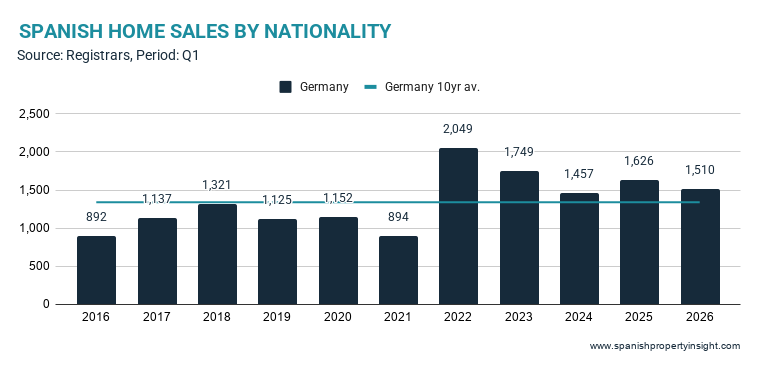
German buyers are still an important force in Spain’s foreign property market, but the latest Land Registrar figures show demand cooling after the post-pandemic boom.
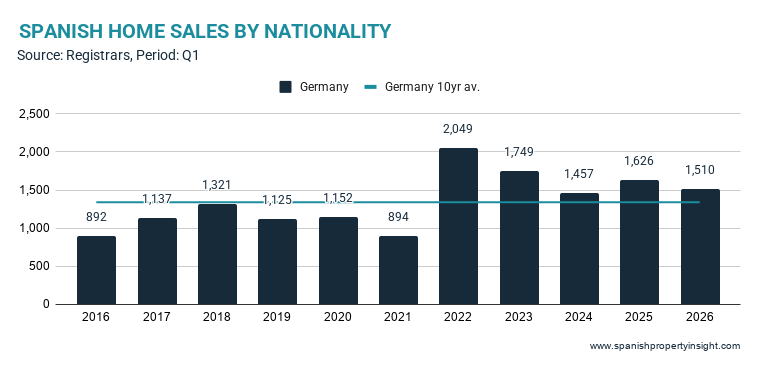
Spanish property acquisitions involving a buyer from Germany reached 1,510 in the first quarter of 2026, according to the latest figures from the Spanish Land Registrars’ Association.
That was down 7.2pc compared with the same period last year, whilst total foreign demand fell by a milder 3.2pc. So German demand underperformed the wider foreign market in the latest quarter.
Even so, German demand was still 12.6pc above its ten-year average for the first quarter, which puts the decline in context. This is a cooling market, not a weak one.
Still well above 2016 levels
Taking 2016 as a base of 100, the German buyer index stood at 169 in Q1 2026. In other words, German demand is still almost 70pc higher than it was in 2016.
The wider foreign market index stood at 193, so German demand has not grown quite as strongly as foreign demand overall, but it remains well ahead of pre-pandemic levels.
Market share near the bottom of its range
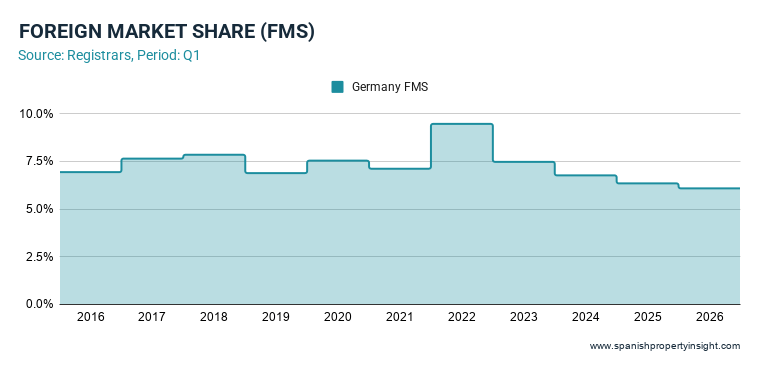
German buyers accounted for 6.1pc of all foreign purchases in Q1 2026, compared with a ten-year high of 9.5pc and a low of 6.4pc.
That puts Germany’s share close to the lower end of its recent range, suggesting other nationalities are now doing more of the heavy lifting in Spain’s foreign buyer market.
The rolling trend points lower
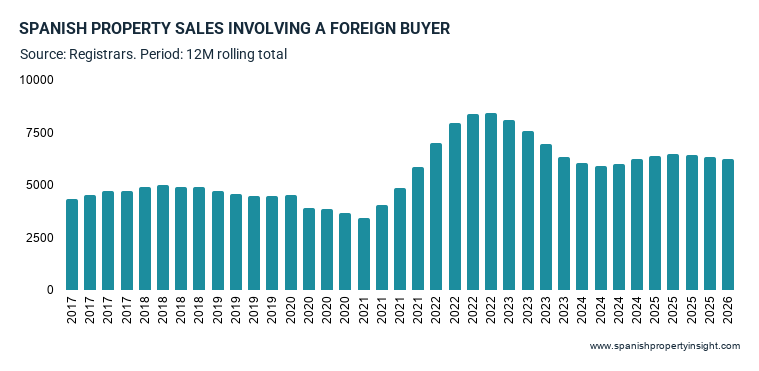
Looking at the four-quarter rolling total, German buyers acquired 6,241 homes in Spain over the latest twelve-month period.
That was down 1.8pc compared with the previous quarter, and the rolling total has now declined for three consecutive quarters.
The takeaway is that German demand is cooling, but remains relatively resilient. German buyers are still active in Spain, especially in the islands and Mediterranean coastal markets, but they appear to be more cautious and selective than during the recent boom.









Author:  Mark Stücklin
Posted on
German buyers are still an important force in Spain’s foreign property market, but the latest Land Registrar figures show demand cooling after the post-pandemic boom.
Spanish property acquisitions involving a buyer from Germany reached 1,510 in the first quarter of 2026, according to the latest figures from the Spanish Land Registrars’ Association.
That was down 7.2pc compared with the same period last year, whilst total foreign demand fell by a milder 3.2pc. So German demand underperformed the wider foreign market in the latest quarter.
Even so, German demand was still 12.6pc above its ten-year average for the first quarter, which puts the decline in context. This is a cooling market, not a weak one.
Still well above 2016 levels
Taking 2016 as a base of 100, the German buyer index stood at 169 in Q1 2026. In other words, German demand is still almost 70pc higher than it was in 2016.
The wider foreign market index stood at 193, so German demand has not grown quite as strongly as foreign demand overall, but it remains well ahead of pre-pandemic levels.
Market share near the bottom of its range
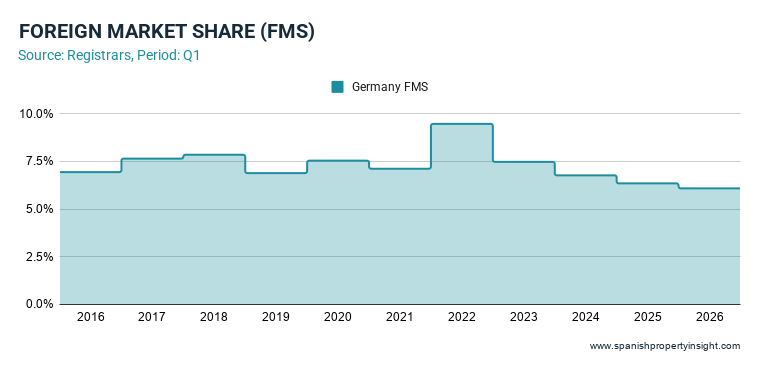
German buyers accounted for 6.1pc of all foreign purchases in Q1 2026, compared with a ten-year high of 9.5pc and a low of 6.4pc.
That puts Germany’s share close to the lower end of its recent range, suggesting other nationalities are now doing more of the heavy lifting in Spain’s foreign buyer market.
The rolling trend points lower
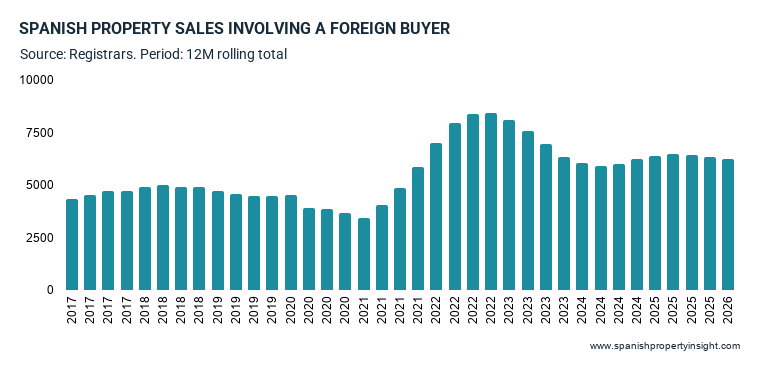
Looking at the four-quarter rolling total, German buyers acquired 6,241 homes in Spain over the latest twelve-month period.
That was down 1.8pc compared with the previous quarter, and the rolling total has now declined for three consecutive quarters.
The takeaway is that German demand is cooling, but remains relatively resilient. German buyers are still active in Spain, especially in the islands and Mediterranean coastal markets, but they appear to be more cautious and selective than during the recent boom.
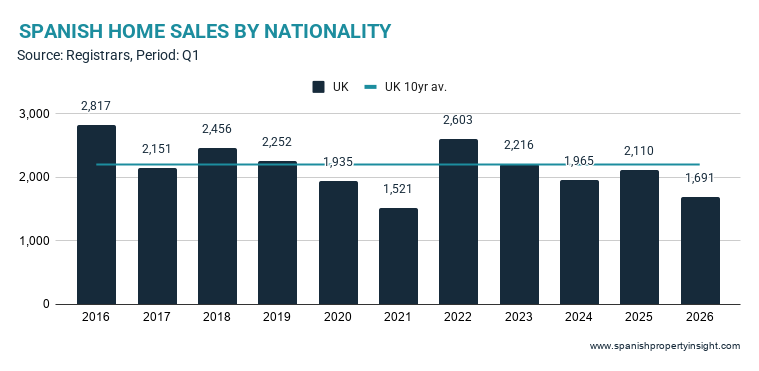
British buyers were once the dominant force in Spain’s foreign property market. The latest Land Registrar figures show just how far that dominance has faded.
The UK remains an important source of demand, but in Q1 2026 British buyers were not just down year-on-year — they were underperforming the wider foreign market and sliding towards levels last seen in the darkest days of the pandemic.
British buyers down almost 20pc in Q1
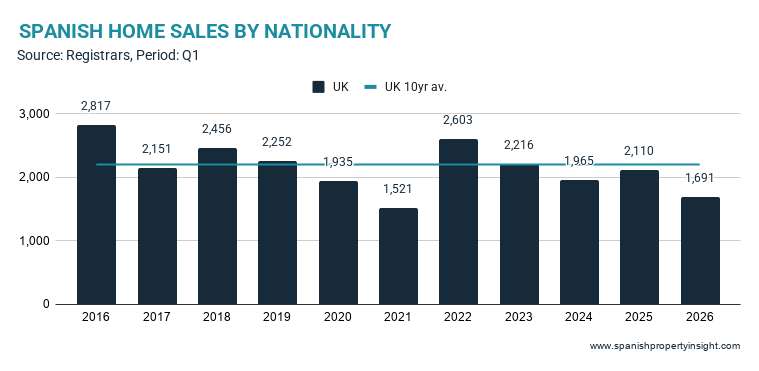
Spanish property acquisitions involving a buyer from the UK reached 1,691 in the first quarter of 2026, according to the latest figures from the Spanish Land Registrars’ Association.
That was down 19.9pc compared with the same period last year, and 23.2pc below the ten-year average for British demand in the first quarter.
By comparison, total foreign demand was down by a much milder 3.2pc year-on-year. So this was not just a case of the whole foreign market taking a breather. British demand fell much faster than the rest of the pack.
That matters because the British used to be Spain’s biggest foreign buyer group by some distance. They still matter, especially in the coastal and island markets, but the numbers suggest they are no longer the market-making force they once were.
A long decline from the Brexit-era baseline
The index tells the story more clearly. Taking 2016 as a base of 100, British demand has fallen to 60 in the latest quarter. In other words, UK purchases are running at roughly 40pc below their 2016 level.
The contrast with the foreign market as a whole is striking. Over the same period, the overall foreign buyer index has risen to 193, meaning the wider foreign market is now almost double its 2016 level.
So whilst Spain has become more popular with foreign buyers overall, the British segment has gone in the opposite direction. Brexit, currency weakness, higher prices, tax changes, and the loss of EU residency rights have all played their part. The British love affair with Spain is not over, but it has become more complicated, expensive, and bureaucratic. Romance, meet paperwork.
Market share hits a new low
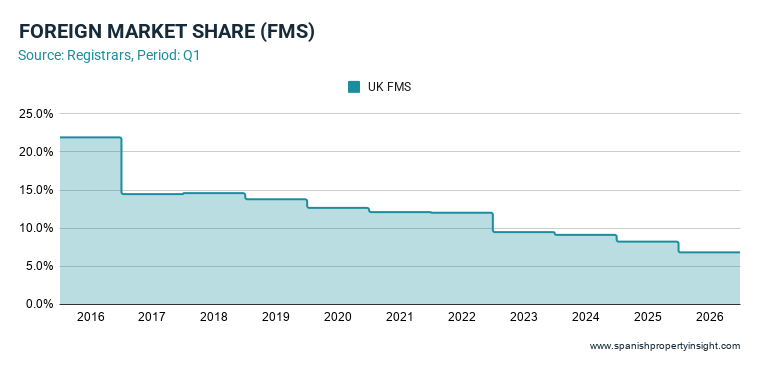
British buyers accounted for just 6.8pc of all foreign purchases in Q1 2026. That compares with a ten-year high of 21.9pc, when the British were in a league of their own.
This is perhaps the most symbolic figure of all. The UK has not disappeared from the Spanish property market, but its share has been steadily diluted as other nationalities have grown in importance.
The rolling trend looks weak
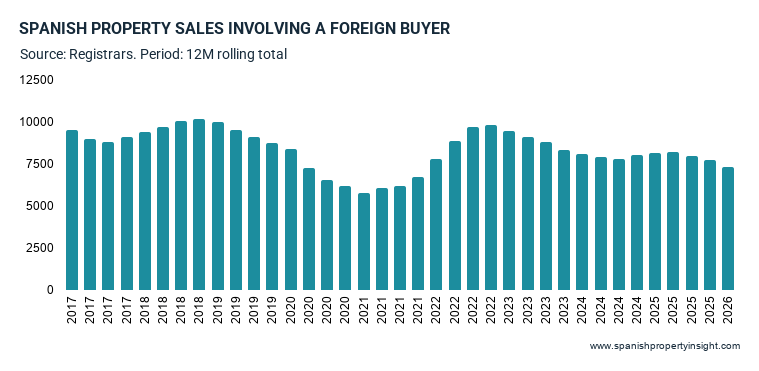
Looking at the four-quarter rolling total, which smooths out quarterly volatility, British buyers acquired 7,347 homes in Spain over the latest twelve-month period.
That was down 5.4pc compared with the previous quarter, with the rolling total now falling for three consecutive quarters. The trend is heading towards record lows, only beaten by the lockdown slump during the pandemic.
The British market is struggling in Spain, even as UK demand appears to be holding up better in destinations like Greece and Italy. Why? One likely explanation is that Spain has traditionally attracted a broader, more price-sensitive British buyer base than some of its Mediterranean rivals. And right now, that segment is under pressure from the weak UK economy, higher borrowing costs, and stretched household finances back home. Spain may still be the favourite, but for many British buyers it no longer looks like the easy, affordable option it once was.
Foreign demand for Spanish property appears to be running out of steam after the extraordinary boom that followed the pandemic, according to the latest figures from the Spanish Land Registrars’ Association.
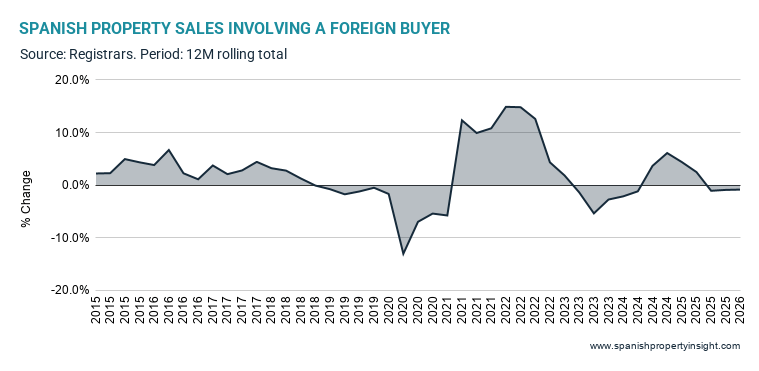
The latest numbers for Q1 2026 reveal that 24,791 Spanish home sales involved a foreign buyer, down 3% on the same period last year. That marks the third consecutive quarterly decline, suggesting that the foreign market has shifted from post-pandemic boom to gentle cooling phase.
A market losing momentum after the post-pandemic surge
The foreign market has already had one false dawn. After cooling in 2023 following the frenetic rebound that came after Covid lockdowns, the market found a second wind in 2024 before slowing again. The latest figures suggest that second rebound has now also run its course.
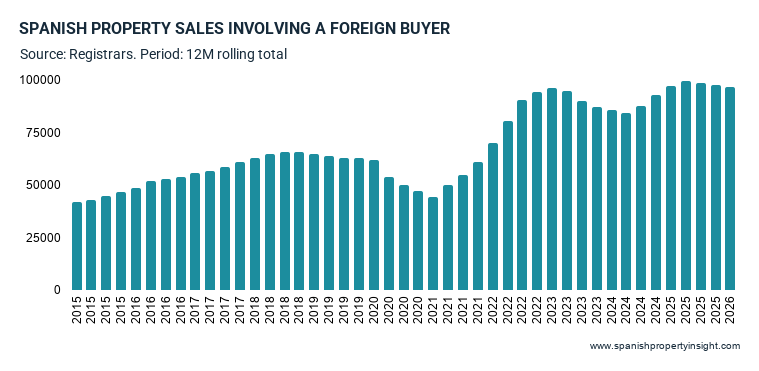
One of the best ways to understand the underlying trend is to look beyond volatile quarterly figures and focus instead on the 12-month rolling total of sales involving foreign buyers (chart above). This smooths out seasonal swings and gives a clearer picture of direction.
Using this measure, the transformation in the market over the last decade is striking. Before the pandemic, foreign demand typically hovered around 65,000 purchases every 12 months. In the wake of Covid, however, demand surged to above 90,000 as lifestyle changes, remote working, accumulated savings, and renewed appetite for sunshine destinations fuelled a buying spree across coastal Spain.
But the latest figures suggest that the market has now reached a plateau.
The 12-month rolling total peaked in Q2 2025 at 99,458 purchases involving a foreign buyer—just shy of the symbolic 100,000 mark—and has edged lower every quarter since. By Q1 2026 the rolling total had slipped to 96,696, down just under 1% compared to Q4 2025.
Still historically strong
Importantly, this is not a collapse. Foreign demand has now declined for three consecutive quarters both year-on-year and on a rolling 12-month basis, but the declines remain relatively modest—typically around 3% to 4% year-on-year, and closer to 1% when viewed through the smoother rolling-total lens.
In other words, the foreign appetite for property in Spain appears to be cooling rather than crashing.
And even after the recent softening, demand remains dramatically above the levels seen during most of the previous decade. The 2020s have, so far, been an exceptionally strong period for Spain’s foreign property market despite—or perhaps partly because of—the chaotic start to the decade with the pandemic.
Not all foreign markets are behaving the same
The headline numbers also conceal important differences between nationalities. Some buyer groups, such as the Polish market, continue to expand, while others—notably the British market—have been weakening.
So whilst the overall market may now be plateauing after the post-pandemic boom, beneath the surface the composition of foreign demand is still evolving. That, however, is a story for another day.
What this means for sellers
For sellers, the shift matters because foreign buyers have been one of the main engines driving many coastal and lifestyle markets in Spain over the last few years. If there are fewer buyers around, even modestly fewer, the balance of power in the market begins to change.
We are not yet in a full-blown buyers’ market. Buyers are not quite “in the saddle” yet. But the direction of travel increasingly suggests that negotiating power is slowly moving away from vendors and towards purchasers.
That means sellers will increasingly find themselves competing for a smaller pool of buyers, whilst also facing growing competition from new-build developments and professional developers who are often better prepared, better marketed, and more flexible on incentives.
In a market like that, simply putting a property online and hoping for the best may no longer be enough. Vendors will need to price more carefully, present properties better, sort out documentation and legal issues in advance, and think more strategically about marketing and negotiation.
In other words, as the post-pandemic frenzy fades, preparation and professionalism are likely to matter more than ever.
Thinking of selling a property in Spain?
A successful sale starts before you put your property on the market — and before you even speak to estate agents or lawyers. The first step is to understand what you own, what your property is worth, what sort of market you are selling into, how the sales process works, who you can trust, and what strategy makes most sense for you.
Too often, owners enter the process without independent advice and end up being steered by agents or others whose priorities may not fully align with their own. SPI offers expert guidance designed to put your interests first, helping you get organised, make sense of the market, and prepare for sale with a clear plan and personalised strategy.
Fill in the form below to find out more about the service.


Mexico’s Most Controversial Politician, Rubén Rocha, Goes To Ground As Cartel Questions Intensify
Insurance company Mapfre decides to pay out €14 million compensation for 2025 blackout

Who Bought Where In The Second Half Of 2025?


-
 ElPais1 week ago
Mexico’s Most Controversial Politician, Rubén Rocha, Goes To Ground As Cartel Questions Intensify
-
blackout April 20253 weeks ago
Insurance company Mapfre decides to pay out €14 million compensation for 2025 blackout
-
 Foreign demand3 weeks ago
Who Bought Where In The Second Half Of 2025?
-

 New Developments3 weeks ago
Inside The Most LUXURIOUS Apartment Building In Spain!
-
Costa Blanca South3 weeks ago
Alicante police chief to retire after 17 years of service
-

 New Developments3 weeks ago
🌅 Stunning Penthouse With Panoramic Sea & Mountain Views Benalmádena
-
biggest ever cocaine bust4 weeks ago
Spain’s biggest-ever cocaine bust – massive Atlantic seizure stuns authorities
-
Abelardo de la Espriella6 days ago
In The Final Stretch Of Colombia’s Presidential Campaign, Undecided Voters Are In High Demand