
Bolivia
Gold Fever Closes In On The Habitat Of The Tilcayo, Bolivia’s Newly Discovered Wild Cat

The landscape of asphalt and concrete that defines La Paz can give way, within just a few miles, to hot, dense forests clinging to the mountainsides. The steep, unforgiving streets north of Bolivia’s administrative capital are replaced by thick vegetation and winding rivers that descend more than 5,000 meters toward the Amazon.
It is in this region that the tilcayo (Leopardus tilcayo), the first wild cat identified in more than a century, was recently described. But the area is also home to significant gold deposits that are drawing companies, mining cooperatives and local communities eager to capitalize on record gold prices and the severe economic crisis gripping the country.
The extraction of this mineral poses a threat not only to the tilcayo but also to the habitat of thousands of animal species. In the municipality of Coroico, one of the seven municipalities that make up the Yungas region, there are around 16 mining areas authorized to operate and another 129 awaiting approval or under review, according to a 2025 survey by the Administrative Mining Jurisdiction Authority (AJAM). The agency carries out frequent inspections because many of those 129 sites are already operating despite not having completed the regulatory process.
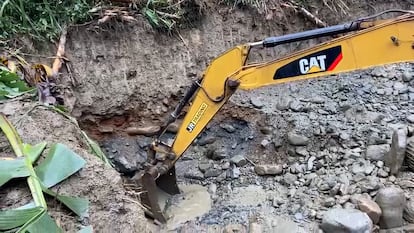
Although some mining is carried out underground, the dominant method is open-pit extraction along riverbanks. Dump trucks, excavators and heavy-haul vehicles move earth, gravel and sediment in search of gold. The sight of felled trees across vast cleared areas signals the arrival of this machinery. The effects of mining are also visible in the vegetation lining the rivers, much of which has collapsed into the water due to landslides caused by soil removal.
One such landslide has opened a crater at the very entrance to the Senda Verde Wildlife Refuge, home to the tilcayo specimen that led scientists to identify the new species.
“We’re incredibly proud of the feline,” says Vicky Ossio, founder and director of Senda Verde since it was established in 2003. “It made us turn our attention back to the natural world. In Coroico, a law has already been passed to protect the tilcayo. How can you do that and at the same time allow mining that affects all wildlife?”
00:48
Heavy machinery operating along the banks of the Coroico River, Bolivia
“With the noise from the [gold-mining] machines, the capuchin monkeys would run away. That noise drives them away. There were even big cats that could be seen crossing the road,” continues the founder of Senda Verde, which is home to about 1,200 animals from 70 species, cared for by a dozen rangers and volunteers.
In fact, the tilcayo that gave the species its name, a specimen known as Tigrino, was itself the result of this forced displacement. A member of the local community found it by the roadside when it was still a cub. It was kept as a pet until 2017, when its rescuer handed it over to the refuge. Nine years passed before scientists formally recognized the discovery of a new species. Since then, Senda Verde has been featured in media outlets around the world.
Ossio says she is inundated with calls from visitors, journalists and officials hoping to see Tigrino, who is around nine years old and belongs to a species that typically lives between 13 and 15 years. But visits to his enclosure are prohibited. “He’s settled — why would we take him out and stress him? To satisfy people’s curiosity?” asks Ossio.
She wants the focus instead to be on the latest incursion by mining cooperatives, the one that left a large crater at the entrance to the sanctuary. Senda Verde and its surroundings have been targeted by the gold rush almost since the refuge opened its doors, but the threat has never been this close.
The mining cooperative behind the latest push is claiming rights to an area caught in a legal gray zone that affects around 30 properties in Coroico. The AJAM classifies these as areas with “pre-existing rights”: concessions granted before the 2014 Mining and Metallurgy Law that must now be brought into line with newer environmental regulations, including the requirement to obtain an environmental license.
The cooperative asserted its extraction rights, while staff at Senda Verde demanded updated documentation. Tensions escalated until three members of the mining cooperative were arrested. They were released three days later.
Mining is also affecting other areas that provide refuge for the tilcayo and nearly 930 vertebrate species in the Yungas, a transitional bioregion on the eastern slopes of the Andes Mountains in Peru, Bolivia, and northwestern Argentina. In Cotapata National Park, one of the three legally protected areas in Coroico, a mine entrance was recorded in 2025. Most local communities have sought legal protection by creating nature reserves, as the advance of extractive activity threatens not only wildlife but also water by muddying it, altering its course and contaminating it with mercury.
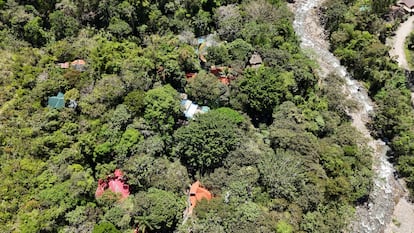
The 12 communities that make up the Río Negro Reserve, just under two miles from Senda Verde, are finalizing the management plan required to secure state protection for their 6,200 hectares against mining. “Every day there is a mining threat. We have identified between four and six cooperatives that threaten 80% of our territory,” says Víctor Álvarez, a reserve member and community representative.
Álvarez acknowledges that although most local residents oppose mining, some community members engage in artisanal or small-scale extraction. This activity is recognized under Bolivia’s Mining and Metallurgy Law, which defines it as mining operations that are labor-intensive and involve low levels of capital goods. “With the economic crisis, there are more and more,” says Álvarez. “They go down to the river in seasons when they don’t have crops. There is also no detailed regulation.”
EL PAÍS observed a group of around 20 of these gold prospectors, known locally as barranquilleros, on the banks of the Coroico River, less than 100 meters from Senda Verde’s rewilding area. They operate from tents where they store pickaxes, gold pans and motor pumps, machines that combine combustion engines with hydraulic pumps to move large volumes of water.
For the refuge’s director, the damage caused by the barranquilleros is no different from that caused by mining cooperatives. “That’s not artisanal mining. They’re using engines and hoses,” she says.
The municipality of Coroico agrees that small-scale mining is increasingly dependent on more sophisticated machinery. “In addition to motor pumps, they use suction dredges to remove rocks, creating what are effectively pits,” says Ana Carranza, Coroico’s director of environmental affairs. “This affects the riverbanks because it increases sediment and water turbidity, while also destroying aquatic habitat.”
The divisions among local residents over how much mining should be allowed have eroded community structures. In the Yungas, mining is no longer seen only as an environmental problem but also as a social one, extending well beyond Coroico.
In the municipality of Coripata, residents confronted the mayor, challenging him to drink water from the rivers that supply the community, accusing him of turning a blind eye to illegal mining. In the municipality of La Asunta, tensions escalated even further: local residents attacked a mining cooperative last September, injuring several people and setting part of its machinery on fire.
Sign up for our weekly newsletter to get more English-language news coverage from EL PAÍS USA Edition

Gold Fever Closes In On The Habitat Of The Tilcayo, Bolivia’s Newly Discovered Wild Cat

Netflix Emitirá ‘La Velada Del Año’ De Ibai Llanos En Directo Los Próximos Tres Años

The Royal Navy’s Flagship Aircraft Carrier HMS Queen Elizabeth Is Heading To Gibraltar For Rare Public Open Day


-

 Uncategorized3 weeks ago
F1 Bahrain Grand Prix will be live and FREE on TV this weekend
-
EU2 weeks ago
EU nicotine crackdown sparks warning that ex-smokers could be driven back to cigarettes
-
Blackout preparedness3 weeks ago
Brussels takes action against Spain over failure to update blackout plan
-

 Uncategorized3 weeks ago
Lewis Hamilton F1 wish could come true as stunning plans for new track revealed
-

 Foreign demand3 weeks ago
Market Snapshot: German Market In Q2 2026
-

 New Developments3 weeks ago
How To Get A Tourist Rental Licence In Andalusia (Spain) – Step-By-Step Guide 2025
-

 Housing access / crisis / affordability2 weeks ago
Radical Housing Decrees Defeated As Snap Election Talk Grows
-
Latest1 week ago
The Changes To Spain’s IRNR Non-Resident Property Tax In 2027