
%
Moonlight Old Town Velez-Malaga Running Event








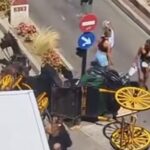
Fallen horse and cart in Fuengirola. Credit: FsQ FB
A horse-drawn carriage overturned in the heart of Fuengirola on Tuesday afternoon after the horse bolted, leaving two women injured and causing disruption in one of the town’s busiest areas.
Emergency services were called to Plaza de la Constitucion at around 3.30pm after the carriage reportedly crashed into a van and a motorcycle before overturning. Despite the dramatic scenes, the horse escaped without injury.
Horse bolted shortly before crash in Fuengirola
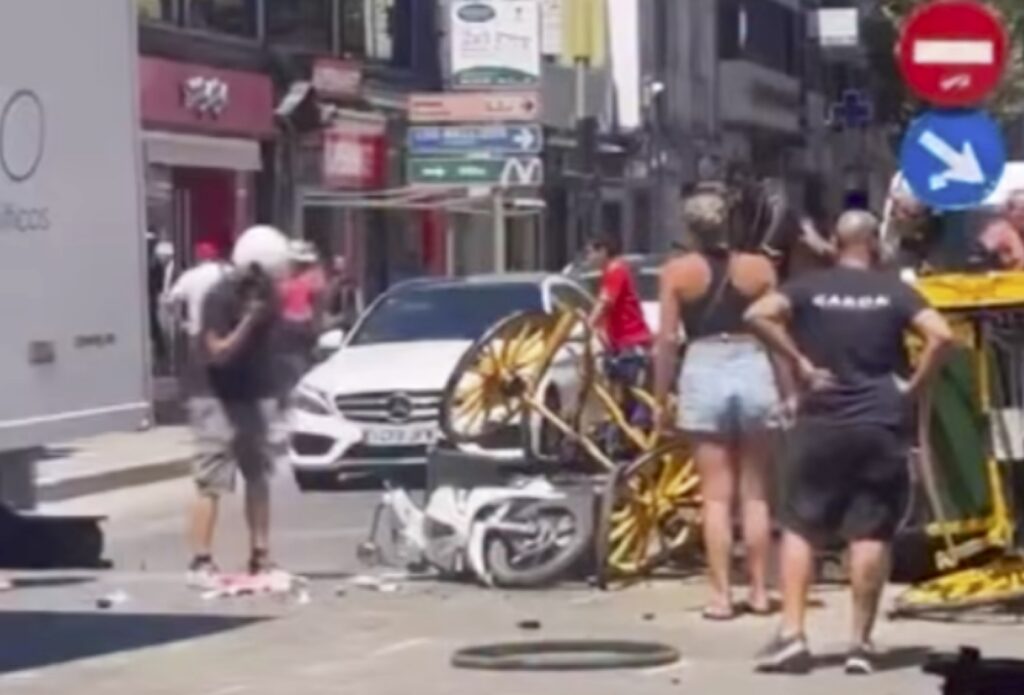
Initial reports indicate the horse first began trotting unusually near Plaza Reyes Catolicos before becoming uncontrollable a short distance later. According to emergency services, the carriage hit a barrier before crossing into the opposite lane, where it collided with a van of some kind and a motorcycle waiting at traffic lights.
Witnesses reported seeing the carriage overturn in Plaza de la Constitucion, bringing traffic to a standstill as police and paramedics rushed to the scene.
Local police have not yet explained what caused the horse to bolt, and no official cause has been released.
Carriage driver taken to Hospital Costa del Sol
Emergency crews treated two women following the collision. The carriage driver suffered a blow to the head and an ankle injury but managed to climb out of the overturned carriage without assistance. Paramedics later transferred the driver by ambulance to Hospital Costa del Sol in Marbella for further assessment. The motorcyclist escaped with minor injuries after suffering a blow to the ankle during the collision.
Local police and healthcare workers were still at the scene while traffic was managed and the damaged carriage removed.
Horse escaped unhurt despite dramatic collision
Remarkably, the horse was reported to be uninjured despite the force of the crash. Images from the scene showed the overturned carriage lying in the roadway as emergency services worked around the vehicle. Initial reports described the other vehicle as a lorry, while local television referred to it as a delivery van. Neither description changes the sequence of events confirmed by emergency services, which state the carriage collided with a commercial vehicle before overturning.
No damage figures have been released, and there has been no official explanation yet for why the horse bolted.
The horse debate in Fuengirola reopens
Fuengirola Town Hall had not issued a public statement on the incident by Tuesday evening, and there has been no announcement of any review of horse-drawn carriage regulations or safety measures in the town, but this incident no doubt reopen the debate over tourist rides by horse in the town.
Horse-drawn carriages remain a familiar sight during Fuengirola’s equestrian celebrations and local festivities, with the town hosting its annual ‘Fuengirola A Caballo’ events in the same central streets used by residents and visitors throughout the year. Animal rights activists are already calling for the instant abolition of the tourist custom. Council leaders must also be asking themselves now if Fuengirola has become far too crowded and full of traffic for horses, especially considering public safety. Mayor Ana Mula acted decisively following the horrific car crash in Torreblanca last year by having installed multiple speed impediments. What changes are to come after this accident are yet to be seen.
Emergency services, including 112 Andalucia, health workers and local police, attended the incident. Investigations into the circumstances surrounding the horse bolting are continuing, although no official cause has yet been identified.

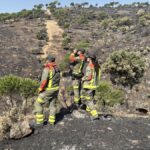
As recovery efforts continue, financial support has started arriving from across Spain. Photo credit: 112 comunidad de Madrid on X
The communities devastated by the Madrid wildfires are beginning the long process of rebuilding after flames tore through thousands of hectares of countryside, leaving homes damaged, businesses disrupted and residents facing an uncertain future. While emergency crews have now moved from firefighting to recovery, the scale of the destruction means reconstruction is expected to take months.
The blaze, which swept across the Sierra Oeste and joined with the Avila fire, became the largest wildfires Spain’s history. Entire neighbourhoods were evacuated as the fire spread rapidly through dry vegetation, while thick smoke blanketed surrounding towns. Hundreds of firefighters, military emergency units and volunteers worked around the clock to bring the situation under control.
Ayuso reveals the surprise name behind €80,000 donation
As recovery efforts continue, financial support has started arriving from across Spain. Donations from businesses, organisations and private individuals have been directed towards the Community of Madrid’s official reconstruction fund, helping families and municipalities begin the difficult task of repairing what was lost.
One donation, however, came from a name few expected. Community of Madrid president Isabel Díaz Ayuso revealed that football icon Lionel Messi had donated €80,000 to support reconstruction efforts in the Sierra Oeste. Announcing the contribution on X, Ayuso thanked the Argentine star for his generosity, writing that Madrid hoped to welcome him soon and give him “the applause he deserves.”

How the donation came about
According to regional government sources, representatives acting on Messi’s behalf contacted the Community of Madrid to ask how they could contribute through the official recovery fund. Rather than making the donation privately through another organisation, they requested details of the regional government’s reconstruction campaign so the money could go directly towards helping affected communities.
The €80,000 contribution will now form part of the official recovery fund established after the wildfire, supporting rebuilding projects across the municipalities that suffered the greatest damage as residents continue returning to normality.
A disaster that changed the landscape
The wildfire left an enormous trail of destruction across the region. More than 27,000 hectares were burned, making it one of the most significant environmental disasters to affect the Community of Madrid in decades. Forest land, farmland and protected natural areas were all consumed by the flames.
Initial assessments indicate around 100 homes were destroyed, while more than 300 other properties suffered damage. Seventeen municipalities were affected, forcing thousands of residents to evacuate or remain under movement restrictions while emergency services battled the advancing fire.
Recovery will take time
Although the emergency phase has ended, rebuilding will continue for many months. Local authorities are assessing damaged infrastructure, restoring essential services and working with residents whose homes or businesses were affected by the disaster.
Alongside reconstruction work, environmental experts have begun evaluating the impact on forests, wildlife and protected natural spaces. Restoring the landscape will be a long-term project that continues well beyond the rebuilding of homes and public facilities.
Support continues to grow
The Community of Madrid’s reconstruction fund remains open to donations from individuals, charities and businesses wishing to contribute to the recovery effort. Officials say every contribution will help restore public infrastructure, support affected municipalities and assist families rebuilding their lives.
Regional leaders have repeatedly thanked emergency crews, volunteers and donors whose support has continued long after the flames were extinguished. The combined effort has provided both financial assistance and reassurance to communities facing the enormous challenge of recovery.
Football rivalry forgotten
Messi’s donation has attracted widespread attention because of his long association with Barcelona, the historic rivals of Real Madrid. Even so, the announcement has been met with praise across Spain, with many commenting that humanitarian support transcends football rivalries when communities are facing tragedy.
For the people of the Sierra Oeste, however, the identity of the donor is unlikely to matter as much as the impact the contribution will have. As reconstruction continues across one of Spain’s worst wildfire zones in recent memory, every donation represents another step towards helping affected towns rebuild and recover.

Horse-Drawn Carriage Overturns In Busy Fuengirola Square

Eclipse Fever Grips Spain As Little-Known Destinations See Hotel Demand Soar

The Fuego Volcano Eruption In Pictures


-

 Latest2 weeks ago
Can Spanish Property Owners Cut Off Utilities To Squatters?
-

 Amazon2 weeks ago
Un Tangle Teezer De Viaje: El Cepillo De Pelo Perfecto Para Tu Neceser De Vacaciones
-

 New Developments2 weeks ago
Luxury Villas For Sale, Estepona – ProjectL1
-

 ChatGPT2 weeks ago
Food-Related Scams Are Flooding Social Media With Hyper-Realistic AI-Generated Videos
-
 Andalucia2 weeks ago
Man Arrested For Assaulting Six-Month Pregnant Partner At Malaga Airport
-
Latest1 week ago
Spanish Wildfires Intrude On Holidaying Foreign Visitors
-
ElPais2 weeks ago
Spain Moves Forward With Law Granting Citizenship To Sahrawis
-
Business2 weeks ago
How UK small businesses are meeting the demand for always-on customer service