
News
Hundreds evacuated as huge fire erupts on Spain high-speed train route

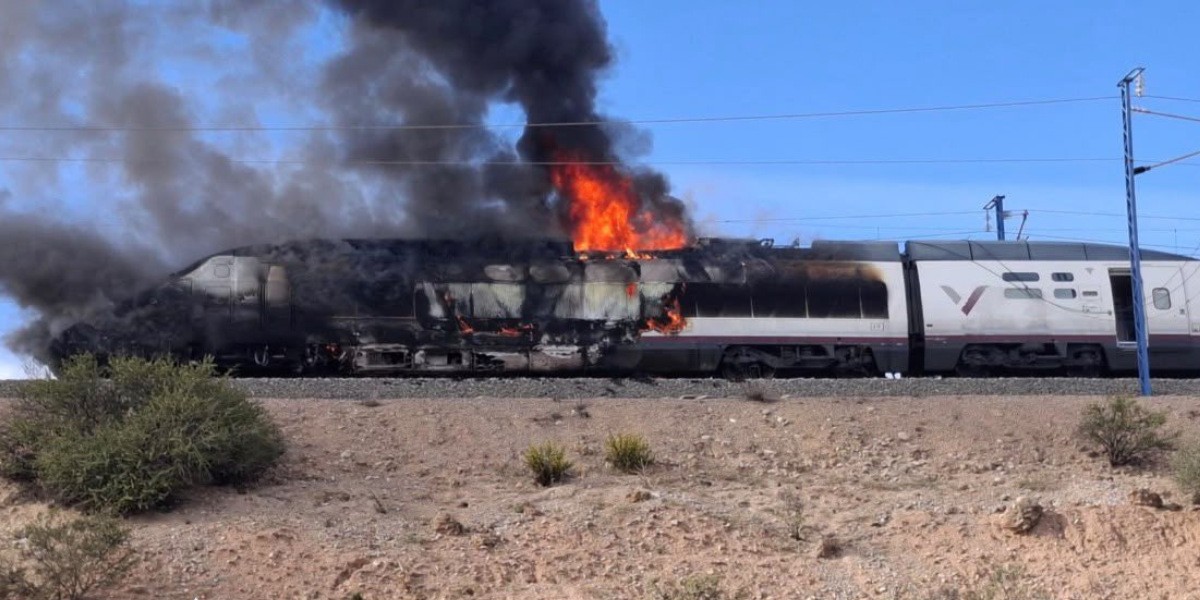
Hundreds of passengers were evacuated from a high-speed AVE train after a fire broke out in northeastern Spain, bringing rail traffic on a key section of the Madrid-Barcelona route to a standstill.
The incident unfolded on Monday, October 12, when a train travelling from Madrid towards Figueres, in Girona, caught fire near Ricla, in Zaragoza province. The blaze forced the suspension of high-speed services between Calatayud and Zaragoza, disrupting journeys along one of Spain’s busiest rail corridors.
With passengers removed from the train and emergency crews called to tackle the flames, travellers faced uncertainty over when they would be able to continue their journeys.
Fire breaks out on Madrid-bound route
The train was carrying 283 passengers when the fire was detected in its rear section at around 4.05pm, according to initial reports.
Emergency services rushed to the scene, with firefighters from Zaragoza Provincial Council working to extinguish the blaze. Passengers were evacuated as a precaution while the emergency response unfolded.
The fire affected the rear locomotive and an adjoining section of the train. Railway authorities also cut power to the overhead electrical cables to allow emergency teams to work safely.
Two people reportedly required medical attention. They included a woman who experienced dizziness and a passenger with reduced mobility. No serious injuries were reported in the initial accounts.
High-speed services brought to a halt
The incident caused major disruption to trains using the affected section of track, with services suspended in both directions while emergency crews and railway teams dealt with the situation.
The timing compounded the difficulties for travellers. Monday was Spain’s National Day, October 12, which coincided with the return period following the long weekend associated with the Pilar festivities.
Passengers travelling between Madrid, Zaragoza and Barcelona faced delays and uncertainty, while the impact extended to other high-speed operators using the same railway infrastructure.
Renfe initially said it could not give a reliable estimate for when services would return to normal.
Passengers offered ticket changes
Renfe announced that affected passengers could change or cancel their tickets without paying additional charges.
Alternative transport arrangements were also being considered to help passengers continue their journeys around the disrupted section.
Travellers were advised to check directly with their train operator for updated departure times, alternative connections and replacement transport arrangements before travelling to the station.
When will trains resume?
The full extent of the disruption depended on the emergency response and the railway infrastructure team’s assessment of the affected section.
Although the incident triggered a suspension of services, subsequent updates indicated that a partial resumption was being considered or implemented. Delays could therefore continue even as trains began moving again.
Passengers planning to travel through Zaragoza should check the latest operator announcements before setting off, as the situation may change throughout the day.















Conor Faulkner – conor.faulkner@thelocal.com
Published: 19 Oct, 2026 CET. Updated: Mon 19 Oct 2026 11:53 CET

Add The Local as a preferred source
In the midst of an election campaign sparked by housing protests, Spain’s possible next Prime Minister, conservative PP leader Alberto Núñez Feijóo, has pledged serious tax incentives to people buying their first home in rural areas of the country.
Become a member or log in to continue reading
More
Comments
Join the conversation in our comments section below. Share your own views and experience and if you have a question or suggestion for our journalists then email us at news@thelocal.es.
Please keep comments civil, constructive and on topic – and make sure to read our terms of use before getting involved.
Please log in here to leave a comment.
See Also



The first evidence of how landlords are reacting to Spain’s controversial new housing decrees suggests that thousands of homes are already being withdrawn from the long-term rental market, making the housing shortage worse rather than better.
According to a survey by the National Federation of Estate Agent Associations (FAI), almost 6,000 rental transactions have been disrupted in just ten days following the government’s emergency housing decrees, which were rejected by Parliament and then reintroduced ahead of the snap general election on 29 November.
The FAI surveyed more than 600 estate agencies in Spain’s main cities and provincial capitals, finding that 88.9% had experienced disruption to their rental business as a result of the regulatory changes.
The most striking finding is that 4,235 properties have been withdrawn from or diverted away from the conventional long-term rental market. Of these, 2,067 were withdrawn altogether, 1,224 switched to the sales market, and 944 redirected towards seasonal or room rentals. Another 1,523 rental contracts have been put on hold.
These are figures reported by the agencies surveyed, not a national estimate, and the survey does not establish how many properties might eventually return to the rental market. Nevertheless, the scale and speed of the reaction are striking.
Landlords vote with their feet
The FAI reports that 78.1% of agencies have seen landlords withdraw properties from long-term letting, whilst 72.4% have experienced rental contracts being delayed or frozen. Based on these early findings, the federation warns that rental transactions could fall by 25% to 30% in the coming weeks.
The problem is particularly acute for small landlords, who account for much of Spain’s private rental supply and are especially sensitive to uncertainty over rent controls, eviction protections and their ability to recover possession.
FAI president José María Alfaro acknowledges the public frustration over the housing crisis but argues that the government’s response is having serious unintended consequences. He also criticises the decision to push the decrees through the Permanent Deputation whilst Parliament is dissolved, warning against hurried legislation in an already strained market.
The predictable consequences of more intervention
These findings are consistent with the concerns I raised in my previous articles about the decrees and the government’s decision to make housing the central battleground of the coming election.
Spain desperately needs more rental housing, yet the government’s approach risks encouraging existing landlords to withdraw properties whilst deterring new investment. Sitting tenants may benefit from greater protection, but those searching for somewhere to live face an increasingly difficult market with fewer choices.
The FAI is calling for an emergency national housing plan involving political parties, regional governments and the property sector, regardless of who wins the election. That would be a more constructive approach than using housing as a political weapon.
The survey is an early warning rather than definitive proof of a lasting collapse in rental supply. But it illustrates how quickly landlords can react when the rules become unpredictable. With the election still six weeks away and the future of the decrees uncertain, there is little reason to expect confidence to recover immediately.
Spain needs policies that encourage more homes onto the market, not measures that persuade their owners to take them off it.

Netflix Emitirá ‘La Velada Del Año’ De Ibai Llanos En Directo Los Próximos Tres Años

Lewis Hamilton
Spain’s Opposition Proposes ‘zero’ Property Tax For First-Time Rural Buyers


-

 Uncategorized3 weeks ago
F1 Bahrain Grand Prix will be live and FREE on TV this weekend
-
EU2 weeks ago
EU nicotine crackdown sparks warning that ex-smokers could be driven back to cigarettes
-

 Uncategorized3 weeks ago
Lewis Hamilton F1 wish could come true as stunning plans for new track revealed
-
 Foreign demand3 weeks ago
Market Snapshot: German Market In Q2 2026
-
Blackout preparedness3 weeks ago
Brussels takes action against Spain over failure to update blackout plan
-

 New Developments3 weeks ago
How To Get A Tourist Rental Licence In Andalusia (Spain) – Step-By-Step Guide 2025
-

 Housing access / crisis / affordability2 weeks ago
Radical Housing Decrees Defeated As Snap Election Talk Grows
-
Latest1 week ago
The Changes To Spain’s IRNR Non-Resident Property Tax In 2027