
ElPais
Lena Dunham’s Body Is Back Again… And Her Memoir, ‘Famesick,’ Reads Differently Now












ChatGPT
From Mamdani’s Veto To Enthusiasm In Estonia: Schools Around The World Are Grappling With The Use Of AI

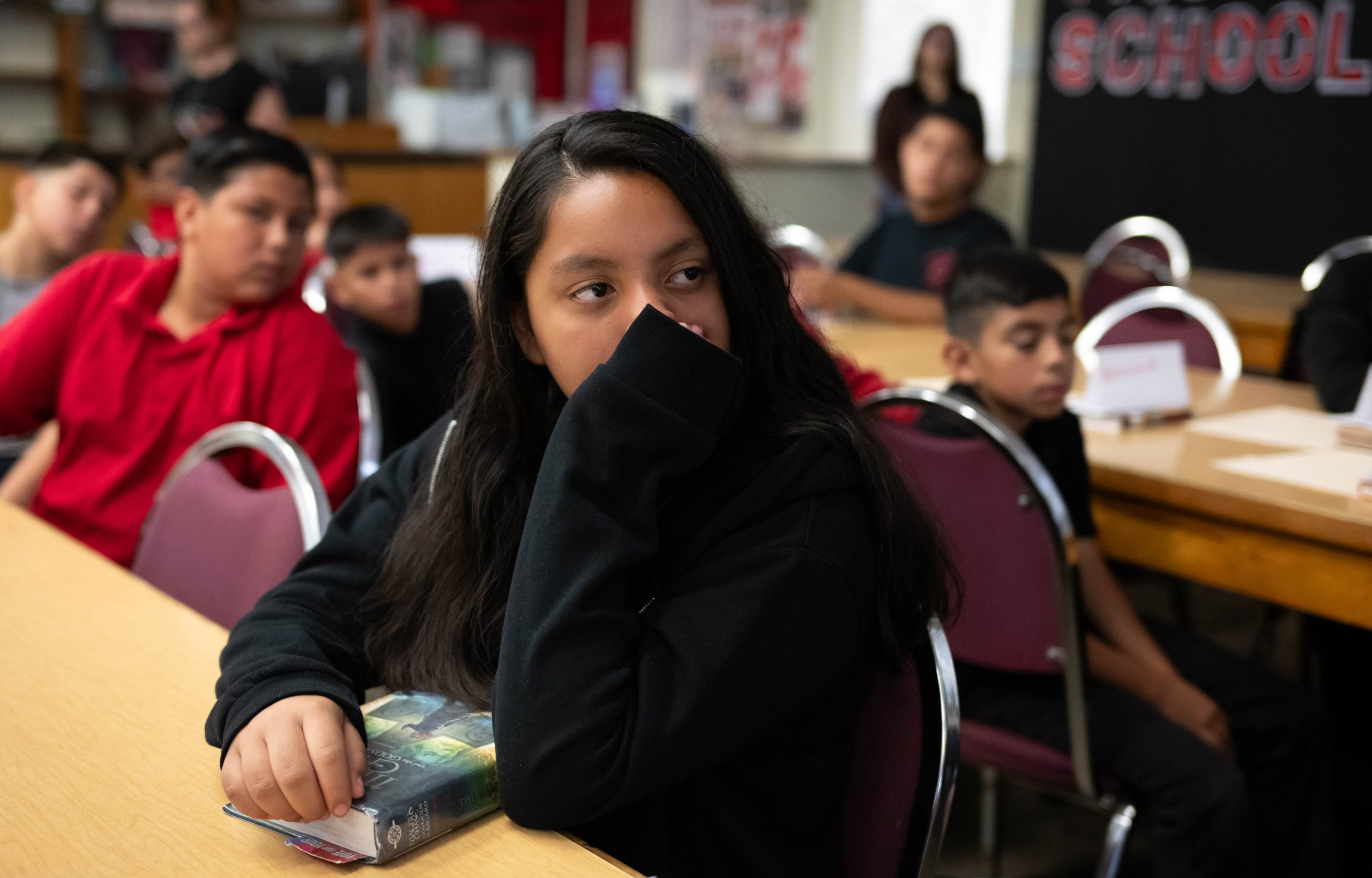
Sandra Martinez Roe, a mother in Los Angeles, hopes that her son will never use artificial intelligence (AI) in school. “I’m not going to let my children be guinea pigs,” she tells EL PAÍS over the phone. The city’s school board granted her wish, at least temporarily, a couple of weeks ago: the Los Angeles Unified School District (LAUSD) has banned AI from public classrooms this school year.
Martinez Roe is a member of Schools Beyond Screens, a parent group that fights against certain technologies in schools. She attended the board meeting where the decision was made. “We went into the meeting prepared, with our demands, some research and a list of experts,” she explains. “When it ended, they had turned off all the AI tools for all grades and age groups. It was a surprise and a huge victory for us,” she sighs.
Similarly, one of the most striking measures implemented in recent days, this one by New York City Mayor Zohran Mamdani, has been to “prioritize student safety and real, human instruction” by imposing “the most expansive student-facing AI moratorium in the nation,” according to city officials.
“The tech industry wants us to believe that A.I.-powered early education is not only inevitable, but necessary. We do not see it that way,” Mamdani stated.
In contrast to this AI blackout in New York and Los Angeles, however, Estonia — the top-ranked European country and third in the world in the Programme for International Student Assessment (PISA) standings — is turning it on. For a year now, it has been providing 16-year-old students with an adapted version of ChatGPT, OpenAI’s chatbot, which offers students guidance rather than simply answering their questions.
Estonian Education Minister Kristina Kallas emphasized this distinction via video call: “I don’t think banning AI will prevent young people from using it. AI use will just be more clandestine and more hidden from adult view, but they’ll still try to use it.”
The Baltic country is deploying this specialized model, developed in collaboration with OpenAI, because it believes that “general-purpose AI isn’t designed to learn,” the minister warns. She describes the ministry’s tool as a “Socratic” kind of GPT (generative pre-trained transformer) that helps students “develop their critical thinking skills and [boost] cognitive growth.”
Kallas emphasizes that her office hasn’t received a single complaint from any Estonian family about implementing the adapted model. The only complaint she’s heard came from her own son and for a different reason. The minister recounts: “My son had started 11th grade when the tool was introduced last year. I asked him, ‘How’s it going?’ And he said, ‘It’s really annoying, because [the program] doesn’t give me any answers.’”
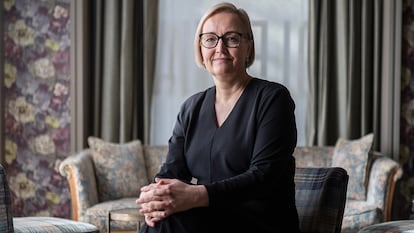
Kallas asserts that this is only the first step. “We need to redesign the learning process, recognizing that students are already using AI at home when they’re doing their homework,” she points out. “They understand the technology much better than the teachers.”
Still, the Estonian government doesn’t plan on allowing AI to be used by students under the age of 16, a policy it shares, in one form or another, with New York City (which is prohibiting the use of the technology for children 14 and under), Norway and China. However, they’re still training teachers regarding how to navigate AI when it comes to elementary and middle-school students. “These are the ages when we need to develop self-directed learners. Teachers know that a 12-year-old is using AI for homework… so we have to design the assignment in such a way that students are forced to think and learn,” Kallas explains.
The minister believes that this is “the greatest challenge facing humanity.” She continues: “[AI] is a technology that doesn’t force us to think; it makes us dependent on machines. Everything happens very quickly in an education system. And, if we don’t act, all of thinking and memory will be outsourced.” This may sound apocalyptic, but Kallas says that she’s working to prevent an educational collapse. “A [blanket ban] is an option, but banning the tools doesn’t make them disappear. The risk is even greater: that learning in schools will become obsolete,” she points out.
Her own logic isn’t so far removed from that of Los Angeles. The city will review the ban, which affects some 380,000 students, at the end of the 2026-2027 school year, according to a spokesperson for the LAUSD. “Our policy is to restrict student access to generative AI platforms while the district reviews instructional use and safeguards,” the spokesperson clarified, in a statement sent to EL PAÍS.
A total ban
Even though New York is the first city in the United States to issue a total ban on AI in classrooms, it’s not the first major step that its education department has taken when it comes to this issue. The Big Apple actually banned student and teacher access to ChatGPT back in January of 2023, shortly after the chatbot’s launch. The technology had raised concerns in the educational sector, due to the ease with which students could use it to cheat on exams. However, the city reversed the measure in May of that same year, in order to “embrace [ChatGPT’s] potential” – a quote from then-New York City Chancellor of Education David Banks, who wrote an opinion piece that month to explain the change in policy.
If you put New York City and Los Angeles on one side of a spectrum, while placing Estonia on the other end, it’s clear that most educational systems worldwide currently fall somewhere in between, without such specific policies. This is according to Mark West, a researcher at the United Nations Educational, Scientific and Cultural Organization (UNESCO). One exception is the United Arab Emirates (UAE), which designates AI as a mandatory subject, starting in preschool. From the age of four, students in the UAE learn to compare machines to humans, taking their first steps when it comes to using AI applications. Meanwhile, those between the ages of 10 and 14 years must learn how to design artificial intelligence systems.
“At first glance, they seem like two opposite poles, but that’s not the case,” West emphasizes. “If you look more closely, the UAE and Estonia actually teach students about AI. We believe that’s important and urgent. But relying on AI for learning is an entirely different matter.”
Spain already relies on it. According to the PISA report published this past September 8, in the developed world, students from Malta and Spain use AI the most for studying. But the five OECD countries where students use it the least for schoolwork achieve better scores on the tests.
The Spanish Ministry of Education has established general rules for the use of AI in schools, but emphasizes in a response to EL PAÍS that education policy rests with regional governments. A guide published on September 8 by the National Institute of Educational Technologies and Teacher Training (INTEF) states that “AI literacy is now a necessary dimension of students’ comprehensive education.” Currently, Catalonia is the only region of Spain that recommends prohibiting the unsupervised use of AI in classrooms, specifically for children under the age of 14.
Schools worldwide are facing this technology without knowing where it will lead their students, at a time when two key figures in the rise of AI — Dario Amodei and Sam Altman — are proposing that the pace of these models’ development be slowed down. Meanwhile, UNESCO is proposing both safeguarding and accelerating the deployment of AI: “We must ensure that these tools help education and children… and that they’re safe,” West emphasizes.
Sign up for our weekly newsletter to get more English-language news coverage from EL PAÍS USA Edition


Donald Trump returned to power in Washington with two major foreign policy promises: to end the war in Ukraine “in 24 hours” and to keep his country out of more “forever wars.” Almost two years after his decisive electoral victory, the Russian invasion continues with no sign of a quick end, and the United States has plunged itself into yet another hornet’s nest in the Middle East. Two conflicts of unpredictable outcome have pushed fossil fuel costs to historic highs worldwide and are increasing doubts about whether — with price signals distorted — supply chains will withstand the pressure.
The relentless chain of setbacks is scarcely matched in recent memory. Through the Strait of Hormuz — the unavoidable exit route for oil and gas from the Persian Gulf — only a handful of ships now sail each day, either at their own risk or escorted by the U.S. Navy; a tiny fraction of the traffic that passed through that key waterway before the first strikes on Iran earlier this year.
Saudi Arabia, the world’s largest crude exporter, was put largely out of action for more than a week: attacks by pro-Iran militias forced the East-West pipeline, its only alternative to Hormuz, to shut down, although Reuters reported on September 24 that operations on the pipeline had resumed, with tankers awaiting loading. The Houthi rebels, always dependent on Tehran, are expanding their control over Bab al-Mandab, another crucial maritime passageway. And Russia, with its refineries severely damaged by Ukrainian drone strikes, is about to extend its ban on diesel exports for another month: supplying its domestic market is now almost a pipe dream. A quartet of adverse factors that, in short, leaves the world on the brink of another energy crisis.
“The situation has deteriorated a lot in the past two weeks [since the Houthis took control of the Bab al-Mandab Strait and following the attacks on the Saudi pipeline]. What we are seeing is unprecedented,” Francisco Blanch, global head of commodities and derivatives at Bank of America, tells EL PAÍS by phone. “The disorder in the Middle East is extreme, and there is neither enough crude on the market or, above all, enough refineries available to process it.”
If the main bottleneck in spring was jet fuel, now — mirroring what happened in the early months of Russia’s invasion of Ukraine — concerns center on diesel. Moscow, a historic European supplier, has nearly half of its refining capacity offline. Riyadh has effectively disappeared from the market: with three key facilities operating below capacity — the Yanbu, Samref and Yasref refineries, all on a Red Sea now turned into a tinderbox — it has been forced to pause all crude and fuel shipments to Europe.
“Neither diesel nor heating oil have much of a short-term solution,” Blanch says. And what prices are signaling, with the gallon above $6 in the U.S. and the liter over €2 in most of the EU, is a “major” potential supply problem on the horizon “if supply chains have not been restored by Christmas.”
Could the world slide into a second major energy shock in less than five years? “Definitely,” Thierry Bros, a professor at Sciences Po Paris, replies on the phone. “Especially Europe, because of its external dependence and because fuel subsidies continue to delay electrification. Since we don’t have gas or oil, our only exit is to diversify and to destroy demand.”
In the words of the Bank of America analyst, “very difficult weeks” lie ahead. And there’s one major unknown: what will happen after the U.S. midterm elections on November 3, in which polls point to a historic reverse for the Republican Party, which may even lose both houses of Congress. “The big question is how Trump will react and whether or not that might open the door to diplomacy.”
Far from being isolated compartments, diesel, gasoline and kerosene are largely interconnected. Refineries — especially the most modern and flexible ones — can choose to produce more of one product at the expense of others. And that is exactly what has been happening for several months: facilities that favored jet fuel are now prioritizing diesel. The result: everything is much more expensive and there is a shared feeling among all analysts consulted that, despite prices already soaring, they do not fully reflect the severity of the situation.
There is, Blanch says, one factor that could “make things even worse”: Trump banning U.S. fossil fuel exports. “U.S. consumers might benefit from lower prices, but it would do great harm to the U.S. economy, which is currently being heavily supported by those sales,” he notes. The impact of such a potential veto, Eurasia Group analysts Gregory Brew and Henning Gloystein write in a recent client note, would be particularly severe in two regions: Europe and Latin America — by far the most dependent on U.S.-sourced fuels. Still, Samantha Gross of the Brookings Institution suspects that “real shortages may hit countries that cannot afford to pay much more for fuels.”

If a full-blown energy crisis has not yet arrived it is only thanks to four mitigating factors with few historical precedents. First, the world market was awash in oil before the Trump-Netanyahu duo launched the first strikes on Iran: supply exceeded demand, a structural imbalance that will widen. Second, the increasingly necessary electrification is reducing — and will reduce further — demand for gasoline and diesel. Third, strategic reserves were full; that is no longer the case after their rapid use in the initial stages of the closure of Hormuz. Fourth, the global economy depends far less on oil and its derivatives than ever before, which significantly lightens the burden of high prices.
And then there is gas. The true Gordian knot in Europe’s 2022–23 energy crisis now seems overshadowed by an oil shock that engulfs everything. But there are reasons to stay alert here too: the closure of Hormuz has sidelined the world’s second-largest exporter of liquefied natural gas (LNG), Qatar, which has been forced to cancel the bulk of its sales to the EU and Asia citing “force majeure.”
Continental reserves of LNG, key for industry and heating, are at their lowest in more than a decade and about 20 percentage points below where they usually stand at this time of year. “What we hope is that this winter, like the last, is not too cold in Europe. Because if it is, we could have serious problems,” says Ana Maria Jaller-Makarewicz, an analyst at the Institute for Energy Economics and Financial Analysis (IEEFA).
Unlike 2022 and 2023, when Russia’s invasion of Ukraine suddenly spiked prices and fears of shortages, we are, the IEEFA analyst sketches, “facing a slow-motion crisis.” Qatar is absent from the market. Flows from Norway are near their limit. And competition with Asia for LNG is much greater than a few months ago. Today’s prices of over €70 per megawatt hour have raised electricity costs, but they pale compared with the over €300 of four years ago. “Europe will have to pay more to attract LNG carriers originally destined for other parts of the world,” Gross predicts by email. “Uncertainty is enormous: the only clear thing is that there is no clear solution in sight,” Jaller-Makarewicz concludes.
Sign up for our weekly newsletter to get more English-language news coverage from EL PAÍS USA Edition
ElPais
English-Speaking, Texan And From Vulnerable Backgrounds: The Americans Still Accessing Abortion Thanks To Mexican Feminists


The year 2023 was pivotal for understanding the effects of abortion restrictions in the United States. A year earlier, in June 2022, the U.S. Supreme Court issued the decision known as Dobbs v. Jackson Women’s Health Organization (JWHO), which overturned the abortion-rights protection established by a previous ruling from 1973: Roe v. Wade. Since then, thousands of American women have ended pregnancies with help from Mexican feminist collectives. Several recent studies put a face to those seeking abortions: a large share come from states such as Texas, where abortion is banned, and live in neighborhoods with high levels of poverty.
These findings emerged from research by several women. Facing a surge in restrictions, Alexandra Wollum, a public health expert and researcher at the Ibis Reproductive Health institute, contacted Verónica Cruz Castro, director of Centro Las Libres, and Sandra Cardona Alanís, founder of the Red Necesito Abortar MX network, with whom she has collaborated for years on scientific studies of sexual and reproductive health. Together they designed a study to try to answer the question: who are the Americans seeking help from feminist collectives in Mexico to access abortion?
Their findings reinforce warnings about what would happen once abortion rights were restricted: the most marginalized women ended up being the most affected. The vast majority of people who sought help from these collectives live in states where abortion is banned. Abortion in places where it is prohibited is often a feasible option only for those who can afford it. For those who cannot buy the medications or travel to a state where abortion is legal, Mexican collectives are an alternative.

Likewise, many women began crossing the border into Mexico to access this health service. Some were even received by Alanís at her abortion clinic in the city of Monterrey, Nuevo León.
By the time they compiled their report, Castro and her colleagues at Centro Las Libres, a feminist organization based in Guanajuato, already had more than 20 years of experience helping women end pregnancies in Mexico — with or without government approval. Since September 2021, they have also been supporting self-managed abortions for women who sought them from Texas.
They did so soon after the conservative U.S. state published a law restricting access to abortion if a physician could detect a fetal heartbeat, claiming this was an indicator the pregnancy could be carried to term successfully — a myth debunked by studies showing, for example, that fetuses with anencephaly, in which the brain or skull do not fully develop, can exhibit cardiac activity despite being nonviable.
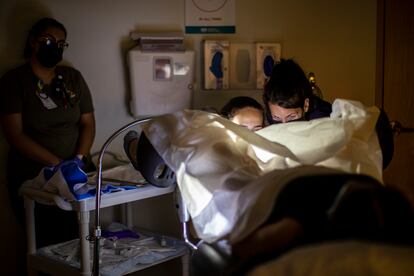
On the other hand, another study explains that the human heart is not fully formed until around the 20th week of pregnancy, so the cardiac activity detectable from the sixth week is not comparable to the heartbeat of a fully formed heart.
The consequence was that many women lost access to this right overnight, including those with conditions that made carrying a pregnancy to term unsafe.
Thus, Las Libres and Red Necesito Abortar MX began providing information and accompaniment for women to end pregnancies at home, sending misoprostol and mifepristone free of charge — two medications used for the process.
After Roe v. Wade was overturned, Castro and Alanís recall how requests for accompaniment increased significantly and began arriving from several states that quickly enacted restrictions and bans on abortion access. In 2023 alone, they received at least 2,850 requests, which they analyzed in the study conducted with Wollum. To do so, they designed a set of questions that, based on the collectives’ experience, people would be willing to answer and established secure channels to communicate with them.
They found that 82% of help requests came from states with complete abortion bans, such as Texas. Using zip code information, they were also able to identify that the rate of people requesting help increased in areas with higher poverty, lower insurance coverage, and a larger share of Spanish speakers. However, to the surprise of the organizers, most of the people who contacted them were English speakers.

In areas where only 5% of the population lives below the poverty line, the rate of requests for accompaniment to Mexican collectives was 0.35 per 100,000 women. In areas where up to 17% live in poverty, the rate rose to 1.63. The overall average in the study was 2.44 women per 100,000.
The findings of this study help reinforce the evidence regarding the already known effects of abortion restrictions. According to Wollum, “support groups are truly helping to bridge a gap in access to abortion for people in the U.S. who, at this time, face the greatest obstacles to receiving care, including cost, distance, and language barriers.”
The specialist is one of a long list of scientists who, from their own work, have contributed research to understand the consequences of abortion restrictions and how to make care safer. In just the past four months, the journal Obstetrics and Gynecology has published at least three studies on the subject. Tuyet Mai Hoang, a social work specialist focused on sexual and reproductive health, authored one of them.

Hoang, who did not participate in Wollum’s study, says one of its chief strengths is the collaboration between activists on the Mexican side and U.S.-based scientists, each an expert in their field. “It’s important that activists, researchers, patients, and other stakeholders take part in the research process and the generation of scientific evidence to inform laws,” she says.
Hoang also recently published a study to better understand the experiences of people who traveled from restrictive states to others where abortion is legal, such as Illinois, where she works. One of her main conclusions is that a key motivation for making that trip is trust. “They don’t travel only to receive abortion care. And not only because abortion is unavailable or banned in their state, but because they sought medical care that, for them, felt safe, reliable, respectful, and nonjudgmental,” the researcher explains.
Anna Fiastro, a public health expert, concurs. Her research reached a similar conclusion, describing how women who travel to obtain misoprostol and mifepristone do so because they distrust remote medicine options. That distrust is fueled by lack of information and fear of possible legal consequences.
For Alanís, activism has shown that collective action can fill the gaps left by governments. Castro adds that the studies conducted in collaboration with Ibis have helped her understand how that idea has spread from Mexican collectives into the United States. She welcomes how the women who have accessed accompanied abortions have even formed their own community networks across the border. That will be the subject of Castro’s future research. However, given the daily criminalization feminists face, she does not think now is the best time to pursue it.
Sign up for our weekly newsletter to get more English-language news coverage from EL PAÍS USA Edition

Estos Clips Son El Truco Definitivo Para Que El Relleno Nórdico No Se Mueva Dentro De La Funda
A mysterious map in a 1599 Bible points towards the location of the lost Garden of Eden
Petrol thieves in Spain see their getaway go spectacularly wrong


-
Latest2 weeks ago
The Vocabulary You Need To Understand The Spanish Citizenship Process
-

 Alex Saab2 weeks ago
Maduro Ally Alex Saab Pleads Guilty In US Money-Laundering Case
-

 New Developments2 weeks ago
How To Get A Tourist Rental Licence In Andalusia (Spain) – Step-By-Step Guide 2025
-

 Uncategorized2 weeks ago
‘Lewis will never trust Charles again’ – F1 journalist issues shocking Ferrari statement – GPFans.com
-

 %2 weeks ago
Benahavis Wildfire Stabilised: 300 Hectares Burnt
-

 Arganzuela1 week ago
Detenido Un Hombre Por La Muerte De Una Mujer De 47 Años En El Distrito De Arganzuela De Madrid
-

 Coaching2 weeks ago
Svend Brinkmann, Psychologist: ‘If You Place Conditions On Forgiveness, Love Or Freedom, You Have Already Destroyed Them’
-
Best airlines1 week ago
Spanish airline Vueling named Europe’s best low-cost carrier for 2026