Connect with us

Cost of living

Living in Spain costs average household almost £13,000 less a year, study finds

Published

on

New research suggests that British households could save almost £13,000 a year by living in Spain rather than the UK. The biggest savings come not from property prices, but from the recurring costs of everyday life.

A new study by CostLiving has found that the average UK household spends £37,353 per year, compared to £24,598 for an equivalent household in Spain—a difference of £12,755 annually, or around 52%.

As Jodi Donnelly, Research & Analysis Lead at CostLiving, explains:

“For anyone weighing up a move to Spain, the purchase price is only half the story. The recurring cost of living, the rent, the energy bills, the fuel, is materially lower in Spain, and that advantage compounds every year you stay.”

The real cost difference is what happens after you move

For many Britons considering a move to Spain, attention tends to focus on property prices. But the research suggests that the bigger financial advantage may lie in what happens after you’ve bought or rented a home.

The study estimates that the average British household spends more than £1,000 a month extra on day-to-day living compared to a similar household in Spain. While property purchase costs can be significant, they are generally a one-off expense. The savings generated by lower living costs continue year after year.

Rent, energy and fuel drive the gap

The biggest differences are found in housing-related running costs.

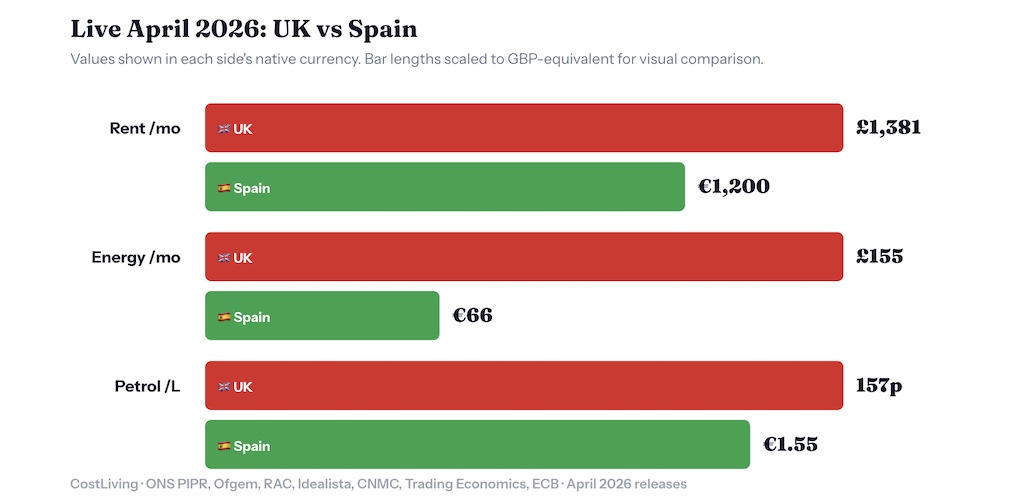
Average monthly rent in the UK is estimated at £1,381 compared to around £1,038 for a typical 80m² flat in Spain. Energy bills are also substantially lower, with Spanish regulated electricity tariffs coming in roughly £98 per month below the UK’s price-capped dual-fuel costs.

Fuel prices help widen the gap further. Petrol costs around 23p less per litre in Spain than in the UK, reducing transport costs for households that rely on a car.

Interestingly, inflation is not the explanation. Consumer prices are currently rising at similar rates in both countries. The difference is that the underlying cost base remains significantly lower in Spain.

What this means for British buyers

For British readers, the findings help explain why Spain remains such an attractive destination despite rising property prices in many popular locations.

Over the last decade, property prices have increased significantly in many coastal markets favoured by foreign buyers. However, Spain’s overall cost structure remains considerably lower than Britain’s. For retirees, remote workers, second-home owners spending extended periods in Spain, and families considering relocation, the savings on everyday living can quickly add up.

Of course, averages never tell the whole story. Living in central Madrid, Barcelona, Marbella’s Golden Mile or Ibiza will cost considerably more than living in many provincial Spanish towns. Equally, London and the South East are not representative of the entire UK.

Nevertheless, the broad conclusion is difficult to ignore: for many British households, Spain still offers a materially cheaper lifestyle than the UK. And unlike a one-off saving on a property purchase, lower living costs are a benefit that keeps paying out year after year.


Continue Reading
Click to comment

Leave a Reply

Your email address will not be published.

%

Why A Video Showing How To Make Olive Oil Is Going Viral As Food Prices Rise

Published

on

why-a-video-showing-how-to-make-olive-oil-is-going-viral-as-food-prices-rise

When prices rise people start paying more attention to how things are made. Photo credit: Davide Bonaldo/Shutterstock

In Spain, the weekly food shop has become noticeably more expensive for many households. Not in a sudden way, but slowly enough that people are starting to change how they buy things. A basket that once felt predictable now often comes out higher than expected. Some products are left on the shelf more often. Others are swapped for cheaper versions.

It is not just one item or one category. Bread, eggs, dairy, fruit, vegetables and cooking oils have all played a part in that shift. Most people are not changing what they eat completely. Instead, they are adjusting how they shop. Smaller baskets. More checking of prices. Less impulse buying.

Changing Habits in the Kitchen

That change has also affected how people cook at home. More meals are being made from basic ingredients instead of convenience food. Eating out during the week has dropped for some households. Nothing about it feels like a lifestyle decision. It is just a response to what things cost. Because of that, everyday ingredients are being looked at differently. Things that were once taken for granted now get more attention.

Olive oil is one of them. It is used constantly in Spanish cooking, so it runs out quickly and gets replaced often. When the price rises, it becomes noticeable in a way that occasional purchases do not.

That is part of why a short video posted on YouTube by the channel Chefsale showing olive oil being made by hand has been widely shared online. It shows a young man known as Valentín producing extra virgin olive oil using olives from a family tree, and it has circulated widely because it connects directly with something many people are already thinking about, whether it is possible to make more basic food items at home instead of relying entirely on shops.

Why the Video Has Gone viral

Valentín’s video is getting so many shares is not just because people are suddenly planning to start producing their own oil in large quantities, (although some might). It is because the idea feels less distant than it used to. When food prices rise, more people start paying attention to where things come from and what goes into them. Content that shows food being made from raw ingredients starts to feel more relevant than it once did.

Olive oil fits into that space clearly. It is something people use every day, but rarely think about beyond the bottle. Seeing it linked to a large amount of raw olives makes the cost feel more understandable, even if most people will never attempt it themselves.

It also sits alongside a new online trend of watching basic food production being done at home or on a small scale. Bread, cheese, butter, preserves and oils all appear in these contents. The interest is not just turning people into producers, but also in understanding what everyday products actually require before they reach a supermarket shelf.

What stands out in this case is the contrast between effort and output. A relatively small amount of finished oil comes from a large quantity of olives, which is part of what people react to when they watch it.

For Those That Want to Know: How to Make Olive Oil at Home

Im pretty sure some of our more curious readers are wondering how making your own olive oil is actually done. The process begins with fresh, ripe olives taken from the tree and cleaned so only the fruit remains. In the video, around seven kilos of olives are used, however I’ve actually looked this up and you can use anywhere between 4 to 9kgs for your own homemade ones. The olives are then washed and selected before being crushed, including the stones, into a paste.

Once crushed, the paste is placed into a fine cloth. The liquid is extracted through this cloth, separating the solid material from the liquid. The remaining solid part can be used as compost or fertiliser. The liquid collected at this stage is not yet the final oil. It is left to rest overnight in sealed containers.

After resting, the liquid naturally separates into layers. The top layer is removed carefully using a spoon or a ladle, the process requires patience as the separation happens slowly. Finally, the liquid is filtered again. After this final step, it becomes extra virgin olive oil. From around seven kilos of olives, the result is approximately 200 millilitres of oil.

Changing perspectives 

The appeal of the video is tied to a simple idea: when everyday food becomes more expensive, people start looking at how it is made and whether it can be done at home.

When prices rise across basic items, more people pay attention to the process behind them. Things that once felt distant start to feel more accessible, and content showing food being made from raw ingredients begins to spread more easily because of that.

Olive oil is one example of this shift, but it sits alongside other foods people are now experimenting with at home as a way of responding to rising costs, rather than just consuming them without question.

Continue Reading

%

How Many Years Does It Take To Buy A Home In Europe — Results Highlight A Divide

Published

on

how-many-years-does-it-take-to-buy-a-home-in-europe-—-results-highlight-a-divide

Housing affordability has become an increasingly important political issue. Photo credit: Saiko3P/Shutterstock

For many people hoping to buy their first home, the biggest obstacle is no longer saving for a deposit but keeping up with house prices that continue to outstrip wages. New research has found that in some European cities, buying an average home now costs the equivalent of almost 19 years of household income.

The findings, based on the widely used price-to-income ratio, highlight the growing affordability challenge across Europe, where property values have climbed far faster than earnings over the past decade. According to the research, Lisbon in Portugal and Split in Croatia are Europe’s least affordable housing markets. Both cities recorded a price-to-income ratio of 18.7, meaning the average home costs almost 19 times the average annual household income.

What does the price-to-income ratio mean?

The price-to-income ratio compares the average cost of a home with the average household’s annual income. It is commonly used by economists to assess whether housing is affordable in different countries and cities.

It does not mean buyers need to save every penny they earn for 19 years before purchasing a property. Most homes are bought with mortgages, while households continue to pay for everyday expenses. Instead, the ratio illustrates how far property prices have moved beyond what people typically earn.

A lower ratio generally indicates that housing is more affordable, while a higher figure suggests buyers face greater financial pressure when entering the market.

Which European cities are the least affordable?

Lisbon and Split topped the rankings, but several other major cities also recorded high price to income ratios. The ten least affordable housing markets in the study were:

  • Lisbon – 18.7
  • Split – 18.7
  • Prague – 18.1
  • Milan – 18.1
  • Tirana – 18.1
  • Vienna – 17.4
  • Belgrade – 17.2
  • Paris – 17.0
  • London – 16.0
  • Brno – 15.8

The results show that affordability pressures extend well beyond Europe’s largest capitals, affecting cities across southern, central and eastern Europe.

Why are house prices rising faster than incomes?

The research reflects a trend that has become increasingly visible over the last decade. House prices have risen steadily in many countries, while wage growth has failed to keep pace.

Portugal is one of the clearest examples. Over the past 10 years, residential property prices have increased by almost 240%, while average wages have risen by around 59%. As a result, many households have found themselves earning more than they did a decade ago but able to afford less when it comes to buying a home.

Several factors have contributed to rising prices. Population growth in cities, a shortage of new housing, higher construction costs and continued demand from both local and overseas buyers have all placed pressure on supply.

In destinations popular with tourists, the expansion of short-term holiday rentals has also reduced the number of homes available for permanent residents, adding to competition in the market.

What do the findings mean for buyers?

Although the price-to-income ratio provides a useful snapshot of affordability, it does not account for every factor involved in buying a home. Mortgage interest rates, taxation, household savings and government support for first-time buyers can all affect whether purchasing a property is realistic.

Nevertheless, the figures demonstrate how difficult home ownership has become in many parts of Europe. Even buyers with stable incomes may struggle to save enough for a deposit or secure a mortgage when property prices continue to rise faster than earnings.

Why housing affordability remains a growing challenge

Housing affordability has become an increasingly important political issue, with governments across Europe introducing measures aimed at increasing housing supply and supporting first-time buyers. However, in many markets, new construction still falls short of demand.

For prospective homeowners, comparing house prices with local incomes offers a clearer picture of affordability than looking at property values alone. While cities such as Lisbon, London and Paris remain attractive places to live and work, they also illustrate how challenging it has become for average earners to get onto the property ladder.

As the gap between wages and house prices continues to widen, the question is no longer simply how much a home costs. For many buyers, it is whether their income can keep pace with the cost of owning one. In Europe’s least affordable housing markets, that gap now amounts to almost 19 years of earnings.

Continue Reading

Cost of living

Living In Spain Costs Average Household Almost £13,000 Less A Year, Study Finds

Published

on

living-in-spain-costs-average-household-almost-13,000-less-a-year,-study-finds

New research suggests that British households could save almost £13,000 a year by living in Spain rather than the UK. The biggest savings come not from property prices, but from the recurring costs of everyday life.

A new study by CostLiving has found that the average UK household spends £37,353 per year, compared to £24,598 for an equivalent household in Spain—a difference of £12,755 annually, or around 52%.

As Jodi Donnelly, Research & Analysis Lead at CostLiving, explains:

“For anyone weighing up a move to Spain, the purchase price is only half the story. The recurring cost of living, the rent, the energy bills, the fuel, is materially lower in Spain, and that advantage compounds every year you stay.”

The real cost difference is what happens after you move

For many Britons considering a move to Spain, attention tends to focus on property prices. But the research suggests that the bigger financial advantage may lie in what happens after you’ve bought or rented a home.

The study estimates that the average British household spends more than £1,000 a month extra on day-to-day living compared to a similar household in Spain. While property purchase costs can be significant, they are generally a one-off expense. The savings generated by lower living costs continue year after year.

Rent, energy and fuel drive the gap

The biggest differences are found in housing-related running costs.

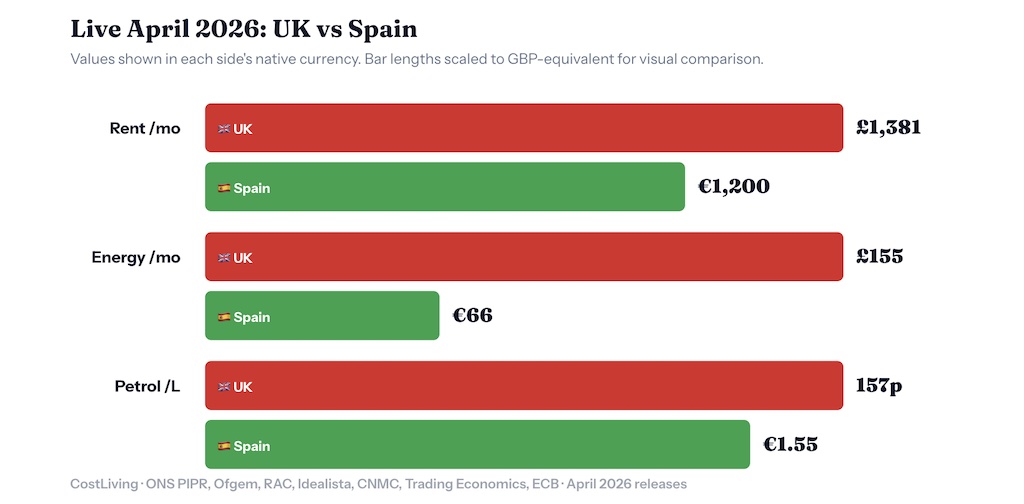
Average monthly rent in the UK is estimated at £1,381 compared to around £1,038 for a typical 80m² flat in Spain. Energy bills are also substantially lower, with Spanish regulated electricity tariffs coming in roughly £98 per month below the UK’s price-capped dual-fuel costs.

Fuel prices help widen the gap further. Petrol costs around 23p less per litre in Spain than in the UK, reducing transport costs for households that rely on a car.

Interestingly, inflation is not the explanation. Consumer prices are currently rising at similar rates in both countries. The difference is that the underlying cost base remains significantly lower in Spain.

What this means for British buyers

For British readers, the findings help explain why Spain remains such an attractive destination despite rising property prices in many popular locations.

Over the last decade, property prices have increased significantly in many coastal markets favoured by foreign buyers. However, Spain’s overall cost structure remains considerably lower than Britain’s. For retirees, remote workers, second-home owners spending extended periods in Spain, and families considering relocation, the savings on everyday living can quickly add up.

Of course, averages never tell the whole story. Living in central Madrid, Barcelona, Marbella’s Golden Mile or Ibiza will cost considerably more than living in many provincial Spanish towns. Equally, London and the South East are not representative of the entire UK.

Nevertheless, the broad conclusion is difficult to ignore: for many British households, Spain still offers a materially cheaper lifestyle than the UK. And unlike a one-off saving on a property purchase, lower living costs are a benefit that keeps paying out year after year.

Continue Reading

Trending

Copyright © 2017 Spanish Property & News