Connect with us

Latest

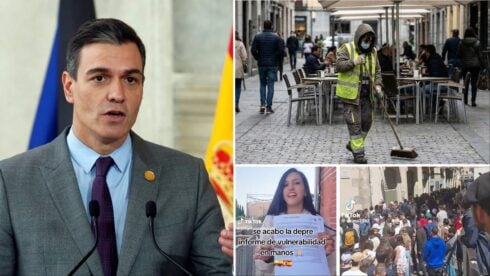
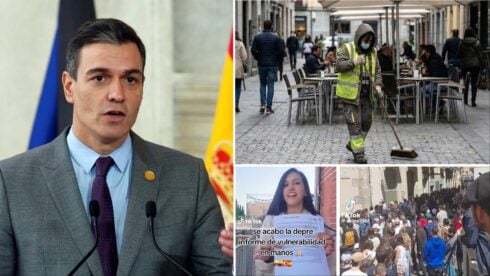
Sanchez Gaffe: PM Hails Spain’s Safest Region As Also Its Least-Foreign During Launch Of €505m Migrant Integration Plan

Published

on

sanchez-gaffe:-pm-hails-spain’s-safest-region-as-also-its-least-foreign-during-launch-of-e505m-migrant-integration-plan

Alejandro Grimaldo

El Atlético De Madrid Anuncia El Fichaje De Grimaldo

Published

on

By

el-atletico-de-madrid-anuncia-el-fichaje-de-grimaldo

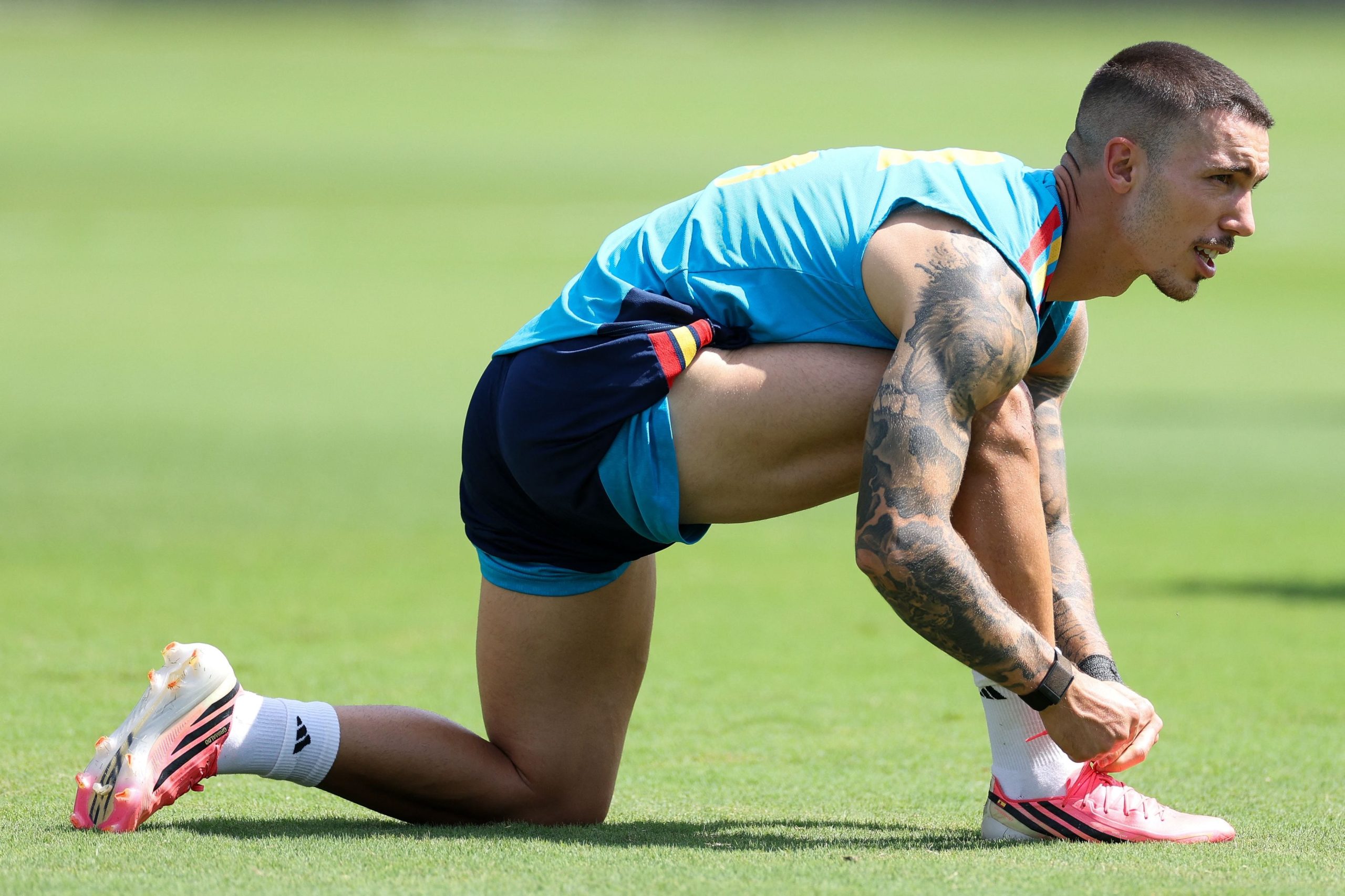
El Atlético de Madrid ha confirmado de manera oficial el fichaje de Alejandro Grimaldo, lateral izquierdo de la selección española de 30 años que se encuentra disputando el Mundial con España, donde todavía no ha debutado. El defensa firma por tres temporadas, con una más opcional, después de una importante carrera en el Bayer Leverkusen. El valenciano ha estado jugando en el club alemán durante las tres últimas tres campañas, ganando la Bundesliga en 2024 por primera vez en la historia del Leverkusen.

Grimaldo es uno de los fijos para el seleccionador nacional, Luis de la Fuente. Con España ha jugado 14 partidos y fue campeón de la Eurocopa 2024. El Atlético anuncia su fichaje después de intentar el de su compañero Cucurella, que ha acabado recalando finalmente en el Madrid.

“El Atlético de Madrid y el Bayer Leverkusen han llegado a un acuerdo para el traspaso de Alejandro Grimaldo, quien firma por nuestro club hasta el 30 de junio de 2030. Polivalente lateral zurdo que también puede ocupar las demarcaciones de carrilero, interior e incluso, mediapunta, destaca por su técnica y por su visión de juego, que le permiten contribuir en ataque marcando y asistiendo con facilidad”, ha anunciado el Atlético en un comunicado.

“Nacido el 20 de septiembre de 1995 en Valencia, Grimaldo se formó en las categorías inferiores del Atlético Vallbonense, del Valencia CF y del FC Barcelona, desde cuyo filial fue fichado por el Benfica en diciembre de 2015. Con la camiseta del club lisboeta disputó 303 partidos, anotó 27 tantos y brindó 66 pases de gol durante siete temporadas y media, a lo largo de las cuales conquistó cuatro Ligas, tres Supercopas, una Copa y una Copa de la Liga en Portugal”, se añade.

En el Leverkusen, Grimaldo ha jugado 145 partidos, anotando la nada despreciable cifra de 30 goles en todas las competiciones que disputó. Grimaldo es un excelente lanzador a balón parado.

Continue Reading

David Beckham

Beckham’s Supplements Promise Better Health — But The Small Print Tells A Different Story

Published

on

beckham’s-supplements-promise-better-health-—-but-the-small-print-tells-a-different-story

David Beckham was famous for the elegant curl he could put on the ball. When he took a free kick, the ball would begin on a straight trajectory before suddenly swerving at the last moment, leaving goalkeepers no time to react. The English footballer exploited a goalkeeper’s predictive error with his technique, luring them with a decoy.

Since retiring from professional soccer, Beckham has continued building a business empire around his image, using it to promote beauty products, produce content for Netflix and help push Inter Miami, the Major League Soccer team where Lionel Messi now plays.

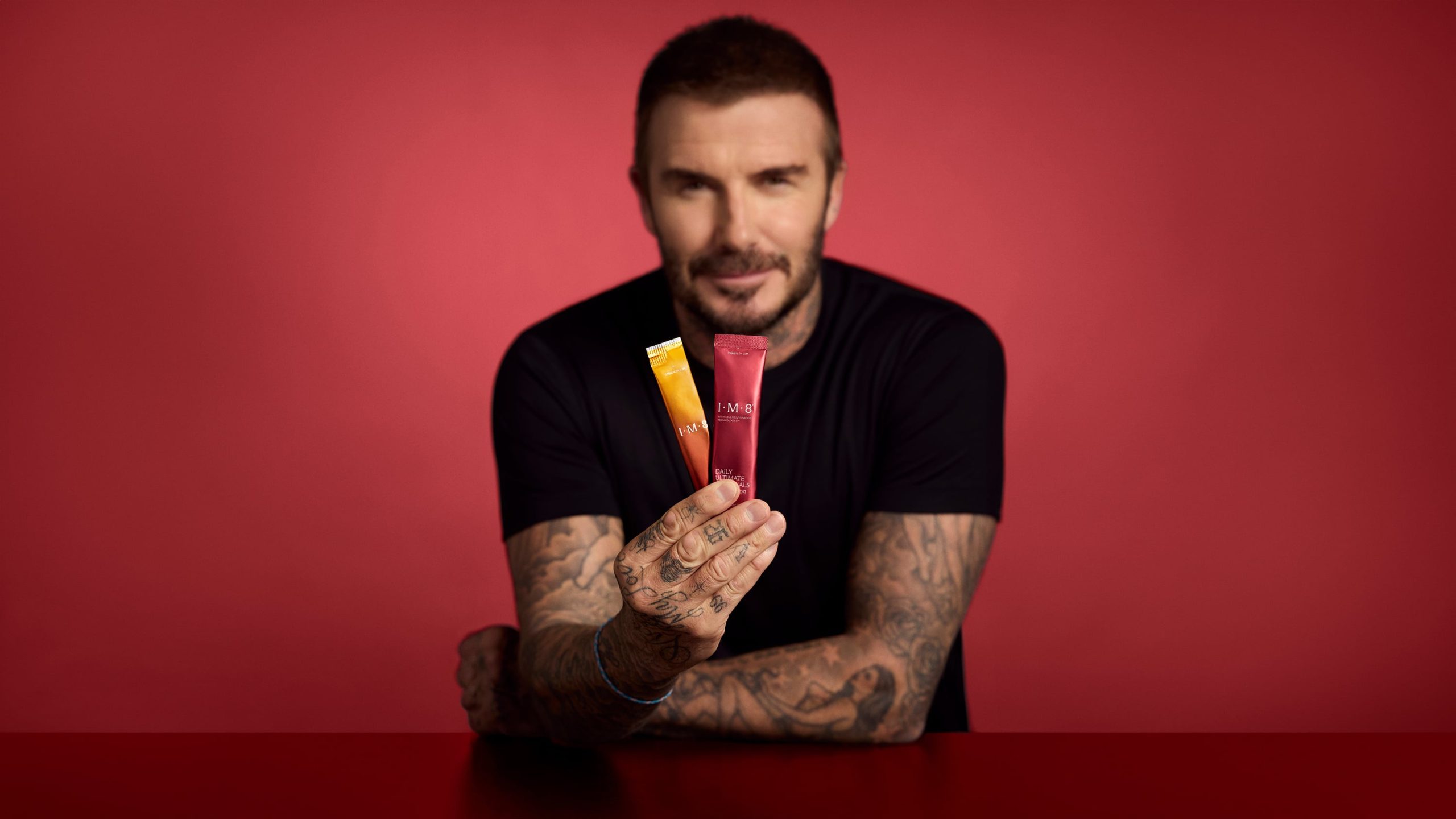
In 2024, Beckham launched IM8, a nutritional supplements brand created with Prenetics Global, a health sciences company based in Hong Kong. IM8 began by selling two products: an all-in-one powder called Daily Ultimate Essentials, priced at $99 as a one-time purchase or $79 through a monthly subscription, and an anti-aging capsule called Daily Ultimate Longevity, available for $89 as a one-time purchase and $75 through a subscription. The product is advertised as concentrating the benefits of more than 20 supplements, with the implied cost savings. Depending on the quantity purchased, that works out to about $8 to $9 a day. “I wanted to create something that is a one-stop shop, one product that actually does it all,” Beckham says on the IM8 website.

“Well done for taking the first steps toward better health and wellness!” the former footballer is heard saying in an introductory video on his page. “We’re committed to enhancing your health and wellbeing with our innovative nutrition essentials.”

Among the claims made about the anti-ageing supplements is that “by addressing the root causes of aging — not just the symptoms — IM8 helps you feel your best today, while supporting your health for the long run.” The marketing also refers to “therapeutic dosing” and “clinically proven” formulas.

Hearing or reading such claims, it would be easy for someone to come away with the impression that IM8’s products improve health. But, as many goalkeepers learned too late, with Beckham it is often worth waiting until the very end to discover the full story. At the bottom of every page on the IM8 website appears the following disclaimer: “These statements have not been evaluated by the Food and Drug Administration. This product is not intended to diagnose, treat, cure or prevent any disease.”

Visitors to the site might also conclude that there is a substantial scientific effort behind IM8’s products. The all-in-one supplement, the company says alongside photographs of people in lab coats and working with microscopes, was developed with experts from the Mayo Clinic and NASA. IM8 also highlights its NSF Certified for Sport accreditation as evidence that the products have undergone independent testing. Those tests, however, do not assess whether IM8 boosts energy levels or slows aging; they merely verify that the contents match the label and are free from banned or toxic substances.

IM8 further claims that, based on a 12-week clinical trial, 95% of those taking Daily Ultimate Essentials felt more energetic, 80% reported better sleep and 85% said their digestion improved. The study, which involved 60 participants, was relatively basic. Beyond the subjective questionnaire underpinning those figures, the only objective measures recorded were weight and body composition, blood pressure and the incidence of adverse effects. There were no detailed blood analyses, metabolic markers or other more sophisticated assessments.

Despite counting specialists from prestigious institutions such as Cedars-Sinai and the Mayo Clinic among its scientific advisers, IM8 chose to conduct its trial at the San Francisco Research Institute, a private organization that carries out clinical studies commissioned by companies and sponsors seeking data to support their products.

The trial results have yet to be made public, despite the company already using the data for marketing purposes. EL PAÍS sought more details about the science behind David Beckham’s supplements by contacting Suzanne Devkota, director of the Human Microbiome Research Institute at Cedars-Sinai Hospital in Los Angeles and one of the “brilliant minds behind IM8.” Devkota did not respond. Instead, an IM8 spokesperson replied, saying she would be “happy to answer any questions” about the brand. After several days of waiting — and another email requesting more time — a response finally arrived nearly a week later.

“The IM8 team cannot provide comments at this time due to lack of availability,” the company wrote. Confidentially, they explained why they were somewhat busy: “IM8 is relaunching its flagship formula as Daily Ultimate Essentials Pro and introducing two new flavors — Mango Passionfruit and Orange Lemon — to combat flavor fatigue next week.” They also offered to send a complimentary sample.

In an email sent last December to a user in Spain, Danny Yeung, IM8’s co-founder and CEO, wrote that he had always believed “the supplements industry could benefit from greater transparency.” “That is why I am starting this series of personal emails to shorten that distance and invite you behind IM8’s curtain,” he wrote.

However, a few days after EL PAÍS contacted the company seeking information, and without any explanation from its communications team, Beckham’s supplements were no longer available to users accessing the company’s website from Spain.

“Scientifically, it has no basis and goes against one of the first principles of supplementation: take only what you need,” says Juan del Coso, an expert in exercise physiology and sports nutrition at Rey Juan Carlos University in Madrid. “If you put 92 ingredients together, you are going to provide doses below the optimal level, and there can also be interactions among supplements,” he says.

Del Coso concedes that “as a marketing product, it is interesting.” “Someone, without needing to understand supplementation, has come up with an idea: if there are several dietary supplements on the market, some with evidence and others less so, and people spend a lot of money buying several, then put everything into one product and tell consumers they are saving money,” he reflects.

“Perhaps the interesting thing here is that Beckham is the face, but there are other athletes doing similar things,” says Del Coso. “Now, in the supplements market, you don’t sell more because you have more scientific evidence. Instead of investing in proving a supplement is effective, market strategies are used to create the idea that it works. Nothing included there is harmful, but supplementation will not produce a significant change in people, or rather it is not proven that it will. That goes against what I try to teach my students: verify with scientific criteria.”

Regarding IM8’s trial, the professor believes they “take anthropometric measures that would not be sufficient even for the quality of an undergraduate thesis.”

Alberto Pérez, a sports science professor at the University of Alcalá, agrees that combining supplements can be a disadvantage: “When you combine them, rather than producing an additive effect, the opposite can happen, because sometimes, for example, supplements compete for absorption,” he says.

Pérez also reiterates a point commonly stressed by nutrition experts: “With a good diet, supplements are unnecessary, except in very specific cases such as people with deficiencies or athletes. Many times people try to fix things with a pill, not exercise, poor diet and lack of sleep, and all at a price that is outrageous for something that isn’t proven.”

At a presentation alongside Beckham, however, an IM8 spokesperson claimed that “even if you have the best diet, you still need extra fortification.”

What is clear is the growing public appetite for these products. The dietary supplements market is already worth close to $200 billion a year and is expected to exceed $400 billion by 2033.

“Now everyone, whether an accredited professional or not, launches their own supplement line,” says nutritionist Juan Revenga.

“The umbrella under which they market these products and make their claims is that of dietary supplements. They are not drugs, but they come in drops, powders or capsules that give them the look of medicine, yet unlike drugs they do not have to demonstrate efficacy nor is there science behind them, so what matters is a large investment in marketing and advertising,” he explains.

Revenga returns to a point made by his colleagues: “All vitamins, for example, have a role in metabolism, but giving more won’t improve the function, because there is a limiting factor, and once you reach the maximum, the function does not improve and it may even worsen.”

A final issue Revenga raises concerns what he sees as the legally questionable way supplements are promoted. “They are breaching advertising regulations,” he says.

“Those who give nutritional advice and show before-and-after images are not complying with the law, because that is a testimonial,” Revenga exemplifies. “People who provide nutritional advice and display before-and-after pictures are not complying with the law, because those are testimonials.”

The IM8 website is packed with endorsements from influencers, doctors and celebrities, including women’s world number one tennis player Aryna Sabalenka and NBA star Giannis Antetokounmpo.

“How is it that, if the law is so clear, there are so many violators and nobody does anything?” asks Revenga. “Because we have a very developed regulatory framework [in Spain], like traffic law, but traffic authorities set up speed cameras and pursue infractions, and in this case that doesn’t happen.”

Sign up for our weekly newsletter to get more English-language news coverage from EL PAÍS USA Edition

Continue Reading

ElPais

Kyiv’s Two Worlds: Between Celebration And War

Published

on

Dasha, 18, sways to the music from head to toe alongside a group of friends as Belgian DJ Matthias Geerts performs. It is Saturday and, along with several hundred other young people, they are celebrating life amid war at a summer festival that serves as a kind of therapy.

They are doing so in one of the places targeted during Russia’s latest major attack on Kyiv on June 15: the grounds of the historic Oleksandr Dovzhenko Film Studios, founded in 1927.

Dasha is a bundle of joy and fun. But, sitting for a few minutes beside the reporter, she admits that her dancing conceals the tragedy of the war: “My father died three years ago after stepping on a mine in the village of Vodyane, in the Donetsk region.”

Despite everything, life in Ukraine’s capital bubbles along with apparent normality. With the harsh winter — marked by power outages caused by the Russian offensive — now over, the resilience of Kyiv’s residents remains the chief survival tool for those who do not wear a uniform, like Dasha. Yet the city continues to embody a painful contradiction.

“After the drones and the missiles, we get up, go to work and then meet friends,” sums up Karina Romanchenko, 24. She works in one of the departments of the vast historical, cultural and religious complex that includes the Kyiv Pechersk Lavra (Monastery of the Caves), a holy site of Orthodox Christianity dating back to the 11th century and a UNESCO World Heritage Site. The complex was also struck by Russian Shahed drones in the early hours of June 15.

On the one hand, the city is full of children enjoying their summer holidays, groups of young people attending concerts, spending time in restaurants and cafés, visiting exhibitions and theaters, and gathering with their families along the banks of the Dnipro River. On the other hand, as Romanchenko notes, there are still nights and early mornings of bombardment, constant worry about relatives and friends at the front, and the impossibility of returning to a normal life.
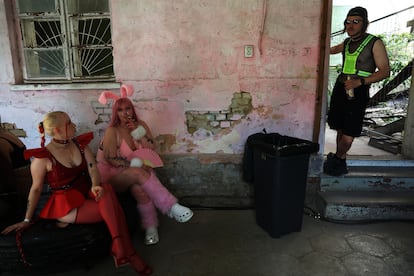
Just a hundred meters from where Dasha and her friends celebrate their youth and freedom, the remains of a completely destroyed building were still smouldering nearly two weeks after the attack. It housed Ukraine’s largest collection of film costumes — around 100,000 in total. In an indirect nod to that irretrievable loss of props and costumes, the Veselka Festival — veselka means “rainbow” in Ukrainian and is also the name of the famous New York restaurant — embraces a simple idea, as Dasha points out while admiring the eccentric outfits of many attendees: “Here everyone can be who they really are.”
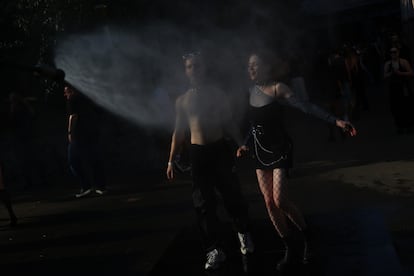
The night before the June 15 attack, the studio grounds had hosted the Dirty Dog festival. The event ended at 10 p.m. because of the curfew, which remains in force between midnight and 5 a.m. Just four or five hours later, the missiles began to fall. The extensive damage — not only to the costume department — has not prevented the Veselka Festival from going ahead.

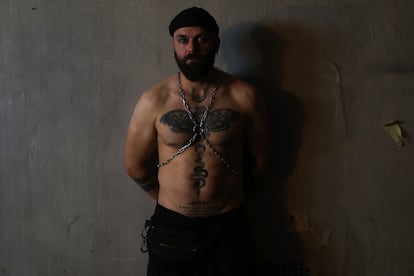
Serguei, 36, strolls through the festival shirtless, displaying his tattoos beneath a chain worn like a cross. “We are at war, but we need this as a refuge,” explains this police officer, whose duties include registering the deaths of fellow officers killed in combat.

He says he once hoped to become an actor and singer — he even hums a song by Spanish artist Alex Ubago, though he knows little about him beyond his nationality. But the 2013 Revolution of Dignity, or Maidan, pushed him to do more for his country, eventually leading him into uniform.

“We live under two worlds,” he concludes, referring to the dichotomy that envelops Kyiv.
Rapid repair

The Kyiv Pechersk Lavra — the oldest monastery in Ukraine — managed to return almost immediately to normal operations after the June 15 bombardment. The city has endured similar attacks since Moscow launched its full-scale invasion in 2022.

Shortly after firefighters extinguished the blaze, workers covered the damaged Dormition Cathedral — the building most affected — with a temporary roof made of wooden beams and plastic sheeting. Within two days, the site had reopened to visitors, although the interior of the cathedral remained closed.

“It was a direct attack,” says historian Kostiantyn Krainii, deputy director of the complex, as he shows the damage.

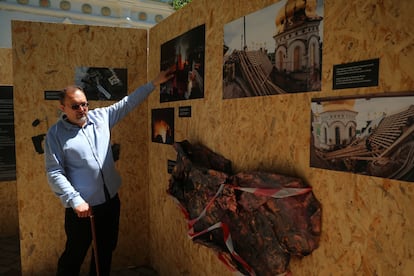
Alongside the cathedral walls, a makeshift exhibition has been set up using chipboard panels to commemorate the strike. Twisted fragments of the roof lie on display, along with what are identified as parts of the Russian kamikaze drones used in the attack.

Krainii says the rapid response by firefighters prevented the cathedral’s main sections from being damaged. The gilded wooden decorations and large icons inside remain intact while workers continue repairs. Several powerful fans run constantly to reduce the high levels of humidity caused by the large amounts of water used to extinguish the fire.

“The damage has been minimal,” the historian, who has worked at the complex for 37 years, says gratefully. “If the fire had reached inside here, this would have burned within seconds, and it would have been a true disaster,” he adds, recalling the dozens of neighbors and emergency workers who saved relics and everything they could in the first minutes after the impact.

In the gardens, a group of children wearing colored identification bibs tour the facilities on a field trip. One of the few tourists is Marion, a 39-year-old Frenchwoman who has traveled to the Ukrainian capital for the first time to spend several days with a friend. She says she is not afraid because she works for a humanitarian agency in a conflict zone, though she prefers not to give more details. She does note, however, that “despite the cost of the war, life goes on” in Kyiv.

Next to the walls of the Kyiv Pechersk Lavra stands the much smaller Monastery of St Theodosius, where Father Makarios, 64, once again welcomes the EL PAÍS correspondent 51 months after their previous meeting. Back then, he spoke of attending courses to prepare for the Russian invasion.

Only a few metres from the entrance arch of St Theodosius, a large building still bears the marks of a second drone strike targeting the monastery.
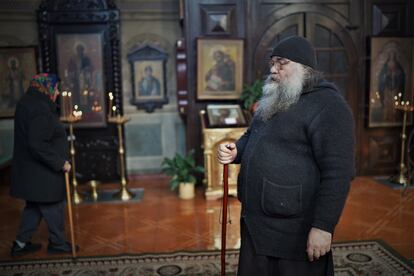
Despite everything, the clergyman, wearing a black cassock and a thick beard, downplays the attack and shows the same conviction and faith as in March 2022. “They bomb loudly and often, and sometimes we can’t sleep for days. But God loves us, protects us and will not allow anything to happen to us. Ukraine will win!” he says firmly, leaning as always on a walking stick.

Occupied areas

Karina Romanchenko gazes at the repaired roof of the Dormition Cathedral from the neighboring bell tower, the highest structure in the complex and one of the best vantage points in the city.

She comes from the outskirts of Melitopol, in the southern region of Zaporizhzhia, which has been under Russian occupation since 2022. Ukrainian forces have recently intensified attacks in the area, seeking to disrupt Russian supply lines to neighboring Crimea.

Romanchenko, who has lived in Kyiv since 2019, tries to speak with her mother every day, although that is not always possible. She says Melitopol suffers frequent power outages. But she is convinced that “crying in the corners all day won’t solve anything.” Although “it isn’t easy, we’ve gotten used to it,” the young woman concludes.
Sign up for our weekly newsletter to get more English-language news coverage from EL PAÍS USA Edition

Continue Reading
Advertisement
Advertisement

Spanish Real Estate Agents

Tags

Trending

Copyright © 2017 Spanish Property & News