Connect with us

%

Passenger’s Gadget Blunder Nearly Dooms Swiss Flight To New York

Published

on

passenger’s-gadget-blunder-nearly-dooms-swiss-flight-to-new-york

SwissAir coming into land. Credit: The Global Guy – Shutterstock

Smoke poured through the front of Business Class on a Swiss International Air Lines aeroplane high over the Atlantic last Monday after a single passenger’s headphone charging case slipped into a seat and started overheating. Flight LX16, bound from Zurich to New York with 208 souls on board, had to divert in a hurry to Bangor in Maine. One careless, everyday mistake put every life at terrifying risk of a mid-air catastrophe.

Charging case turns deadly mid-flight
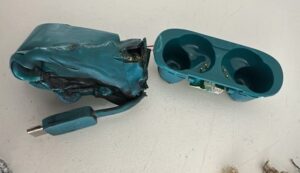
Melted headphones cause of near disaster.
Credit: @Turbinetraveler X

Technical teams later traced the smoke to a commercially available headphone charging case fitted with a power bank. That little cheap plastic box had worked its way into the seat mechanism at the front of Business Class, jammed solid, got crushed and began pumping out fumes from its damaged lithium battery. Swiss confirmed there was never any actual flames in the cockpit, earlier reports got that completely wrong. Smoke stayed limited to the front Business Class area only. Firefighters met the plane on the ground in Bangor, checked everything and found no heat or flames. Everyone walked off unhurt, if coughing through smoke inhalation a little.

Crews on LX16 did exactly what years of simulator drills demand when smoke of unknown origin appears. Pilots pointed the aeroplane at the nearest suitable airport and got it down safely. Swiss later said: “When there is smoke of unknown origin on board, we take no risks.” That decision stopped a potential disaster in its tracks.

SMOKE ONBOARD SWISS A330 TRACED TO DAMAGED EARBUDS CHARGING CASE

SWISS says the smoke event that prompted the diversion of Flight LX16 from Zurich to New York JFK was caused by a wireless earbuds charging case that became lodged inside a passenger seat, where it was damaged and… pic.twitter.com/Ok6w6lWP1F

— Turbine Traveller (@Turbinetraveler) July 29, 2026

Careless passenger error that could have killed hundreds

Picture the scene: a packed long-haul flight, thousands of feet up, and one traveller lets a power-bank-equipped charging case tumble into the seat. That mindless slip turned a routine journey into a terrifying near-miss. Lithium batteries can go from warm to lethal in moments once they are crushed or shorted. This was no mechanical failure or freak weather; it was pure passenger carelessness that could have cost dozens of lives in a matter of minutes. Families, business travellers, children, all of them sat just a few rows from a device that started pumping toxic smoke into the cabin because someone could not keep their gadgets under control.

Swiss has already banned the use of power banks on every flight since the start of 2026. Travellers may still bring a maximum of two, but they must stay on the person, in the seat pocket or inside hand luggage under the seat. Overhead lockers and checked bags are strictly off-limits. Identical rules cover e-cigarettes. Anyone whose device suddenly feels hot, starts smoking, looks damaged or vanishes beneath a seat must alert cabin crew at once. Every Swiss aeroplane carries special Lithium Safe Bags ready to isolate the danger.

Crew actions and stark reminder for all passengers

Quick thinking by the pilots and cabin crew of LX16 prevented panic turning into tragedy. Regular simulator practice meant the diversion to Bangor followed standard safety drills without hesitation. All 208 passengers and the full crew left the aeroplane unharmed. Swiss is now helping those travellers reach New York or rearrange their journeys.

One passenger posted on X, “On flight LX16 from Zurich to NYC and just had to make an emergency landing in Bangor! Weird (re: scary) experience. Apparently there was smoke in the business class cabin.”

He went on to say, “I should have mentioned it above, but my sincere thanks to the pilots for handling a stressful situation so well, and to the crew for remaining calm and professional. Hope you can pass on my thanks @FlySWISS.”

Buses arriving pic.twitter.com/TIKBtfgTL0

— Ian Walker-Sperber (@ianwsperber) July 27, 2026

This incident is another brutal reminder of the thin line between a minor gadget and a full-blown airborne emergency. Lithium batteries do not forgive mistakes. One passenger’s casual handling of a charging case forced an unscheduled landing and put hundreds of people through a proper scare that could so easily have ended far worse. Airlines across the world keep tightening the rules for good reason. Keep your power banks where they belong, watch them like a hawk, and speak up the second anything feels wrong. Anything less risks turning the next flight into a headline nobody wants to read.


The holiday essential that could be a major fire hazard. Urgent warning for holidaymakers this summer

%

Dog Survives Four Days Alone As Guardia Civil Makes Emotional Wildfire Rescue

Published

on

dog-survives-four-days-alone-as-guardia-civil-makes-emotional-wildfire-rescue

Every major wildfire brings heartbreaking decisions. Photo credit: Egor Tetiushev/Shutterstock

When families fled the advancing wildfire in Ávila, they had only minutes to leave. For one dog, there was no escape. As flames tore through parts of the province and thousands of residents were forced from their homes, the animal remained trapped inside an evacuated house, alone and out of reach while one of Spain’s worst wildfire emergencies unfolded outside.

Four days later, the story took an extraordinary turn. Officers from the Guardia Civil found the dog alive. The rescue has become one of the most emotional moments to emerge from the devastating wildfires that have scorched large areas of central Spain, reminding many that disasters do not only affect people.

Four days trapped behind closed doors

The dog had been left inside the property after emergency evacuations forced residents to leave the area as the wildfire spread. With roads closed and emergency services focused on protecting lives, there was no safe way for anyone to return. For four days, the house remained inside the restricted zone while firefighters battled the blaze. When officers from the Guardia Civil were finally able to enter the area, they searched the property and discovered the dog still alive.

The animal was rescued and later reunited with its relieved owners. The Guardia Civil shared the rescue as one of the many operations carried out during the wildfire emergency, offering a rare moment of hope amid days dominated by images of smoke, flames and destruction.

Wildfires separate families from their pets

Every major wildfire brings heartbreaking decisions. When evacuation orders are issued, families often have only minutes to leave their homes. While many manage to take pets with them, circumstances sometimes make that impossible.

Roads are closed, visibility disappears and emergency services prioritise getting people to safety. Animal welfare organisations have repeatedly warned that disasters place thousands of domestic animals at risk every year, particularly during fast-moving wildfires. The Ávila blaze has been no exception.

Not the only animal rescue

The rescue of the trapped dog follows several other operations involving animals during the wildfire emergency. In recent days, firefighters rescued around 20 dogs from a kennel threatened by the flames after forcing entry to reach the animals before the fire arrived.

Emergency crews have also assisted livestock owners attempting to move horses, sheep and cattle away from danger as the fire spread across the countryside. While the focus has rightly remained on protecting human life, many emergency workers have continued risking their own safety to save animals wherever possible.

One of Spain’s worst wildfire emergencies

The fires affecting Ávila and neighbouring areas have forced large-scale evacuations, destroyed woodland and threatened homes across the region. Thousands of residents have been displaced while firefighters, military emergency units and Guardia Civil officers continue working to contain hotspots and protect communities.

For many evacuees, leaving home meant not knowing what would remain when they were finally allowed back. Some have returned to damaged properties. Others have found homes completely destroyed. Against that backdrop, the rescue of one dog may seem like a small story. For its owners, however, it meant everything.

A reminder of the hidden victims

Wildfires leave scars that extend far beyond burnt forests. Families lose homes, businesses lose livelihoods and entire communities face months or years of recovery. Animals often become the forgotten victims. Domestic pets, farm animals and wildlife can all become trapped as fires move rapidly through rural areas, leaving emergency services with impossible choices.

Sometimes, behind the doors of an abandoned home, another life is waiting to be saved. For one family in Ávila, that wait lasted four days. Thanks to the determination of the officers searching evacuated properties, it ended with the reunion they feared might never happen. In the middle of one of Spain’s most destructive wildfire disasters, it is one story with a happy ending.

Continue Reading

%

Monks In Florence Find 19th-Century Recipe

Published

on

monks-in-florence-find-19th-century-recipe

An old archive clean-up inside a centuries-old Florentine convent has just thrown up a surprise that is turning heads outside of Italy.

Dusty discovery in a Florentine convent

Hidden for more than a century in the pharmacy archives of the Convent of San Marco, a faded promotional leaflet has just been found during routine cleaning. Father Manuel Russo, rector of the convent, told local press that the tonic was once among the pharmacy’s top sellers.

Ingredients that mirror a global brand

The recipe lists 30 grams of kola nuts and 10 grams of Bolivian coca leaves, infused in one litre of an alcoholic mixture. These exact components would later appear in John Stith Pemberton’s French Wine Coca in the 1880s, and, after the alcohol was removed, the non-alcoholic drink became Coca-Cola in 1886. Missionaries are thought to have brought both nuts and leaves from South America and Africa to Tuscany, where monastic pharmacies prepared such remedies for the local population.

Older than the American original

The Tuscan formula predates Pemberton’s creation by several decades, according to the friars. That timing has fuelled speculation that Europe may have beaten the United States to the idea of a coca‑and‑kola tonic. Yet the rector cautioned that there is no documentary proof of a direct link between the San Marco elixir and the later global brand. Coca‑Cola’s own formula is a closely guarded secret, first written down in 1919 and stored in a secure vault.

Wine, not water, made the difference

Where the two drinks diverge is the base. The Florentine monks steeped their ingredients in a litre of alcohol, producing a wine-based restorative common across 19th-century Italy and France. Pemberton’s version originally used wine as well, but when Fulton County in Atlanta introduced temperance measures, he swapped alcohol for water and sugar syrup, launching Coca-Cola as a “temperance drink” at soda fountains in 1886.

For curious readers

For fans of odd history and culinary curiosities, the find offers a rare glimpse into how monastic pharmacies served their communities with fortified tonics long before today’s energy drinks. The discovery also adds a European twist to a story often told as purely American, inviting bartenders, food writers and travellers to imagine a 19th-century bar crawl in Florence that might have featured a local “proto-cola” on the menu.

Continue Reading

%

Care Home Killer Given Spain’s Toughest Sentence For Insulin Murder

Published

on

care-home-killer-given-spain’s-toughest-sentence-for-insulin-murder

Care homes exist to protect those who can no longer protect themselves. Photo credit: PeopleImages/Shutterstock

Families place enormous trust in the people caring for their elderly relatives. It is a trust built on the belief that those who cannot protect themselves will be treated with dignity, compassion and respect. That is why one of Spain’s latest Supreme Court rulings has struck such a nerve.

The country’s highest court has imposed ‘prisión permanente revisable’, Spain’s toughest criminal sentence, on a nursing assistant who murdered a 98-year-old care home resident by injecting her with insulin despite knowing she was not diabetic. The decision overturns an earlier 20-year prison sentence and sends a powerful message about crimes committed against society’s most vulnerable.

A murder inside a place meant to provide care

The case dates back to August 2022 at a municipal care home in León. The victim was a 98-year-old woman living with advanced dementia, entirely dependent on those around her for her daily care. According to the Supreme Court ruling, the nursing assistant first assaulted the elderly resident before administering insulin taken from the home’s medical supplies. 

The victim did not suffer from diabetes, the injection caused severe hypoglycaemia, leaving her in a coma before she died several days later in hospital. What makes the crime particularly disturbing is where it happened. Care homes exist to protect those who can no longer protect themselves. Residents and their families place enormous confidence in carers, believing they are in safe hands. Instead, prosecutors argued, that trust was exploited in the worst possible way.

Spain’s highest court steps in

Last year, a jury found the woman guilty of murder and the Provincial Court of León sentenced her to 20 years in prison.  However, prosecutors appealed, arguing the punishment failed to reflect both the victim’s extreme vulnerability and the abuse of trust involved, Spain’s Supreme Court agreed.

Judges ruled that the circumstances justified prisión permanente revisable, a sentence reserved for the country’s most serious crimes. Unlike a life sentence in some countries, reviewable permanent imprisonment allows an offender to request a review after serving a substantial minimum period behind bars. Release is only considered if strict legal conditions are met and the offender is judged no longer to present a danger to society, it remains Spain’s most severe criminal penalty.

A crime that shocked Spain

The ruling has reignited debate about protecting elderly people living in residential care. Spain has one of Europe’s fastest-ageing populations, with increasing numbers of families relying on nursing homes to care for relatives suffering from dementia and other conditions requiring constant supervision.

Most care workers perform demanding jobs with professionalism and compassion. Cases like this remain exceptionally rare. That rarity, however, is precisely why they generate such public outrage. When abuse or violence occurs inside a care home, it shakes confidence far beyond the family directly affected.

Trust is everything

The Supreme Court placed significant weight on the victim’s inability to defend herself. At 98 years old and living with advanced dementia, she depended entirely on those responsible for her care. Rather than offering protection, the court concluded that the defendant used her position to commit the crime.

That abuse of trust became one of the key reasons for increasing the sentence. For many families, it is difficult to imagine a greater betrayal. Every day across Spain, relatives leave parents and grandparents in the care of professionals believing they will be treated with kindness. The overwhelming majority are, but this case serves as a reminder that safeguarding vulnerable residents requires constant vigilance.

Why the ruling matters

Legal experts say the judgment is significant because it demonstrates the Supreme Court’s willingness to apply Spain’s toughest punishment where victims are exceptionally vulnerable and offenders exploit positions of care or authority.

The decision also reinforces the legal protection afforded to elderly people who are unable to defend themselves. For prosecutors, the ruling reflects the seriousness of crimes committed against people whose lives depend entirely on those looking after them.

Justice, but no closure

Nothing will undo what happened inside that care home in León. A family lost a mother, grandmother and great-grandmother in circumstances almost impossible to comprehend. The Supreme Court’s decision cannot change that.

What it can do is send a clear message that crimes committed against the elderly, particularly by those entrusted with their care, will be treated with the utmost severity. For thousands of families with loved ones living in care homes across Spain, that message may offer some reassurance.Trust remains the foundation of every care home. When that trust is deliberately broken, Spain’s highest court has made clear it will respond with the harshest punishment the law allows.

Continue Reading

Trending

Copyright © 2017 Spanish Property & News