
ElPais
Providence, The City That Embraces The World Cup Without Hosting A Single Match















Bruce Willis
Emma Heming, Wife And Caregiver For Bruce Willis: ‘I Thought I Had To Take It All On Myself And That I Was A Failure Because I Needed Support’


When Emma Heming Willis walked into a neurologist’s office nearly four years ago, she left with a whirlwind of emotions. Fear, surprise, anxiety, disorientation. But to cope with them, she left with just one thing: a piece of paper. A single brochure, a single printed sheet, was all the former model — who turns 48 on June 18 — took with her from that medical center. She was drowning in medical jargon and technical terms but was lost as to how to proceed. Because she had just been told that her husband, superstar Bruce Willis, the kind-hearted action hero admired around the world, not only had aphasia — as they had known for months — but also frontotemporal dementia, an incurable and irreversible condition. And there she was, a small piece of paper in her hand, the world crumbling beneath her feet. Perhaps that was the spark that led Heming to become, in addition to a wife, mother, caregiver, and patient advocate, an author.
In September, Emma Heming Willis published The Unexpected Journey, a guide to caring for the caregiver. Specifically, it’s aimed at caregivers of people with dementia, but it’s also for anyone who cares for a dependent person. A gentle yet thorough book, featuring insights from doctors, therapists, specialists, and people who have walked that path, it has just been published in Spanish under the title Un viaje inesperado. In fact, there are already more than a dozen editions in different languages, which she searches for on the shelves of her home library in Los Angeles. “I think it shows that this is a universal problem,” she says about the warm welcome the book has received globally. “There are so many caregivers out there without any guidance or roadmap. And we’re all figuring it out as we go. I’m so excited that this book is now available in Spain.”
From that room, she speaks with EL PAÍS early on a Tuesday morning. She’s an early riser; she was up at four in the morning. She has no shortage of work. She cares for her husband of more than 17 years, as well as her two daughters, Mabel, 14, and Evelyn, 12. She manages her foundation, her literary projects, and, above all, raises awareness about the importance of caregivers receiving help without feeling guilty. “And it’s not just my story, right? It’s so many people’s. This is the issue: walking out of there with nothing was really hard. And then realizing that, okay, I have to figure this out. I have to understand what support now is needed for Bruce, for our two young children,” she recalls. So she used the most logical, yet also the worst, method: searching on the internet. “And you know what the internet is like; when you look up any kind of disease, it’s a horrible place to go, and leaving that appointment, I just realized how unsupported caregivers are. We walk out with no support, and we’re asked to do so much where it’s not humane,” she reflects.
And yet Heming knows exactly where she stands: she is a young, healthy woman in a stable family, with access to support, financial resources, an education, and good connections. She doesn’t deny these advantages. In fact, she uses them precisely to reach a wider audience. “I know I’m in a privileged position because I have access, I have resources that many people don’t have,” she acknowledges. “And I knew I had all this important information and couldn’t keep it to myself. I wanted to be able to put it into a book.”
When a neurologist shared statistics with her about caregivers “who sometimes die before their loved ones,” it had a profound impact on her. “That book is probably 25% my story, but I really feel like the beauty of it are the experts and the specialists that share what they know. It’s not just me saying, ‘Oh, go get support, go get help.’ It’s the experts and specialists that say it; they give the caregiver permission to care for themselves, to ask for support, and to know that they’re not a failure if they need the help and support. I thought I had to take it all on myself and that I was a failure because I needed to ask for support.”

Before reaching that point, the Heming-Willis family went through the ordeal of getting a diagnosis. At first the model found the actor acting strangely; she couldn’t quite put her finger on it, but he wasn’t himself. She even began to think that maybe he no longer loved her, that he wanted to leave his family behind — she couldn’t make sense of any of it. After a long journey, in early 2022, they were told he was suffering from aphasia, a speech disorder. It was in late 2022 that the actor was diagnosed with frontotemporal dementia, which has caused his comprehension and memory to gradually fade. You can see it, for example, in how Heming refers to him in the book and in the interview: she speaks in a painful past tense. Because she knows her husband is no longer the man he once was.
A few months later, in February 2023, the family decided to go public with the diagnosis. Heming says that, in doing so, they also wanted to change the way this disease — and so many other neurological conditions, such as Alzheimer’s — are viewed by the general public. “I think that our family knew that by showing what we were going through with Bruce and this disease, we would see a change in how people look at dementia, how people talk about it. Moving away from the shame and the stigma that surrounds it, I wanted our two young children to not have to think that they have to talk about their dad’s disease in a hushed home like this was some dark family secret.”
“Bruce is so beloved and he has such a global reach. And I knew that this announcement could hopefully change what people perceive dementia to be. So I was really happy that we were able to get the support that our family needed. I am happy that we were able to share and make this conversation normalized,” she says.
All of this has led Heming — with the support of Willis’s ex-wife, Demi Moore, and the three older daughters from the couple’s previous marriage — to become an advocate for neurodegenerative diseases. Her insights have been featured in magazines and on television shows and have helped millions of people understand what it’s like to live with someone who is ill — even if that person is famous. In fact, she publicly asked the paparazzi not to chase and photograph Willis, because it affected him and them as a family. “I just wanted to protect my husband; I just wanted him to be able to navigate the world safely. I just wanted to be able to protect his space,” she recalls. “At People magazine there was an editor that when I came out with that statement, they made a conscious decision that they would never photograph anyone who was sick and publish it. And I felt like that was right.”
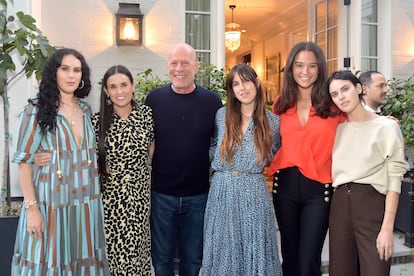
In her nearly 300-page guide, she helps caregivers manage the situation and, above all, take care of themselves. She speaks from experience, because when she felt overwhelmed, she isolated herself from her friends and loved ones, living in “a little bubble,” as she calls it, until she realized what she was doing and how “unhealthy” it was. That’s why she reaches out to another group: those who, though close by, don’t know how to help.
“People don’t know what to do; they don’t want to overstep. The message that I would get is that ‘if there’s anything you need, please let me know.’ That’s very well-meaning, and you know that’s a beautiful gesture, but it just puts another added stress on the caregivers to figure out, well, what can I ask? And it gets very complicated.” She encourages caregivers to raise their voice. “Caregivers need to understand that this is not a solo mission, and we’re not a failure because we are asking for support. We really need to learn to bring back our communities in our lives. We need to be able to depend on our neighbors. We live in this world that is so disconnected, and we need to get back to the sense of community and support and the idea that if parenting takes a village, so does caregiving.”
When they discovered the illness, the couple had two young daughters, who are now teenagers. “Bruce has three adult daughters, so I had to learn how to communicate with them about something that I was even still trying to come to terms with as well. We always feel like we make the world and everything be rainbows and unicorns for our children. But that’s not our world. And what we’re going through as a family with their father and his disease, that’s not that world. So it’s been really important for me to learn how to communicate with them in an age-appropriate way. When I give them the information, I wait for them to sort of ask me questions. And when they ask me the questions, I give them truthful answers. Which isn’t always easy, but I think that helps them feel a little bit more safe in that, knowing that I’m never going to tell them something that’s not true. And that if anything changes, I’m going to let you know.” Although not everything is ideal: “I’m not saying I do it perfectly all the time. I’m not a perfect caregiver. I’m not a perfect person. I’m not a perfect mom, of course. I think as caregivers and parents, we’re just trying to do the best that we can. And my daughters know that.”
Faced with this lack of awareness, Heming is also creating a guide to help family members of patients with frontotemporal dementia know what to do in the early stages. Shouldn’t that be the healthcare system’s job? Exactly, she says. “We need to understand as a society that we will need care or give care in our lives. No one is exempt from being a caregiver. It might not be happening to some now, but it will, and I think we don’t have a healthcare system that even sees the caregiver. They are unsupported. So we need to figure out a better system. We have to use our voices to be able to make the changes that we need.”
Still, she feels proud of herself. “That’s what I want caregivers to know, that in the beginning, it’s really hard. You’re learning new things. You have to come to terms with your person and this disease, and you’re dealing with the grief and the pain of that. For me, it was about really understanding that there is nothing that I can do to change the outcome of this disease. And I’ve tried; I’ve tried everything that I possibly can, but there is no treatment, there is no cure for this disease, so I’ve been able to educate myself, surround myself with people that are way smarter than me and that have been on this journey longer than me. I am really proud of where I am today and how far I’ve come. I know our support system will be prepared, and that really helps settle the anxiety a little bit. Not a lot, but at least it brings it down to know that I’ll be prepared, you know?”
The disease has also brought her something: “I think there’s one thing that’s beautiful about dementia. It gives you the gift of time. We can get so busy in life and be juggling a million things, but I think learning how to be present and be with the people that we love is so important. It’s allowed me to slow down in certain respects to really be able to appreciate the people and the love and the support that we have within our lives, so that we can continue to provide for Bruce and my family.”

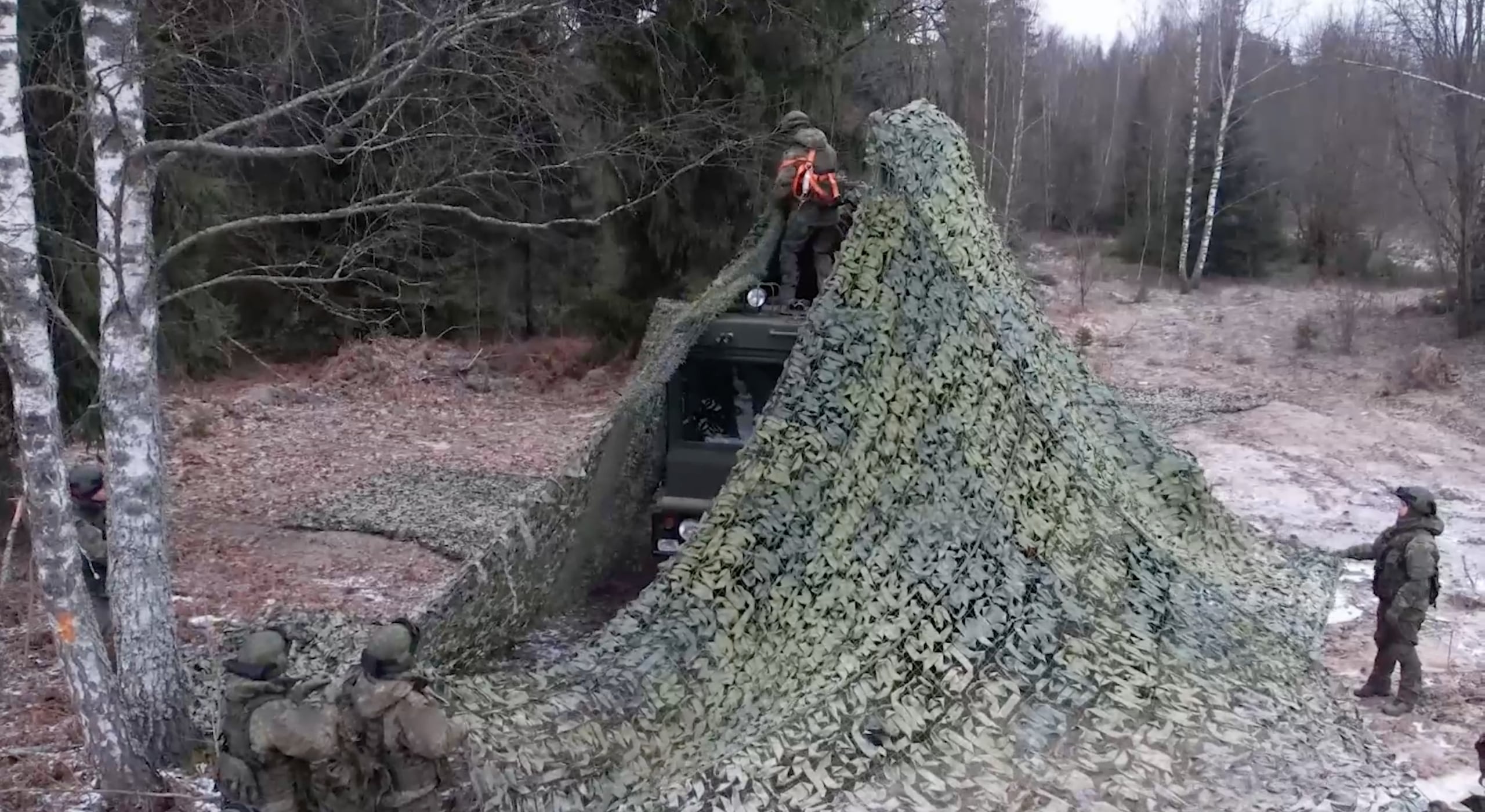
During one of the latest large artillery offensives against Ukrainian territory, on May 24, Russia used two Oreshnik missiles. Throughout the night and at dawn, Moscow launched more than 600 drones and 90 missiles against the capital, Kyiv. Four people were killed and around 100 were wounded. The intermediate-range Oreshniks struck Bila Tserkva, a town south of Kyiv, and the outskirts of the city of Donetsk, territory occupied by Russian forces in the Donbas region in the country’s east. The latter fell there by mistake. Moscow missed its target with a very powerful, hypersonic weapon that is almost impossible to intercept. The warhead was conventional, but this model can carry a nuclear payload. Russian President Vladimir Putin acknowledged last Thursday from Saint Petersburg that the projectile that was lost was “experimental.”
A test, according to the Kremlin’s version, of a missile with great destructive potential that the Russian military has already used on four occasions, always as a conventional weapon, against neighboring Ukraine. The Oreshnik is one of the examples included in the report published on Monday about nuclear arsenals by the Stockholm International Peace Research Institute (SIPRI). The research center says the nine nuclear-armed states (the United States, Russia, the United Kingdom, France, China, India, Pakistan, Israel, and North Korea) “modernized and improved” their arsenals over the past year, deploying new systems to deliver atomic munitions or systems capable of doing so.
Among these advances are the Oreshnik on the Russian side, but also, on the U.S. side, the LGM-35A Sentinel intercontinental missile, the Columbia-class nuclear-powered submarine, and the B-21 Raider heavy bomber. These are only some of the new capabilities for delivering atomic munitions driving the new nuclear arms race.
One of the warnings sounded in the report is the following: nearly four decades after the end of the Cold War, states are again relying on nuclear weapons as instruments of power. And that is despite efforts to reduce the role of such armaments. The need to display atomic muscle to deter adversaries is growing, which increases the risks of miscalculation and escalation at a time when the number of conflicts in the world is rising — the current total is 49 — most of them internal.
During the past year there were six interstate wars: Afghanistan–Pakistan; India–Pakistan; Iran–Israel/United States; Russia–Ukraine; Cambodia–Thailand; and the Democratic Republic of the Congo–Rwanda. Only in the latter two did a nuclear-armed actor not participate.
According to SIPRI’s inventory, completed in January 2026, there are 12,187 nuclear warheads in the world, around 9,745 in military stockpiles for possible use, about 130 more than a year earlier. Of the total, an estimated 4,012 are deployed on missiles, aircraft or in storage — Russia and the United States have over 1,700 each — about 100 more than in January 2025. Between 2,100 and 2,200, mostly Russian and American, are in a state of highest operational alert for immediate use via ballistic missiles.

Despite this, the total number of nuclear warheads continues to decline thanks to the dismantlement processes — faster than production — of those removed from Russian and U.S. arsenals under agreements reached after the fall of the Iron Curtain. The Stockholm research center warns that this trend could reverse in the current context. “There is increasing evidence that nuclear-armed states are setting aside, and even abandoning, their disarmament commitments and, instead, are flaunting their nuclear power,” says Hans M. Kristensen, a researcher at SIPRI.
In technical terms, the alarms are not so much about the number of deployed warheads, which is rising slightly, but about the delivery systems that accompany them and are being renewed at breakneck speed. Nevertheless, beyond the arsenals of less transparent countries such as North Korea, which has about 60 warheads, or Israel, with around 90, SIPRI’s latest inventory draws attention to the growth of China, which now has 620 nuclear warheads, about 20 more than the previous year. It is estimated that most are stockpiled in storage far from silos for launch.
At the Victory Day parade held in September 2025, Beijing displayed several previously unseen systems, such as a new transporter for its DF-31 intercontinental ballistic missiles and a new launcher for the DF-61. Both missile models can carry nuclear warheads.
The rhetoric about the war has once again placed the atomic bomb and its deterrent capacity at the center of attention, even more so after the New Strategic Arms Reduction Treaty, the only surviving U.S.–Russia arms control agreement, expired in February. Since then no public meeting between the parties has been held to renew it. Washington now insists that negotiations include China at the table.

And tensions are rising. Since the start of the invasion of Ukraine, Russia has several times issued threats brandishing its nuclear arsenal, particularly voiced by its former president and current deputy head of the Security Council, Dmitry Medvedev. The United States, despite Donald Trump’s ambiguity about NATO, continues to extend its nuclear umbrella over Europe. The European members of the Alliance — only France and the United Kingdom possess nuclear weapons, 290 and 225 respectively, of a strategic (long-range) character — are aware that without U.S. protection they would have no deterrent capacity.
Washington stores tactical (short-range) munitions in five allied countries (Italy, Germany, Turkey, Belgium and the Netherlands), and other states such as the United Kingdom, Poland, Finland and Sweden have recently signaled interest in hosting this type of armament. In response to this interest, Moscow late last year deployed its hypersonic Oreshniks in neighboring and loyal ally Belarus — the two countries conducted military exercises with nuclear-capable weapons in mid-May. And alongside this increasingly intense battlefield, propaganda in the old Cold War style. On June 5, Saint Petersburg inaugurated an amusement-park attraction decorated with mock missiles and national colors. Its name: Oreshnik.
Sign up for our weekly newsletter to get more English-language news coverage from EL PAÍS USA Edition

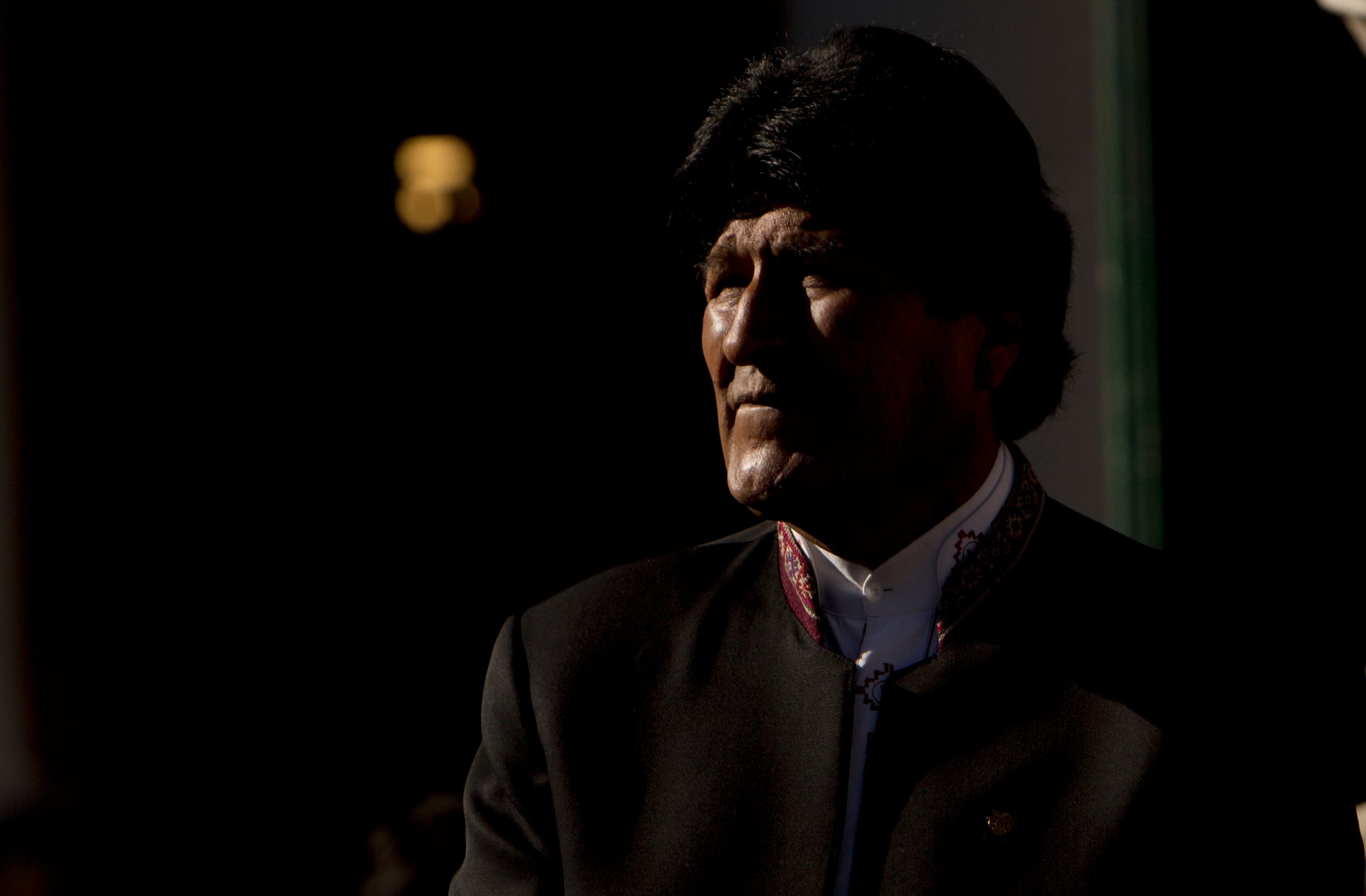
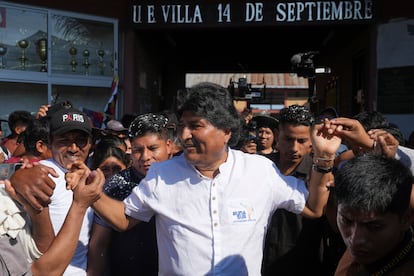
Evo Morales, 66, is entrenched in the place where he built his political power: the Chapare province, Bolivia’s coca-growing region. There he cultivates avocados, farms fish, plays chess, runs and does sit-ups to stay in shape, all while closely monitoring the Indigenous uprising that has put Bolivian President Rodrigo Paz on the ropes just six months after taking office.
The prominence of the former president – who governed the country between 2006 and 2019 – had waned. But Paz has revived it by asserting that Morales is the main instigator of the ongoing protests and road blockades that have no visible leaders and are spreading throughout the country. “I didn’t call for this mobilization,” Morales defends himself, during an interview via video call with EL PAÍS.
Seven years after being forced to resign as head of state, Morales is a fugitive from justice. However, he refuses to voluntarily appear before the court that is set to try him for alleged child trafficking and sexual abuse. He argues that there has been no due process.
When Paz promised to capture Morales, he challenged him: “Let them come get me, but those who [arrest] me should ask themselves whom they are [arresting]: the first Indigenous president.”
Question. What were the causes that led to the social conflicts that Bolivia is currently experiencing?
Answer. What’s brewing now is an uprising – a rebellion of the Indigenous movement – against the neoliberal model and against the neocolonial state. In 2005, for the first time, an Indigenous president won, breaking all the established capitalist formulas. [From the capitalist perspective], the Indigenous movement has no political rights… we’ve had almost no rights since colonial times. But I finally said: “We do have political rights.” In 14 years, we demonstrated that Bolivia had great hope. Economically, we nationalized [certain assets]; socially, we redistributed wealth.
The 2019 coup pitted the empire against the people; the gringo against the Indigenous people. The coup was about lithium… and now the issue of lithium has resurfaced. When I say it’s an uprising against the neoliberal economic model, it’s because the people don’t want basic services to be privatized. Rodrigo Paz has already introduced 10 laws – in mining, gas, energy, lithium – to privatize [resources]; that’s where the uprising comes from. In the midst of the conflict, he continues to sign memorandums with the United States regarding rare earth elements.
Q. President Paz considers you to be the instigator of the protests. What’s your opinion on this?
A. I didn’t call for this mobilization. There’s a fundamental issue here: you can’t govern based on lies. Rodrigo Paz lied, he deceived [Bolivians]. Why are they mobilizing? Well, he said: “The day after I take office, there will be no fuel shortage.” And now, there’s junk gasoline (degraded gasoline). The gasoline is coming out like Coca-Cola – black – and it’s ruined almost all the cars. He issued a decree so that the wealthy people don’t pay taxes; he passed a law to reclassify small properties as medium-sized properties, which is being defended by agribusinesses… to sum up, I understand why people are angry. They say, “He hasn’t kept this or that promise.” Now they’re saying, “Out, out!”
I already said: “If you want to avoid a bloodbath, this pacification process involves [the president stepping down] and an election being held within 30 days. That’s constitutional.”
Q. Do you believe that Paz’s resignation is the only possible solution to the crisis?
A. I expressed that opinion a week ago, [but] I don’t make the final decision. There’s total persecution… and [the administration is] preparing a state of emergency, which is very serious. Article 28 of the state of emergency law speaks of “presumption of operational legality” – the granting of impunity to [the security forces]. This is extremely serious. Article 30 addresses the “use of lethal force,” [meaning that] whoever kills won’t be investigated.

Q. What will happen if Paz declares a state of emergency?
A. Knowing my brothers and sisters in the Bolivian highlands, if they rise up, it’s impossible for them to lose. If someone is killed, there’ll be an even stronger reaction. They aren’t afraid; [this is] an act of rebellion.
Q. Paz was democratically elected for a five-year term. Why shouldn’t he complete his term? If people are dissatisfied with his policies, shouldn’t they wait for the next elections to vote for another candidate?
A. [Finishing his term] is his duty. But he promised everything and didn’t deliver. A comrade said that, during the campaign, Paz called her “sister, comrade.” [But] today, according to him, we’re vandals paid by drug traffickers; he repeats what the empire says.
Q. Would you run in the next elections?
A. I’m not desperate [to launch a] candidacy. Two days ago, the foreign minister said that everything is ready for Operation Delta Ñ (supposedly a reference to Lauca Eñe, the town where the former president has sought refuge). They want to seize Evo, arrest him and immediately declare a state of emergency. They’ll take Evo from Viru Viru (the international airport in Santa Cruz) to Buenos Aires or Lima. And, from there, to the United States.
Q. The president also announced that they’re going to capture you at any moment.
A. Let them come get me, but those who arrest me should ask themselves whom they’re arresting: the first Indigenous president. [A couple of weeks ago], Marco Rubio said that the United States wouldn’t allow drug-trafficking criminals to overthrow democratically-elected leaders. Paz is just repeating what he said.
Q. If you’re not seeking to mount a presidential bid, do you want to leave politics?
A. I’m a small farmer now; I planted avocado trees yesterday. I even thought about getting married. But my comrades tell me, “Without you, the political movement will go to hell; you have to stay.” Our revolution must continue, but people say, “Evo or nothing.” I have an obligation to support them; it’s our work. Our demands will only be met when we’re in power.
Q. Who will be the candidate representing the Indigenous peasant movement?
A. Candidates will emerge from grassroots meetings; it’s [an] open [process]. Today, I was at an event with the only governor [from my party] – Leonardo Loza – in Cochabamba. In Bolivia, we have many leaders and comrades.
Q. But you still don’t consider any of them to be your potential successor?
A. That may be true. We need to build a [new] political instrument, together with middle-class intellectuals who once saw us as a source of hope.
Q. Your former vice president, Álvaro García Linera. said that one of the mistakes made during your administration was not taking into account the growing discontent of the middle class. Do you agree with him?
A. I wouldn’t say so. [I acknowledge] that we haven’t implemented programs to rethink history [or remember] the struggles of our ancestors. In short, we haven’t been able to ideologize. We’ve [dialogued] with this new middle class because our democratic revolution was important… but based on my experience, I’d say that you have to shield yourself with your own people, with people from humble backgrounds.
Q. Your government had the support of various sectors, such as the urban middle classes. But today, has the Indigenous movement become radicalized? Have the bridges been burned?
A. That’s what has happened since the 2019 coup. I deeply regret that some of the middle-class leaders with privileges are now in prison. In 2021, I contacted Luis Arce (who governed Bolivia from 2020 until 2025) and told him, “Lucho, there are rumors that your son is involved in shady dealings. Stop it; it’s going to affect us.” Now, look: he’s in jail. Later, I told Lucho that we needed to move forward in the fight against drug trafficking… but he neglected that, too.
You have to make yourself loved and feared. Unfortunately, that’s the nature of political life, of union life. I distanced myself from Lucho in December of 2022. I saved the political movement by distancing myself. Otherwise, I’d be in jail.
Q. You have an open case against you. If you’re innocent, why don’t you turn yourself in?
A. For 30 years, they’ve been accusing me of being a drug trafficker, a terrorist. If I were a drug trafficker, I’d already be in jail. They wanted to disqualify me in the 2005 [elections], but I beat them and became president. [Jeanine] Áñez (who governed Bolivia from 2019 until 2020) filed 29 lawsuits against me for terrorism, civil disobedience, incitement to commit crimes… they found nothing. Now they’re fabricating human trafficking charges and issuing an arrest warrant, but there was no due process.
The press itself says that 200 police officers and 800 soldiers are waiting for me at the hearing. As if I’m stupid enough to go. They’re trying to arrest me, to kill me. They can’t prove the crime. On May 5, the alleged victim submitted a memorandum stating that she wasn’t anyone’s victim. So, that [case] should be closed.
Q. What guarantees should be made for you to appear before the courts?
A. The prosecutor’s office should drop the case.
Q. But the case is for human trafficking: a complaint from the victim isn’t necessary. The prosecutor’s office can investigate ex officio, by virtue of office.
A. But what if there’s no evidence? There was no due process. And there’s no victim. It’s a purely political action. Before, Evo was a drug trafficker, a terrorist; now, he’s a pedophile.
Q. Do you feel strong enough to continue in politics?
A. I still lead the Seis Federaciones del Trópico de Cochabamba (translated as the Six Federations of the Tropics of Cochabamba, a collective representing coca leaf growers in the Chapare region). I have a youthful spirit. In January, I got sick like never before; I had chikungunya, but I’ve recovered and I’m back to normal. I go to the soccer pitch to run 60 laps; I do 1,000 sit-ups five times a week, in two sessions. My schoolmates move around with walking sticks and they ask: “What does Evo eat?”
Sign up for our weekly newsletter to get more English-language news coverage from EL PAÍS USA Edition

Última Hora De La Guerra De Estados Unidos E Israel Contra Irán, En Directo | Irán Confirma El Acuerdo De Paz Con Estados Unidos, Que Se Firmará El Viernes En Suiza
Torremolinos installs smart traffic lights on its beaches to warn about UV radiation levels
Alicante’s La Mar Solidaria opens water sports to people of all abilities


-

 Africa2 weeks ago
Europe Enters The ‘era Of Deportations’
-

 Alberto Fujimori7 days ago
Peru’s Roberto Sánchez And Keiko Fujimori Urge Caution As Vote Count Continues In Very Tight Presidential Election
-

 %2 weeks ago
Major Strike In Portugal To Cause Widespread Disruption To Air And Rail Travel
-

 Uncategorized1 week ago
Max Verstappen F1 future hangs in the balance as three teams block 2027 rule changes
-

 Barcelona1 week ago
Spain, A Country Of 50 Million People With Infrastructure For 40 Million: ‘The Cracks Are Starting To Show’
-
David Beckham1 week ago
A Journey Through The Ages Of Soccer In The United States
-

 Brasil2 weeks ago
Caetano Veloso: ‘Right Now Concern Predominates Within Me; Brazil Seems Unable To Save Itself’
-
Latest1 week ago
Today In Spain: A Roundup Of The Latest News On Friday