
Home sales
Heads-Up! Q2 2026 Housing Numbers Just Published By The Notaries – A Good Time To Sell, But Buyers Are Becoming More Cautious

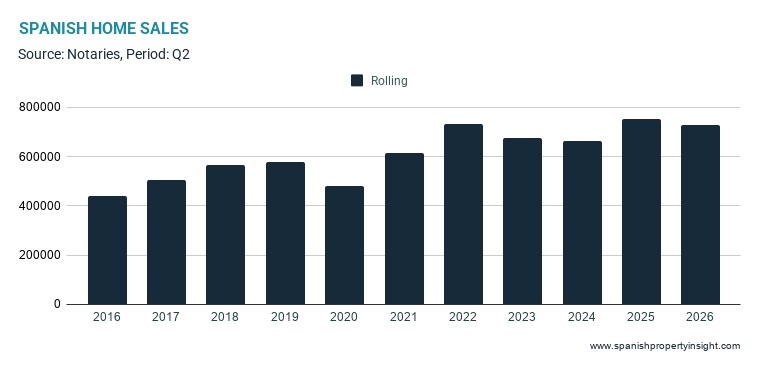
Sales have eased from last year’s exceptional levels, but prices continue to hit new highs. The latest figures suggest the market is becoming less frenetic, whilst remaining favourable for most vendors.
The Spanish notaries have just published their Q2 housing market figures, giving us the first clear picture of how the market performed in the first half of 2026. The headline is that sales are easing after last year’s record-breaking performance, but prices are still rising strongly. In other words, the market is cooling down, but only in terms of transactions, not values.
Sales cool after a record year
The notaries recorded 181,206 home sales in Q2, down 9% on the same quarter last year. That follows a 7% decline in Q1, taking first-half sales to 353,237 transactions, around 8% below the exceptionally strong first half of 2025.
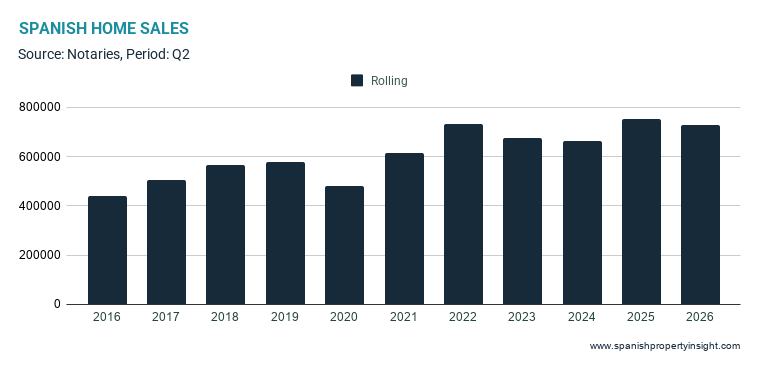
On the face of it, that looks like a meaningful slowdown. However, last year was one of the strongest on record, so comparisons were always going to be demanding. A better way to judge the underlying trend is the rolling four-quarter total (chart above), which smooths out seasonal fluctuations.
On that measure, annual sales slipped to 726,349 transactions, down just 2% on a year earlier. That suggests the market is losing momentum rather than falling off a cliff. By historical standards, activity remains high, just no longer at the exceptional levels seen last year.
Prices still heading in the opposite direction
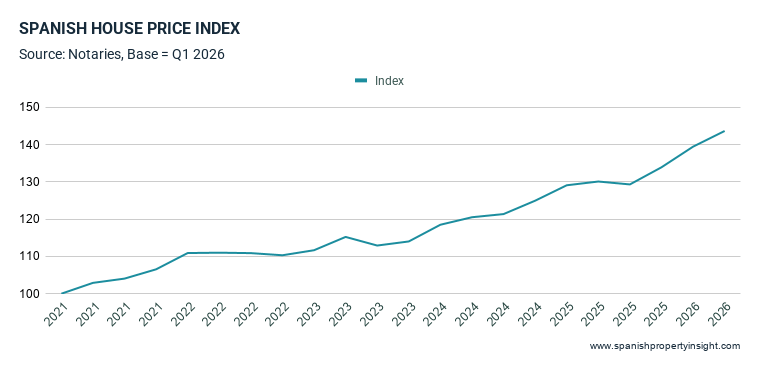
Whilst sales have softened, prices continue to move the other way. The average price reached €2,094 per square metre in Q2, up 10% year-on-year, the strongest rate of annual price growth since 2022. The average Spanish house price is up 44% in the last 5 years, as illustrated by the index chart above.
This divergence between sales and prices is a familiar feature of housing market cycles. Transactions usually react first as buyers become more cautious or take longer to commit. Prices often continue rising for several more quarters because sellers are reluctant to reduce asking prices, particularly when supply remains tight.
That appears to be exactly what is happening in Spain today. Buyers are pushing back after several years of rapid price growth, and the shortage of homes for sale is preventing demand from translating into lower prices. The result is fewer transactions but continued price inflation.
A good window for sellers?
These figures also offer a useful perspective for anyone thinking about selling.
Last year was probably the easiest market in which to find a buyer quickly, but today’s market is still highly favourable by historical standards. Sales have eased, but they remain at healthy levels, whilst prices continue to climb at a robust pace.
For owners already considering a sale, this may prove to be a good window of opportunity. There is no sign of an imminent market crash, but if transaction volumes continue to soften over the coming quarters, price growth is likely to slow eventually, and could even turn negative further down the line. That is how most housing cycles evolve.
For now, however, the evidence points to a soft landing rather than a hard one. The Spanish housing market is cooling, but it is doing so in an orderly way, with prices still well supported by limited supply.

Get the full picture
Don’t stop here. SPI’s in-depth reports go beyond the headlines with hard data and analysis of key markets and housing trends in Spain. Visit the reports section to get the full picture.






Home sales
Heads-up! Q2 2026 housing numbers just published by the notaries – A good time to sell, but buyers are becoming more cautious

Sales have eased from last year’s exceptional levels, but prices continue to hit new highs. The latest figures suggest the market is becoming less frenetic, whilst remaining favourable for most vendors.
The Spanish notaries have just published their Q2 housing market figures, giving us the first clear picture of how the market performed in the first half of 2026. The headline is that sales are easing after last year’s record-breaking performance, but prices are still rising strongly. In other words, the market is cooling down, but only in terms of transactions, not values.
Sales cool after a record year
The notaries recorded 181,206 home sales in Q2, down 9% on the same quarter last year. That follows a 7% decline in Q1, taking first-half sales to 353,237 transactions, around 8% below the exceptionally strong first half of 2025.
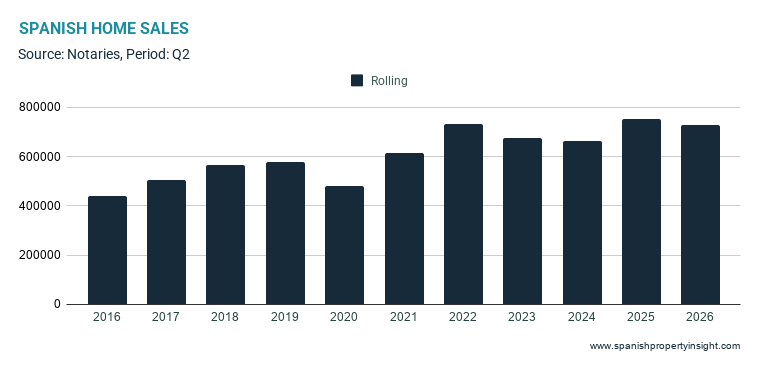
On the face of it, that looks like a meaningful slowdown. However, last year was one of the strongest on record, so comparisons were always going to be demanding. A better way to judge the underlying trend is the rolling four-quarter total (chart above), which smooths out seasonal fluctuations.
On that measure, annual sales slipped to 726,349 transactions, down just 2% on a year earlier. That suggests the market is losing momentum rather than falling off a cliff. By historical standards, activity remains high, just no longer at the exceptional levels seen last year.
Prices still heading in the opposite direction
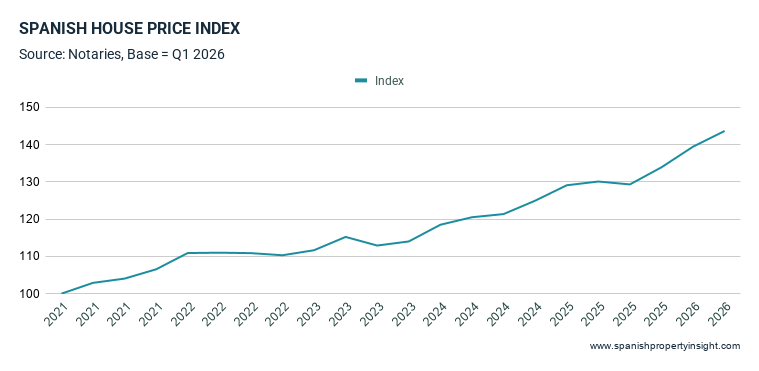
Whilst sales have softened, prices continue to move the other way. The average price reached €2,094 per square metre in Q2, up 10% year-on-year, the strongest rate of annual price growth since 2022. The average Spanish house price is up 44% in the last 5 years, as illustrated by the index chart above.
This divergence between sales and prices is a familiar feature of housing market cycles. Transactions usually react first as buyers become more cautious or take longer to commit. Prices often continue rising for several more quarters because sellers are reluctant to reduce asking prices, particularly when supply remains tight.
That appears to be exactly what is happening in Spain today. Buyers are pushing back after several years of rapid price growth, and the shortage of homes for sale is preventing demand from translating into lower prices. The result is fewer transactions but continued price inflation.
A good window for sellers?
These figures also offer a useful perspective for anyone thinking about selling.
Last year was probably the easiest market in which to find a buyer quickly, but today’s market is still highly favourable by historical standards. Sales have eased, but they remain at healthy levels, whilst prices continue to climb at a robust pace.
For owners already considering a sale, this may prove to be a good window of opportunity. There is no sign of an imminent market crash, but if transaction volumes continue to soften over the coming quarters, price growth is likely to slow eventually, and could even turn negative further down the line. That is how most housing cycles evolve.
For now, however, the evidence points to a soft landing rather than a hard one. The Spanish housing market is cooling, but it is doing so in an orderly way, with prices still well supported by limited supply.

Get the full picture
Don’t stop here. SPI’s in-depth reports go beyond the headlines with hard data and analysis of key markets and housing trends in Spain. Visit the reports section to get the full picture.

Kimi Antonelli set to star alongside Mickey Mouse and Donald Duck in iconic Disney comic book

El Leganés Hace Oficial El Fichaje De Álvaro Morata
Take That confirm Fuengirola 2027 gig as only Andalucia stop: Tickets on sale next week
Make a small donation at Miramar shopping centre and transform a child’s first day back at school
Don’t wake the polar bears! Tourist fined €4,560 for blowing boat’s horn

How To Get A Tourist Rental Licence In Andalusia (Spain) – Step-By-Step Guide 2025


-
back to school1 week ago
Make a small donation at Miramar shopping centre and transform a child’s first day back at school
-
arctic wildlife2 weeks ago
Don’t wake the polar bears! Tourist fined €4,560 for blowing boat’s horn
-
 New Developments1 week ago
How To Get A Tourist Rental Licence In Andalusia (Spain) – Step-By-Step Guide 2025
-

 BCE1 week ago
Los Precios De La Energía En Europa Volvieron A Escalar Por Encima Del 10% En Julio
-

 Uncategorized1 week ago
How Kimi Antonelli saved Red Bull as Max Verstappen signs blockbuster F1 deal
-

 ElPais2 weeks ago
Family Of Former Mexican Federal Police Officer Killed On Ukraine Frontline Faces Agonizing Wait For His Remains
-
airports in Spain1 week ago
British families flying between UK and Spain given fresh EES warning for under-12s
-

 %2 weeks ago
Why Your Spanish Country House Zaps You Every Summer