Ryanair said Wednesday that it would reduce its winter schedule in Europe as the Irish no-frills airline and other carriers come up against higher fuel costs caused by the US-Iran war.
As a result, Europe’s biggest airline by client numbers cut the passenger target for its fiscal full year to April 2027, to 214 million from 216 million.
“It is sensible to strategically reduce the group’s exposure to unhedged jet fuel during the unprofitable winter schedule,” Ryanair said in a statement.
Ryanair didn’t release details of which flights would be axed over the winter.
The airline, which flies mainly across Europe, tends to post losses between November and March as demand tails off following the peak summer season.
It said it expected the “one-off winter schedule cut” to reduce its winter losses by €70 million to €100 million ($80 million to $115 million).
The airline also warned that European short-haul fares “will increase materially” if high oil prices continue through to summer 2027.
The Dublin-based carrier said that with the majority of its jet fuel for its current financial year secured at around $67 a barrel — far below current prices — it remained on course for a profitable 2026/27.
But it estimated net profit would come under Ryanair’s record profit after tax of €2.17 billion seen in 2025/26.
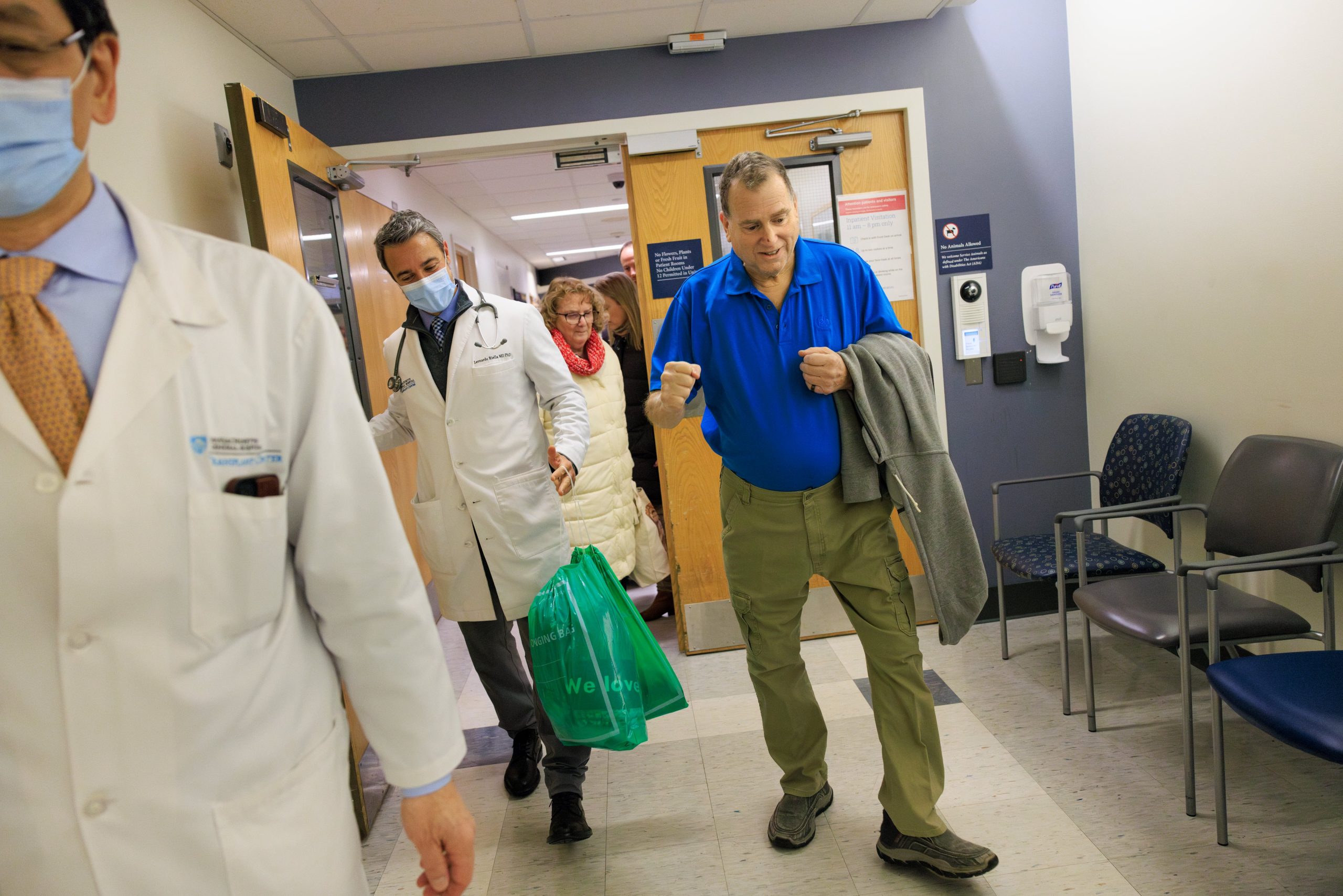
En enero de 2025, Tim Andrews recibió un trasplante de riñón de un cerdo en el Hospital General de Massachusetts, en Boston. El paciente, que tenía 66 años en el momento de la intervención, vivió con ese riñón durante 271 días sin necesidad de la diálisis que había requerido los dos años anteriores para sustituir a sus riñones fallidos. Esos nueve meses son el récord de duración para un trasplante de un animal a una persona.
In 2018, after spending his adolescence in an Israeli-blockaded Gaza watching videos online about circus activities abroad, Muhammad Jader decided to bring what he had learned to his community. After waiting a decade to painstakingly acquire the necessary equipment, he and nine other Palestinians opened the Free Gaza Circus.
The aim was to “spread circus culture” among children and young people through workshops and courses based on what they had learned on social media. In a “modest space” they set up in the Jabalia refugee camp in northern Gaza, they began teaching those skills, he recalls today, eight years and much suffering later. The project, which he founded with his brother Yusef, grew steadily until it reached 480 students at a time when leaving Gaza was already difficult.
In October 2023, Hamas launched its surprise attack and Israel began bombing the enclave, killing hundreds of people a day and ordering the displacement of more than half of Gaza’s then 2.3 million residents from the north, where Jabalia is located, to the south. “We didn’t know where to go or what to do. We left all the equipment behind in the middle of the bombardments. For a month, we were simply traumatized,” he remembers.
As Benjamin Netanyahu’s government turned life in Gaza into a mix of attacks, repeated displacement, hunger and destruction, teaching circus tricks would have seemed like an ill-timed luxury. Jader, displaced from his native north to the southernmost city of Rafah, realized that the circus could no longer be about skills. It had to become a tool for mental health and survival.
“We sat down and decided we had to use our energy to start giving our people hope. To make them feel safe for a while and break the routine of tension and bombardment. Until October 7, 2023 [when the bombings began], our goal was training and teaching. When the war started, it became about providing emotional and social support through activities in the displacement camps. About distracting children and young people from the bombing and destruction around them,” he says during a patchy phone call. Many Gazans rely on mobile signals from neighboring Egypt or Israel, or use international SIM cards, because Israel has barred journalists from freely entering Gaza for nearly three years.
A loudspeaker and scraps of fabric
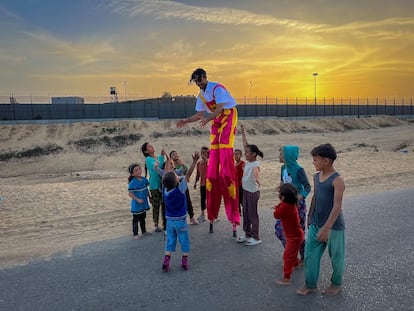
The first thing they did was buy a small loudspeaker. Then they set about searching through the rubble for scraps of fabric and colorful clothing, which they stitched into their own clown costumes.
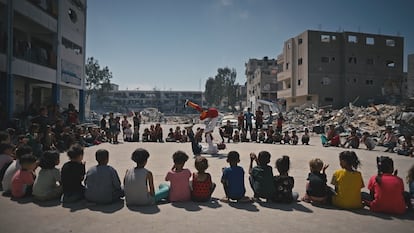
The circus shifted its focus to free outdoor performances aimed at bringing smiles amid adversity, using little more than red noses, juggling balls and stilts made from salvaged pieces of wood.
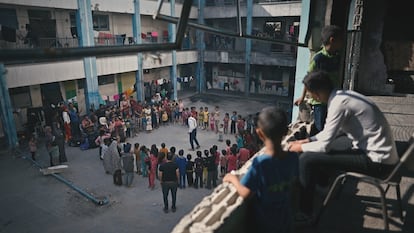
The systematic destruction of buildings left most Gazans living in tents. During the summer, this new version of the circus would wait for the fierce daytime heat to subside before gathering crowds of all ages eager for a brief escape from the daily routine of queuing for food and drinking water from humanitarian and charitable organizations, or from hours spent scavenging wood or even plastic among the rubble to use as fuel for cooking.
“Older people came too, and it was very moving to see that we were putting smiles on adults’ faces as well,” recalls Jader, now 27. “They had no work, they were sitting around with nothing to do, and afterward they would tell us how happy they were and asked us to keep coming.”
“When the army withdrew from Khan Younis, we went there to perform and saw more smiles on the faces of elderly people than on those of children,” he continues. “That convinced me even more that the circus is very important in this situation.”
Created as a permanent educational initiative, the circus was thus forced to reinvent itself as a traveling troupe focused on psychosocial support. According to UNICEF, virtually all of Gaza’s 1.1 million children require mental health and psychosocial support services. Even before the invasion, Gaza had only one psychiatrist for every 100,000 inhabitants.
In the spring of 2025, Israel intensified its use of hunger as a weapon of war by preventing any food from entering Gaza. The result was famine for more than a million people, with dozens of emaciated children dying from starvation.
The circus decided to stop. “Children wake up and go to bed hungry […] We cannot offer psychological support to people who have not been able to eat anything. Even we, as performers, are exhausted from hunger and worn down by this situation,” they said in a statement.
That October, U.S. President Donald Trump imposed a ceasefire on Netanyahu in Gaza, and the circus resumed its activities. Israel continues to carry out airstrikes, with 1,320 people killed during the 10 months of the ceasefire, controls 60% of Gaza, prevents reconstruction in the devastated territory and still restricts the entry of aid. But the attacks are far less intense, the constant displacement has become a thing of the past, and there is considerably more food available in the markets.
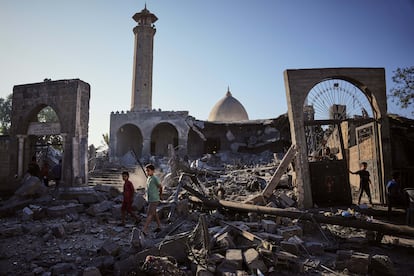
Since this was the closest thing to stability they could hope for in the short term, they resumed training in May. Not in Jabalia, where the center that once housed their activities now lies in ruins, but in Deir al-Balah, the new home of hundreds of thousands of displaced people. And not with the full team. Of the 10 partners who founded the circus, three have been killed during the Israeli invasion. Only four of the survivors have managed to reunite and restart training and educational activities in a tent provided by the Palestinian philanthropic foundation Tamer, in collaboration with UNICEF.
Last January, they took advantage of the ceasefire to return to the original site and search for equipment among the rubble. “We only recovered simple things,” like carabiners or mats, “but it gave us hope,” Jader recalls. The most expensive and hardest-to-get items remain buried there, like the bicycle or the unicycle and the rigging needed to hang aerial silks. “Outside Gaza, they’re easy to find, but for us, getting them in the first place was like finding treasure,” he says.
That is why the circus focuses on teaching floor acrobatics and clowning, which require fewer resources. And in a Gaza where few people speak of the future with any sense of hope, the project survives largely through personal commitment. “We don’t have projects, nor a clear plan, nor steady support, nor an operating budget,” Jader admits.
For now, though, he is worried about something more immediate: the nearly 190 children enrolled in the activities. “I think,” he says, “I have a problem with the size of the tent.”
Sign up for our weekly newsletter to get more English-language news coverage from EL PAÍS USA Edition




 Over 30 armed men descended on a farmhouse in the Dutch village of Overasselt in the early hours of Tuesday over a missing cocaine shipment.