
Australia
Saul Newman: ‘If You’re Elon Musk And You’ve Bought Everything, The Only Thing Left To Sell Is A Way To Escape Death’













Ten European countries are investigating alleged abuses committed against their nationals while taking part in expeditions organized by the Global Sumud Flotilla, which was carrying humanitarian aid to Gaza and was intercepted by Israel in international waters.
Prosecutors from 10 European Union member states — Spain, France, Italy, Portugal, Belgium, the Netherlands, Poland, Slovakia, Sweden and Finland — along with Australia, have been cooperating and sharing information on cases and investigations opened following complaints against Israeli politicians, officials and military commanders, including members of Benjamin Netanyahu’s cabinet, for torture, kidnapping, ill-treatment and other alleged crimes. This was confirmed to EL PAÍS by legal sources who took part in a meeting held on September 16 in The Hague.
All the countries that attended the meeting have some form of inquiry underway into the flotilla raid, according to those sources, who said the purpose of the gathering was to exchange information on their respective investigations. The meeting, which lasted around eight hours, took place within a framework of cooperation coordinated by Eurojust, the EU’s judicial cooperation agency. Australian representatives attended as guests. In at least five other European countries, including Germany, Norway and Austria, complaints have been filed over the same events, but the authorities have not yet decided whether to open formal investigations.
Most of the states represented at the meeting were primarily interested in gathering information that could support cases they have already opened, or may pursue, in their own jurisdictions. These focus on alleged crimes committed against their citizens during the flotilla raid in October 2025 and when a second humanitarian mission was intercepted by Israeli forces in international waters in May this year, the sources said.
The first reports of the meeting in The Hague emerged in Italy, according to an exclusive report by the newspaper La Repubblica. The Rome Attorney General’s Office, headed by chief prosecutor Francesco Lo Voi, later confirmed in a statement that meetings had taken place with representatives from other countries, without providing further details. A spokesperson for Eurojust, meanwhile, declined to comment “on possible meetings or confirm the existence of ongoing investigations.”
Investigations in Spain
Spain was represented at the meeting by Dolores Delgado, the prosecutor responsible for coordinating human rights and democratic memory cases within Spain’s Attorney General’s Office. Delgado launched an investigation from within the Attorney General’s Office in 2025 into crimes allegedly committed by Israel in Gaza.
Also present was investigating judge Francisco de Jorge, who is overseeing an ongoing case at Spain’s High Court, the Audiencia Nacional, concerning the flotilla raid. In July, he agreed to hear a criminal complaint against Eyal Zamir, chief of staff of the Israeli military, and Ram Rotberg, commander of the Israeli navy, allowing the case to proceed.
These sources note that, unlike other countries, Spain has been investigating the matter for many months. In June 2025, after receiving a report from the National Police, Delgado opened a case file into the actions of the Israeli military against the civilian population in Gaza. The aim was to gather evidence and submit it to the proceedings already under way against Israel before the International Court of Justice (ICJ), as well as to the cases against Prime Minister Benjamin Netanyahu and Israel’s then defence minister, Yoav Gallant, before the International Criminal Court (ICC).
After the flotilla raid took place in October last year, Spanish prosecutors incorporated the incident into their investigation and, according to prosecution sources, prepared reports and took testimony from several of those affected. Among them was Ada Colau, former mayor of Barcelona, who was travelling aboard one of the vessels in the expedition.
However, once proceedings were opened at the High Court, every aspect of the investigation relating to the raid on the vessels had to be transferred to Judge Francisco de Jorge. Under Spanish law, when an investigating judge opens proceedings into specific events, prosecutors cannot conduct a parallel investigation into the same facts.
The High Court case also has a distinctive feature. Unlike other countries, which have opened investigations because their own citizens were affected and want to examine crimes that may have been committed against them, Judge De Jorge accepted the complaints against the two Israeli commanders after concluding that, under the United Nations Convention on the Law of the Sea, Spain has jurisdiction only over events that took place aboard flotilla vessels sailing under the Spanish flag.
According to his interpretation, those vessels were, for practical legal purposes, Spanish territory. Spain can therefore investigate alleged crimes committed on board them, regardless of the nationality of the victims. The judge stressed, however, that his jurisdiction ends once passengers were transferred to Israeli territory or to other vessels. In other words, he cannot investigate alleged abuses committed after flotilla activists left the Spanish-flagged ships.
For freelance journalist Néstor Prieto, one of the flotilla participants who led the complaint before the High Court, the investigation is “positive, but insufficient,” because the alleged rights violations continued during the activists’ several days in detention and because it excludes participants who were not travelling aboard Spanish-flagged vessels.
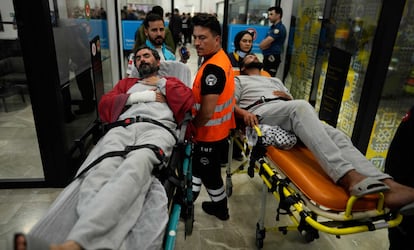
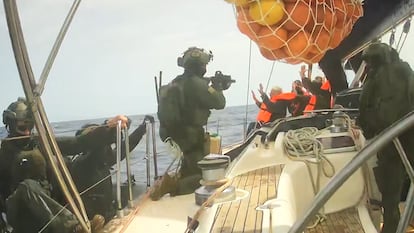
The reporter, who was part of the October 2025 mission aboard the Adara, says several military vessels surrounded their ship, fired tear gas and boarded it. From that moment, they spent “between 12 and 14 hours” cut off from the outside world and crammed into the vessel’s cabin. During that time, they were subjected to physical and verbal abuse, threatened with firearms, and given little access to food, water or medication. Upon arrival in port, those detained were transferred to a prison, where they remained until being deported more than 72 hours later.
In the flotilla that set sail in May, the level of violence escalated significantly. As EL PAÍS contributor Ignacio Ladrón de Guevara, who was aboard one of the vessels, later recounted, the beatings and mistreatment were so severe that the mission recorded at least 35 bone fractures and more than 10 allegations of sexual abuse. Taser shocks and stun grenades also became part of daily life for members of the flotilla.
Saif Abukeshek, one of the leaders of the Global Sumud Flotilla, who was detained during the May mission, believes all these allegations should ultimately lead to convictions.
“They carried out a military interception in European waters and entered Greek territory. The violations committed by Israel are very clear and the orders that were given were made public,” he says, referring to threats issued by the Israeli government.
The Palestinian-Spanish activist spoke to EL PAÍS from the Italian port of Augusta, where campaigners were carrying out actions at sea to prevent commercial ships bound for Israel from making a stop there.
Israel’s chain of command under scrutiny
Bound, forced to kneel and publicly humiliated. That was how Itamar Ben Gvir, Israel’s far-right national security minister, chose to present the flotilla activists detained in May.
“This is how we welcome terror supporters. Welcome to Israel,” the minister declared in a video he posted on social media. The footage sparked an international outcry and even drew criticism from Netanyahu. In June, prosecutors in Italy opened an investigation into Ben Gvir on allegations of kidnapping and torture.
Following complaints filed by 50 Italian passengers, prosecutors decided to go a step further and announced a broader investigation targeting not only Ben Gvir but also 13 other senior Israeli officials, including Defence Minister Israel Katz. Unlike Spain, the Italian authorities are seeking to establish the full sequence of events, from the moment the vessels were forcibly boarded until the flotilla participants were deported from Israel.

Israel’s entire chain of command is under scrutiny, from Eyal Zamir, commander of the Israel Defense Forces, and Daniel Levy, head of the national police, to the officer in charge of the Ashdod naval base, the port where the activists were brought ashore, and the governor of Ketziot Prison, where several of them were held for days.
After being named in the investigation, Israel’s prison authorities said they had acted “in accordance with the law and with full respect for the activists’ fundamental rights.”
Although they are examining abuses allegedly committed during two different flotilla missions, Italian prosecutors argue that the cases point to a modus operandi involving systematic violence and human rights violations. They also reinforce the view that, although the alleged abuses took place at different times, they were carried out under the same chain of command.
What began as isolated complaints and condemnations has developed into a growing wave of cases moving through European courts. In June, judicial investigations were opened in France and Poland. That same month, Australian police announced that they were investigating allegations of rape and torture made by a group of activists from their country.
In the Netherlands, seven flotilla participants filed a complaint in July accusing Israeli military personnel of sexual assault. In August, the Turkish government, one of the strongest critics of the Israeli authorities, issued arrest warrants for 35 Israeli suspects, including Netanyahu, over alleged crimes against humanity and torture committed against flotilla participants.
Sign up for our weekly newsletter to get more English-language news coverage from EL PAÍS USA Edition
Ben Shelton – Carlos Alcaraz En Directo, La Final Del Masters 1000 De París En Vivo | El Murciano Se Lleva El Primer Set En El ‘tie-Break’

Spanish Judge ‘asks UAE To Arrest Couple’ Suspected Of Ordering Execution Of Marbella’s Infamous BBL Surgeon Dr ‘Buttman’

FIA confirm Max Verstappen hit with 30-place grid penalty ahead of Brazilian Grand Prix


-
DGT3 weeks ago
Viral video in Spain sparks fury over drivers who ‘have no idea how to drive’
-
Automated supermarket4 weeks ago
Spain’s 24-hour shop with no tills expands to Barcelona Airport
-

 Uncategorized4 weeks ago
Williams F1 driver caught up in four-car pit lane pileup
-
News4 weeks ago
Hundreds evacuated as huge fire erupts on Spain high-speed train route
-
Council tax (IBI)3 weeks ago
Barcelona plans 150% property tax increase on tourist flats ahead of 2028 ban
-
Keeping cats and dogs outside3 weeks ago
Spain’s pet owners face fines of up to €200,000 for animal welfare offences
-
Age Concern Marbella - San Pedro2 weeks ago
Halloween lunch sells out as 51 join Marbella get-together
-
airports3 weeks ago
Travelling between Spain and Italy? The extra border checks could soon end