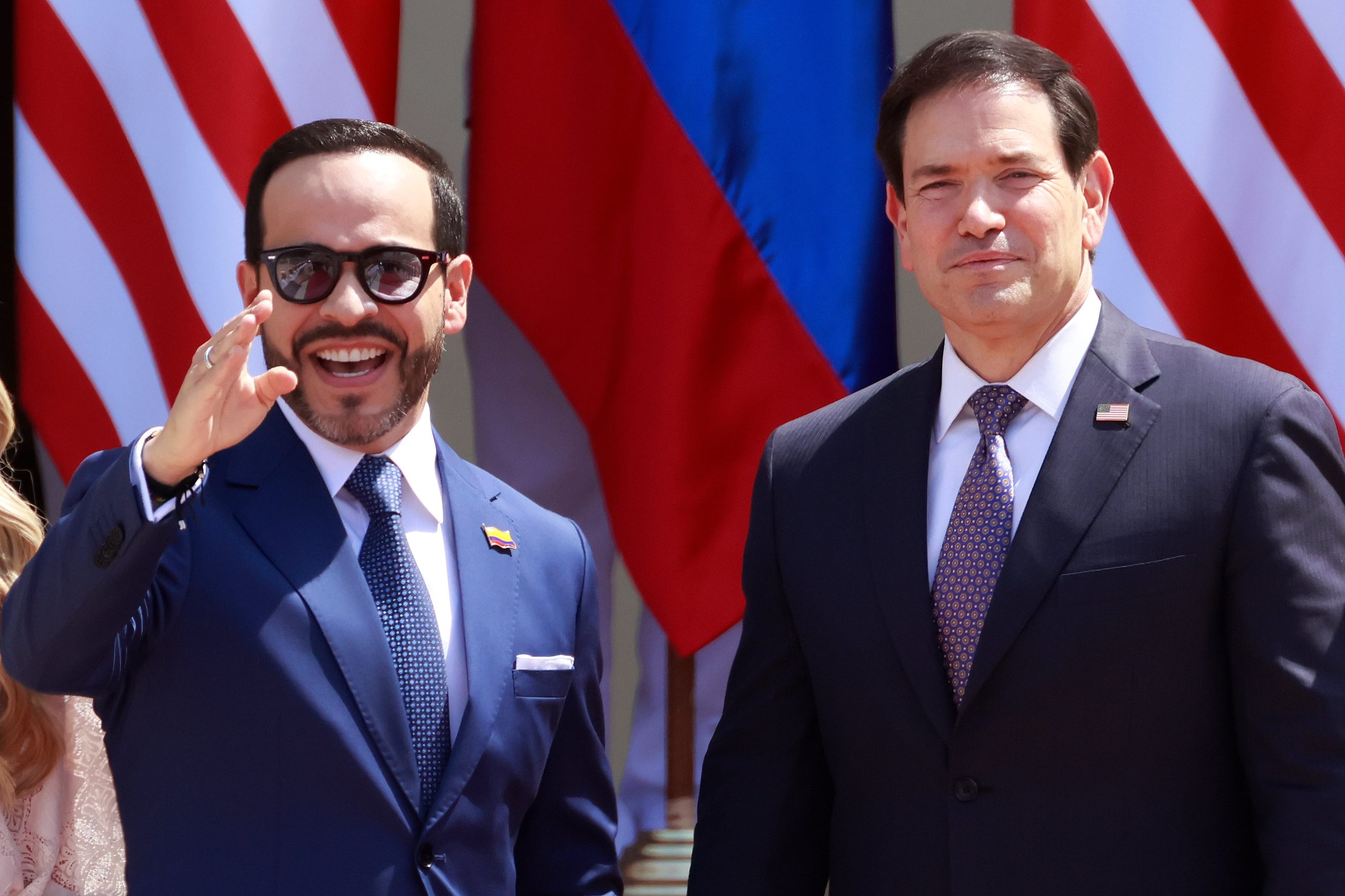
The days of confrontation are now a thing of the past: the United States and Colombia once again view each other as friends. This was confirmed on Tuesday following the meeting between Colombian President Abelardo de la Espriella and U.S. Secretary of State Marco Rubio. It was De la Espriella’s first high-level visit, and he chose to host it at his home in Barranquilla. There, he welcomed the diplomat with hugs and smiles — a sign of the good relations both administrations are hoping to foster. In practice, this translates into a series of security and investment measures outlined in the so-called Barranquilla Agreements.
“We discussed many security issues, and this is key, because without security there can be no prosperity. The opportunities that exist between Colombia and the United States go far beyond mere security,” Rubio said in Spanish during a press conference — which did not allow questions from reporters — at the end of his meeting with De la Espriella.
“It’s not every day that you travel to a country and have the opportunity to speak with a head of state whom you’ve known since before he entered politics. Two and a half years ago, we sat at the same table at a wedding in South Florida,” Rubio recalled with a laugh.
De la Espriella focused his remarks on detailing the agreed-upon points, which he summarized as three objectives: “To rebuild the country, revive the economy, and strengthen the hemisphere.” The first point addresses the recovery of areas affected by the devastating earthquake on August 10, with support from the United States. The idea is to attract U.S. capital to invest in the country in projects across various sectors, such as infrastructure, housing, and energy. In exchange, the president commits to maintaining fiscal discipline and improving legal certainty.
Agreements on rare earths and energy
Regarding the economy, De la Espriella has proposed leveraging Colombia’s resources — its geographic advantage and labor force, among others — to advance large-scale economic projects, though he did not provide specific examples. What the president did mention is that he will cooperate with the U.S. in the critical minerals and rare earths sector.
One of the two memorandums of understanding signed on Tuesday between Rubio and Colombian Foreign Minister Omar Bula delves deeper into this issue. The document does not grant the U.S. mining rights to Colombia’s deposits of some 20 chemical elements, such as lithium or copper, but it does bring the two countries closer together on this issue. The plan is to “position Colombia as a reliable partner in strategic supply chains related to clean technologies, electrical infrastructure, batteries, and advanced industries.” Securing global dominance over these materials has been one of Donald Trump’s primary interests, in response to their high concentration in China.
The other agreement concerns nuclear energy for civilian use. The Ministry of Foreign Affairs has stated that the memorandum “opens a space for technical, gradual, and responsible dialogue on the possible applications of nuclear technology for energy security and scientific research.”
But perhaps the most important component of the agreements is the fight against drug trafficking, one of the central pillars of the policies of both Trump and De la Espriella. Specifically, the Colombian president has stated his desire to “establish himself as Washington’s primary partner in hemispheric security,” and to that end, he has highlighted his so-called “21st-Century Patriot Plan,” through which he seeks to upgrade the country’s military capabilities by modernizing its radar systems, drones, and intelligence services, among other areas. “Colombia will contribute its own resources, [but] we need financial support from the U.S. We’re going to work on the fight against drug trafficking. We’re going to conduct aerial spraying [against coca crops]. We’re going to go after the armed organizations…” the president assured.
On this point, De la Espriella confirmed that Colombia is already part of the Shield of the Americas, the coalition founded by Trump that now includes 18 countries with the goal of confronting drug trafficking networks in the region. To that end, it will establish an operational headquarters in Medellín. “Any criminal who doesn’t submit will be taken out. It’s either prison or the grave,” the president emphasized, echoing the promises he made during the campaign.
Venezuela and migration
At the end of his statement, De la Espriella emphasized that he will work closely with Washington to ensure regional stability with regard to Venezuela. “Colombia will partner responsibly with the United States in efforts aimed at guaranteeing regional stability and will deepen cooperation on border, migration, and security issues,” he said.
On the issue of migration, De la Espriella addressed one of the first controversies of his term: the order to deport undocumented immigrants, a measure mirroring that implemented by the Trump administration. “Our principle is simple: legal, safe, and orderly migration. We are against illegal migration.”
Left out of both officials’ remarks was the Colombian government’s request to Washington to suspend the 12.5% tariffs on its products due to the earthquake and the pressure now being felt by hundreds of business owners. Although trade associations had hoped for a gesture of relief, it appears this issue was left out of the meeting.
At its conclusion, De la Espriella made a request that, as he emphasized, was more personal: he asked for the reopening of a U.S. consulate in Barranquilla. “It’s an issue that touches my heart, and I told the secretary so.” The diplomatic office has been closed for more than 30 years.
“It was a frank, in-depth, strategic, and cordial conversation. May God bless the United States, and may God bless Colombia,” De la Espriella concluded. For his part, Rubio will continue his tour of Latin America on Wednesday in Ecuador and will wrap it up on Thursday in Peru. He will meet with Presidents Daniel Noboa and Keiko Fujimori, respectively.
Sign up for our weekly newsletter to get more English-language news coverage from EL PAÍS USA Edition

















 ElPais2 weeks ago
 Uncategorized1 week ago