
Donald Trump
E








Cártel Jalisco Nueva Generación
Mexico Sends Trump A Message Of Effectiveness With The Arrest Of Drug Trafficker ‘El Jardinero’

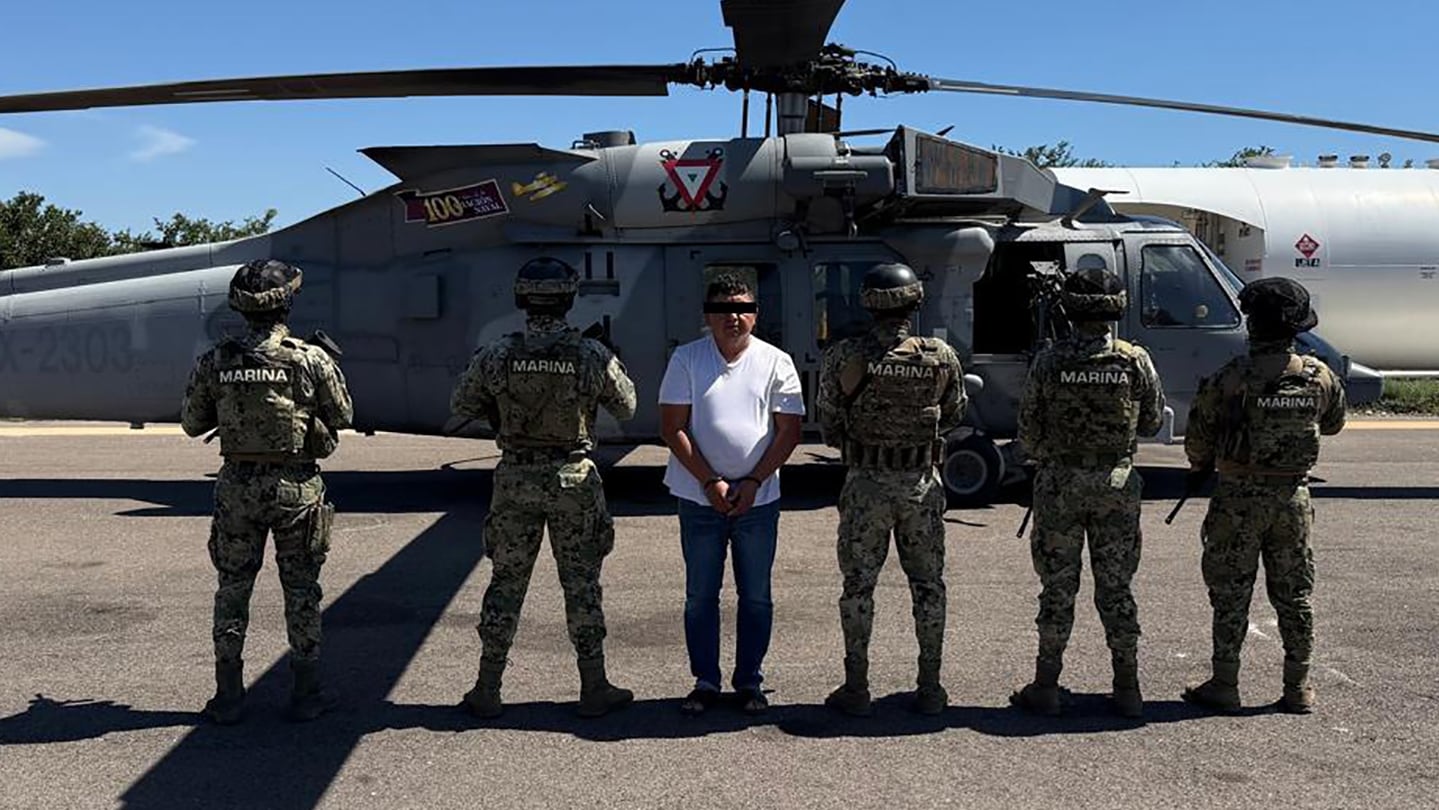
With the arrest of Audias Flores, aka “El Jardinero” (The Gardener), one of Mexico’s most wanted drug traffickers and a leading contender to take over the decapitated Jalisco New Generation Cartel (CJNG), Mexico has not only dealt a brutal blow to that criminal organization, but is also trying to send a message of effectiveness to Washington and contain Donald Trump’s interventionist impulse in his crusade against drugs.
Just a few hours after the Mexican government released the image of the cornered drug lord, military authorities provided details of the capture. Not a single shot was fired, and the two-hour operation took place after 19 months of investigation. That same day, authorities also arrested César Alejandro N., alias “El Güero Contra,” in charge of the cartel’s finances and logistics, as well as Metro 9, the leader of one of the Gulf Cartel’s factions in Tamaulipas, on the border with the United States.
It was all in stark contrast to the bloody operation in February that captured the cartel’s leader, Nemesio Oseguera, alias “El Mencho,” and triggered a wave of violence across the country that left 25 soldiers dead. While the violence was quelled within 72 hours, it left a sense of chaos and uncertainty for several weeks.
The arrest of El Jardinero involved U.S. intelligence, a cooperation that Mexican President Claudia Sheinbaum wants to leave at that, given Trump’s repeated offers and pressure to intervene more directly on Mexican soil. Sheinbaum’s containment strategy hinges on demonstrating results to Trump to convince him that Mexico is capable of managing the problem by itself, at a tense moment in relations with Washington, with whom Mexico is negotiating the United States-Mexico-Canada Agreement (USMCA), vital to its economy.
El Jardinero, in addition to managing a significant flow of cocaine north and a large extortion network targeting truckers, had been a prime target of the DEA, the U.S. Drug Enforcement Administration, for years. While awaiting a judge’s decision on his legal future, the possibility of his extradition to the United States remains high, and it has been requested. The Sheinbaum administration has already sent 92 prisoners to the U.S. in the past year to face charges related to organized crime. “It’s another offering to Trump, yes, but also a victory for the Navy [one of the Mexican military branches], and they’ve done it with zero deaths,” explains Carlos Pérez Ricart, a researcher at the Center for Economic Research and Teaching.
In a new version of the Monroe Doctrine, Trump has been exerting strong pressure for months on several Latin American countries, in what he considers his hegemonic sphere of influence. The fight against drug trafficking, curbing migration, and limiting China’s influence in the region are the pillars of his Shield of the Americas, the alliance he presented a month ago with 12 leaders from the region, all ideologically aligned with him.
With Mexico, Washington employs a threatening rhetoric, hinting at attacks against cartels on Mexican soil and embracing the notion that the cartels control the country. And this isn’t limited to security matters; it also extends to Mexico’s alliances, such as the oil shipments to Cuba that ceased after Trump threatened tariffs on any supplier, and to economic relations as well. Last September, Mexico raised tariffs on Chinese cars to 50%, a move viewed in Beijing as a sign of submission to U.S. “coercion.”
Although security cooperation with the United States is fluid, as seen in these recent operations, the limits that Sheinbaum tries to impose often face even more pressure from the other side of the border. The arrest of El Jardinero, which had been in the works for months, also “serves to demonstrate the government’s effectiveness and decisiveness” to Washington, explains Maria Teresa Martínez Trujillo, a specialist in violence and professor at the Monterrey Institute of Technology.
Domestically, the president is sending a message of sovereignty, which has been called into question by the scandal generated by the fortuitous revelation—following a traffic accident in which two Mexican and two American officials died—of the presence of CIA agents on Mexican territory without the authorization of the federal government, once again raising concerns about interference.
Partisan use
Regarding the arrest of El Jardinero, Sheinbaum said on Tuesday: “There may be information from some U.S. government agency, but it has to be within the framework of the existing understanding and not from a ground operation with elements of any of the investigative agencies.” And she added, to emphasize the difference with other administrations: “That was the daily reality during [President Felipe] Calderón’s term. All Mexicans are very protective of our independence, and particularly the Mexican government. This government. The government of [Sheinbaum’s predecessor and founder of the leftist Morena party Andrés Manuel] López Obrador.”
The statement was also a swipe at the war on drugs that Calderón implemented starting in 2006, and which dramatically increased the number of homicides and disappearances by militarizing security. Calderón belongs to the right-wing National Action Party (PAN), the same as the governor of the state of Chihuahua, on the northern border, where CIA agents were involved in a joint operation with state officials.

Chihuahua is one of the few states not controlled by Morena, Sheinbaum’s party, and there are elections scheduled for next year. The president demanded explanations from the governor about the CIA agents’ presence in her state; this led to an investigation that ended with the resignation of the state prosecutor, who gave contradictory accounts of what happened.
“The president has been very harsh with the governor and very lenient with the United States,” says Pérez Ricart. “Many state governments have their own logic regarding cooperation with the United States; that’s a fact. But the president can’t acknowledge this publicly, and we only found out because they died in an accident,” he says. In this way, “Morena found a way to damage an opponent of the PAN party to weaken her in the lead-up to the elections.”
Sign up for our weekly newsletter to get more English-language news coverage from EL PAÍS USA Edition
They committed no crime, but Hayam El Gamal and her five children have personally experienced all the abuses the Department of Homeland Security is accused of in its anti-immigration campaign. After spending more than 10 months detained, they hold the record for the longest time spent during Donald Trump’s presidency at the Dilley Detention Center in Texas, which has faced numerous complaints of inhumane conditions. The crime for which they were imprisoned was not committed by them, but by their father, from whom El Gamal is now divorced.
Mohamed Soliman was responsible for an attack against Israelis demonstrating in Boulder, Colorado, in support of the release of hostages held in Gaza. He threw homemade bombs at them, killing one person. Soliman faces dozens of charges, including first-degree murder and hate crimes, and could face the death penalty.
As if it were a cruel joke, Immigration and Customs Enforcement (ICE) released El Gamal and her children last week, complying with a court order, only to detain them again less than 48 hours later when they showed up for a mandatory appointment with the immigration agency. This time, they were put on a plane that their lawyer believes was bound for Egypt, their country of origin, from which they fled more than three years ago. An urgent request from their defense team and a new emergency court order resulted in the plane changing course, allowing them to return home to Colorado.

“They violated a court order that had already been issued, as in the case of Kilmar Abrego García, only this time with five children involved,” his lawyer, Eric Lee, told EL PAÍS by telephone, referring to the case of the Salvadoran man who was deported by mistake and detained by ICE after being released by a judge.
This Wednesday, they are scheduled to appear again in Denver before ICE officials, fearing another attempt at deportation. The children’s neighbors and teachers have demonstrated on numerous occasions to secure their release, and on Saturday, when they were detained again, they protested in front of Colorado Springs City Hall.
The endless nightmare this family has endured began in June 2025, when Soliman perpetrated the attack. Nothing could have prepared them for what fate had in store. The family and the accused himself maintain they were completely unaware. “I didn’t think it was possible that my quiet, peaceful father could have done something so horrible until I saw the video. The person in that video might have looked like my father, but I couldn’t believe it was the person I knew,” his eldest daughter, Habiba, who had just graduated from high school, would later testify. Soliman himself stated that “no one knew about his plans and that he never spoke to his wife or family” about them. His family described him as a very private person who barely communicated with them.
Then-Secretary of Homeland Security Kristi Noem announced on social media that ICE had detained Soliman’s wife and children. Habiba, along with her four siblings (five-year-old twins, a nine-year-old girl, and a sixteen-year-old boy) and her mother, were taken to a hotel while the FBI conducted its investigation, in which they cooperated fully. They spent two days there, “without knowing they would be the last days we would be free for a long time,” the young woman would later say.

Unidentified ICE agents told them the hotel wasn’t safe and that they would be taken to another hotel. Instead, they were locked in a cell where they spent eight hours and had their phones confiscated. From there, they were told they would be transferred to a pleasant family center to await their court case. In the middle of the night on June 3, they arrived at their destination: the Dilley Detention Center.
The White House posted on the X platform: “Six one-way Tickets for Mohamed’s Wife and Five Kids. Final Boarding call coming soon.” El Gamal’s lawyers stated in court documents that the family had been in the United States for almost three years and therefore did not qualify for expedited deportation, which is only available for stays of less than two years. The family arrived in August 2022 and applied for asylum in September.
The nightmare had only just begun. The following months were marked by mistreatment and despair. In a conversation with EL PAÍS from Dilley, Habiba recounted the inhumane treatment she received. One of her twin brothers, then four years old, suffered an appendicitis attack, and no one believed him. He was only taken to the emergency room when, hours after enduring severe pain, he began vomiting. The poor quality of the food, the lack of access to medicine, and the contempt with which most of the staff treated them—common complaints among the detainees—took a toll on the family’s physical and psychological health. Just when they thought things couldn’t get any worse, Habiba was separated from her family in January and taken to another section of the center. The official justification was that she had turned 18, but Habiba had turned 18 several months earlier, so she believed it was punishment for publishing a letter denouncing her situation.
Please take the time to read the whole statement of Habiba Soliman, detained at Dilley for 8 months with her mom, 5 year old twin siblings, 9 yr old sister, and 16 yr old brother.
🧵 1/12 pic.twitter.com/T9XXbym31R
— Eric Lee (@EricLeeAtty) January 25, 2026
In a statement released Saturday, the Department of Homeland Security asserted that the family was receiving “full due process” and called the judge who ordered their release an “activist judge” who is “releasing this terrorist’s family onto American streets, AGAIN.” “We are confident that the courts will ultimately rule in our favor,” said Lauren Bis, acting deputy secretary of the department, according to Reuters. The statement did not explain why the family was detained on Saturday, following the ruling issued on Thursday.
Lee, however, expects a different outcome: “We will not stop until they are free from the threat of illegal deportation by this government.”
Sign up for our weekly newsletter to get more English-language news coverage from EL PAÍS USA Edition

S
S

Tourist Overcrowding Spurs New Measures In Spanish Cities

Luxury Villas For Sale, Estepona – ProjectL1

Stylish 3-Bedroom Apartment With Panoramic Sea Views – Benalmádena
Brussels warns Spain that migrants regularised under controversial scheme will be deported back to Spain if they try to move to other EU countries


-
 New Developments4 weeks ago
Luxury Villas For Sale, Estepona – ProjectL1
-
 New Developments4 weeks ago
Stylish 3-Bedroom Apartment With Panoramic Sea Views – Benalmádena
-
eu response to spain migration policy3 weeks ago
Brussels warns Spain that migrants regularised under controversial scheme will be deported back to Spain if they try to move to other EU countries
-

 %4 weeks ago
Poland Disconnects Utilities At Russian Consulate That Moscow Refuses To Hand Over
-
Costa Calida3 weeks ago
Murcia unveils monument marking 175th anniversary of Burial of the Sardine
-
Costa del Sol3 weeks ago
Easter on the Costa del Sol: a time of renewal
-
ChatGPT4 weeks ago
He used ChatGPT to sell his home – and walked away with €100,000 more than expected
-

 Uncategorized4 weeks ago
Kelly Piquet