
Donald Trump
The ‘new Era’ Of Latino Socialists In New York: ‘If The Democratic Party Wants To Lead, It Must Create A Solution To The Immigration Problem’

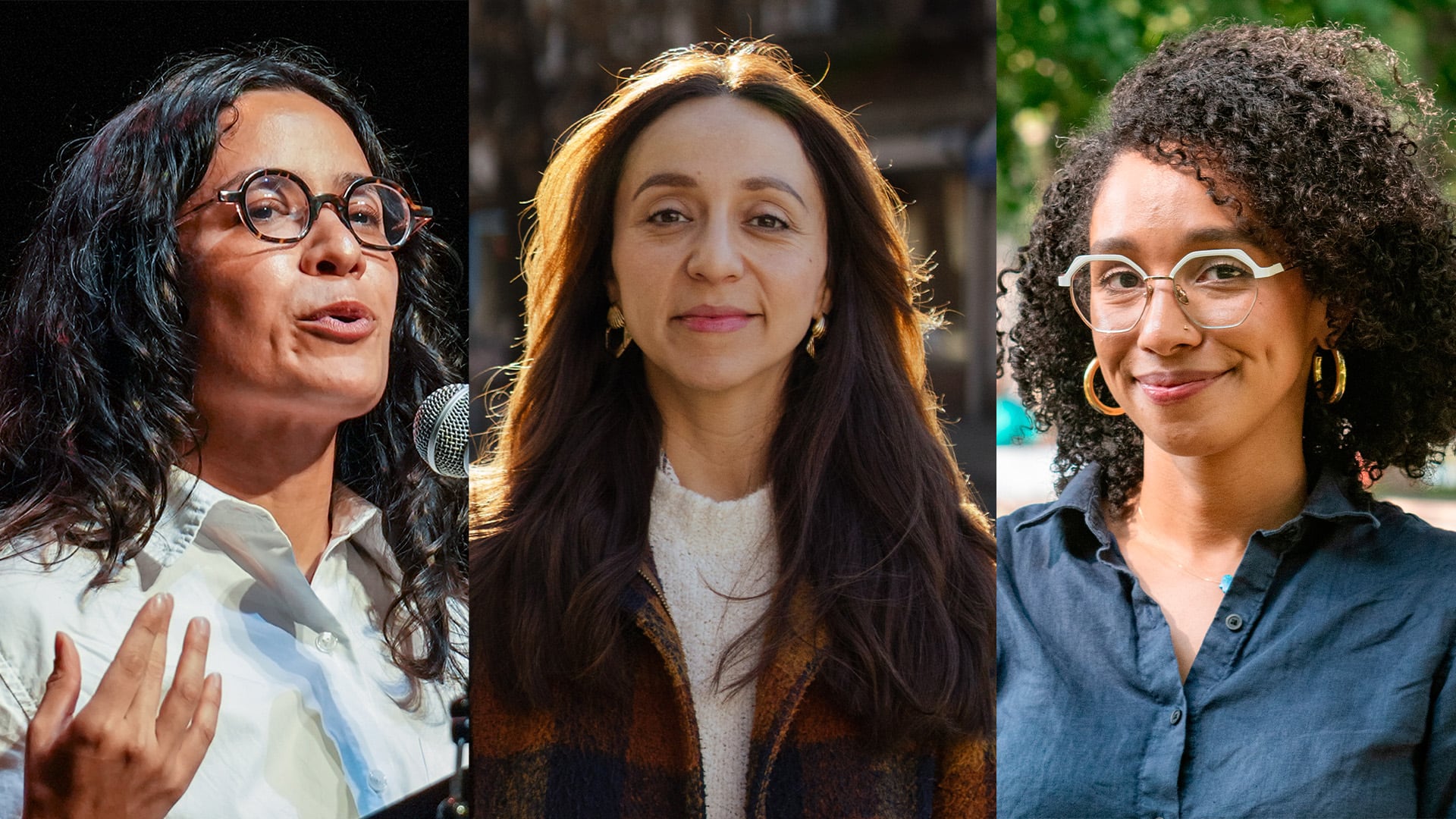
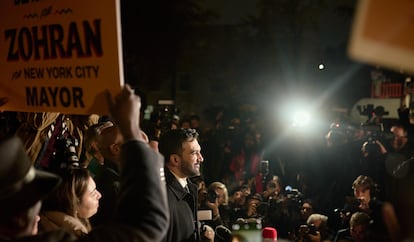
On the cover of issue number 304 of The Indypendent, a “free and progressive” paper printed on gray stock that New Yorkers pick up in libraries, laundromats, conference rooms and subway stations, Claire Valdez and Darializa Ávila Chevalier appeared back to back, both with broad smiles, in those June days when Mayor Zohran Mamdani endorsed them in the state Democratic primaries. When they finally became the nominees for the November congressional elections, Valdez and Chevalier grabbed the issue of The Indypendent, recreated their poses from the cover in person—victorious and amazed that the future had been sketched out for them in advance. One striking detail: both were Latina, the former of Mexican roots; the latter a daughter of Dominican parents. Both alternated Spanish and English on the campaign trail, self-identify as socialists, and worry about the things that concern people like themselves these days: that immigration enforcement might take a neighbor, or that paychecks won’t stretch to the end of the month.
Shortly after the primaries, the Instagram page DSA Latinos Socialistas invited everyone to a conversation where they would sell Venezuelan empanadas and, at the same time, raise funds to help Venezuelans who survived the earthquakes. Four panelists were scheduled for the talk: Ecuadorian Diana Moreno, who had filled Mamdani’s vacated seat as state assembly member for Queens’s 36th District; Illapa Sairitupac, the son of indigenous Peruvian immigrants whom Mamdani also backed and who won the Democratic primary for Assembly District 65; Claire Valdez, running for the 7th Congressional District seat; and Darializa Ávila Chevalier, the candidate for the 13th. A poster in large letters read: “Latina socialist politics in New York: a new era.” They were coining the idea that times had changed.
They were all fresh faces, people in their thirties; none yet had the look or cadence of a conventional politician. They came from roles as community organizers, artists, PhD students, political science graduates and social workers. Politics had not yet left its mark on them, they had not promised anything they hadn’t delivered, and so people went out to vote for them to get rid of the old establishment players. They were part of—and also a product of—the aura Mamdani left in an election that revived the American left, and therefore shared what, as a generation and as members of the Democratic Socialists of America (DSA), others also defended: rejecting any money from the American Israel Public Affairs Committee (AIPAC), condemning the genocide in Gaza, and pushing for more affordable cities.
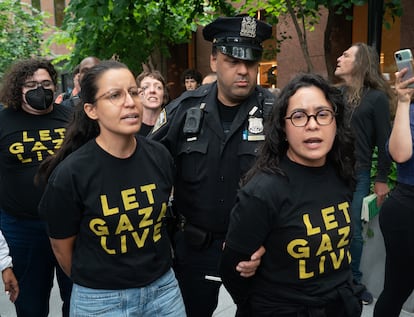
But one thing set Latino politicians apart from their colleagues: when they talked about abolishing the U.S. Immigration and Customs Enforcement agency, or ICE, they did not see the idea only as a necessary political stance but as the possibility of ending an agency that detains and deports migrants; migrants were, and are, their own families, friends or neighbors. “At parties or at the dinner table we talked about how much it costs to change immigration status, whether the neighbor was having trouble with immigration authorities. That’s how politics was talked about in my house,” Chevalier told EL PAÍS, recalling the days when she was still a girl born in Miami.
When these candidates talk about labor rights, they do so after having been employed and paid very little themselves: “I’ve had to work since I was 14,” Valdez says; she grew up in Lubbock, in northwest Texas. “I worked in fast-food restaurants and supermarkets. Once, at a Taco Bell, I messed up an order and my manager put those tacos in front of my face and said: you just wasted seven dollars of our product. He threw them in the trash in a very dramatic way to make me feel bad. I was paid $7.25 an hour, so those three tacos were worth an hour of my life.”
These new Latino politicians come from families that invested time and money so their children could study; they later moved, came to New York, and are now holding or seeking federal or state office. It’s not that they were the first Latinos in local or national politics: by then there were already names like Tiffany Cabán, Alexa Avilés, Marcela Mitaynes, Jessica González-Rojas, Kristen González, and the prominent figure Alexandria Ocasio-Cortez, but more were joining at a moment they described as very particular.

“We are being attacked by agencies like ICE and, obviously, the high cost of living affects Latino families a lot,” says Moreno, who arrived from Ecuador as a child with her sister and parents, who survived by washing dishes in a Mexican restaurant and cleaning hotel rooms. “Our community is living with a lot of fear. Trump is creating undocumented people because he is ending all temporary protected status programs and asylum protections, and that’s something we also have to lead on.”
Just as it’s symptomatic that the DSA’s strength has emerged, precisely, during the Trump era, almost as an immunological reaction, Moreno finds it coherent that more Latinos are becoming interested in socialist policies in the United States. Their own message includes them; the opponent’s excludes them. “It’s like a mirror of what’s happening in Latin America, where we have many governments that, sadly, with the support of the Trump administration, have turned to the far right. In Latin America people are also living the same affordability crisis.”
If Chevalier reaches Congress next year, she would be the first Dominican woman to do so. She sees it as an achievement. “I would be one of the few people in Congress who can speak directly in Spanish to the Latino community,” she says. “We’re seeing more and more Latinos voting for Trump, but we can’t complain when we are not speaking directly to that community. It’s a huge responsibility for me to take this position, to take this office, a responsibility to my district in New York but also to a community that has felt abandoned.”
The district Valdez represents, covering parts of Brooklyn and Queens, has for decades been home to Latino communities that have recently been displaced by high prices and gentrification. She wants to address that. “It’s really important that we have Latino socialists going to Washington to fight specifically for those communities,” she says. “Especially in my district, there’s a long history of organizing, particularly within the Puerto Rican diaspora, to fight bad landlords, build homes and communities specifically in Bushwick and Williamsburg. It’s the same community now under attack due to rising rents, low wages, poor working conditions and ICE harassment.”
And this is precisely one of the common demands all these candidates plan to take to Washington, Albany or City Hall: unite to abolish ICE. “If we take back the House of Representatives, there will be a Democratic majority in Congress that will open a lot of space for us to do work. We have to address the immigration crisis. We have to start exercising real oversight over ICE. That agency has to be abolished and we have to push for an immigration policy that is humane, that is welcoming,” Valdez says.
Chevalier, for her part, says it is possible to return to a country like the one where she was born, back when an agency like ICE did not exist. “What we’re seeing is an enormous risk to our community’s safety; people are being killed in the streets, they’re being separated from their families, children are being separated, jailed and disappearing in detention centers. That does not provide security for anyone. There’s no reason a civil process should look like a concentration camp.”
Rise and criticism of the DSA
Years ago, before she moved to Brooklyn to pursue a career as a visual artist, one of Claire Valdez’s aunts fell ill. She had to be airlifted to a hospital in Texas and remained hospitalized for quite some time. She had no health insurance and was left with thousands of dollars in medical debt. “She was a working-class person who had no ability to pay that money back,” Valdez says. It was 2017, right after the high-profile campaign of independent Vermont Senator Bernie Sanders, who identified as a democratic socialist, a leftist ideology that talked about narrowing economic inequality, expanding social programs and advocating for working-class rights.
Sanders’s proposal to spark a “political revolution” was rejected by many sectors, especially those who saw in the idea the specter of communism. Claire felt that, for the first time, someone was speaking for people like her. “Bernie Sanders had been the only person who spoke so clearly about how outrageous medical debt is in the United States, one of the richest countries the world has known. So when he ran again in 2019, I volunteered on that campaign and knocked on doors across the city; I even went to New Hampshire to canvass for him. I got involved in political organizing thanks to Bernie Sanders.”
Sanders’ spectacular campaign was the gateway to the path later taken by the DSA, which drew an army of young people from across the country and then gained strength with the arrival of figures like Alexandria Ocasio-Cortez. Ten years after that campaign, Sanders, now 84, was first at Zohran Mamdani’s swearing-in as New York mayor and later supporting Chevalier and Valdez in the primaries. The DSA arrived at this moment much stronger: with more than 100,000 members across nearly 200 chapters in the United States, which have found in it the only group that, in the Trump era, speaks openly about responsibility in the Israel–Palestine war, condemns corporate money’s influence, and proposes a reform of the country’s economic system.
“We are in a unique political moment where people are hungry for a new kind of politics in which they can also participate,” Diana Moreno says. The figure of the volunteer knocking on doors has been essential: Mamdani managed to gather about 100,000 people who knocked on some 1.6 million doors across New York City, and who have since recruited other DSA members.
“We’re not telling people: ‘vote for me, I will save you, I will fulfill all those promises.’ Rather we’re inviting people to be part of the movement. You have to put in the work, because democracy is a team sport and that’s something that people aren’t used to. Most of us think participating in democracy means voting every one or two years, or every four, but we’re saying: ‘No, it doesn’t end and begin when we win; it has to be defended and maintained and for that we need you,” Moreno says.
Amid the DSA’s rise—first with Mamdani’s campaign, then with his decision as mayor to back three socialist candidates (nine of the ten New York City candidates endorsed by the DSA won the Democratic primaries), and later with victories by other members nationwide—the organization began to face some pushback. The establishment has compared them to Cuban or Venezuelan ideologies, and many migrant communities from those countries feel a rejection of any proposal that sounds like “socialism.” Moreno does not rule out that the organization needs to reach out to those people.
“Many have negative memories and experiences with their governments, and that’s something we must take seriously, not ignore, and we must speak clearly about the kind of democratic socialism we offer,” she says. “For us it’s extremely important to tie socialism to democracy. Our socialism aims to respond to the current problems of the majority of people; we want more people to participate. People have lost faith in both Democrats and Republicans, because they have seen a Republican Party focused only on its racist project of expelling immigrants, stealing from public funds to give to Israel or their billionaire friends, and Democrats aren’t fighting hard enough to stop those changes. The American people are going through a crisis of democracy, and we want them to find in us, the democratic socialists, an answer and hope for the future of democracy.”
The seventh district, represented by Valdez and covering parts of Brooklyn and Queens, has been labeled the “Communist Corridor” because of the DSA’s electoral strength there. According to Valdez, the criticism comes from many people who “have family experiences, or have themselves experienced authoritarianism and do not want to be associated with democratic socialism or communism.” Still, a Gallup poll last year showed that 49% of Americans aged 18 to 34 had a positive view of socialism, compared with 30% of those over 55.
“I think what we’ve been showing, at least over the last few years, is that democratic socialism in the United States right now has particular characteristics and a particular history. It’s the socialism of Martin Luther King Jr., Helen Keller and many other leaders—something very different from authoritarianism elsewhere,” Valdez says. “For me, democratic socialism is about expanding democracy, ensuring people can be political actors in their own lives. It’s about universal programs like universal childcare, free public schooling, higher education, universal healthcare, expanding rent stabilization and making sure people can afford to live and have real dignity.”
The other criticism socialists have faced recently doesn’t come only from the far-right end of the spectrum but also from mainstream Democrats. Some argue this leftist movement poses a danger to the Democratic Party in the upcoming presidential elections. But the socialists agree that that party has not offered a better option in its recent shots at the White House.
“That’s always been the Democrats’ excuse; they’ve never been able to offer their own vision of what they will give us. It always has to be compared with the fear we should have of the Republicans,” Moreno says, then cites the current immigration crisis as an example. “If the Democratic Party wants to lead, it must create a solution to the immigration problem. They must offer comprehensive, humane immigration reform, which unfortunately has been completely erased from Democrats’ language. I mean, when we now talk about immigration, we only talk about ICE. But when we talk about immigration we have to talk about immigration reform and a dignified path to citizenship that doesn’t take advantage of people, because this country, like it or not, will always depend on our labor, will always depend on our work. The question for Democrats is whether they will accept us as human beings, not just our labor.”
Sign up for our weekly newsletter to get more English-language news coverage from EL PAÍS USA Edition









Donald Trump
The Shadow Of The United States Lengthens Over Southern Greenland: ‘We Are Going To Lose Our Homes’

The Narsarsuaq Museum no longer has set opening hours. Since the airport closed in the spring, few visitors come to this remote settlement in southern Greenland. However, if someone asks for Ole Guldager’s house and goes to ask him to open it, he is happy to oblige. The museum occupies one of the barracks of the former military base, a long wooden building painted red with a brick chimney. Beside the entrance sits the radial engine of a World War II aircraft, corroded by decades of exposure to the elements. Behind the building stretches the airstrip that U.S. soldiers built in record time. Today, however, that same country appears not as an ally from the past but as a growing threat to the island’s sovereignty and natural resources, especially in places like Narsarsuaq, one of three bases the United States would seek to reopen.
When Guldager turns on the lights, uniforms, rifles and carbines, field telephones, a metal stretcher from the old hospital, slot machines and letters confiscated by censors that described extreme isolation and never reached their destination emerge from the gloom. The rooms reconstruct the daily life of the thousands of U.S. servicemen, pilots, and nurses who passed through the former base. Among the hundreds of photographs are several of Marlene Dietrich, taken in 1944. For a few hours, the actress brought a bit of Hollywood glitz to that inhospitable corner of fjords and mountains to lift the troops’ spirits.
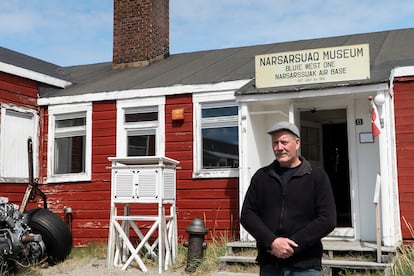
Guldager arrived in Narsarsuaq as a child. He was born in Denmark, but his father worked at the civil airport into which the former military installation was converted after the Americans left in the late 1950s. A historian and archaeologist — and one of the island’s few beekeepers — he has devoted much of his 58 years to researching the place where he grew up and chose to stay.
The last plane landed in April. The airport was closed because another one opened in Qaqortoq, the regional capital, where about 3,000 people live, and it made no sense to maintain two for such a small population. But the reality is that since then Narsarsuaq has been emptying out. Guldager estimates that of the 150 residents it had, about 40 remain. Everything revolved around the airport, which for more than six decades was the main gateway to the island’s south, handling thousands of passengers each summer. Now there are weeks when barely a dozen visitors arrive. The hotel, one of Greenland’s largest, closed its doors the same day the airfield shut down.
Among those who do not plan to leave is Storch Lund. The grandson of Henrik Lund — the poet who wrote the lyrics to Greenland’s anthem — he grew up on a farm across the fjord and moved to this shore as a teenager to work as a mechanic’s apprentice. He went on to run the airport for more than two decades, and also ran a café and a souvenir shop that closed a few months ago. He also started a company to transport tourists to other settlements. Today, only one of his boats still operates with low demand; the other two remain moored. At 69, he finds it hard to accept that “nothing happens in Narsarsuaq anymore.”
It is into that void that the United States now reappears.
As the village withers, the shadow of Donald Trump lengthens over it. The U.S. president, who tried to buy Greenland from Denmark during his first term, threatened earlier this year to take control of the island “the easy way or the hard way.” Tensions eased after several European allies deployed troops to the Arctic territory in support of Danish sovereignty, and the crisis moved onto a diplomatic track. For seven months representatives of Denmark and Greenland have been negotiating behind the scenes in Washington with the Trump administration over the terms of an expansion of the world’s leading military power on the planet’s largest island, home to just 56,000 people.
In those talks, the United States demands sovereignty over the territory occupied by any future U.S. military installations on the island — a status similar to that of British bases in Cyprus — a demand Danish and Greenlandic representatives are unwilling to accept.
Washington’s strategy rests on the bilateral defense agreement signed with Copenhagen in 1951, a treaty that allows, upon request, an expanded U.S. military presence in this territory of the Kingdom of Denmark. General Gregory Guillot, head of U.S. Northern Command, informed the Senate in March of the intention to establish three new “defense zones” in Greenland to strengthen surveillance of Russian nuclear submarines and counter China’s growing influence in the Arctic.
In May, four weeks after Narsarsuaq’s international airport was downgraded to a heliport, U.S. Marine Corps personnel and representatives of the U.S. Embassy in Denmark arrived to inspect the airstrip, the deep-water port, and other facilities at the former base.
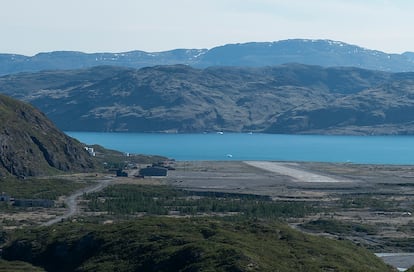
Guldager fears that the return of U.S. troops will eventually evict the residents who still hold on in Narsarsuaq. “We are going to lose our homes and have to leave the place where we have lived and worked all our lives,” he laments. Author of a book about the dozens of military installations the United States built in Greenland during the Nazi occupation of Denmark, Guldager recalls that during the 1953 expansion of the Pituffik base —the only one Washington still maintains on the island, in the northwest — dozens of Inuit families were forcibly relocated 80 miles from their homes.
“The Americans built everything, but this is my home,” Guldager emphasizes. With nostalgia he recalls how in just three years that uninhabited plain became a town with roads, workshops, mess halls, a hospital, a cinema, a basketball court and a gym. In the dying days of World War II about 4,000 people lived there, more than in any other Greenlandic settlement at the time.
Code-named Blue West One, the Narsarsuaq base was part of a chain of stops crucial for ferrying military aircraft from America to the fronts in Europe and North Africa. More than 10,000 aircraft refueled or were repaired there during the conflict.
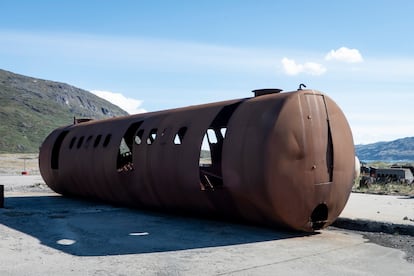
The United States abandoned the base in 1958, leaving a deep environmental footprint; a toxic legacy for a population whose identity depends on balance with its surroundings. The coastal landscape was strewn with rubble, scrap metal, pipes, batteries and thousands of rusty drums. A few miles away, the old military hospital, which had capacity for 250 beds, burned down in the 1970s. No one removed the asbestos panels, and small white fragments of this toxic material lie scattered across the valley. Residents fear the strong winds will continue to carry dangerous particles toward the village, although today they are more worried about Donald Trump.
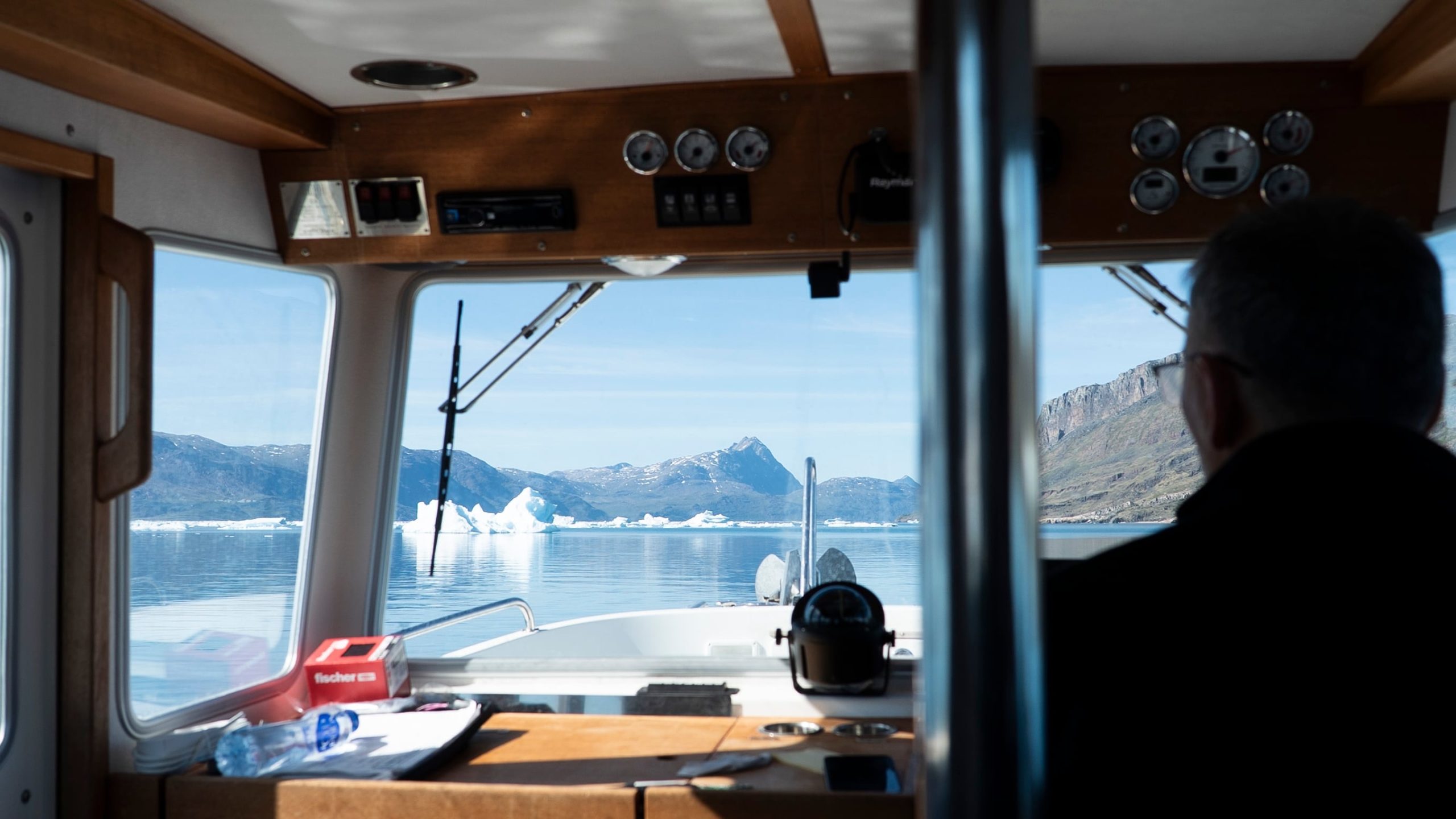
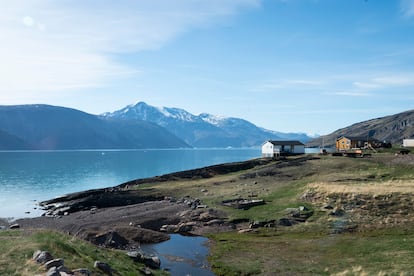
The consequences of the airport’s closure and the specter of a U.S. return are also felt across the fjord. Although less than two miles apart, Qassiarsuk and Narsarsuaq belong to different worlds. Even though crossing that stretch of water takes barely 15 minutes, ice buildup, strong winds, or dense fog can cut communication between the two shores for days. Qassiarsuk stands on the remains of the farm where Erik the Red settled at the end of the 10th century after being exiled from Iceland. There he named the territory Groenland (green land, in Old Norse) and laid the foundations for Viking colonization.
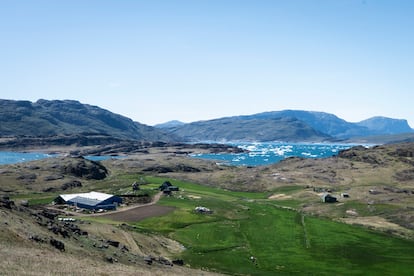
Far from the classic frozen image, Qassiarsuk dazzles in summer amid hills of intense green dotted with houses painted bright red, yellow, and blue. Although the village has barely 50 inhabitants, it is one of Greenland’s main livestock centers. This activity, like agriculture, is concentrated almost exclusively in the strip of the island south of the Arctic Circle.
A five-mile path leads to Tasiusaq, where a single family keeps the farm and the guesthouse running. There, Aviaja Lennert and her son’s fiancée bustle in the kitchen to prepare dinner for a pair of German guests who are about to arrive with their backpacks after more than two hours walking from Qassiarsuk. Getting around the island requires patience: without roads connecting settlements, transport depends on boats and helicopters, and when water is not involved short trips are made in a buggy, by snowmobile, or on foot. To replenish energy after the walk, the hosts have prepared a menu that includes homemade bread, fish soup and roasted lamb with local potatoes and wild herbs they gathered themselves. For dessert, rhubarb compote.
Lennert divides her time between tending the farm’s 600 sheep, looking after travelers, and teaching the few children at Qassiarsuk’s school. Despite her efforts to diversify income, the family faces a precarious period after the airport’s closure. This summer they have received far fewer guests than in previous years. Now another concern has resurfaced that Lennert thought had been banished: mining, a latent threat capable of ruining the natural resources on which their livelihood depends.
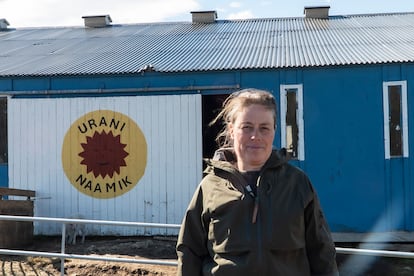
Her farm is near Kvanefjeld, a deposit that holds one of the world’s largest reserves of rare earths and uranium. Lennert thought that threat had passed five years ago when she tearfully celebrated the electoral victory of Inuit Ataqatigiit, the ecologist party that had promised to ban uranium extraction to curb Kvanefjeld’s exploitation. She was one of the most active voices in the Urani Naamik (No to uranium) movement, whose cheerful orange sun remains painted on the side of her barn. “It is very important for us to have healthy nature from which we can obtain our food,” she argues to explain her firm opposition to extractive projects that could contaminate the area. Today she worries about Trump — whom she refers to as “the unnameable” — both for his interest in controlling the island and for his desire for the immense wealth of its natural resources.
While Kvanefjeld remains blocked, Washington’s gaze has turned to another vast rare earth deposit a few miles away. Tanbreez hosts reserves practically free of uranium, so its exploitation is not legally prohibited. Aware of its strategic value, U.S. diplomacy maneuvered to prevent the project from falling into Chinese hands and facilitated its transfer to the New York firm Critical Metals. The operation has the firm backing of the Trump administration, which mobilized the state export-credit agency to inject up to $120 million, amid reports of investor interest linked to the magnate’s circle —including his son Donald Trump Jr. — in the mine’s development.
The U.S. president insists on keeping up the pressure. Although he toned down his threats from February onward, at the NATO summit held in July in Ankara he reiterated that the vast island “should be controlled by the United States and not by Denmark.” In early August, Trump posted an image on social media showing a giant figure of the president looming menacingly over a settlement in the Arctic territory, accompanied by a terse message: “Hello, Greenland.”
Last week that extractive voracity ran up against the island’s regulatory wall. The Greenland government ordered the postponement of a controversial oil exploration project in the territory’s east led by Greenland Energy, a Texas-based firm linked to Trump’s circle. The company, which had moved the necessary equipment, intended to start drilling without the required permits, prompting a “serious warning” from local authorities.
EU seeks to strengthen its influence
Faced with Washington’s advances, the European Union is trying to stake out ground and strengthen its influence in the Danish autonomous territory. Barry Andrews, an Irish MEP and the European Parliament’s rapporteur for relations with Greenland, calls for a common front and warns against the White House’s ambitions. “We must make it clear to the Trump administration, again and again, that Greenland’s sovereignty must be respected; we cannot trust the United States anymore,” he stresses by email. Andrews is pushing to double European investment in the island to €500 million in the next budget framework.
Along the same lines, Danish MEP Christel Schaldemose, a vice president of the European Parliament, advocates “investing more and creating better development opportunities.” The social democrat stresses by phone that the EU should be the island’s preferred partner, while always respecting that decisions about resource extraction and the future of mining rest exclusively with Greenlanders.
That right to decide is what led the southern community to mobilize en masse against the Kvanefjeld mega-project when, five years ago, they felt their way of life threatened. In that civic resistance Inga Gísladóttir played an active role, an unusually multifaceted professional — social worker, IT specialist and air traffic controller — who also travels the world as a narrator of Norse mythology. Born in Iceland, Inga has just completed 15 years in Greenland and has returned from three months in Qaqortoq training controllers for the new airport.
Her stance on the geopolitical scramble for the island’s resources is categorical: “Just because this is a vast, sparsely populated land does not mean anyone can come and take it over; it belongs to those who want to preserve it.” In a matter of days she will leave Narsarsuaq, unsure where she will go next. After returning from a walk to see for the last time the glacier that looms a few miles from the village, Gísladóttir brushes away mosquitoes as she evokes the deep Inuit connection to the land: “Here the relationship with nature is not extractive; it is not seen as something to profit from, but as a heritage we must enjoy and preserve for future generations.”
Sign up for our weekly newsletter to get more English-language news coverage from EL PAÍS USA Edition
America
Estados Unidos Deporta Al Reino Unido A Milo Yiannopoulos, El Activista De Ultraderecha Que Defendía Redadas Masivas


Donald Trump
The Real Reason Trump And Spain Are At Constant Loggerheads, According To Leading Expat Geopolitical Analyst

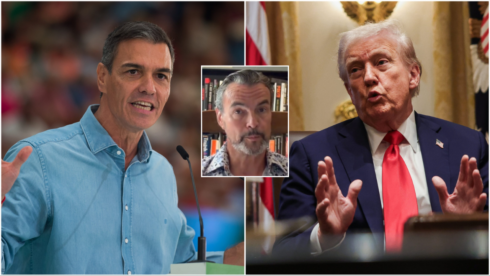
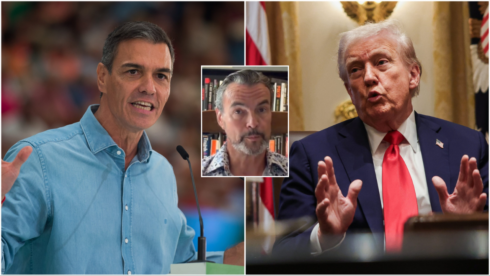 LEADING geopolitical expert Richard Cowl unpacks the reason why US president Donald Trump has targeted Spain in recent months.

The ‘new Era’ Of Latino Socialists In New York: ‘If The Democratic Party Wants To Lead, It Must Create A Solution To The Immigration Problem’

Portuguese Man O’ War Warning

Eight Dead, 20 Missing After Cyprus Ferry Sinks
Make a small donation at Miramar shopping centre and transform a child’s first day back at school

How To Get A Tourist Rental Licence In Andalusia (Spain) – Step-By-Step Guide 2025

Family Of Former Mexican Federal Police Officer Killed On Ukraine Frontline Faces Agonizing Wait For His Remains


-
back to school2 weeks ago
Make a small donation at Miramar shopping centre and transform a child’s first day back at school
-
 New Developments2 weeks ago
How To Get A Tourist Rental Licence In Andalusia (Spain) – Step-By-Step Guide 2025
-
 ElPais2 weeks ago
Family Of Former Mexican Federal Police Officer Killed On Ukraine Frontline Faces Agonizing Wait For His Remains
-

 Uncategorized1 week ago
How Kimi Antonelli saved Red Bull as Max Verstappen signs blockbuster F1 deal
-

 Ceuta2 weeks ago
Hundreds Of Migrants Left In Ceuta After Mass Border Crossing Stage Protest To Demand Asylum From Spain – ‘I Don’t Want To Return!’
-

 BCE2 weeks ago
Los Precios De La Energía En Europa Volvieron A Escalar Por Encima Del 10% En Julio
-
airports in Spain2 weeks ago
British families flying between UK and Spain given fresh EES warning for under-12s
-
Alicant2 weeks ago
British pub giant bans loud phone videos and calls, should bars in Spain follow?