
Caracas
The Opposition Returns To The Streets In Venezuela After María Corina Machado’s Return: ‘She’s Coming To Step On The Accelerator’

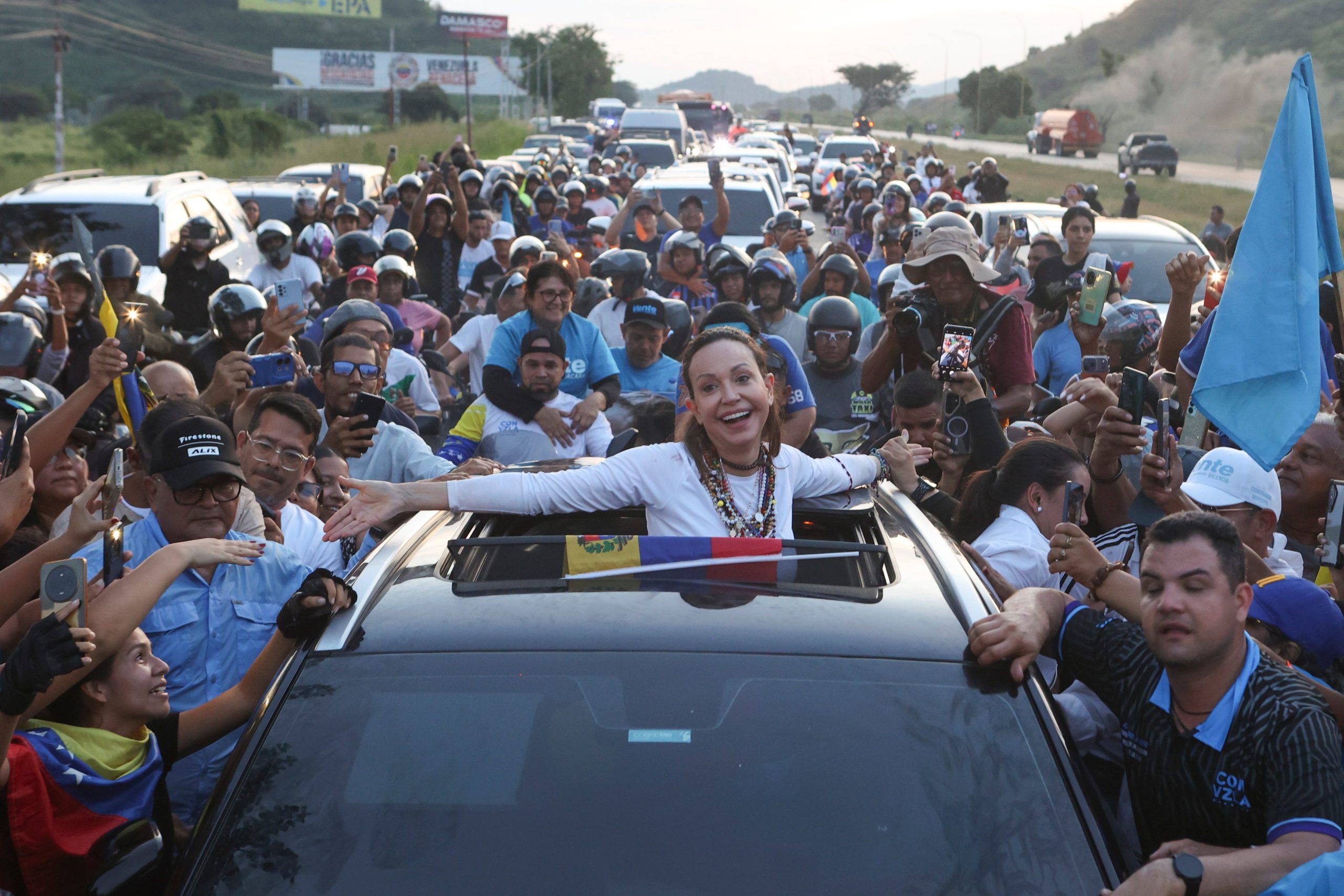
It was a long and emotional day for thousands of Venezuelans who could not believe it when they heard on Sunday morning that the opposition leader María Corina Machado had returned to Venezuela. When her message started circulating on cellphones — “I am here. With you.” — thousands of supporters of Machado and opponents of Chavismo began pouring into the streets to follow her slow march to the capital, Caracas, in an epic demonstration of Venezuelans shedding the fear of repression that had been holding them back for so long.
Machado, who reportedly entered the country via Colombia, took over 10 hours to reach the capital, flanked by enthusiastic supporters who surrounded her vehicle. The opposition leader did not make any statements, but her mere presence on the streets was enough to drum up enthusiasm among a population that is anxious for change following the U.S. invasion and capture of Nicolás Maduro in January.
Speaking from the United States, President Donald Trump said he didn’t know anything about Machado’s return to Venezuela. “I don’t know anything about it, but I think she’s a very nice woman. She gave me her Nobel Prize, so how can I say anything else? And I hope she’s safe, she’s a very nice woman. But we’re doing really well in Venezuela,” he said before a trip to speak at a campaign rally in Michigan.
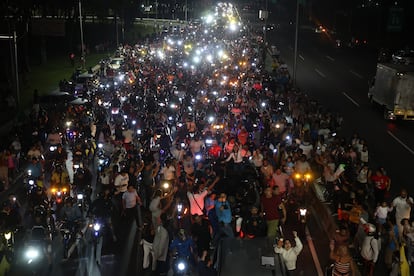
Machado was received by thousands of people in Caracas. The crowds filled up several lanes of one of the country’s main highways as people danced, honked their horns and waved flags. The news had been a surprise to everyone. For many, it was a sign of hope in a year of change and perhaps the beginning of a political transition that is dragging on.
Opponents who follow Machado hope the process that began with the dialogue table between the members of the 2015 National Assembly and the interim government can now be accelerated. “Machado is coming to step on the accelerator,” said some of those who were waiting for her. Seferino Guadarrama, 64, a leader of Vente Venezuela, Machado’s party, says he cried when he learned Sunday morning that his “boss” had returned. A granddaughter who joined Machado’s caravan called him from Yaracuy to tell him. “Dinorah [Figuera, an exiled lawmaker who was part of the 2015 Assembly and was recently tapped to negotiate with Chavismo] was moving too slowly,” the activist says. He is celebrating this political milestone far from his town because a year ago he had to hide from political persecution.
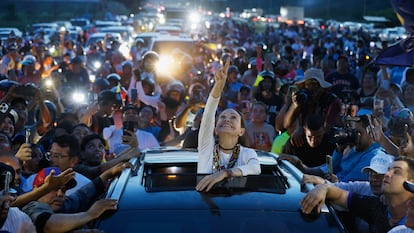
Hundreds of supporters gathered very close to Fuerte Tiuna, where Nicolás Maduro and his wife Cilia Flores were captured on January 3 during the United States’ Operation Absolute Resolve. That day, celebrations were muted by fear and uncertainty. People now see Machado’s return as an opportunity for an extended celebration. The atmosphere was one of jubilation and hope. “They had us cornered, unable to take to the streets,” Guadarrama says.
At least two lanes of the Valle-Coche highway, which serves as the city’s access from the country’s west, were filled with people, motorcycles and parked vehicles. Drivers passing through, including cargo trucks, joined the celebration by honking. People also gathered on the bridges adjacent to the road.
The enthusiasm of thousands of Venezuelans mixed in with all the questions regarding her return, and the surprising silence from the government, led by Delcy Rodríguez at the behest of the United States. The street celebrations were not met with repression; on the contrary, the sense of freedom was one that had not been felt for years. Machado advanced on the capital in a clear challege to Chavismo and even to Washington, which had sidelined her in the talks between the government and the opposition.
Marisol Morgado, a 64-year-old homemaker, came from the other side of the city to see the leader’s return; Machado had left the country clandestinely last December. “It took me by surprise,” the woman said, holding a flag. “She’s coming to organize it all, to get things working. There are a lot of people who are suffering,” she added, referring to the transition process.
Some political leaders also joined the gathering. Héctor Urgelles, secretary of Alianza Bravo Pueblo, a party that is allied with Machado’s, was among those who showed up. “A government’s legitimacy is only achieved through an election. That is why María Corina is coming,” said the politician, noting that people have lost their fear of returning to peaceful protest for change. “Things have changed a lot since January 3 and now we can be in the streets again,” Urgelles added.
Loredams Medina, 36, a resident of El Valle, ran out of her house because she wanted to see Machado. As the hours passed, the crowd grew and supporters began to occupy the highway in both directions. The woman was surprised to see such a large opposition demonstration in the west of the city, in the same parish where Maduro began his political career. “I’m very happy; I have the hope that she’s going to speed everything up,” Medina says. By “everything” she means the tasks of the dialogue table, such as appointing the Supreme Court, the new National Electoral Council and calling elections. “But I also feel uncertain about what will happen.”
Sign up for our weekly newsletter to get more English-language news coverage from EL PAÍS USA Edition








Alex Saab
A White House Feud With A Turkish Twist: A Whirlwind Romance, A Trumpist Wedding And Missing Millions

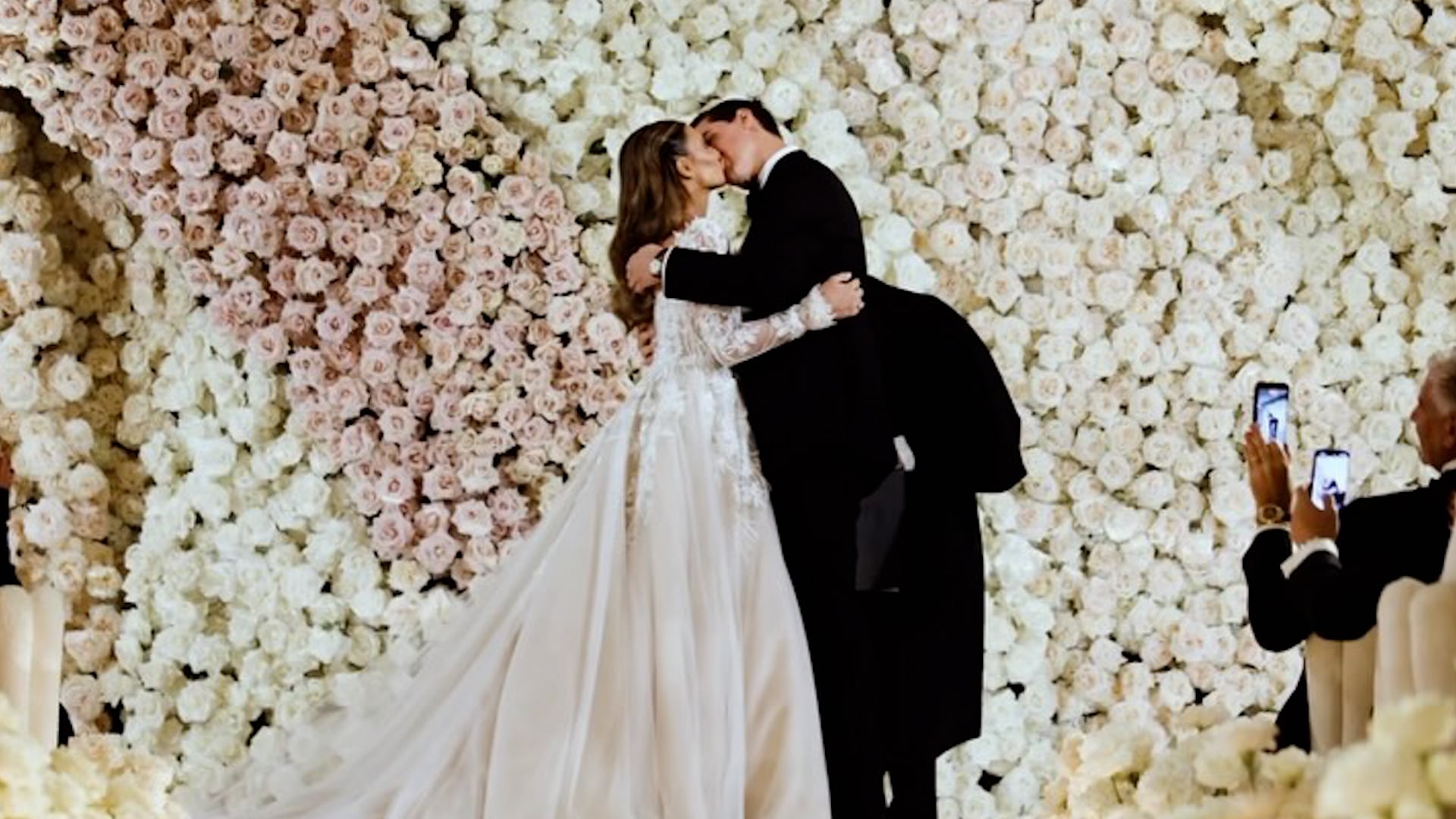
About 900,000 fresh flowers hung from walls, columns and ceilings; there were tins of caviar for each guest, Dom Pérignon, three wedding dresses and a 30-piece orchestra. The Waldorf Astoria ballroom in New York hosted a wedding in September that was put together in under three months and cost around $10 million, according to the U.S. media. It was the week of the United Nations General Assembly, with Manhattan full of heads of state and diplomats, and the party drew major figures from U.S. power circles, oligarchs, Congolese politicians, the rapper Nelly on stage, and even former boxer Mike Tyson. But above all the celebration brought together the top ranks of Trumpism: the attorney general Todd Blanche; the FBI director Kash Patel; and White House counsel Will Scharf. It was a MAGA wedding for the glossy magazines.
The hangover from that party has passed, but the couple has been dominating headlines for more than a week. No longer so much for their lavish wedding as for their connections and, above all, for the bitter fight that has erupted after this fairy-tale union. The bride, Alina Habba, 42, was once Donald Trump’s personal lawyer. The groom, Turhan Mildon, who says he is 29 — although some documents list him as being 25 — is a Turkish investor who did business in Venezuela thanks to Alex Saab, former president Nicolás Maduro’s front man. The couple met in late 2025 at Washington’s Kennedy Center and began dating in early 2026. And into this brief romance stepped an old friend of the couple, Richard Grenell, former U.S. special envoy to Caracas — which now explains why no one invited him to the party.
What might read like a Turkish soap opera is, at its core, a fight over Venezuela. Weeks after the wedding, on October 9, Habba entered the Oval Office to accuse Grenell of making millions of dollars transferred by her newlywed husband disappear. She did not pick an ordinary day: it was one day after The New York Times sent her husband a series of questions about his businesses in Venezuela.
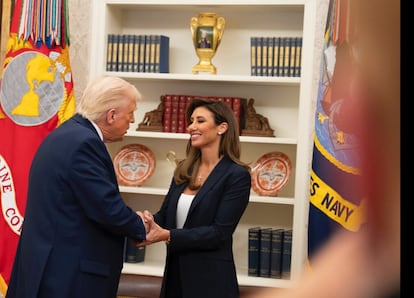
Habba’s account, according to Axios and the Times, is that in the spring of 2025 Grenell persuaded Mildon to transfer $17.6 million to TX-AT, a Texas security and defense firm for which Grenell worked as a consultant in 2024. The details of the deal behind that transfer remain unclear, but Axios reports thatGrenell sent a message promising that the investment would be rewarded with access to the U.S. president, VIP events and administration officials. Of that total, $5.6 million was meant to be used as a donation to the Kennedy Center, which Grenell was then running, but the money never arrived.
The tangle has grown in recent days. The money transfer, The New York Times reports, did not actually come directly from Mildon but from an account linked to the government of the Democratic Republic of Congo, whose president had hired the Turkish businessman as an adviser. Grenell calls the whole thing absurd, denies the messages and says he never received a cent from Mildon.
The struggle over Venezuela
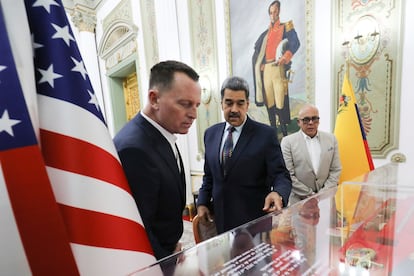
The plot goes beyond Washington power squabbles and exposes two men who tried to profit from the U.S. push against Chavismo and were swept up by Maduro’s fall. On October 12, The New York Times published a piece laying out the first details of the dispute that was about to erupt. It linked the Turkish investor to Saab’s front operations and reported that in June the interim president of Venezuela, Delcy Rodríguez — the same official who handed Saab over to Washington — had ordered the freezing of Mildon’s contracts in the country. Rodríguez cited failure to meet investment goals, but the punishment, the Times reports, did not last long. The chavista leader reversed course as soon as she learned the name of the Turkish investor’s new bride.
The Kennedy Center’s starring role turns this story into a personal matter for Trump, who appointed himself chair of its board. U.S. media have revealed Trump had grown disenchanted with Grenell over a string of negative headlines about the institution. The president announced Grenell’s departure in March of this year, and earlier, in November 2025, Democratic senators had opened an investigation into him and the center’s leadership over cronyism and corruption, which Grenell denied. This time, Trump put the case in the hands of Will Scharf, his counsel, one of the notable guests at the wedding. Mildon’s lawyer handed over text messages and a transfer receipt. In one message from May 2025, Grenell allegedly said he wanted to make Mildon the U.S. face in Venezuela.
The formula for success
Mildon grew up in a small Turkish town near the Dardanelles Strait, where his family owned auto shops and gas stations. He summed up his formula this month to Forbes Turkey with a play on English words: previously the emphasis was on know-how, now it’s on know-who. He put that premise to use in 2021 by marrying the daughter of a construction magnate close to Turkish President Recep Erdoğan. Later, in the RDC — where in 2023 he began advising President Félix Tshisekedi — he obtained a diplomatic passport and won major public contracts. And in June 2025, just months after his divorce, Mildon became engaged to María Eugenia Ceballos, daughter of Venezuelan Admiral Remigio Ceballos, the entrepreneur’s spokesman told the Times. Ceballos was for years the operational chief of Venezuela’s armed forces, a man sanctioned by the U.S. for corruption and human rights abuses.
At the end of 2023 Mildon landed in Caracas and found his true godfather. Alex Saab had just returned from a U.S. prison after a prisoner swap with the Biden administration, and months later Maduro appointed him minister of industry, in charge of dealing with foreign investors. In March 2025, Saab awarded him the operation of the state cement plants. Months later, he handed him a shrimp business expropriated from its founder, who was jailed after being accused of financing the opposition. Mildon boasted to Forbes Turkey of producing 4.5 million tons of cement a year, three times the country’s total output according to figures seen by the Times. In June he visited a cement plant wearing chavista red and posed with his thumbs up, in a Trump-style gesture. His business group said in a statement there have been no cancellations of its contracts and that its business volume continues to grow.
Mildon not only did business with Saab but also tried to sell his virtues to Washington. According to The New York Times, he spent months trying to build ties between Maduro’s front man and Republicans in Trump’s circle. Several people who met Mildon before the autocrat’s capture on January 3 told the paper that he praised Saab and presented him as “the main power operator in Venezuela and the key to a peaceful resolution of the conflict with the United States.” The Trump administration even considered sanctioning Mildon, two people involved in those talks told the paper. His spokesman called that a “totally false and malicious rumor,” and a U.S. official also cast doubt that sanctions had been seriously contemplated.
Grenell, for his part, had positioned himself as the man of dialogue in Venezuela. In January 2025 the diplomat met with Maduro at Miraflores and returned with six freed Americans. He sold that as his great achievement, although behind the scenes there was also Harry Sargeant III, an American oil magnate who has been sidelined by Washington. For months Grenell argued that an agreement with Chavismo was possible, even opening Venezuela’s oil in exchange for Maduro remaining in power.
Mildon and Grenell were allies of the same cause and defended Chavismo’s survival, though their fates are now uncertain. The dialogue strategy ended up in a drawer in the Oval Office. Marco Rubio cornered Grenell, persuaded Trump to harden his stance, capture Maduro and select Delcy Rodríguez as successor. With January 3, both men lost influence, although Mildon’s fortunes have been radically altered by his romance with Habba. Love triumphed while also unleashing an internal war.
Sign up for our weekly newsletter to get more English-language news coverage from EL PAÍS USA Edition
Abelardo de la Espriella
Venezuelan Women Continue To Have Secret Abortions As Colombia Threatens To Close Its Borders To Them

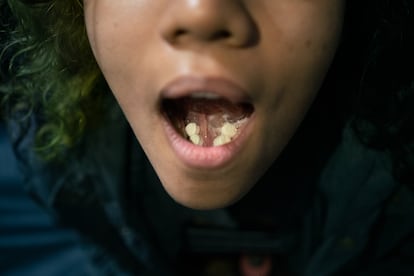
It is 2022. In a neighborhood in western Caracas, Yolanda (a fictitious name) walks through a checkpoint manned by hooded police officers. In her pocket, she carries a small transparent bag containing several misoprostol pills – the second part of the treatment recommended by the World Health Organization (WHO) for a safe medical abortion.
She walks quickly, without looking back. Any nervous movement could lead to her arrest. That package could land her in jail: in Venezuela, abortion is punishable by up to two years in prison, while assisting in an abortion could get you a two-and-a-half year sentence.
The country has changed a great deal since then, especially since U.S. forces captured Nicolás Maduro on January 3, 2026. However, women’s reproductive health isn’t on the agenda. Laws are being reformed at breakneck speed to exploit oil and gold, while Venezuelan women – who can only legally get an abortion if their life is in danger – continue to resort to clandestine networks.

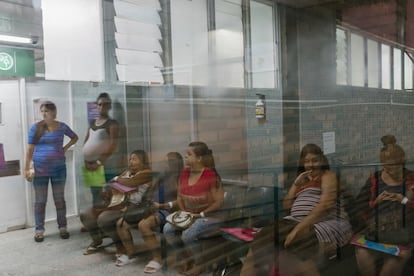
Oftentimes, not wanting a child is a matter of survival. “It’s not that I don’t want to be a mother. It’s that, right now, I can’t afford diapers, baby formula, or doctors. I just can’t,” Tatiana (a fictitious name) laments. She’s the recipient of the pills.
In almost one out of every three Venezuelan households, there isn’t sufficient income to even cover food needs. This is according to the 2025 National Survey of Living Conditions (ENCOVI).
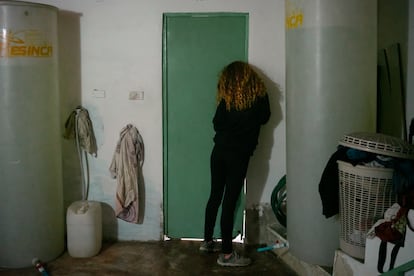
Tatiana, a 22-year-old dancer at the time, had already taken the mifepristone, the first part of the treatment. When she was speaking with EL PAÍS, she was taking the first dose of misoprostol. And, just 15 minutes later, she ran to the bathroom to vomit up what little she had eaten for lunch. Yolanda followed her, held back Tatiana’s curly hair and closed the door.
That house, narrow and full of stairs, hadn’t had running water for years. Next to the bathroom, a garbage can that had been converted into a 50-liter tank served as a place to get water to bathe, flush the toilet and brush your teeth. Yolanda asked Alberto, Tatiana’s partner, to boil some water. That way, he’d be able to keep his trembling hands busy.
In Venezuela, what happens in that room has been happening in secret for decades. In the latest survey conducted by the Venezuelan Association for Alternative Sexual Education (AVESA), in which 500 women took part, 5.1% admitted to having had a abortion by taking medication.
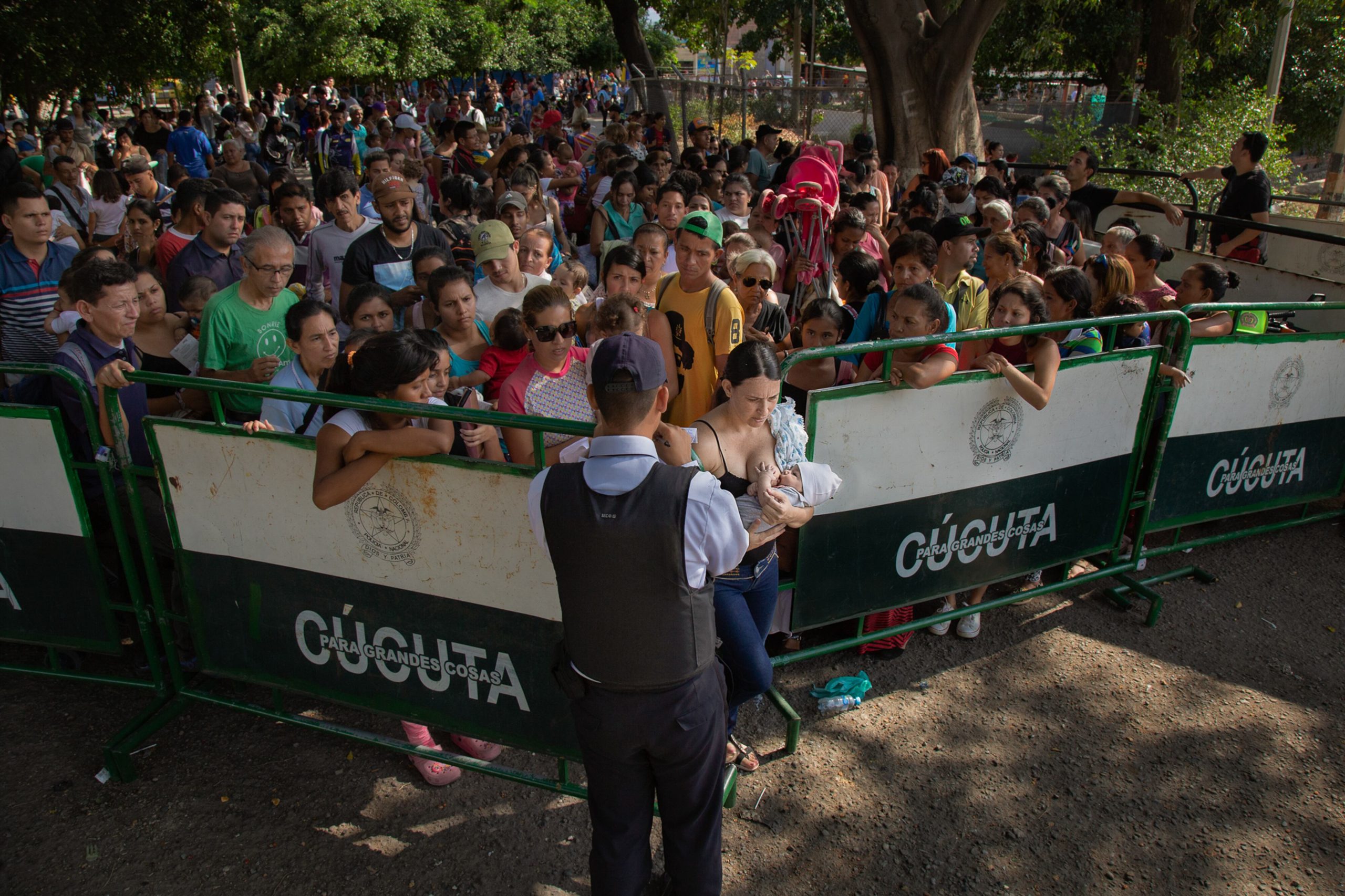
Women and girls with fewer resources buy the pills on the black market, where they’re often scammed. Wealthier women pay more than $800 at clandestine clinics in Venezuela. And others cross the border: in Colombia, abortion is legal up to the 24th week of pregnancy, even for migrants. But that door is threatening to close. This is due to a constitutional reform that seeks to prohibit abortion. Washington’s foreign aid cuts have also affected Colombia-based organizations that attend to migrants’ reproductive needs.
Four years after Tatiana’s procedure, abortion doulas continue doing the same work, now in a country with hospitals that have been overwhelmed since the double-earthquake of June 24. One of these healthcare aides is currently supporting a woman for whom carrying her pregnancy to term could be fatal.
On paper, this is the only case in which Venezuelan law permits abortion. But her doctor insists that she have the baby anyway. This woman hasn’t been able to get the pills. And, weighed down emotionally, she’s alone: her partner left her when he found out about the pregnancy. “Many men have opinions about abortion and [feel that they have the] right to make decisions about our bodies… but the truth is that many women are abandoned during pregnancy,” the support worker says.
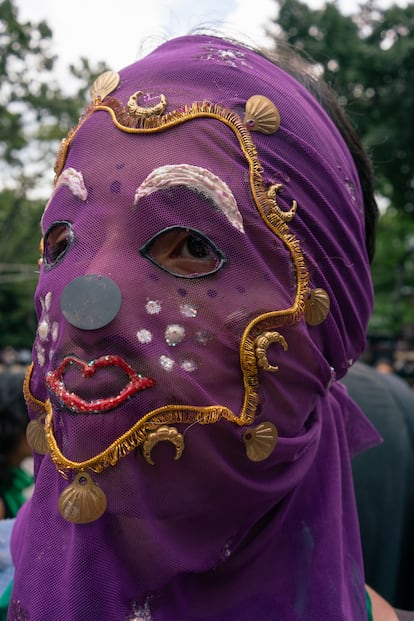
Daniella Inojosa – director of the feminist organization Tinta Violeta (“Purple Ink”) – explains that the existing exception that permits abortion in Venezuela “is practically nonexistent.” It only covers abortions that are performed by a doctor to save the mother’s life. It doesn’t consider her physical or mental health, and, since there’s no established procedure for applying it, it’s left to the doctor’s discretion. “This leaves women completely defenseless,” Inojosa points out. Only a few countries in the region such as El Salvador, Nicaragua, Honduras and the Dominican Republic are even more restrictive: they prohibit abortion without exception.
Suspicion also extends to miscarriages. “If you show up at a hospital with an ongoing miscarriage, [you’re automatically criminalized], based on the assumption that you’ve had an abortion,” Inojosa continues. She asserts that some women are imprisoned for having abortions, although her organization has no way of knowing how many.
The same Venezuelan Penal Code that ignores women’s health does, however, consider the notion of honor: sentences are reduced by between one-third and two-thirds if the perpetrator of a crime acts “to defend their honor” or – in the case of men – the honor of their wife, mother, sister, or daughter.
Heads of their households
The figures vary depending on the study, but more than half of Venezuelan households are headed by women. And, in these households, poverty reaches 80%, or 11 points higher than in those headed by men. “If I’m overwhelmed with unpaid care work, I don’t have time to have a paid job,” says Suzany González, a lawyer and executive director of the Center for the Study of Sexual and Reproductive Rights (CEDESEX). “The crisis has reinforced gender roles in relation to childcare and housework,” warns the researcher Laura Cano.
We go back to 2022. Inside the house, Tatiana’s contractions begin. Yolanda sits her on the toilet, so that she can expel the contents of her uterus. She repeats: “You can do this. You’re strong.” Tatiana moans. When it’s all over, the petite Yolanda carries her to the bed, even though Tatiana is much taller and heavier than she is.
Tatiana had someone by her side, but many other women face this ordeal alone. In Venezuela, there’s no recent official data to measure what’s happening to this population of women, although the last epidemiological bulletin – published in May of 2017 – recorded 756 maternal deaths in 2016, or 65.8% more than the previous year. And abortion was the fifth-leading cause of death. According to United Nations estimates, in 2020, 259 women died in Venezuela for every 100,000 live births, almost triple what the rate was in 2000. This was the largest increase in the world during that period of time.
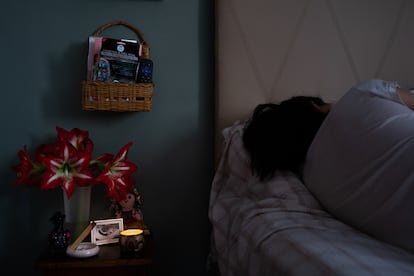
With Tatiana already in bed, Yolanda lights purple candles on the windowsill and prays. Not to the saints, as is customary in Venezuelan homes, but to her female ancestors. She opens the refrigerator, but there’s nothing to settle Tatiana’s stomach. Instead, she prepares a herbal tea, which Tatiana drinks while sitting up on her pillow, her eyes watering. Through the barred window, the candle flames and threadbare curtains sway in the breeze.
Praying to the ancestors runs counter to the wave of evangelization in the country, which various humanitarian crises have only served to intensify. According to Inojosa, since 2014, evangelical churches have become guardians of morality in Venezuela. And, she notes, “all the churches share a common fight against the legalization of abortion.” Without sex education in schools, information about contraceptives – including emergency contraception – barely reaches women and girls. This, according to researcher Laura Cano, “creates an atmosphere of secrecy and unsafe practices.”
The Colombian gateway
“While women living on the border face complex realities, they’re actually the fortunate ones in [Venezuela], because they can cross the border and receive care,” says lawyer Suzany González. Since 2022, a ruling by the Constitutional Court of Colombia has allowed voluntary abortion up to the 24th week of pregnancy. Additionally, health regulations guarantee abortion access to migrants. And, regardless of their immigration status, the authorities are not notified.
Even so, according to Cristina Rosero Arteaga, a senior legal advisor at the Center for Reproductive Rights, many women don’t seek care for fear of deportation, while some government entities along the border violate the law and even threaten them.
In Colombia, however, there’s now a new president, Abelardo de la Espriella, who opposes abortion. And there’s a constitutional reform being pushed by the pro-life bloc in Congress that seeks to protect life from the moment of conception. No previous attempt has succeeded, but pro-choice activists say that they’ve never felt such a reactionary wave before. And the pressure is also coming from Washington: according to lawyer Selene Soto, several organizations that attend to migrants have stopped offering abortion services since Trump reinstated the 2025 ban on U.S. funding to NGOs that perform abortions or provide information about abortion.
In Nariño, a Colombian departmento (state) bordering Ecuador that acts as a transit point for migrants, Yanni Caicedo, from the feminist organization Unidas Para Avanzar (“United to Move Forward”), explains that many Venezuelan women depend on the Catholic Church for support, because there isn’t a single public shelter for migrant women. And that same Church, she says, judges them: “They aren’t listening to those of us who are part of the Church because we’re having abortions… yet, at the same time, we [still believe] in God.”
Since many migrants are evangelical Christians, her organization’s members have trained in feminist theology, in order to speak to them from a faith-based perspective: “There’s a merciful Christ who would surely march with us on September 28,” she notes, referring to International Safe Abortion Day.
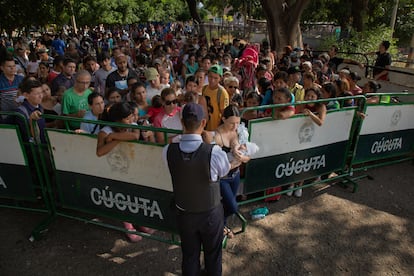
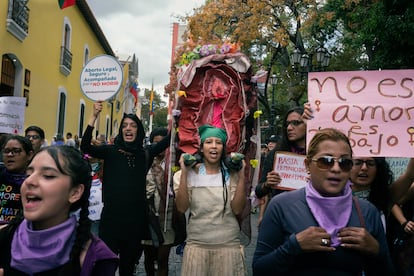
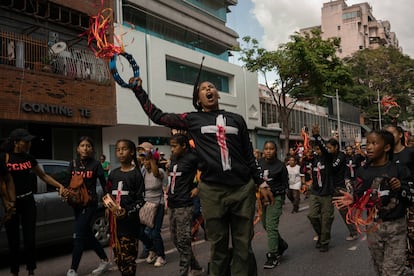
This past September 28, hundreds of women marched in Bogotá. In Caracas, a few dozen people gathered in the rain in Plaza Venezuela to demand the decriminalization of abortion.
Today, Tatiana is 26 years old. And she still dances. She believes that she made the right decision, although she admits to having “some pangs of a guilty conscience.”
“I’m grateful that I’m not a mother right now… especially after the earthquake. If everything was chaotic before, now, it’s even worse,” she sighs. “My God, if I can’t even take care of myself, imagine if I had to take care of someone else?”
What she remembers most about that afternoon is that she wasn’t alone… and, because of that, she didn’t end up “in a bad place.” Like the women Caicedo describes, Tatiana also speaks from a place of faith: “I’m grateful that my companion crossed my path. I know God put her there for me.”
Translated by Avik Jain Chatlani.
Sign up for our weekly newsletter to get more English-language news coverage from EL PAÍS USA Edition
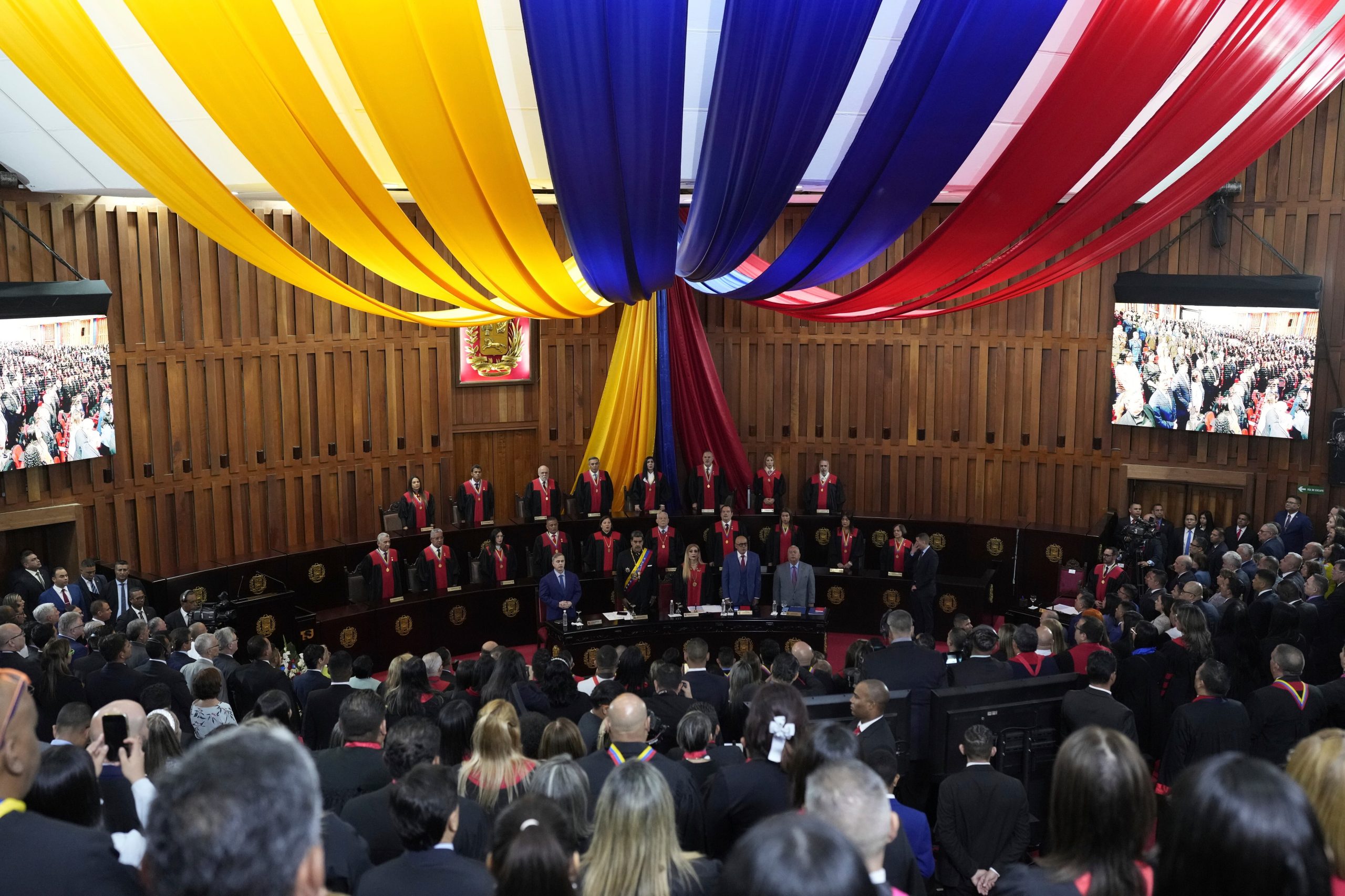
Washington has stepped on the accelerator to renew Venezuela’s Supreme Tribunal. It is its first major democratizing initiative in the country and the main task of the negotiation table between the 2015 National Assembly and the government of Delcy Rodríguez, which meets again this Wednesday. The goal is to have a new court by December, but beyond the outline the United States published last week, nothing is as yet known about the timetables, the profiles sought, the procedures to challenge appointments and how civil society will take part in a process crucial to a country that is supposedly moving toward a democratic transition.
Venezuela’s new Supreme Tribunal will be chosen through an unprecedented process. The United States is driving Venezuela’s return to institutional rule through a procedure carried out outside the Venezuelan Constitution. The path has been built from the U.S. State Department, which is closely monitoring the talks at the negotiating table.
This renewal process replaces the one Chavismo had launched months earlier in the National Assembly, chaired by Jorge Rodríguez, the same official who now leads the negotiations for the government side. That earlier procedure had evident flaws, such as changing the rules midstream. It was not clear how many magistrates would be chosen and the law was later amended to raise the number of seats on the Supreme Tribunal of Justice (TSJ) from 20 to 32 justices, which increased the number of vacancies. Before the June earthquakes more than 500 applications had been submitted for a single post. No decision has been announced on what will happen to credentials that had already been accepted.
The State Department announced the negotiating round amid the emergency caused by the earthquakes, and its first agreement was to renew the Supreme Tribunal in full. Since then the design has been revealed in instalments. Last week, after meeting with Dinorah Figuera, the opposition’s representative in the dialogue, Washington reported that the negotiators had appointed a commission of seven jurists to verify applicants’ credentials. That advisory council will apply the first filter, but it is still unknown on what criteria, and from the list it approves the 32 new justices will be chosen.
The other cog of the mechanism, the Nominations Committee, will finish being formed this week. To the 11 deputies who already sit on it, with a Chavista majority, 12 civil society members will be added, though their characteristics, the timetable and procedural details have not been specified. The scale by which candidates for Supreme Tribunal justice will be evaluated is also unknown. “The credentials verification commission opens an opportunity, but it must be governed by transparency,” warned lawyer Magaly Vásquez at a forum organized by the Andrés Bello Catholic University. “It is necessary to know clearly and in advance its powers and that, once the call and selection begin, the rules of the game are not changed.”
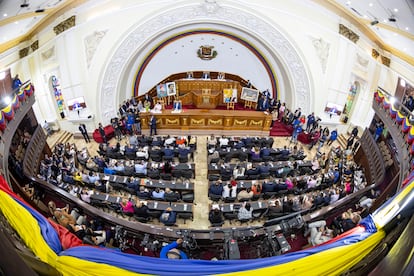
Among jurists and human rights defenders concern is growing over the haste with which the parties want to close a process full of loose ends, and one that will also serve as a template for the next one: the appointment of a new National Electoral Council, which is on the negotiators’ agenda. What is at stake is a true political transition, and for that reason every step is being watched cautiously while confidence in the process cannot be taken for granted.
At forums and meetings there is doubt that the opaque labyrinth of the judiciary can be transformed — a system that has become part of Chavismo’s repressive apparatus, where all judges are provisional, lack career stability and work under heavy pressure. Recent allegations by former magistrate Bárbara César Siero, who says she was coerced through the kidnapping of family members to sign rulings that disqualified opposition politicians (including the ruling against María Corina Machado), have exposed the courts’ lack of independence and the scale of the challenge this reform entails. Even deputy Pablo Pérez, acting vice president of the Nominations Committee, acknowledged this a few days ago: “Aside from the problem of partisan quotas that have been used in the powers, we also have judicial tribes.”
Human rights defenders have also issued warnings. “There will not be change or a political transition if minimum democratic standards for oversight are not met. Citizens do not have clear information about the process,” said activist Debora Van Berkel of the NGO Ideas for Democracy at a meeting of rights advocates on Tuesday.
The dilemma, various sectors say, is how citizens can scrutinize a process that the United States controls so closely. “The renewal of the judiciary is part of the political and institutional reordering, but we need it so that public powers are genuinely independent and useful to citizens,” said Óscar Murillo, director of Provea, who also emphasized the context in which it is taking place: “Venezuela is in an increasingly factual situation, it is outside the Constitution. And we are here because we want to return to the Constitution. There is a second element, which is the great influence of a key actor, the United States, which can say it is satisfied with the deadlines being set, which are not necessarily those of the people.”
Sign up for our weekly newsletter to get more English-language news coverage from EL PAÍS USA Edition

Motril’s Haunted Factory

Netanyahu’s Future Hangs In The Balance In A Decisive Election For The Entire Middle East
What Measures Are In Place In Spain To Help People With Autism?


-

 Uncategorized4 weeks ago
F1 Bahrain Grand Prix will be live and FREE on TV this weekend
-

 New Developments4 weeks ago
How To Get A Tourist Rental Licence In Andalusia (Spain) – Step-By-Step Guide 2025
-

 New Developments3 weeks ago
Luxury Villas For Sale, Estepona – ProjectL1
-
Blackout preparedness4 weeks ago
Brussels takes action against Spain over failure to update blackout plan
-
EU3 weeks ago
EU nicotine crackdown sparks warning that ex-smokers could be driven back to cigarettes
-

 Uncategorized4 weeks ago
Lewis Hamilton F1 wish could come true as stunning plans for new track revealed
-
 Housing access / crisis / affordability4 weeks ago
Radical Housing Decrees Defeated As Snap Election Talk Grows
-
British tourists arrested in Magaluf3 weeks ago
British tourists arrested after taxi driver left bloodied in Magaluf