
ElPais
The Øresund Strait, The New Frontier In Russia’s Hybrid War Against NATO

The port and ferry terminal in Helsingborg are bustling with activity. Everything operates with an almost choreographed efficiency. Ferries maneuver slowly; refrigerated trucks wait their turn to board alongside cars, cyclists, and workers who cross the Øresund Strait as if taking a commuter train. After all, only 2.5 miles separate Swedish Helsingborg (population 114,000) from Danish Helsingør. From the waterfront, under the oblique light of northern Europe that lengthens the evenings over the water, the strait is so narrow it is hard to see it as a strategic border. But that maritime line, which looks ordinary on maps, is today one of the flashpoints between Russia and NATO. It is the setting of a gray, hybrid war of maritime sabotage and ghost ships.
The Øresund Strait, also known as the Sound, is one of three gateways from the Baltic Sea to the Atlantic Ocean, along with Denmark’s Great Belt and Little Belt. That means every vessel entering or leaving the Baltic — cargo, energy, oil, data cables, or military — passes through this corridor.
For centuries, controlling Øresund meant controlling access to the Baltic, says Per Svensson, 62. Tanned from his morning walks, he downs a black coffee in a café near the Helsingborg ferry terminal as he recounts working for two decades on the port’s ships. Now he likes to sit and watch the ferries and freighters coming and going — and read about the region’s history. “These waters have always been ordinary to us, not a border. Now everything seems to have changed,” he says, pensive.

Historically, these straits were a source of power and wealth for Denmark, which for four centuries collected maritime tolls. In post–Cold War Europe, that geostrategic significance faded somewhat under decades of Nordic integration, short ferry crossings, and weekend tourism. There are no tolls today. But the strait’s old strategic importance has returned forcefully amid Russian efforts to move the hydrocarbons that fuel its war against Ukraine.
In 2025, Nordic authorities verified the passage of at least 292 vessels linked to Russia in the region. Ships that left Russian Baltic ports transited Øresund or the Great Belt to the North Sea and from there to the Atlantic. From the terrace of the luxury Clarion hotel in downtown Helsingborg, where NATO foreign ministers met last week, you can see those vessels almost every day, says Sweden’s Foreign Minister Maria Malmer Stenergard.
They look like ordinary ships, but beneath a dense layer of bureaucracy they are part of what is called the ghost fleet, or shadow fleet, Malmer Stenergard says. These are aging vessels with opaque ownership structures designed to make them hard to trace, flying flags of distant countries that change frequently — ships the Kremlin and its orbit use to move hydrocarbons. It is their way of evading Western sanctions over the war in Ukraine.
Intelligence reports have also recently documented that many of those ghost ships carry armed contractors on board whose job is to protect the cargo, and who give those vessels a military aura. “You cannot prove they are Russian military, but there is evidence they are linked to paramilitary companies with ties to the Kremlin,” a Swedish official says.
Russia’s war against Ukraine, which shook Europe more than four years ago and changed its landscape and mindset forever, produced a structural shift in the Nordic region that today, under the Kremlin threat, has been hardened. The invasion ordered by Vladimir Putin pushed Finland and Sweden into NATO. Both Nordic countries provide the Alliance with invaluable strategic and geographic capabilities. Their accession, together with the existing membership of Estonia and Denmark, changed the Baltic’s standing. With the exception of the Russian exclaves of Kaliningrad and St. Petersburg, it became an allied sea — almost a “NATO lake,” as experts put it. That raised the value of strategic points such as Helsingborg.
Conflict in the shadows
Far from being placid, the Baltic is now one of the primary laboratories of Russia’s hybrid warfare, says Elisabeth Braw, a researcher at the Atlantic Council’s Transatlantic Security Strategy Center.
There are no fleet battles or classic naval engagements. The Kremlin uses more ambiguous tactics, such as sabotage or damage to maritime infrastructure, interference with navigation systems, manipulation of AIS signals, covert operations that are hard to attribute, and espionage activities.
And at the heart of that hybrid war is the ghost fleet. “Russia has discovered these ships can be used for more than moving oil — to cause damage in the Baltic — so they are exploiting them,” warns Braw, who has extensively researched the Kremlin’s hybrid warfare.

Moscow has found it can inflict substantial damage without using military forces. There is also an environmental risk from those decrepit tankers carrying Russian hydrocarbons. Since October 2023, authorities in the region have recorded at least 11 significant incidents of damage to submarine cables — mainly telecommunications and power lines; some incidents involved gas pipelines and other critical infrastructure, according to an Estonian intelligence report. Although most investigations have not officially attributed the incidents to the Kremlin, several of the most serious cases have involved vessels linked to Russian ports or the ghost fleet.
Ships such as the Fitburg, detained by Finnish authorities in December 2025 after being implicated in damage to telecom cables between Finland and Estonia. The freighter was sailing under the flag of Saint Vincent and the Grenadines, had departed St. Petersburg, and was found with its anchor down in Finnish waters — a pattern that bears a strong resemblance to the Russian shadow fleet.
Thus, Helsingborg, a bottleneck of the Baltic, has shifted from a peripheral, quiet place to an area under watch. The small southern Swedish port city and the Øresund Strait are now part of the Atlantic defensive architecture.
Maritime law establishes that vessels that appear linked to the Russian ghost fleet have the right to sail. And unless there is evidence of environmental risk, illegal fishing, or another crime against maritime traffic, Swedish, Danish, Estonian, or Finnish authorities have limited room to act.
A few months ago, however, the Swedish government enacted a legal change that expands the Coast Guard’s powers to request insurance information and to monitor ships merely transiting Swedish territorial waters and even Sweden’s Baltic exclusive economic zone. “We are not at war, but we are not at peace either,” Prime Minister Ulf Kristersson has said.
Back at Helsingborg’s port, whose terminal almost fronts the terraces of waterfront restaurants and cafés crowded under the May sun, Karin Akerman says she is “a little worried.” The 55-year-old teacher has two teenage grandchildren and fears the war may one day reach her waters. “We always thought we would never experience a conflict, but nothing feels safe anymore,” she says. Nearby, in a small square, two teenagers record a TikTok video. For a couple of days the town’s attraction has been the tide of police and military personnel deployed during the NATO meeting. “Nothing ever happens here. And I don’t think anything will happen,” one of them says.
Not far away, at various points along the Skåne coast, concrete bunkers built during World War II and expanded during the Cold War still face the Sound. For years they were historical, anachronistic remnants of a Sweden on alert when the Baltic was seen as a potential line of confrontation with the Soviet Union. Now, in a country that is continuing to militarize and which talks about submarine cables, maritime surveillance, espionage, and hybrid warfare, they make sense again to many.
Sign up for our weekly newsletter to get more English-language news coverage from EL PAÍS USA Edition






Abelardo de la Espriella
In The Final Stretch Of Colombia’s Presidential Campaign, Undecided Voters Are In High Demand

Donald Trump
Life In A ‘persecuted’ Migrant Community In Texas: ‘For Us, A Police Officer Is An Enemy’

Lidia and her family have become increasingly isolated at home as more neighbors are detained by local police or immigration agents. She used to walk for an hour every afternoon, going peacefully to the doctor, to do the shopping, or to take her mother-in-law to church. Not anymore. She doesn’t trust the police either: if she were in a car accident, she’d rather arrive home safely in the damaged vehicle. She lives in Colony Ridge, an immigrant neighborhood 40 minutes from Houston, which for years has been targeted by conservative politicians — including Texas Governor Greg Abbott — who consider it a magnet for undocumented immigration.
Since Donald Trump took office again in January 2025, for Lidia, those arrested in her community went from being someone’s acquaintance to being her own neighbors and friends. She recounts how the father of the family across the street was arrested and deported to El Salvador a few weeks ago; the house was abandoned as everyone subsequently left. Her neighbor on the corner was hit by a car on a nearby road and the police, instead of helping her, demanded her immigration papers and, since she didn’t have any, turned her over to Immigration and Customs Enforcement (ICE). Her 13- and 20-year-old children were left alone. A friend of her husband was also detained, and Lidia never found out if he got to try the goat meat she had just cooked for him.
“Now, when you see a police officer, you go around praying, ‘Lord, make me invisible to the enemy.’ We no longer see the police and think, ‘I’m safe.’ No. Now, for us, a police officer is an enemy,” says Lidia. That’s not her real name. She agreed to speak only under a pseudonym because she’s afraid of being recognized and detained by immigration authorities. Other residents of this community preferred not to share their stories for the same reason.
While she was talking, Lidia called a neighbor whose children were detained three days before Thanksgiving in 2025: one has already been deported to Mexico and the other has been held in an ICE facility ever since. “We had never felt like this: persecuted, harassed,” says the Honduran woman, who has lived in the United States for 13 years, 11 of them in Colony Ridge.
And she’s not just speaking for herself. Lidia says her six-year-old godson cries if his mother hasn’t arrived home by 4:15 p.m. “He’s heard the police are going to take his mom away. He starts asking where she is. It’s psychological trauma. This man [Trump] doesn’t see what he’s doing. Children have the right to feel safe.”

In January 2025, when Trump returned to the White House, Colony Ridge residents walked the streets or did their shopping without fear. They thought they couldn’t be arrested because they hadn’t committed any crimes. At that time, they believed Trump’s promises, the then-Republican candidate having stated during the 2024 election campaign that he would deport “the worst of the worst” — the criminals. They didn’t feel targeted.
However, as the months passed and they saw ICE agents, state police, and highway patrol officers stop them for any reason whatsoever — for having a burned-out taillight, for carrying tools in the trunk of the car, or simply for looking Hispanic — that feeling changed. Some families chose to keep their children at home, while others sent them to school in Ubers; American neighbors began buying for the undocumented immigrants; and some even sold their land or transferred it to relatives with legal immigration status so they wouldn’t lose it in case of deportation.
In June 2025, Alejandrina Morales, a resident of this community, summed up the neighborhood’s feelings: “We feel like we’re being hunted just for looking Hispanic.” Her husband was detained by ICE agents at his own tire shop, and after his release, she said he was never the same again.
The conservative view on Colony Ridge
The members of this community don’t call it Colony Ridge. That’s the name given to it by the media and the governor. Its residents — mostly families of mixed immigration status — refer to the six neighborhoods where they live, which have been developed by Colony Ridge Land LLC since 2013, individually: Grand San Jacinto, the first one built; Santa Fe, Camino Real, Rancho San Vicente, Montebello, and Bella Vista.
These are plots of land on the outskirts of Houston, in northeast Texas, cheaper than in the city, with access to basic services, and where owners can build homes — with restrictions — or park trailers. Lidia has lived in this community since 2015. She remembers that for years it was a safe place, where it was normal to see children playing in the street.
The fear now felt by this community — located in a county where 33% of the population is Hispanic, according to the 2024 Census — is well-founded. Along with Florida, Texas is one of the states most committed to Trump’s policy of mass detentions and deportations. According to ICE records, nearly 400 state police officers have cooperation agreements with the federal agency to hand over custody of those detained or arrested without legal immigration status. Three of these officers serve Liberty County, where Colony Ridge is located.
Governor Abbott himself has referred to this community as a “sanctuary” for undocumented immigrants, a concept he condemns. He has also taken direct action against them. In February 2025, he announced on social media that Colony Ridge would be “the target” of a joint operation between local and federal authorities to detain immigrants: 118 residents were arrested. Since then, the streets of this neighborhood look much like that day in February, some days with more officers and police, others with fewer, but they are always patrolling.
Furthermore, for the past three years, undocumented immigrants living in Texas, and in this community in particular, have felt the shadow of a law that would allow state authorities to arrest, detain, and deport them. This is the controversial SB 4. The implementation of this legislation — which has been described as one of the “most extreme” against immigration — has been blocked by the courts on several occasions. The latest setback came last week when a district judge in Austin blocked some of its provisions, ruling that they “conflict” with federal agencies, the only ones responsible for enforcing immigration law in the U.S. It remains to be seen what further legal action the state will take in its attempt to implement it.

This combination of realities is what makes Lidia and the Colony Ridge community continue to add restrictions to daily life: “We are tied hand and foot right now, hoping that God will take care of us.”
The ‘nightmare’ of deportation
Lidia says that in conversations with her neighbors there is a recurring theme: the deterioration of the mental and physical health of many of them as a result of stress.
She has high blood pressure. During a recent doctor’s visit, her doctor told her that her blood pressure was higher than normal. Lidia explained that it could be due to increased anxiety and fear that keeps her from sleeping at night.
“I have nightmares every day,” she says. “I’ve dreamt that we’re being chased and that later, when we’re in Honduras and want to go back, we can’t; that our relatives don’t answer the phone or that the phone doesn’t have our family’s numbers saved.” These dreams have taken her and her husband back to their childhood homes, which are no longer even owned by their families.
Lidia says the family doesn’t know what to do. Some days they wake up certain they must sell all their properties in the community and leave for Mexico or Honduras, where they are originally from. Other days they feel they should stay and wait for Trump’s remaining years in office to pass.
While they decide, she says she will continue to support her neighbors in any way she can. At the beginning of the year, she helped with a fundraising raffle to buy plane tickets for three children who were left alone after their parents were deported. She recalls donating about three more times, whenever she can.
Although they have lost a great deal over the past few months, Lidia is glad that this time has brought them one benefit: “A community that has learned to stick together more closely.”
Sign up for our weekly newsletter to get more English-language news coverage from EL PAÍS USA Edition

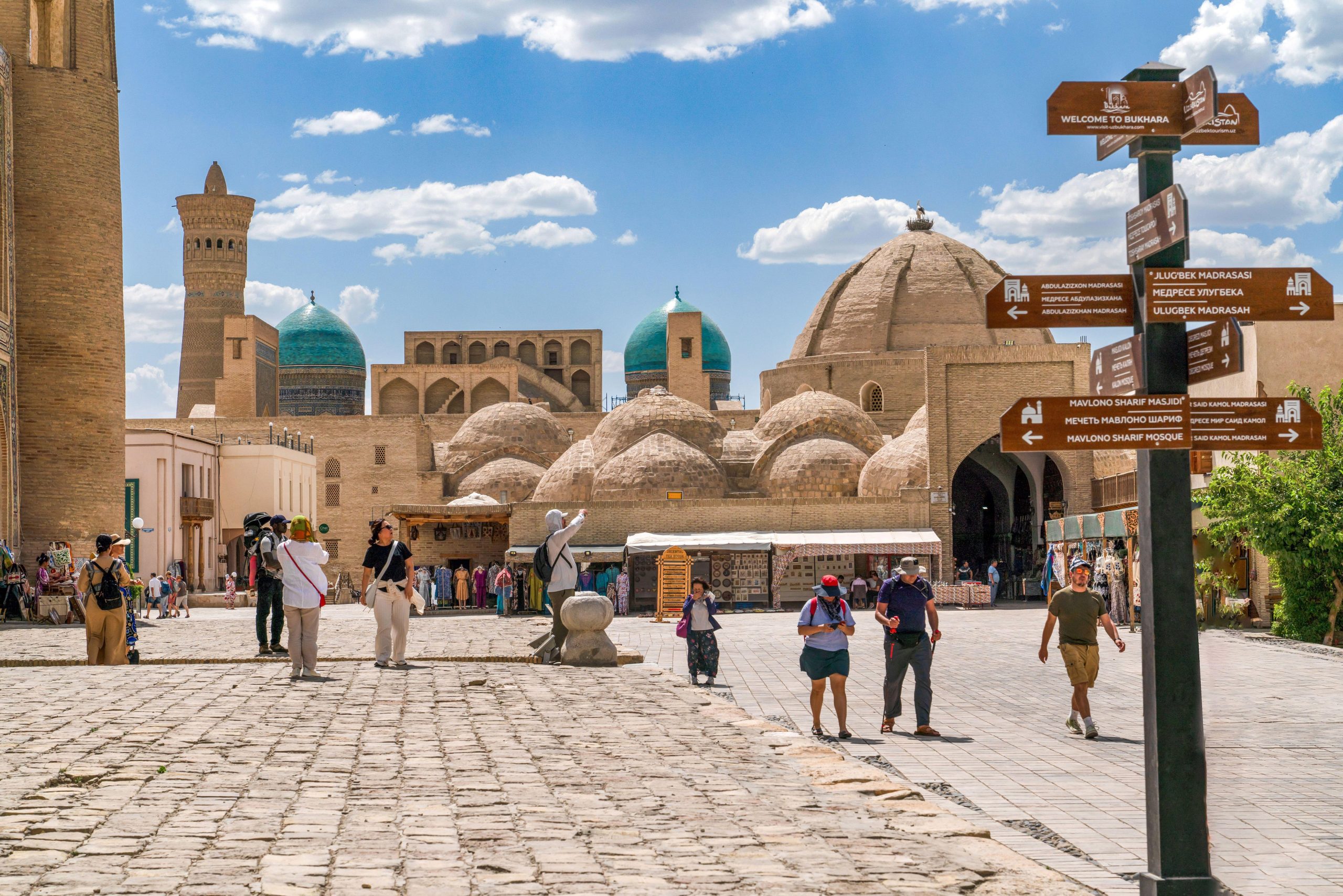
One nation and two contrasting cities whose differences tell the story of Uzbekistan’s DNA. This is what’s entailed by visiting Bukhara and Tashkent, from the golden age of the Mongol and Persian empires to the days of the Soviet regime.
Let’s begin with Bukhara, a city on the famous Silk Road, steeped in over 2,000 years of history. Its madrasas, mosques, turquoise tiles and domes, dating as far back as the 9th century, make it one of the best-preserved medieval cities in Central Asia. Its original urban fabric has been so well maintained that it has been a UNESCO World Heritage Site since 1993. The ancient Persian city served as a major center of Islamic culture for centuries, as evidenced by Lyabi Hauz (meaning “by the pond”), one of its central squares that was once bustling with commercial and religious activity. Shaped like an irregular polygon, it houses the Nadir Divan Begi Madrasa, a complex of low towers, arches, mosaics, and interwoven ornamentation that evokes a sense of stepping back in time. The khanaka (a place of relaxation and reflection for Sufis) near this complex is also named after the vizier Nadir Divan Begi.

Walking west, the distinctive 16th-century domes of Toki Sarrafon shelter one of the city’s must-see bazaars, surrounded by alleyways lined with restaurants, shops, and stalls. You must walk through it to reach the Khoja Kalon Mosque with its splendid minaret and the Khodzha Govkushon Madrasa, whose name alludes to the slaughter of bulls, as the site was a slaughterhouse almost until the 16th century when it was transformed into a madrasa. Equally impressive is Arq, the walled fortress that, in addition to its generous dimensions, is notable for its curved shape, so different from the linear design of the European standard. A few meters away, the Bolo-Hauz Mosque is equally memorable, as its name suggests, translating to “children’s pond,” with its colorful exterior courtyard containing 20 carved wooden columns. The Mausoleum of Ismail Samani, made of baked brick and equally beautiful, is located in a peaceful park just behind this religious monument, and houses the tomb of the founder of the Samanid dynasty.

Bukhara is beautifully illuminated at night, and one of the areas that benefits most from this is Po-i-Kalyan, the city’s most famous landmark and a must-see on any trip, with its spectacular madrasa and equally impressive mosque and minaret. Another domed covered market, Toqi Zargaron, is located nearby. A little further from the center, though a perfectly manageable distance, is the Chor Minor monument, whose splendid and distinctive four minarets represent the four cardinal directions. Built in the 19th century by order of a wealthy Turkmen carpet and horse trader, Caliph Niyazkul Bey, it is one of the city’s most unique sights.

The most striking aspect of all these buildings is that many of them become the venue for the Bukhara Biennial, a major arts event that, every two years, brings the most relevant contemporary artists to this location. The premise is very strict: every element of modernity must be perfectly integrated with local tradition so that the event is neither intrusive nor exclusionary for the local population. Renowned artists such as Subodh Gupta, Antony Gormley, Marina Perez Simão, and Louis Barthélemy have already exhibited their work here. The artists must conceive their works not only with the historical setting in mind but also create them in collaboration with local artisans. Fortunately for these artists, the city is rich in crafts: ceramics, tiles, puppets, textiles, pottery… The 2027 edition will run from September to November, a great time to visit the city because, in addition to the pleasant temperatures that this time of year guarantees visitors, the exciting art event fills the streets day and night with locals and foreigners, yet doesn’t prevent one from getting a sense of what the city is like under normal circumstances.
A unique architectural hybrid
In Tashkent, the country’s capital, the Rakhimovs — ceramic craftspeople who have maintained their family and artistic heritage for seven generations — have for decades run a workshop in a quiet neighborhood in the western part of the city. A seemingly unremarkable street hides a peaceful corner where one can discover the unique character of this type of applied art. It is a profession in Uzbekistan that is strictly passed down from parents to children, with each generation creating its own techniques and motifs to add another link to the chain that allows their legacy to continue.
“First, we learn the basic techniques and roots of this art from our parents and grandparents. Then we focus on creating our own designs, ideally reflecting the times we live in. Finally, we teach the younger generation before they become teenagers, because that’s when their imagination is at its peak. All of this happens in the same place,” explains one of the family members, a father and grandfather of ceramic artists, in the beautiful, light-filled courtyard of Rakhimovs Studio. To one side is the work area, where the creative tools, works in progress, and even those discarded during the trial-and-error process reside. This space, steeped in tradition, also displays the various artistic iterations of this dynasty of creators. Some of these pieces are for sale. But before entering the workshop, you must make an appointment through their website.
The works of some of their ancestors can be found in the State Museum of Applied Art and Handicrafts of Uzbekistan. The building itself is a spectacle in its own right. It is a former palace of a Russian diplomat, decorated inside by some of the finest muralists and woodcarvers. The audio guide included with admission is essential to understanding the story the museum tells. It contains more than 7,000 pieces of folk art created in different regions of Uzbekistan: pottery from Rishtan, traditional costumes and gold embroidery from Bukhara, knives from Chust, and more.
Uzbekistan was part of the Soviet Union until its collapse in 1991. As a result, the capital city is a hybrid that blends with Soviet modernism and brutalism. This is due to the earthquake that struck the city in the 1960s, which necessitated the reconstruction of many of its major structures. In fact, Tashkent is an open-air museum of this type of architecture, unlike any other city in the former Soviet empire.

The people who designed these buildings allowed something unique: breaking the minimalism of Soviet concrete with decorative elements characteristic of Islamic art. One of the greatest examples of this fusion is the People’s Friendship Palace, whose futuristic, screw-shaped elements at the top contrast with the traditional pandzharas, latticework typical of Islamic architecture. This nod to Uzbekistan’s Islamic heritage is even more evident in the State Museum of the History of Uzbekistan.
Another great icon of this architectural fusion is the Hotel Uzbekistan. This enormous building, constructed in the early 1970s, inherits the open-book structure of Moscow’s Cosmos Hotel. But, once again, a gigantic latticework with geometric shapes characteristic of the aesthetic seen in Bukhara (although, in this case, made of concrete) covers the building’s 17 floors. Its function is not merely aesthetic, as this design allows for the management of light and heat within the structure. On its rooftop, as befits a luxury hotel, there is a restaurant and cocktail bar with a large observation deck.

Underground, many of the capital’s metro stations boast interior architecture replete with chandeliers, marble, and colorful carved alabaster, exuding a splendor similar to that of the renowned Moscow Metro. This connection is particularly evident at Kosmonavtlar station, which any visitor will almost inevitably pass through, being one of the most centrally located.

One of the organizations driving change in the country is the Uzbekistan Art and Culture Development Foundation (ACDF), which, in addition to preserving, promoting, and protecting cultural heritage, seeks to place Uzbekistan on the map of modern world art. One of its ambitious projects is the reconstruction of the residential palace of Grand Duke Romanov, commissioned in the late 19th century by Nikolai Konstantinovich Romanov, the grandson of Russian Emperor Nicholas I. Exiled to the Turkestan region by his family, he lived in Tashkent until his death in 1918. He left a positive mark on the city as one of its great patrons of the arts, and fostered its development. For example, he financed the city’s first cinema (Khiva), built irrigation canals, and founded numerous companies. The impressive palace, a clear heir to European architecture, can currently only be admired from the outside; its reopening is not scheduled until 2027.

Sign up for our weekly newsletter to get more English-language news coverage from EL PAÍS USA Edition
The Øresund Strait, The New Frontier In Russia’s Hybrid War Against NATO

E

E


-

 Competiciones3 weeks ago
E
-
blackout April 20252 weeks ago
Insurance company Mapfre decides to pay out €14 million compensation for 2025 blackout
-
 Foreign demand3 weeks ago
Who Bought Where In The Second Half Of 2025?
-

 New Developments3 weeks ago
Stylish 3-Bedroom Apartment With Panoramic Sea Views – Benalmádena
-

 America3 weeks ago
E
-

 New Developments3 weeks ago
Luxury Villas For Sale, Estepona – ProjectL1
-

 New Developments2 weeks ago
Inside The Most LUXURIOUS Apartment Building In Spain!
-

 Holiday rentals4 weeks ago
Why Removing Tourist Lets Isn’t Fixing Spain’s Rental Shortage