
california
The Race For Los Angeles Mayor: Two Democrats Battle Over Housing, Affordability And The Olympics


In the race for the mayoralty of Los Angeles, the second-largest city in the United States, two things are certain: a woman will win, and she will be a Democrat. But with a high share of undecided voters and only days remaining before the election, it is still unclear whether Karen Bass will win another term or whether the progressive challenger Nithya Raman will take the post.
As in many other countries, Americans’ daily lives are shaped far more by local governments than by the federal government. Their streets, schools, taxes and housing depend on decisions made by their cities and states. That is why, on November 3, many voters will be watching not only the battles for control of the U.S. Senate and House of Representatives, but also key local contests that will shape the future of their communities. Los Angeles, the heart of California, is one such case where voters will choose their next mayor.
On one side is Karen Bass, 73, who was born and raised in Los Angeles. The first woman to hold the office in the city’s 250-year history, she is seeking a second and final term as mayor. On the other is Nithya Raman, 45, a member of the City Council, born in India and educated at Harvard, who represents the city’s 4th District. Her constituency includes such densely populated and diverse areas as the Hollywood Hills, the San Fernando Valley and the Santa Monica Mountains. If elected, Raman would become Los Angeles’s first mayor of Asian descent.
The two candidates have been colleagues and are both Democrats. Their approaches to governing are not dramatically different, which has only added to voters’ uncertainty. With less than two weeks to go before the election, more than one in five voters are still undecided.
Polls so far suggest Raman may have the edge over Bass, but with nearly 21% of voters still undecided, it is still too early to know how the race will unfold. The latest survey gives Raman an eight-point lead, 47% to 39%, while an average of the three most recent polls puts her ahead by five points.
Raman, committing to infrastructure
Raman is not well known nationally, and until a few months ago she was barely known beyond her district, which includes the indie and increasingly upscale Silver Lake, where Raman lives with her husband and twins. However, almost at the last minute, she decided to enter the mayoral primary held in June, running against Bass and another candidate, Spencer Pratt, a 42-year-old Republican from the MAGA world and a former participant in a youth reality TV show. Pratt ultimately lost the primary after a lengthy and slow vote count.

What Raman is proposing, and what appears to be resonating with voters, is simplicity: transparency and organization, qualities she argues are essential in a city of nearly four million people. The broader Los Angeles area, including other cities and parts of the metropolitan region, has almost 13 million residents, half of them Latino. Raman is running a campaign in which she promises to direct tax revenues toward improvements in the city that Angelenos can see and feel.
First, she wants residents to be able to afford to live in the city. Building is expensive and complicated because of lengthy approval processes and permit requirements. The median price of a home stands at $928,000, according to the real estate site Zillow. Raman says she will simplify and speed up those procedures from day one and create an office dedicated to helping tenants.
In a city where the car is king, she wants to revitalize major avenues and fill them with shops and restaurants. She has highlighted the revival of the iconic Hollywood Boulevard, which has fallen into decline. She wants clean streets, free of potholes, with good sidewalks and adequate lighting, promising even to create a map showing broken streetlights. She also wants fewer homeless people on the streets. Despite municipal efforts, numbers continue to rise: up 3.4% in the city and 1.2% in the county between 2025 and 2026. More than 73,000 people are living on the streets in Los Angeles, according to a city report.
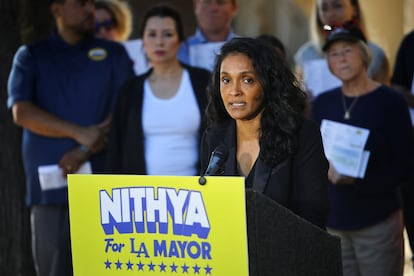
Raman also says that within her first 100 days she will hire more operators for the 911 emergency service, appoint a chief financial officer for City Hall (because the city currently has none), add a position to improve film productions in Hollywood, which have been leaving the city, and create a much-needed commission to tackle the problems facing Los Angeles International Airport, which has spent years waiting for the opening of its long-delayed automated people mover.
The 2028 Olympic Games are a central part of Raman’s platform, even though she opposed bringing them to the city not so long ago and remains skeptical about the mega sporting event set to arrive in 600 days. “I want the Olympics to succeed. But that cannot mean giving LA28 a blank check while Angelenos carry the risk,” she wrote in August on her X account, arguing that the private organizing committee, LA28, had reached “an irresponsible deal” with the city. For now, she will launch an initiative to plant 100,000 trees in the two years leading up to the Games.
Bass, by contrast, has been a strong supporter of the Games. In an interview with the Los Angeles Times, she called them “a once-in-a-lifetime opportunity to showcase Los Angeles to the world,” and argued the event is “a chance to deliver real, lasting benefits to our city and the people who call it home.”
Bass, under the shadow of homelessness and the wildfires
Beyond the Olympic Games, Bass says one of her priorities will be to push back against the mass immigration raids in a city that has been deeply affected by the hardline tactics of Immigration and Customs Enforcement (ICE) and that has repeatedly taken to the streets to protest U.S. President Donald Trump and his immigration policies.
Bass, who served in Congress from 2011 to 2022, including during Trump’s first term in office, says she will continue to fight as she did then. “The immigration raids may have left our daily headlines, but they haven’t stopped,” she told EFE.
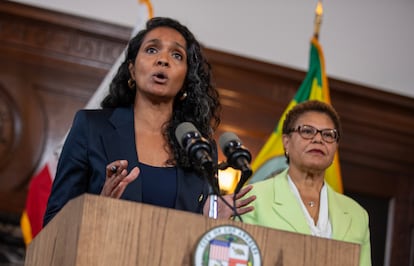
Housing is also central to Bass’s campaign. She argues that 10,000 homes have been built during her time in office, but since she was elected in November 2022, the high cost of living and the difficulty of finding affordable housing and well-paying jobs have caused the city’s population to fall. According to census figures, Los Angeles lost 54,000 residents between July 2024 and July 2025, the steepest population decline recorded by any major U.S. city.
In a state where costs are especially high, with gasoline prices reaching as much as $10 a gallon, Los Angeles is becoming increasingly unaffordable. Nearly one in 100 residents does not have health insurance, the poverty rate stands at 16% compared with 11% for California as a whole, and homeownership remains out of reach for many: only 36% of Angelenos own their homes, compared with 56% statewide, according to census data.
But the issue that has most overshadowed Bass’s legacy, and could weigh on her re-election bid, is the Los Angeles wildfires of January 2025. During some of the darkest days in the city’s recent history, fires tore through 16,000 hectares in Pacific Palisades on the west side and in Altadena and Pasadena to the northeast. Twenty-five people died and more than 11,400 homes were destroyed. Bass was criticized for being slow to respond because she was on a minor trip to Accra, Ghana. She declared a state of emergency remotely, returned after the fires had already erupted and, upon arriving at the airport, declined to answer reporters’ questions.

Although she tried to make amends by maintaining a visible presence at shelters and alongside victims after her return, many of those affected, especially residents of the Palisades, which falls within her jurisdiction, never forgave her. During a televised debate with Raman on October 14, Bass apologized.
“There’s not a day that goes by that I don’t think of the lives lost, the families that lost their home, and the families where the home is still standing but they’re not able to be in it,” she said. The mea culpa was necessary, but the political cost for Bass will not be known until voters deliver their verdict on November 3.
Sign up for our weekly newsletter to get more English-language news coverage from EL PAÍS USA Edition












Bernie Sanders
‘They Should Pay More Than The Poor’: The Battle To Make California’s Richest Give Up 5% Of Their Fortunes


Citadel is one of the most visited shopping centers in Los Angeles. But in these lean times, few customers browse its clothing, bag and shoe stores. On this hot October afternoon, Rocío López is here, treating herself to “a luxury” amid the cuts her family has made to blunt the impact every time they fill the car’s tank or do the grocery shopping. The pressure on her finances became clearer with her latest tax return: she and her husband were shocked to find they owed $8,000 to the IRS.
“The more you work, the more you pay,” says the Mexican immigrant, visibly angry, who lives in Garden Grove, 28 miles from Los Angeles. López believes the playing field is not level for everyone. She has a point: California’s wealthiest pay around 0.2% of their total wealth each year in state income taxes — about $3.2 billion — according to an analysis by the National Bureau of Economic Research.
With that inequality in mind, López, who became a U.S. citizen 15 years ago, recently voted in favor of Proposition 40. The measure would introduce a one-time tax of 5% on the total wealth of California tax residents whose net worth is $1 billion or more. Backers expect to raise about $100 billion, to be used mainly to fund the public health system that serves low-income people.
“They should pay more than the poor,” says López, who earns a living caring for people with special needs — work that, at the entry level, is often paid at minimum wage. “The rich take advantage of the situation, and that’s not fair,” she adds.

Proposition 40 is presented as a social-justice initiative intended to force billionaires who live in California to contribute more through the tax code, as some leading economists have proposed. But polls show the measure divides voters. Backers attribute that lack of consensus to an aggressive ad campaign funded by large donations from some of Silicon Valley’s wealthiest businesspeople, and to the absence of support from the Democratic establishment.
‘Five percent is very little’
Kaelynn Pérez, 19, studies medicine at the University of Southern California (USC). She learned about Proposition 40 through social media and says she will take time to hear both sides before voting. Although the young woman, who lives in Downey — a predominantly Hispanic suburb 13 miles southeast of Los Angeles — believes the wealthy should pay more into the tax system, she still has doubts about whether the initiative is well crafted and whether, if approved, it would benefit the community as much as it could. “Maybe it should be reworked and put on a different ballot,” she says.
“I think asking them to pay 5% is too little. There are a lot of people looking to make a lot of money from this, and that’s fine, but I don’t think it’s enough,” says the young woman, who is preparing to vote for the first time in a federal election.
Among the billionaires who could be affected by the proposition, the first who comes to her mind is Mark Zuckerberg, owner of Meta, the parent company of Facebook, WhatsApp and Instagram — the latter one of the social networks she uses most. “It would be good to put the rich in a position where they can help the community,” Kaelynn says. “I’ve never seen media coverage saying Mark Zuckerberg has donated X amount to students or given opportunities to people who need support,” she adds.
Polls show a narrow lead for yes on Proposition 40. Forty-six percent of voters surveyed during the second week of October said they backed it, versus 43% who opposed it, according to a Citrin Center–Politico poll. In mid-September, another survey by the Public Policy Institute of California (PPIC) put support at 52%, just above the threshold needed for the initiative to pass. A University of California poll published at the end of September found 45% would vote in favor.

“This contradicts everything I thought I knew about political science,” said Jon Gould, dean of the School of Social Ecology at the University of California, Irvine (UCI), during a recent forum analyzing the initiatives on the November 3 ballot in the state. “I thought voters would say, ‘My God, we need the money. It will go to education and health care and it also affects the multimillionaires. Count me in.’ But for now, it seems that’s not the case,” he said.
‘They don’t pay what they should’
There are differing views among Democrats as well. While Vermont Senator Bernie Sanders supports taking a share of the largest fortunes in California, outgoing Governor Gavin Newsom questions the measure’s structure and argues that a tax of this kind should be applied nationally.
Campaign financing to defeat Proposition 40 is proportional to the size of the pockets that would be affected. State financial reports show more than $340 million has been raised, mostly from tech billionaires. The largest donor is Google co-founder Sergey Brin, who has contributed at least $102 million.
That spending spree shows up in the aggressive political marketing flooding traditional and social media. “When the money runs out, Sacramento will come back with another tax,” warns one ad.
Juan José Estrada, 19, studies mechanical engineering at a public university in San Diego, on the California–Mexico border. He says he prefers to ignore campaign advertising to avoid being influenced. On Proposition 40, whose ads keep appearing on his phone, he has a clear stance and recently cast his ballot by mail. “Billionaires don’t pay what they should,” he says. “They should pay more.”
Sign up for our weekly newsletter to get more English-language news coverage from EL PAÍS USA Edition
America
Ephemeral Companies And $100 Million In The Bank: The Mysterious Fortune Of The Owners Of The House Of Horrors
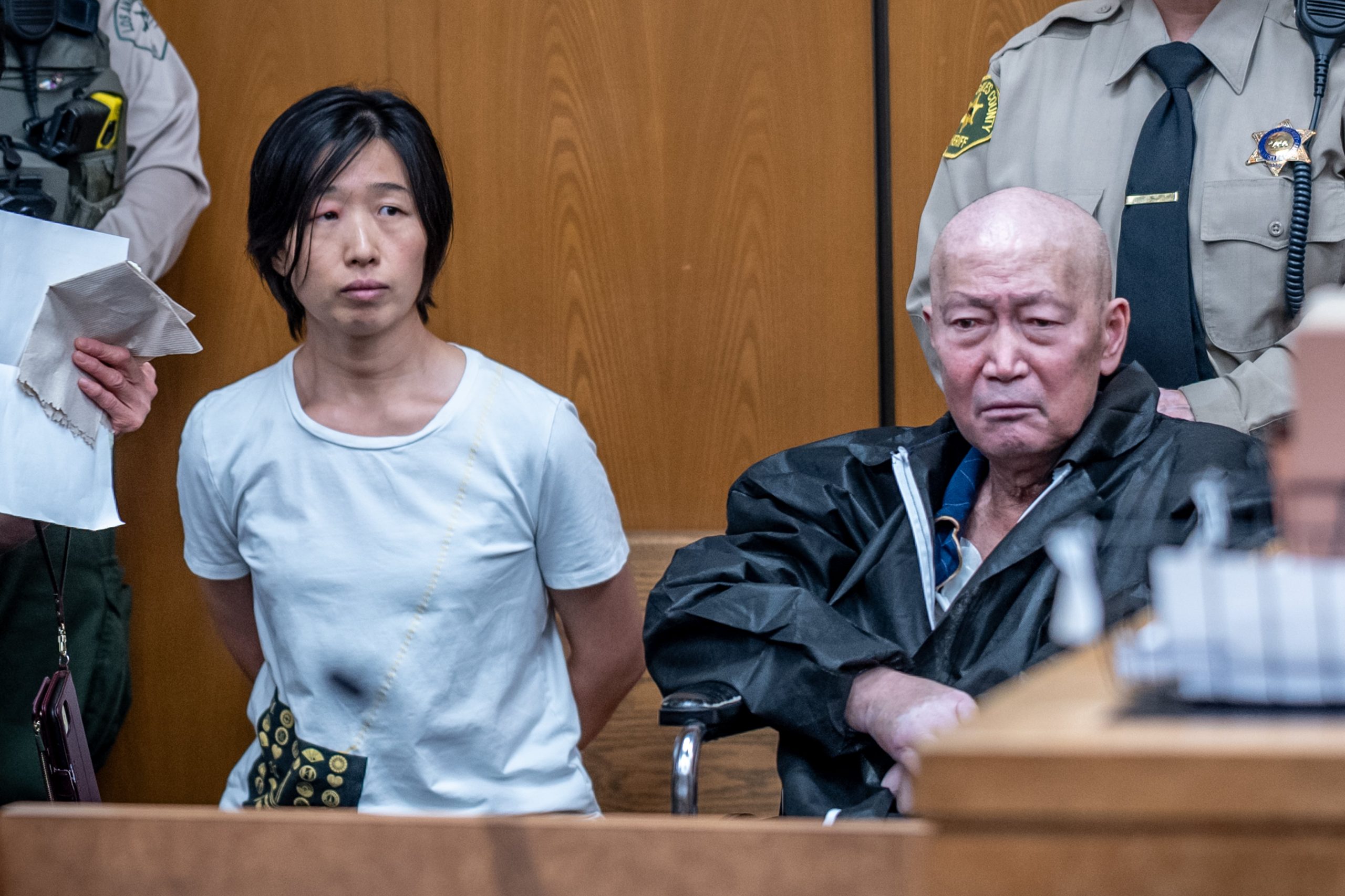
Google Maps still shows a prosperous image of Pacific Place, a business center on the busy Valley boulevard in a suburb east of Los Angeles, California. But that picture no longer matches reality. The windows of a mental health clinic and a real estate agency have been boarded up to protect the premises from vandalism. One by one, shops pulled down their shutters until the mall was almost deserted. Several businesses belonging to an enigmatic figure also closed: Guojun Xuan, a wealthy Chinese immigrant who is at the center of a chilling case involving the alleged mistreatment of 21 children at his Arcadia mansion.
Xuan, 66, and his partner, Silvia Zhang, 39, were arrested days ago in a police operation in response to a serious child abuse allegation. As Los Angeles County sheriffs escorted them to patrol cars that would take them to local jails, agents from the Federal Bureau of Investigation (FBI) searched every corner of their luxurious two-story mansion, which has nine bedrooms, ten bathrooms and a swimming pool. On the California real estate market, the property is valued at $4.5 million.
The FBI is keeping the focus of its investigation confidential. “The affidavit supporting the search warrant has been sealed by the court and, therefore, I cannot comment on the nature of the investigation,” an agency spokeswoman said in a statement sent to EL PAÍS.
The enigmatic Xuan and Zhang filled their mansion with children through a sophisticated scheme that paid up to $135,000 to women who rented their wombs. Some accepted the money without asking many questions; others barely knew their clients were “a Chinese couple” who wanted to fulfill the dream of having children. Behind the operation was Mark Surrogacy Investment, a surrogacy company in which Xuan was listed as an executive and whose corporate headquarters was the Arcadia mansion.
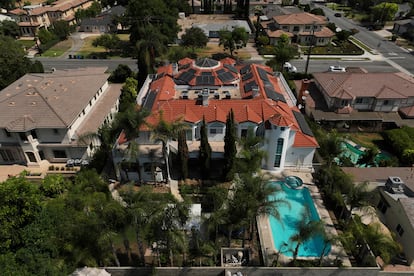
The company operated legally for only a few months, from February to June 2025, according to the California Secretary of State. Its closure coincides with the police investigation that exposed alleged beatings that Xuan, Zhang and a group of nannies who lived with them inflicted on children aged between two months and four years. The children are now in the care of the local government.
Another red flag was that Mark Surrogacy Investment did not generate profits; rather, it was a financial burden for its owners. “It was not that the company was financing them. They were the ones who, in fact, financed the surrogate mothers to have these children,” said Nathan Hochman, Los Angeles County prosecutor, at a press conference in which he revealed harrowing details about what he called “the house of horrors.”
“The number of children who were subjected to this alleged horrific abuse is unprecedented. The alleged corporal abuse of these children is appalling and revolting, especially at the hands of those who were supposed to protect them,” Hochman told reporters. “The motivation to have all these surrogate children is part of an ongoing investigation,” he added.
200 bank accounts
Without a fortune backing them, the pair would hardly have been able to sustain a family of that size. Xuan had access to around 200 bank accounts and at least 70 corporate accounts, whose combined value exceeded $100 million, prosecutors said at a hearing. Authorities asked that bail be set at amounts commensurate with the resources available to the couple. A judge, however, set bail at $20 million for each of them.
“The amount is absurd. It’s $100 million per each defendant,” protested Mitchell Krems, the couple’s defense attorney, in a statement quoted by ABC7. “He’s being unfairly scrutinized because he has so many children. There’s no law against having all these children, none at all, so my client is not abusive whatsoever,” the lawyer said.
Krems declined to grant an interview to EL PAÍS. He also did not answer a series of questions the newspaper sent him through a consulting and digital marketing agency. The questions addressed Xuan’s businesses, his properties in California, the large payments to the women who carried the children and the child abuse accusations.
The 15-page complaint does not focus on the couple’s financial resources. It only mentions them when detailing payments of at least $45,000 to the women who carried their children and the salaries of those who helped care for the youngsters. “Xuan took ten bundles of cash from a bag in his office, after which the defendant Zhang went to pay the nannies who lived there in cash,” Prosecutor Hochman recounted during the conference.
Another mansion in Arcadia is linked to the couple. It is on First Avenue, less than two miles from the residence searched by the FBI and the sheriffs. Court documents list it as one of the addresses registered by Silvia Zhang. The property has two floors, six bedrooms and six bathrooms. Its melon-colored façade contrasts with the white trim. Four Roman-style columns adorn the main entrance. In the front yard, a fountain with goldfish welcomes visitors. Built in 2001, the luxurious residence is valued at $3 million by Realtor.com, 16% higher than its estimated value in 2022.
A more modest property, located on a hill in Pomona, is listed as the headquarters of Hope Surrogacy, a surrogacy company that was active from March to June 2021 and that, according to California Secretary of State records, was run by Zhang. Pomona, a predominantly Hispanic suburb 30 miles east of Los Angeles, contrasts with the opulence of Arcadia.
The house on Tonner street is small compared with the couple’s mansions, but it sits in a neighborhood with privileged views and away from denser, lower-income areas. Despite its appearance, the rise in property prices puts its value at a figure that may seem disproportionate: $1 million.
Ephemeral businesses
At Pacific Place in El Monte, Xuan and Zhang’s businesses had short lives: some remained active for only a few months; others, at most, a couple of years. One company operated under the same name during two separate periods before closing permanently in January 2023.
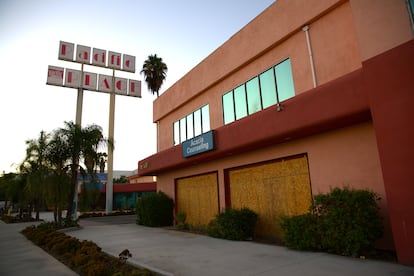
The list of companies registered at that commercial center that list Xuan and Zhang as principals is extensive: Yudao Management, Future Spring Surrogacy, Hongxing Investment, Shangdao Management, Renquan Investment, Future Management, YZA Investment, Heavenly Way Investment and Rain Prosperity Investment.
In some of these firms, Xuan and Zhang alternated in executive roles. On a few occasions is she listed as the principal responsible party.
The Pacific Place businesses operated between April 2019 and May 2025. Although their owners did not specify to the California Secretary of State the activity of each company, court documents indicate some were related to the real estate sector.
In Mark Surrogacy Investment, the surrogacy agency headquartered at the Arcadia mansion, Xuan was listed as chief executive and Zhang as manager. Several of the children who lived in the residence were born through that company. According to authorities, Xuan and Zhang were the only clients.
Sign up for our weekly newsletter to get more English-language news coverage from EL PAÍS USA Edition

This story was co-published with Puente News Collaborative, a binational nonprofit journalism organization dedicated to providing accurate, high-quality reporting on the border between Mexico and the United States.
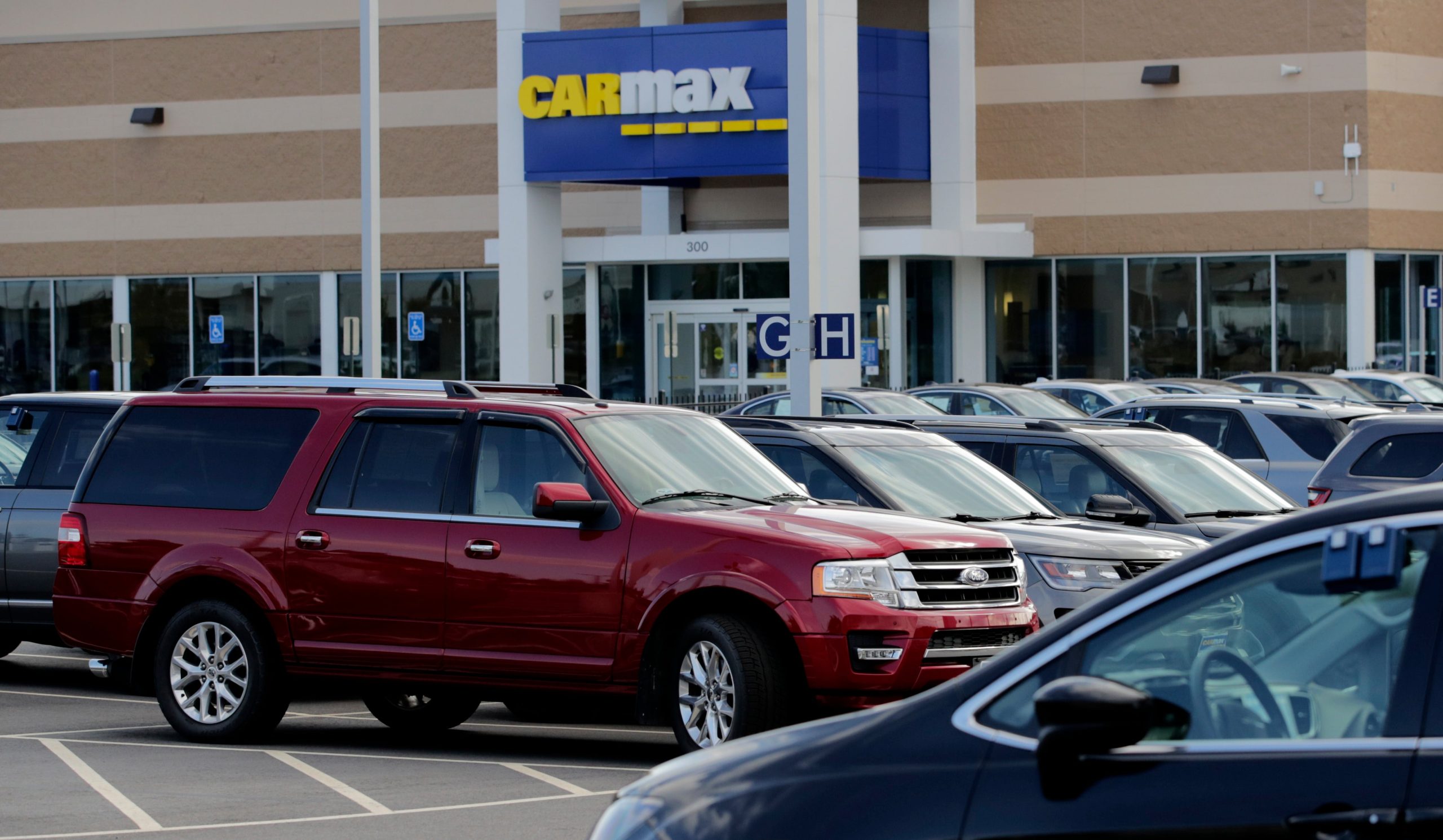
Mexican cartels are stealing cars and trucks from U.S. rental agencies at an alarming rate, spiriting thousands of vehicles across the border each year to keep top capos in the latest model BMWs and Cadillacs.
Law enforcement agencies and companies charged with trying to recover stolen vehicles say that while much of the theft happens in border states, particularly Texas, cartels have stolen vehicles from as far away as New York, Chicago and Miami. But California remains the top target.
Los Angeles Police Department Sgt. Juvey Mejia, a member of the Task Force for Regional Auto Theft Prevention, said the cartels love heavy-duty pickup trucks and Jeeps.
“Anything that can drive through tough terrain to get away from border patrol so they can move dope,” Mejia said.
Along with Chevy Suburbans, Ford Raptors and Toyota pickups, the vehicles of choice include Cadillac Escalades and BMW SUVs, according to people whose job it is to recover them. To battle rival cartels or authorities, cartels sometimes convert the trucks into mutant tanks, adding heavy ballistic-proof steel plating, firing ports and gun mounts.
The thefts don’t require much stealth: vehicles are rented by cartel operatives and then driven across the border. California sees significant theft, in part, because of its restrictive privacy laws on GPS tracking of rental vehicles, according to Sharky Laguana, owner of Bandago Van Rentals based in San Francisco.
Unlike other states, California requires rental agencies to wait to turn on GPS tracking until the vehicle return deadline has passed and the renter has been notified. By then, most stolen vehicles are deep into Mexican territory.

“California allows criminals to take advantage of the fact that we are not allowed to see where the vehicle is until it’s too late,” Laguana said. The American Rental Cars Association, a trade group, said in a statement that California laws make it harder to recover vehicles.
“Members are reporting a sharp increase in rental vehicle theft from California into Mexico, where California law uniquely restricts rental fleet operators from accessing technology to protect and recover their assets,” an association said in a statement. “The result is millions of dollars in annual theft-related costs.”
The number of rental cars stolen in the United States and taken to Mexico each year is unknown, but it is believed to be in the thousands. Businesses charged with recovering the vehicles estimate only a small percentage of them are ever found.
But statistics compiled by the California Highway Patrol give some sense of the problem. According to the CHP, since 2023, about 850 vehicles stolen in California have been recovered each year in Mexico. The numbers do not distinguish which cars are rentals or privately owned, but rental industry representatives estimate that many are rentals.
Early this year, criminal groups stole 10 new Ram pickup trucks from Oakland, Los Angeles and Las Vegas airports, according to private investigators. The trucks ended up in Jalisco state in regions controlled by the violent, New Generation Jalisco Cartel.
The private investigators recovered one with help from the Mexican army. Security forces also seized a cache of .50 caliber Browning and Barret weapons.
In another haul this year, thieves stole six 2026 Jeep Wranglers from Oakland and Las Vegas. Four have been recovered so far. Private investigators believe the vehicles were destined for the Sinaloa Cartel.
The same investigators received requests last week to recover a dozen stolen Rams that were tracked to Sinaloa and seven to Durango state.
“For the cartel, it is the cheapest way for them to do business,” said Kevin Carter, owner of Collateral Consultants, a rental car recovery company in Texas. “There’s no sense in them buying a car when they could rent one for a few hundred bucks, and it’s theirs forever.”
Along with California, Texas and Arizona are the other top targets for Mexican criminal groups.
One tactic involves cartels hiring people in the U.S. via social media to rent a vehicle for five days, get the damage waiver that includes covering the car if it is stolen, and then leaving the keys in the vehicle still parked in the rental parking lot. An operative arrives, picks up the car and drives it south to Mexico.
In other cases, thieves will rent the vehicle online or at a kiosk using a stolen identity, said Mejia, the LAPD officer. Since the pandemic, it’s not unusual for people to wear protective masks, so the renter will wear a mask to hide their identity from the kiosk camera. “They know it won’t be traced back to them,” Mejia said.
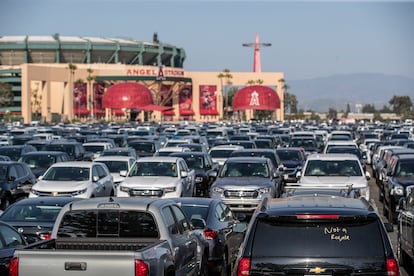
The process for reporting a stolen rental vehicle varies from state to state, but it is often tedious. It can take three days after the vehicle has gone missing for a company to prepare a demand letter to the renter seeking the return of the vehicle. The notification is required before a vehicle can be reported stolen, and it can take another two days to send the letter by certified mail.
Depending on the state, a company might have to wait up to nine days to report the theft to police. Only then can it appear on the U.S. National Crime Incident Database, the FBI-managed database where stolen vehicles are reported.
More days will pass before the VIN number is registered in Mexico’s stolen vehicle database. If the car or truck was rented in one state, set to return in another state and crossed into Mexico via a third, the coordination required between three state law enforcement agencies can make timely recovery of the vehicle even more complicated.
Many vehicles are never registered in the U.S. stolen car database.
Carter, from Collateral Consultants, said that of the around 1 million cases he has seen in his 15 years recovering rental vehicles in the U.S. and elsewhere, less than half made it onto the U.S. database.
A vehicle is not considered officially stolen until it appears in the registry. Large rental agencies often don’t bother recovering vehicles that disappear across the border and consider the loss a cost of doing business, Carter said.
“It’s a calculated risk to most of the big companies,” he said.
While insurance companies insure rental agencies against vehicle damage, they do not cover theft, according to Luguana of Bandago Van Rentals. Most agencies are self-insured, meaning the loss of a vehicle cuts into their bottom line, he said.
Though sometimes the target is a single vehicle, authorities have also uncovered larger theft operations.
In 2024, the Colorado attorney general’s office indicted 17 people associated with the Sinaloa cartel, accusing them of stealing 190 new Ford F150s and luxury suburbans near the Denver airport. The cartel operatives drove the stolen vehicles, valued at nearly $10 million, south to Mexico, according to court documents, and exchanged them for cocaine, fentanyl and methamphetamines.
In the Texas border city of Laredo, Deputy Police Chief Timothy Tubbs said he has seen a 50% increase in the theft of rental vehicles — about 10 a month.
“They have seen how easy it is to steal a rental car, and the process it takes to report it,” Tubbs said of criminal groups. And the vehicles are supporting drug trafficking into the U.S., he said. “These stolen vehicles empower the cartels,” Tubbs said. “It is another tool for them to continue their smuggling and continue their violence.”
Once the vehicles are in Mexico, operatives approach corrupt Mexican officials, change out the U.S. license plates for Mexican plates and register the vehicles on Mexico’s online car registry platform, according to car recovery experts. Authorities install a chip that is scanned by machines along federal highways. The chips are supposed to flag stolen cars and trucks, but since the Mexican plates are valid, the vehicles are never listed as stolen.
In the United States, stolen vehicles are far more likely to be identified, experts said, for a variety of reasons: a routine maintenance check or scan by a highway license plate camera could trigger an alert. But once it arrives in Mexico, it essentially vanishes.
“It crosses that border, it is a brand new car,” Carter said.
Cartels steal more cars and trucks when turf wars break out because they require more resources, one U.S. law enforcement official said. And in recent years, cartels have increasingly splintered as leaders have been arrested.
One of the more dramatic examples is the Sinaloa Cartel, founded by the now imprisoned Joaquín “El Chapo” Guzmán. His sons, known as Los Chapitos, are fighting a rival faction for control of the criminal group.
The ruthless Jalisco Cartel has fought to expand its territory warring with groups from Baja California to Michoacán and Chiapas states and is fighting wars on multiple fronts as it seeks to expand its presence.
Though many stolen vehicles disappear, some are recovered. In Guerrero state last November, the Mexican army seized a Toyota TRD Pro and other vehicles loaded with high-caliber weapons and nearly half a ton of meth.
According to sources familiar with another recovery, in August a member of the New Generation Jalisco Cartel went to the border city of Mexicali to pick up a tractor-trailer with a 2026 Cadillac Escalade and a late model Ram hidden inside, apparently to evade the stolen car detection system until they could be outfitted with Mexican plates.
But private investigators hired to recover the Cadillac began tracking it. They asked not to identify their tracking methods to avoid tipping off criminals. The investigators notified the Mexican army, providing the license plate number.
Their tracking method allowed them to see the vehicle was on the move, passing through toll booths and military check points, but without setting off alarms. At one check point, National Guard soldiers opened the trailer and, finding a wall of hay bales, let it pass.
At the next check point, however, soldiers pulled back the bales to reveal the Cadillac and Ram.
The driver said he was to be paid nearly $1,500 for the trip and admitted the cars were bound for drug lords.
Fisher is a special correspondent. This article is a collaboration between the Los Angeles Times and Puente News Collaborative, a bilingual nonprofit newsroom. Reporting for this article was supported with a grant by the Fund for Investigative Journalism.

The Race For Los Angeles Mayor: Two Democrats Battle Over Housing, Affordability And The Olympics

Age Care Costa Del Sol Pop-Up Shop

Animal Cruelty Shock: 61 Dogs And Cats Rescued


-

 Uncategorized4 weeks ago
F1 Bahrain Grand Prix will be live and FREE on TV this weekend
-

 New Developments4 weeks ago
How To Get A Tourist Rental Licence In Andalusia (Spain) – Step-By-Step Guide 2025
-

 New Developments3 weeks ago
Luxury Villas For Sale, Estepona – ProjectL1
-
Blackout preparedness4 weeks ago
Brussels takes action against Spain over failure to update blackout plan
-
EU3 weeks ago
EU nicotine crackdown sparks warning that ex-smokers could be driven back to cigarettes
-

 Uncategorized4 weeks ago
Lewis Hamilton F1 wish could come true as stunning plans for new track revealed
-

 Housing access / crisis / affordability3 weeks ago
Radical Housing Decrees Defeated As Snap Election Talk Grows
-
British tourists arrested in Magaluf3 weeks ago
British tourists arrested after taxi driver left bloodied in Magaluf