Connect with us

Argentina

Trump Receives Flávio Bolsonaro In The Oval Office Three Weeks After Lula

Published

on

trump-receives-flavio-bolsonaro-in-the-oval-office-three-weeks-after-lula

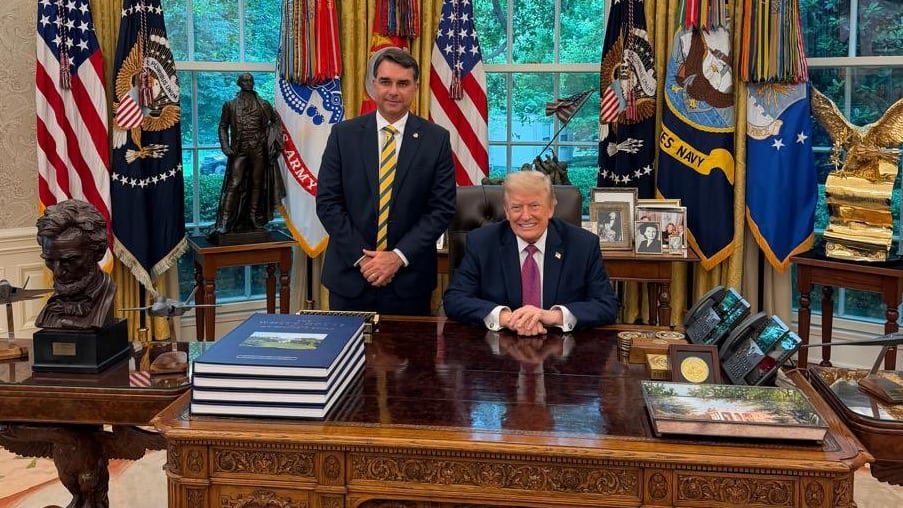
U.S. President Donald Trump gave a boost on Tuesday to the presidential bid of Brazilian senator Flávio Bolsonaro, son of former president Jair Bolsonaro, by receiving him in the Oval Office, 19 days after meeting there with Brazil’s president, former union leader Luiz Inácio Lula da Silva. Barring a surprise, Lula and Bolsonaro’s son are expected to face each other at the ballot box in October. Flávio Bolsonaro’s team hopes the photo with Trump will help him overcome a popularity crisis and consolidate his candidacy.

The senator announced the meeting by posting the photo with Trump on Instagram with no comment other than two thumbs-up emojis. Until the last minute it was unclear whether the meeting would take place. The right-wing presidential hopeful was received at the White House just hours after Trump, who will turn 80 on June 14, underwent a series of medical exams at Walter Reed National Military Medical Center, the third such checkup in less than a year and a half in what the presidential office describes as “his annual physical.”

Leaving the White House, the Brazilian told reporters he had asked Trump to designate the Primeiro Comando da Capital (PCC) and the Comando Vermelho (CV) — the most powerful organized crime groups in Brazil — as terrorist organizations. He said, however, that he did not ask Trump to endorse his presidential campaign.

The face-to-face lasted one hour and 40 minutes, one of Bolsonaro’s companions, journalist Paulo Figueiredo — who is under investigation in Brazil for coup plotting — told O Globo. “How is your father?” the U.S. president asked his visitor, Brazilian media reported.

So far the White House has not issued a statement about the meeting, which was not on Trump’s official schedule and had not been announced by any channel of the presidential office. The conversation came less than three weeks after the U.S. president met in the Oval Office with President Lula in a working meeting that included lunch.

The eldest son of former president Jair Bolsonaro also visited 1600 Pennsylvania Avenue in Washington at a time when Trump is pushing to announce as soon as possible a preliminary agreement with Iran that would allow a definitive end to the war while the most contentious issues between the two countries — above all Iran’s nuclear program — continue to be negotiated. Above all, the White House seeks to reopen the strategic Strait of Hormuz, through which 20% of the world’s oil and gas flow.

Less than two weeks ago, the scandal that abruptly halted Bolsonaro’s campaign broke in Brazil. Intercept Brasil published an audio in which the candidate, in a conspiratorial tone, solicits money from a convicted banker he claimed not to know to pay for a biographical film about his father. It turned out that the banker — now jailed on fraud charges — had pledged millions of dollars for the movie. Bolsonaro’s son defended himself, saying it was a private conversation between two individuals about private funds to finance a private project.

But the latest polls show a certain decline for Bolsonaro while President Lula has gained ground; before the scandal the two had been in a technical tie for weeks.

Securing time with Trump for the candidate is a coup for Eduardo Bolsonaro, the third brother and the family member in charge of relations with Trumpism, who has also posed with the Republican. According to Brazilian press reports, the route to Trump went through the U.S. secretary of state, Marco Rubio.

The photo with Trump allows Bolsonaro to once again link the family’s political project to Trumpism, a relationship that had soured after the tariff punishment imposed by the Republican at the behest of the far-right Brazilian clan backfired on them.

The meeting with Trump also helps Bolsonaro’s son project the image of an international leader. The right-winger, who presents himself as a moderate version of his father, attended the meeting wearing a green-and-yellow tie, the colors of the Brazilian flag and the same colors as the tie President Lula wears on major occasions.

The fear of interference by Trump or his administration in the elections, as has happened in Honduras and Argentina, hovers over the Brazilian campaign. Last year the U.S. exerted extraordinary pressure on Brazil to drop prosecutions against Jair Bolsonaro. It failed. The former president is now serving a 27-year prison sentence for plotting a coup d’état against Lula.

Sign up for our weekly newsletter to get more English-language news coverage from EL PAÍS USA Edition

Argentina

Myriam Bregman, The Trotskyist Who Is The Argentine Politician With The Best Image

Published

on

myriam-bregman,-the-trotskyist-who-is-the-argentine-politician-with-the-best-image

“Milei is an employee of the big businessmen who have made millions in recent years and expect to make many more with him. He is not a lion, he is a pampered kitten of economic power.” It was October 2023, and Myriam Bregman, from the lectern assigned to her at the candidates’ debate, issued a warning about the man who, days later, would become president of Argentina. While many politicians avoided confronting a figure whose popularity was rising fast, Bregman delivered one jab after another, using the same ironic, irreverent style that infused the libertarian discourse — only in the opposite direction.

Over Milei’s two and a half years in office, Bregman — 54, a national deputy for the Workers’ Left Front–Unity — has held that line, setting herself apart from an opposition she describes as hesitant and fearful when it comes to resisting policies such as labor reform or cuts to education, healthcare, wages, and pensions. An opposition, she warns, that seems overly concerned with not contradicting the spirit of the times or the dictates of marketing handbooks.

That stance, in part, is what has propelled her in Argentine polls. She appears as the political figure with the highest positive rating in surveys such as those by Atlas Intel, where she scores 47 points of positive image (against 46 negative) and is the only one among the 14 leaders measured to show a favorable balance. Pollsters note that a positive image does not equate to voting intention, but the figure reflects growing public recognition of her and her party, which until now has always been electorally marginal. In the 2023 presidential election, Bregman finished fifth, with 2.7% of the vote.

Nicknamed La Rusa — “the Russian” — because of the combination of her Jewish surname, blond hair, and light eyes, Myriam Bregman was born in a tiny town called Timote, 280 miles from Buenos Aires. She had to move at age 15 to finish high school in a nearby town. She studied law at the University of Buenos Aires, where she became active in left‑wing politics and, together with other lawyers, founded the Center of Professionals for Human Rights (CeProDH) to defend people detained during the countless protests of the 1990s.

Amid the political, economic, and social chaos unleashed by the 2001 financial crisis, the organization also took on the challenge of defending workers who were taking over bankrupt factories. And shortly afterward, when the laws guaranteeing impunity for those responsible for the crimes of the last military dictatorship (1976–1983) were struck down, it began working on prosecutions against the perpetrators. Within the collective Justicia Ya!, Bregman became a plaintiff in cases involving crimes against humanity and pushed forward the trial of the notorious repressor Miguel Etchecolatz — during which the witness Jorge Julio López was disappeared.

She held her first institutional post in 2015, when she became a deputy for the Workers’ Left Front — the coalition that brings together the four main parties of the Argentine left: the Socialist Workers’ Party (PTS), to which she belongs; the Workers’ Party (PO); Socialist Left (IS); and the Socialist Workers’ Movement (MST). She stepped in to complete the term begun by a colleague, under an internally agreed‑upon rotation system. She later served as a legislator in the city of Buenos Aires and was then elected national deputy in 2021 and 2025.

Her profile is the mirror image of Milei’s, in the sense that what the Argentine president uses as insults are, for her, identity markers: she is left‑wing, socialist, a human‑rights advocate, feminist, anti‑imperialist.

“He says his proposal is antagonistic to ours, and the truth is it is,” she tells EL PAÍS. “Milei is submissive to the International Monetary Fund, he lets himself be governed by Donald Trump and by [U.S. Treasury Secretary Scott] Bessent, and we truly fight for the dream of San Martín and Bolívar: to integrate Latin America, to confront imperialism, to fight for a federation of Latin American states — essentially the opposite of being a Yankee colony.”

She continues: “[Milei] believes there should be practically slave labor, and we think work hours should be shared between the employed and unemployed, that no one should work more than six hours a day, five days a week, with a salary one can live on.”

The conversation is occasionally interrupted by the barking of her dog, aptly named Dimitri. Bregman lives in the Buenos Aires neighborhood of Chacarita and, in line with her party’s doctrine, earns the equivalent of a teacher’s salary and donates the rest to “various struggles.”

“Anyone you ask will tell you they see us on the street, on the subway, teaching,” she says. “We live like any worker, and I believe we should. It’s easy to talk about ‘the caste,’ but to show up in a Tesla [she is referring to a recent appearance by Manuel Quintar in the Congress parking lot with a Tesla Cybertruck, which sells locally for more than $200,000] or to travel on a private plane while decrying the caste is contradictory. I think Milei believed he could manage that contradiction, and his mask is falling off — that’s why the Adorni affair has caused him such a crisis. These were people who said they would fight the caste and now live like the caste.”

Bregman is referring to Manuel Adorni, Milei’s chief of staff, who is being investigated by the courts for alleged illicit enrichment. Adorni was on the receiving end of one of her barbs a few weeks ago, when he appeared in Congress to deliver his mandatory periodic report. “Do you know what people call you?” Bregman asked the official. “Aloe vera, a popular joke — a popular joke meaning that every day they discover more properties.”

Her explosive rhetoric does not prevent her from maintaining good relations with lawmakers across parties. Even Milei, who sat next to her when both were deputies, once said before taking office that he found her “likeable” and “coherent.”

Bregman doesn’t remember whether the scene described in a newspaper column actually happened — veteran lawmaker Miguel Ángel Pichetto telling her in a congressional elevator that if she toned down the Trotskyism and moved toward social democracy, the Casa Rosada, the seat of government in Argentina, would be within reach. But she says it wouldn’t have been the first time she received such advice.

“Some suggest it to you, others try to beat it into your head through repression in the streets,” she says. “There are different ways of trying to get us to moderate, but if we have gained this recognition, it is precisely because we did not moderate. Moderation has already been tried; it has a name — Alberto Fernández’s government — and it was a resounding failure.”

Despite the discontent with Milei, many Argentines still credit his government with certain economic achievements — from lower inflation to fiscal discipline. When asked how she squares these two realities, she replies: “Argentina’s political leadership is very colonized by neoliberal ideas that have deeply penetrated and now seem sacrosanct. People talk about fiscal balance and zero deficit as if they were good in themselves, achieved through wage and pension cuts. The great hemorrhage here is external debt, and there is no way out unless the fraudulent debt is challenged.”

Bregman continues: “It’s not hard to find examples around the world that show that with the United States and the IMF steering a country’s destiny, there is no way out for the popular majority. Argentina produces food, and kids go to bed hungry; Argentina produces energy, and we can’t pay the bills. There is a plundering of resources in Argentina, and today it seems you have to accept it silently or be labeled utopian.”

In Argentina, the left has historically been overshadowed by Peronism, a movement based on the legacy of former president Juan Domingo Perón, built on a broad working‑class base. From her rise in the polls, the challenge she identifies is “organizing the sympathy”: preventing that surge of support from dissipating and turning it into actual activism.

The goal is to use the current moment to reach sectors that had never looked to the left as an electoral option and to represent what she calls a “new working class” — one that goes beyond the archetype of the unionized factory worker and now includes, for example, precarious professionals, app‑based delivery workers, teachers, and public employees. Her presidential candidacy for next year “is on the table,” though the final decision will come from the Workers’ Left Front’s internal debate.

“Despite this increase in recognition, I try to be serious and not create the impression that it’s easy to challenge the power structures or take on the dominant classes, because we’ve come through many years of demagoguery in which leaders present themselves as knowing everything and solving everything, and then produce enormous frustrations,” she says. “To change the situation, you have to affect interests, and that can only be done with mobilization and organization, with struggle, because no one will give up their power and privileges willingly. Not even through an election. They will fight and defend with all their might everything they can.”

Sign up for our weekly newsletter to get more English-language news coverage from EL PAÍS USA Edition
Continue Reading

Argentina

Milei Government Reaches Agreement With US For Joint Patrols In The South Atlantic

Published

on

milei-government-reaches-agreement-with-us-for-joint-patrols-in-the-south-atlantic

Javier Milei’s government announced Wednesday the signing of an agreement with the United States to strengthen “its surveillance and control capabilities in the South Atlantic,” according to an official statement. The deal runs for five years and means, on one hand, a U.S. contribution of technology to modernize the South American country’s naval equipment and, on the other, authorization for forces from U.S. Southern Command to take part in patrolling Argentina’s southern sea.

The U.S. embassy in Argentina had already previewed the matter, but the signing of the agreement was only confirmed on Wednesday by the Argentine Ministry of Defense. The letter of intent signed by officials from Southern Command and the Argentine navy will allow the country to “incorporate new operational capabilities, technology, and training for personnel,” as well as improve “the detection, monitoring, and surveillance capabilities of maritime spaces” and “the response to illicit activities and threats.”

What the official statement did not specify was the formal title the agreement will carry, a detail the U.S. embassy did disclose under the slogan Protecting Global Commons Program. That reference to treating Argentina’s maritime zone as a “commons” alarmed sectors opposed to Milei, who are critical of his unconditional geopolitical alignment with Donald Trump’s administration.

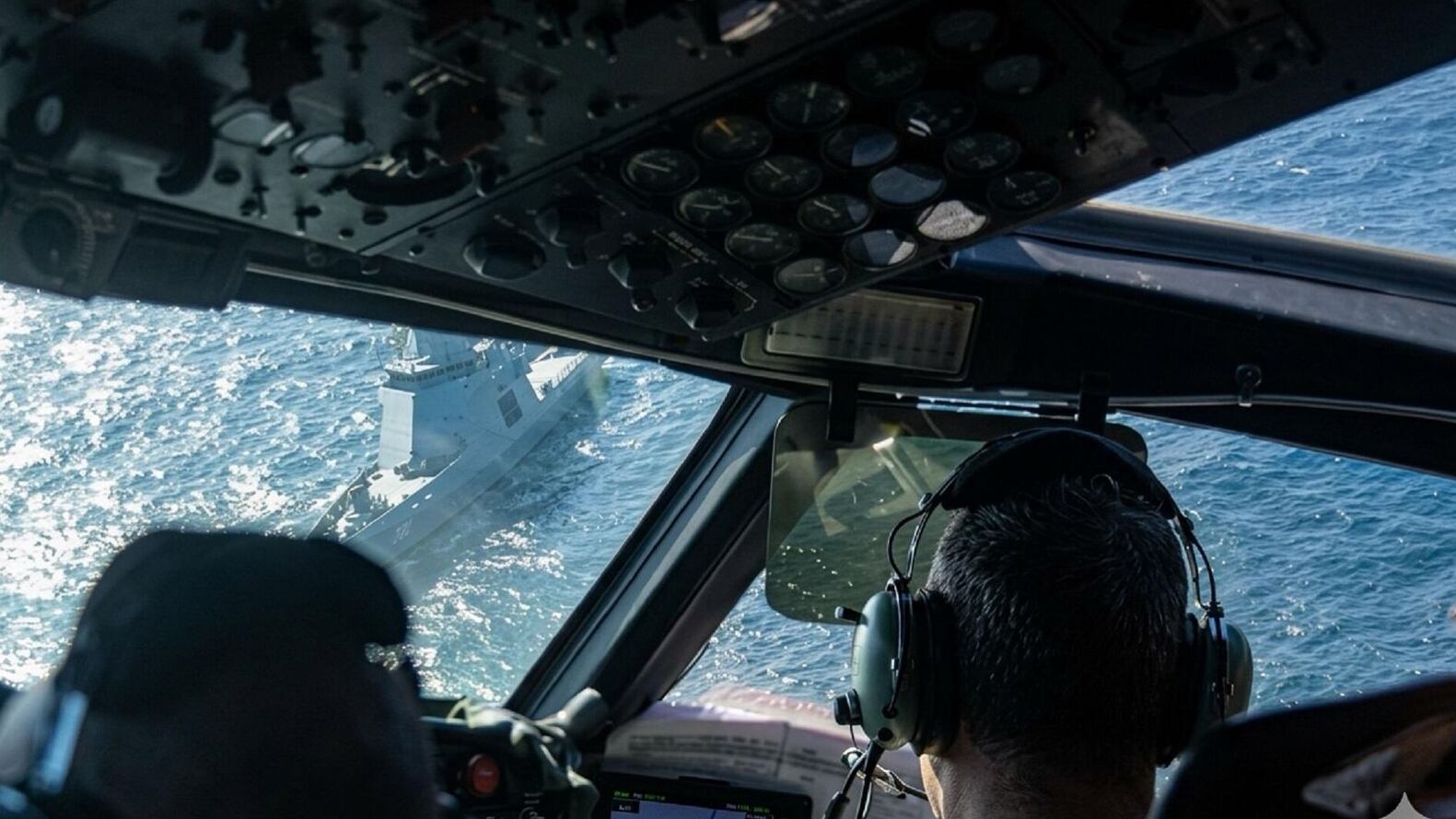
Cooperation between the two countries has already begun with the U.S. provision of “multispectral sensors, command-and-control systems, communications, and data-link equipment” for an Argentine navy B-200M Cormorant aircraft. It will continue with the supply of two Textron B-360 ER MPA aircraft, equipped to carry out surveillance tasks, detect vessels, and identify maritime traffic, among other functions. The Argentine navy will also receive “vertical takeoff drones suitable for operation from offshore patrol vessels” and a simulator for P-3C Orion aircraft.

The initiative is part of the U.S. Department of Defense’s Program 333, through which Washington seeks to deepen its military ties with allied countries. In that sense, the U.S. embassy in Argentina emphasized that the letter of intent inaugurates a “strategic five-year alliance to defend the global commons and strengthen regional security.” Milei’s government, by contrast, stressed another perspective on the agreement: “We will defend our maritime sovereignty with greater presence, technology, and our own capabilities to protect Argentina’s strategic interests.”

Most of the criticism of the accord came from Peronism. “The Argentine sea is not a global commons. It is an area where Argentina has the obligation to exercise its own jurisdiction and to safeguard its resources,” said Carlos Bianco, Buenos Aires province’s minister of government and right-hand man to Governor Axel Kicillof, one of the figures aiming to run against Milei in the 2027 presidential election. “Instead of offering our South Atlantic as an area for training and naval mapping to other powers, the national government must carry out its sovereign functions there,” Bianco added.

The Kirchnerist group La Cámpora also rejected the “global commons” label. “It belongs to Argentines and is strategic for national development. Argentina’s maritime zone is one of the most productive and diverse in the world,” it said in a statement, accusing Milei of “giving away strategic information about the South Atlantic.”

Since taking office at the Casa Rosada in December 2023, the far-right Milei has ended Argentina’s traditional global commitment to multipolarity and subordinated the country’s foreign policy to his relationship with Trump. That stance has already produced numerous actions, from backing the U.S. and Israel in the war with Iran to authorizing U.S. military exercises inside the country and the president’s visit last month to the nuclear-powered aircraft carrier USS Nimitz when the ship was off the Argentine coast.

Sign up for our weekly newsletter to get more English-language news coverage from EL PAÍS USA Edition

Continue Reading

Argentina

A World Cup In The Middle Of A Climate Crisis: How Will The Heat Affect Your Team?

Published

on

It’s difficult to find an area that hasn’t been affected by climate change, which, among other things, is behind the increased frequency and intensity of heat waves worldwide. Sport is no exception, and competitions like the Winter Olympics and major cycling tours have been — or will be — seriously affected by global warming. The most-watched sporting event on the planet, the FIFA Men’s World Cup, being held in North America and starting in less than a month, will also be impacted by this crisis.

A study by scientists at World Weather Attribution (WWA) warns that around 25% of the World Cup matches to be played — 26 of the 104 scheduled — will likely take place in conditions that pose a risk to the health of the players and, in some cases, even to the fans attending the stadiums. The researchers, led by Frederick Otto and Theodore Keeping of Imperial College London, used historical temperature data and other meteorological variables to determine whether safe conditions would be exceeded at the time each match was scheduled to take place.

In 26 of those scheduled matches, the scientists determined that temperatures are likely to exceed 26 degrees Celsius WBGT during the course of the game. WBGT stands for Wet Bulb Globe Temperature, a unit commonly used in the sports world to measure heat stress on the human body. It takes into account not only air temperature but also humidity, solar radiation, and wind speed. The study estimates that five matches will exceed 28 degrees Celsius WBGT, the equivalent of 38 degrees Celsius in dry heat or 30 degrees Celsius in high humidity, Otto explains.

The authors performed the same risk calculation for 1994, when the World Cup was held in the United States, at the same venues and times of year. They conclude that the “risk of these more extreme conditions has almost doubled” due to “climate change” caused primarily by the burning of fossil fuels. “In 1994, the climate was approximately 0.7 degrees cooler than it is now,” notes Joyce Kimutai, another researcher who participated in the analysis.

The venues, dates, and times for the three group stage matches of the 48 qualified teams have been confirmed. The matches will be played in various cities across Canada, Mexico, and the United States. Data from the study indicates that Portugal will face the worst heat, with an 80% probability of temperatures exceeding 26 degrees Celsius in all three of its group stage matches. The Netherlands, Saudi Arabia, and Cape Verde follow (all with a 74% probability).

In the case of Spain, two of its matches — those held in Atlanta (USA) — carry a 23% probability of exceeding 26 degrees, and in the third, in Guadalajara (Mexico), the possibility is practically zero.

Reining champion Argentina will have it a bit worse. In one of their matches (June 22, in Dallas at 1:00 p.m.) there is a 100% chance of temperatures exceeding 26 degrees Celsius and a 22% chance of exceeding 28 degrees Celsius. In Argentina’s other two matches, the risk of exceeding 26 degrees Celsius is 14% and 24%, respectively.

Professor Otto explains that, to determine the risk thresholds, they relied on the recommendations of the main international players’ union, FIFPRO (International Federation of Professional Footballers). “The union suggests that a temperature of 26 degrees WBGT is quite dangerous and that playing in these conditions would require cooling breaks.” He adds, “28 degrees is objectively dangerous, and the players’ union suggests that matches should be postponed.” But it’s not only dangerous for the players. “There are also the fans, who may gather outdoors beforehand and are at even greater risk because they won’t be supervised,” Otto warns.

In the case of the Colombian national team, only one of its three group stage matches carries a risk (a 40% chance for the June 27 match in Miami). Furthermore, the stadium where it will be played lacks cooling measures, such as air conditioning. Uruguay, for example, plays two of its three matches in the same venue, with a 100% probability of temperatures exceeding 26 degrees WBGT.

On the other hand, there are 13 teams that will play their three matches with less than a 5% probability of temperatures exceeding 26 degrees Celsius. Among them are the three host nations: Mexico, the United States, and Canada.

Given the expected temperatures, this will be the first World Cup to implement cooling breaks in every match — regardless of the weather forecast for each location and day — during each half. This measure has also drawn some criticism. The previous World Cup, held in Qatar in 2022, had to be played between November and December due to the high summer temperatures in the region. “We will probably see more World Cups scheduled during the winter months, as we saw in Qatar in 2022, or held in cooler climates like Northern Europe,” predicts Donal Mullan, a researcher at Queen’s University Belfast, who a year and a half ago published another study focusing on temperatures during the 2026 World Cup.

Theodore Keeping notes that of the 16 designated venues, three will be particularly affected according to his calculations: Houston, Dallas, and Atlanta, all in the United States. In this case, all three venues have air conditioning, which will somewhat reduce the risk.

Once the group stage is over, the knockout phase will begin, where the risk of heat stress will remain. The final is scheduled for July 19 in New York at 3:00 p.m. According to the WWA study, there is a 12% chance that the dangerous temperature of 26 degrees Celsius will be exceeded. And “a one in 37 chance that the 28-degree threshold will be surpassed in that match, the dangerous conditions that, according to the players’ union, should cause a delay in the game,” Keeping points out. At the 1994 World Cup, that chance was one in 56.

Controversial breaks and schedules

FIFA has decreed that, for the first time in history, there will be a three-minute break at the midway point of each half — approximately at the 22nd and 67th minutes, respectively — in all matches, regardless of temperature, time of day, venue, or whether the stadium is covered or air-conditioned. The widespread implementation of hydration breaks has not been without controversy.

Initially, criticism focused on the possibility that the risk could be reduced if matches were scheduled for the evenings, when temperatures drop. However, playing matches during the hottest hours is necessary to accommodate international broadcast schedules: matches played in the evenings in the Americas, which will also take place, will be broadcast in the middle of the night in Europe, where the most valuable audience for television networks is located. Given the value of the World Cup broadcasting rights — it is estimated that FIFA will pocket $3.9 billion from this alone — the option of eliminating prime time was never considered. In fact, the opening match and the final will be played at 1:00 p.m. in Mexico and 3:00 p.m. in New York (9:00 p.m. CEST), respectively, times when the heat reaches its daily peak.

Therefore, some believe the decision to implement hydration breaks across the board may be related to economic reasons. These six minutes of broadcast time also constitute a new commercial break with a very high audience, presumably larger than during the 15-minute halftime break. The price of advertising space will vary enormously depending on the match, but the highest estimates for a 30-second ad are around $585,000 for the final, presumably during one of the hydration breaks.

Beyond the motivations, the fact remains that the breaks will impact the flow of the matches. Critics believe the pauses will disrupt the rhythm of the game. Other analysts, however, believe they will be a good opportunity for coaches to make tactical adjustments.

Sign up for our weekly newsletter to get more English-language news coverage from EL PAÍS USA Edition
Continue Reading

Trending

Copyright © 2017 Spanish Property & News