
Housing politics
Which Election Result Would Do The Least Harm To Spain’s Housing Market?

Author:  Mark Stücklin
Posted on
Spain votes this Sunday in a general election called by Socialist Prime Minister Pedro Sánchez after Congress rejected his housing decrees. I look at what the parties propose and ask which election result is most likely to ease the housing crisis.
How I judge the promises
My view is that political intervention in housing tends to backfire. Government has a clear job to do. It should plan neighbourhoods well, enforce basic building standards, fund social housing for those who need it and invest in public transport. For the rest of the market, from modest flats to luxury homes, the priority should be to make building easier where people want to live. Simpler rules, predictable planning decisions and fewer delays would cut costs and give private investors a reason to build.
The same principle applies to renting. Rent caps can benefit sitting tenants, but they also make it less attractive to let a property or spend money maintaining it. The people who pay for that are those still looking for a home, especially those on lower incomes. Spain also needs legitimate temporary lets for students, people on work assignments and those who travel for medical treatment. Blaming landlords, foreign buyers and investment funds may win votes, but deterring their capital leaves a gap the government is in little position to fill. That’s my test for the parties’ promises. Will they make it easier to build, maintain and let more homes?
Eight years of promises
After eight years of socialist Sánchez-led leftwing government, Spain still builds too few homes where demand is strongest. The Bank of Spain identifies constraints on supply as a principal factor in the shortage. Since the 2023 Housing Act opened the door to local rent caps, affordability has continued to deteriorate. In the second quarter of 2026, house prices rose 12.2% year on year. In the third quarter, Idealista had 10% fewer long-term rental listings than a year earlier. And in the first nine months, registered sales of price-regulated homes fell 10%, compared with 3.2% for market-rate homes. Those sales include existing homes, so completions are the figure to watch when ministers promise new ones.
The least bad
- Popular Party (PP). The clear first choice on housing. Repealing the Housing Act, removing rent caps, freeing up land and speeding up planning would give builders and landlords more reason to invest. A million homes is a campaign promise. The planning reforms are what matter.
- Vox and Junts. Vox would repeal the Housing Act too, but its plans to tax non-EU buyers more heavily and give Spaniards priority for subsidised housing count against it. Junts deserves credit for protecting small landlords and backing new construction, though it also wants to bar certain funds from buying rental homes.
Bad
- The Socialists PSOE would double down on rent intervention. Coalición Canaria wants to restrict foreign purchases and holiday lets. The Basque nationalist PNV has sensible proposals on planning and renovation, but its support for extending existing tenancies by decree makes me wary. SALF (The Party is Over Party) has some attractive ideas on purchase taxes and rent guarantees, alongside a promise to make first homes 35% cheaper by law.
Terrible
- Frente Amplio, Podemos, ERC, EH Bildu and Compromís. The details vary, from Podemos’s proposed 40% rent cut by law to ERC’s higher taxes on second homes and Compromís’s proposed ban on purchases by non-residents in high-pressure areas. Across these programmes, tighter controls, higher taxes or expropriation would, in my view, deter the investment Spain needs to ease the shortage.
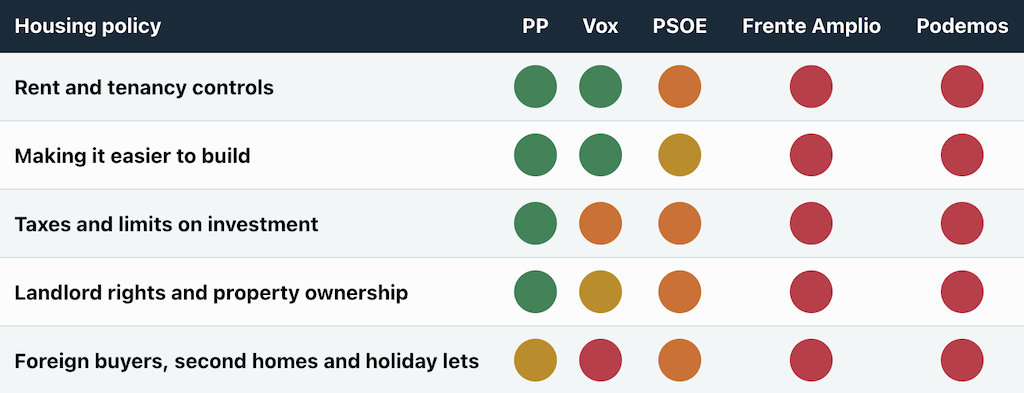
How housing-friendly are the parties’ programmes?
More market-friendly Mixed or unclear Unfavourable Strongly unfavourable
| Housing policy | PP | Vox | PSOE | Frente Amplio | Podemos |
|---|---|---|---|---|---|
| Rent and tenancy controls | |||||
| Making it easier to build | |||||
| Taxes and limits on investment | |||||
| Landlord rights and property ownership | |||||
| Foreign buyers, second homes and holiday lets |
What the next government could mean for housing
The polls put a PP majority on its own well out of reach. The likeliest route to a PP government is with Vox, either in coalition or with its support in Congress. That’s the least bad outcome for housing in my view, though Vox’s proposed tax penalties for non-EU buyers would be bad news for the second-home market.
A PSOE-led government relying again on parties to its left would, I expect, bring tighter rent controls and more restrictions on owners and investors. After eight years of Sánchez-led government, it’s hard to see how more of the same would make homes easier to find or afford.
Even if the PP and Vox can agree to repeal the 2023 Housing Act and make it easier to build, it takes years to turn a planning reform into homes people can move into. That’s what’s riding on Sunday’s vote for the housing market. The next government can start to ease the shortage, or spend another term making it harder to fix.













A Spanish tax incentive designed to attract wealthy foreigners is under political attack for being too generous, whilst some of its beneficiaries are campaigning internationally because they feel they have been fleeced.
With Spain’s general election just days away, the left-wing political party Podemos is calling for the abolition of the so-called Beckham Law, a preferential tax regime designed to attract international talent and high earners to Spain. The party argues that it allows wealthy foreigners to pay too little tax whilst contributing to the country’s housing affordability problems. Some of the foreigners who have taken advantage of the scheme, however, have a rather different story to tell.
Speaking at an election rally organised by ERC in Barcelona last Sunday, Podemos politician Irene Montero described affluent expats arriving in Spanish cities, delighted by how cheap everything seems to them, working on their laptops in cafés and co-working spaces, whilst driving up housing costs and pricing locals out of their neighbourhoods.
Her message to the international community, delivered in English, was: “Expats, you have to pay!”
There is a certain irony in her choice of words, as we shall see.
A tax incentive, not tax evasion
The Beckham Law is a scheme specifically designed by Spain to attract international talent and economic activity. Subject to eligibility requirements, beneficiaries pay income tax at a flat rate of 24% on qualifying earnings up to €600,000, for a maximum of six tax years.
According to Spanish tax agency figures reported by El País in June 2025, beneficiaries earn an average of €160,000 a year in employment income. At 24%, that would translate into an annual income tax bill of €38,400.
In her rant, Montero contrasted the tax treatment of wealthy expats with that of local residents such as “Lluïsa and Mohamed”, implying that the former contribute less to the public purse than the latter. But this confuses tax rates with tax contributions. Whilst Beckham Law beneficiaries enjoy a lower tax rate than they would otherwise face on the same income, an illustrative annual tax bill of €38,400 is considerably more than the typical Spanish taxpayer pays. And had these expats chosen to live elsewhere, Spain would not have collected any income tax from them at all.
Meanwhile, over at the tax office…
Some beneficiaries of the Beckham Law might be rather annoyed to learn that they are not paying enough tax in Spain.
The international law firm Amsterdam & Partners has been running a campaign accusing the Spanish tax authorities of enticing wealthy foreigners to Spain with attractive tax incentives, only to move the goalposts once they are here.
Through its campaign website, Spanish Tax Pickpockets, the firm alleges that taxpayers have been subjected to retrospective investigations, unexpected tax demands, punitive fines and costly legal battles. It has even taken out advertisements in the Financial Times, The Wall Street Journal, and the Irish Times warning readers about the fiscal dangers of the Beckham scheme.

The Spanish tax agency rejects these allegations, pointing out in May 2025 that only 185 of the approximately 37,000 taxpayers who had opted for the regime over the preceding decade had been subjected to inspections for possible non-compliance.
The dark irony of it all
So we have two campaigns revolving around the same piece of Spanish legislation. One argues that the tax deal offered to wealthy foreigners is too generous; the other that it is not quite the deal advertised.
Montero’s portrayal of expats also bundles together people in very different circumstances: international executives, digital nomads and ordinary foreign residents. Whilst some digital nomads qualify for the Beckham Law, others do not, and plenty of expats living in Spain pay their taxes under exactly the same rules as “Lluïsa and Mohamed”.
But the dark irony is that the Beckham Law, presented by Podemos as a tax giveaway to wealthy foreigners, is actually a source of substantial tax revenue from people who might otherwise never have moved to Spain. And for some of those it succeeded in attracting, what was supposed to be a tax break has turned into a fiscal nightmare.
There is, perhaps, one thing Montero and the clients of Amsterdam & Partners could agree on: abolishing the Beckham Law. Though for rather different reasons.
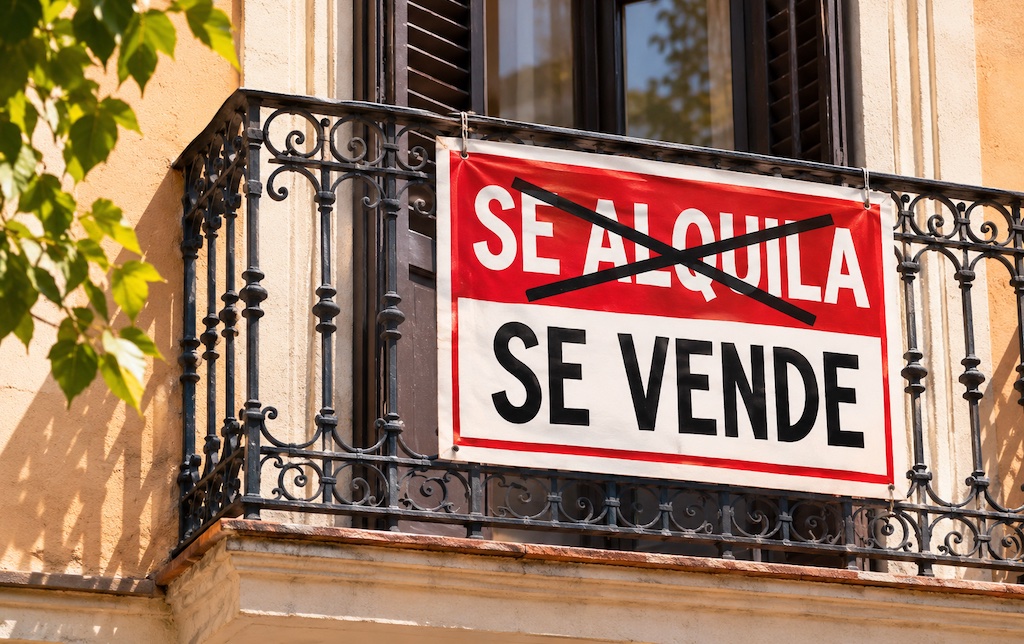
With elections just days away, Spain’s Socialist-run government has announced generous income increases for public-sector workers and other favoured groups while forcing landlords to take a real pay cut. The consequences for housing supply will be grim.
Pay rises for some, income cuts for others
Just nine days before Spain’s general election, the Socialist-led government announced a 4.5% pay rise for public-sector workers in 2027 and a 5.3% increase in the minimum wage. Pensions are also heading for an inflation-linked increase, expected to be around 3.5%.
The public-sector agreement dates from last year, but the timing of its approval is politically convenient, to say the least. It looks just like electoral populism.
Meanwhile, landlords face the opposite treatment. Under October’s new rental regulations, annual rent increases are generally capped at 2% without a fresh agreement, while some rents cannot rise at all. Tenants can also qualify for compulsory contract extensions of up to two years.
With inflation running at 4.9%, landlords are being forced to accept declining real rental income. Meanwhile, maintenance, insurance, community charges and taxes keep rising, squeezing net returns even harder.
Punished for providing housing
Landlords invest their savings and capital in providing homes for people who cannot afford, or simply don’t want, to buy. They provide an essential service while accepting substantial costs, responsibilities and financial risks.
And most aren’t institutional investors or so-called vulture funds. According to the Bank of Spain, around 90% of landlords are private individuals, most owning just one or two rental properties.
Yet the government treats them as if they deserve punishment for investing their capital in rental housing.
Rent controls aren’t technically fines, but forcing landlords to accept declining real returns amounts to a financial penalty for providing a perfectly legitimate and necesssary service.
The immediate beneficiaries are sitting tenants, who enjoy below-inflation rent increases and greater security of tenure. In effect, purchasing power is being transferred from landlords to sitting tenants.
The invisible losers
But there’s another group of losers who barely feature in the debate: people looking for somewhere to rent.
Landlords aren’t stupid. Why tie up hundreds of thousands of euros in rental housing, with all the costs, restrictions and risks of non-payment, when other investments might offer better risk-adjusted returns with far less hassle? Right now you can get a better return from cash in a savings account.
Spain already suffers from a chronic shortage of rental housing. Making private investment less attractive risks shrinking supply further, leaving prospective tenants competing for even fewer homes. Landlords can sell up or invest elsewhere. New investors can simply avoid the rental market.
So it’s clear that this government thinks that public-sector workers and other favoured groups deserve protection from inflation with public money, while landlords are allowed no such protection. Prices and taxes rise across the economy, but rent controls focus the pain on landlords, who get punished for investing their personal savings in Spanish rental housing. If the Socialists are still in power after the GE on Sunday, nobody should be surprised if the stampede out of the sector continues.


Spain has approved a controversial new housing decree imposing sweeping restrictions on landlords and a 10% VAT on holiday rentals from December. What does it mean for property owners?
On 12 November, the Permanent Deputation of the Spanish Congress approved Royal Decree-law 29/2026 by 35 votes to 34, confirming measures introduced by Prime Minister Pedro Sánchez’s government in October following the controversial eviction of an elderly tenant in Madrid.
This decree, in force since 8 October, includes restrictions on evictions involving so-called ‘vulnerable’ occupants until 2030, additional tenancy extensions, limits on rent increases, tighter regulation of seasonal and room rentals, restrictions on certain property investors, and new tax measures.
A second decree, which would have introduced automatic five- or seven-year extensions of residential tenancies and substantial compensation for landlords refusing to renew, was rejected by 35 votes to 34. If you want a deeper dive into the measures included in both bills click on learn more.
Learn More
Spain’s two housing decrees: What has been approved and what was rejected?
Updated 12 November 2026
The Spanish government introduced two emergency housing decrees in October 2026, widely known as the Maricarmen decrees. On 12 November, the Permanent Deputation of Congress approved the first by 35 votes to 34 but rejected the second by the same margin, with the votes reversed.
Here is a summary of the principal measures and what they mean for property owners and tenants.
Decree 29/2026 — Approved and in force
This decree came into force on 8 October and has now been ratified. It introduces the following measures:
- Eviction protections: Extends protections for vulnerable tenants and occupants without alternative accommodation until 31 December 2030, subject to conditions and exceptions, including for private owners with no more than two properties. Compensation mechanisms apply in certain cases.
- Rental contract extensions: Qualifying tenants with existing residential leases expiring before the end of 2028 can request extensions of up to two additional years. Existing statutory three-year extensions in designated stressed housing markets take precedence.
- Rent increases: Until 31 December 2027, annual rent increases are generally limited to 2% without a new agreement, or frozen where the existing rent exceeds the applicable reference-price ceiling.
- Seasonal and room rentals: Tighter rules require genuine justification for temporary tenancies and restrict their use to circumvent ordinary residential tenancy protections. Rent ceilings apply in designated stressed markets, including limits on the combined rent charged for individual rooms.
- Landlord obligations: Additional restrictions on charging tenants property taxes, agency fees and compulsory insurance, alongside stronger tenant rights concerning maintenance and preferential purchase rights.
- Property investment: Certain corporate investors and large landlords are prohibited from acquiring residential properties for less than 70% of their official valuation, subject to exceptions.
- Holiday rentals: A new 10% VAT charge applies from 1 December 2026 to furnished accommodation let for stays of 30 nights or fewer, even without hotel-style services. An exception applies to accommodation in the owner’s habitual residence.
- Property taxes: Municipalities are given powers to impose additional property-tax surcharges on qualifying vacant homes and tourist accommodation in designated stressed housing areas.
- Tax incentives: New income-tax deductions for qualifying tenants and revised tax reductions for landlords who meet certain conditions, including affordable rents.
- First-time buyers: A new €10 billion financing programme, called TU CASA, provides for interest-free loans of up to €50,000, subject to eligibility conditions, to help qualifying buyers purchase their first home.
Decree 28/2026 — Rejected
This separate decree proposed substantially greater security of tenure for residential tenants but was defeated before its scheduled commencement on 15 November.
Its principal proposals were:
- Automatic tenancy extensions: After the initial statutory rental period of five years for private landlords or seven years for corporate landlords, tenancies would renew for successive periods of the same duration unless either party gave the required notice.
- Longer notice periods: Landlords wishing to terminate at a contractual expiry would generally have to give six months’ notice, rather than four.
- Compensation for non-renewal: Landlords choosing not to renew would generally have to compensate the tenant with the greater of 12 months’ reference rent or one month’s reference rent for every year of occupancy.
- Exceptions: Compensation would not normally be payable where the landlord genuinely needed the property for personal or qualifying family use, the tenant was not habitually resident, the tenant had another suitable home locally, or certain other statutory conditions applied.
The rejection means these proposed changes will not take effect. Existing tenancy duration and termination rules continue to apply, subject to the separate extensions and protections introduced by the approved first decree.
What happens now?
Decree 29/2026 remains in force following parliamentary ratification. Decree 28/2026 has been rejected and will not take effect.
However, with a general election scheduled for 29 November, the future of Spanish housing legislation remains politically uncertain. A new government could amend or repeal the surviving measures.
Property owners should check how the approved changes affect their individual circumstances, particularly before renewing or terminating tenancies, arranging seasonal rentals or letting holiday accommodation.
Holiday rentals face 10% VAT from December
The biggest news for many owners from outside of Spain is that from 1 December 2026, furnished properties let for stays of 30 nights or fewer will generally attract VAT at 10%, even when the landlord provides no hotel-style services.
Until now, ordinary holiday lettings without hotel-style services have generally been exempt from VAT. The new law removes that exemption for short stays, with an exception for accommodation in the landlord’s own habitual residence.
This means that someone who owns a second home in Spain and rents it to holidaymakers for a week or two when not using it will normally have to charge VAT. The change also affects occasional landlords, not just professional holiday-rental businesses.
A €1,000 holiday rental would therefore cost €1,100 including VAT if the tax is added to the existing price. Alternatively, an owner keeping the advertised price at €1,000 would have to account for approximately €91 in VAT out of that amount.
The change applies to mainland Spain and the Balearic Islands, but not the Canary Islands, Ceuta or Melilla, which have different indirect-tax systems.
What will holiday-home owners have to do?
Owners whose lettings become subject to VAT will generally need to register their activity with the Spanish tax authorities using the relevant census declaration, usually Form 036, issue the appropriate invoices or records, and submit periodic VAT returns, normally using Form 303.
That could impose a significant administrative burden on owners who only rent out their properties for a few weeks each year. Non-resident owners will also need to establish who is legally responsible for accounting for the tax, particularly when bookings are handled through an agency or online platform.
There is also the question of whether owners can recover VAT on expenses relating to their rental activity, potentially offsetting part of the new tax liability.
The legislation establishes the 10% rate and its commencement date, but practical questions remain concerning existing bookings, advance payments, invoicing arrangements and the treatment of mixed personal and rental use. Owners should obtain professional tax advice before changing their procedures.
More hassle guaranteed
The government argues that its measures will improve housing affordability and discourage speculative investment. Critics warn that additional restrictions and taxes will discourage private investment and reduce the supply of rental accommodation.
Holiday rentals are an obvious political target, but taxing second homes used by their owners for part of the year is unlikely to make much difference to the supply of affordable housing where it is most needed.
With a general election scheduled for 29 November, the future direction of housing policy remains uncertain. A new government could reverse some of these measures, although the approved decree remains law unless changed.
Foreign owners should start thinking about any eventuality. The 10% VAT charge is scheduled to start on 1 December, and anyone offering short-term lets should review their pricing and tax arrangements before then.

Antonio Banderas Opens Wedding Venue
Spain’s Canary Islands Plead For Help Amid ‘unprecedented’ Migrant Surge

George Russell warned to back down to


-

 New Developments4 weeks ago
Luxury Villas For Sale, Estepona – ProjectL1
-

 New Developments3 weeks ago
The San Roque Club – Townhouses For Sale
-
costa blanca live music4 weeks ago
Beatles tribute: The Liverpool Band returns to Orihuela Costa
-
countryside4 weeks ago
Rural revival: Five Almeria villages make moving inland easier and more enticing
-

 New Developments4 weeks ago
Stylish 3-Bedroom Apartment With Panoramic Sea Views – Benalmádena
-

 America3 weeks ago
Así Ha Sido La Primera Jornada Del World In Progress 2026: Del Anuncio De Sánchez De Ayudas Para Las Víctimas De Urda A La Reivindicación De Rebeca Grynspan Del Papel De La ONU
-
All Saints4 weeks ago
Driving to Andalucía this weekend? DGT warns of extra traffic after train crash
-
Eating out in Gibraltar4 weeks ago
Young woman left horrified after Gibraltar restaurant receipt carries shocking racist slur