
Earthquake
4.1 quake hits Murcia making windows rattle with frightful memories

Librilla in Murcia at the epicentre of earthquake.
Credit: Sapoproductions Wiki CC
Residents across Murcia and into Alicante got a sharp reminder of the ground’s restlessness this Sunday lunchtime when a 4.1 magnitude earthquake struck near Librilla.
Just before midday the tremor arrived at 11.59am, its epicentre sitting northwest of the small town of Librilla, just west of Murcia city. Official readings from Spain’s Instituto Geografico Nacional put the depth at a mere five kilometres, shallow enough for people indoors to feel windows and furniture vibrate quite clearly. Intensity reached III-IV on the European scale, meaning plenty of folk noticed it without anything collapsing.
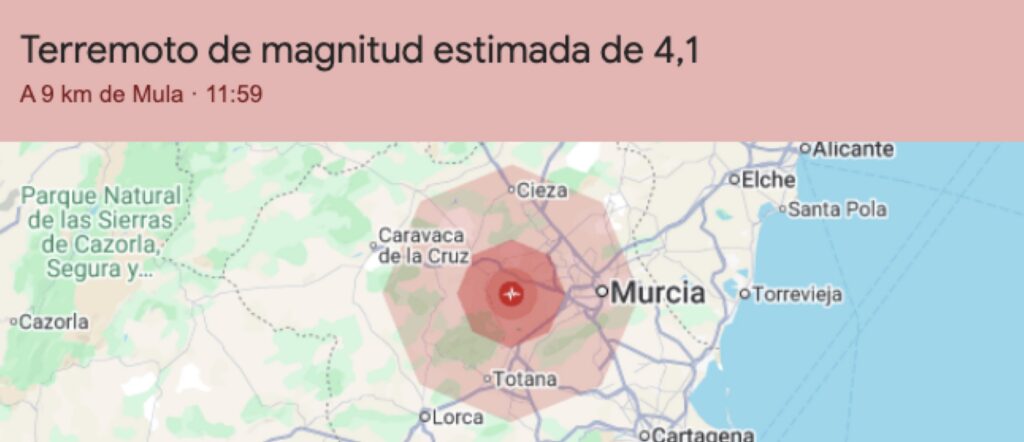
Credit: Google
Phones lit up almost at once. Emergency services pushed out ES-Alert messages around noon warning of possible further shakes and giving an early estimate of magnitude 4.5. More than 80 calls flooded the regional 112 centre as people from Murcia City, Molina de Segura, Alhama and other spots checked in. So far no one has reported injuries or damaged buildings, though authorities keep gathering accounts.
Why this corner of Spain feels every little jolt
Southeastern Spain sits on several active faults, the Alhama de Murcia fault among the busiest. Most of the constant small movements pass unnoticed, yet that same geology makes the area unusually sensitive. When something of this size hits so close to the surface, the shake travels easily through the soil and into homes.
Lorca memories still run deep
For many living here the moment brought an unwelcome flashback. Fifteen years on from the 2011 Lorca earthquake, one of magnitude 5.1, nine people were killed and whole streets wrecked, so nerves are still heightened. Older residents especially speak of that sudden dread returning the second the floor starts to move. Younger ones who grew up hearing the stories still jump at the first rattle. Social media filled quickly with messages describing the brief but unmistakable sway, mixed with quiet relief that this one stayed mild.
Local teams continue checking reports while the Instituto Geografico Nacional refines its figures. For now the episode ranks as a solid reminder rather than a disaster: a quick, widely felt quake that left the furniture rearranged in people’s minds more than in their living rooms. Anyone who felt it is being asked to fill in the official macrosismic questionnaire so experts can map the effects more accurately.





Última Hora De La Entrada De Inmigrantes A Ceuta, En Directo | Las Autoridades Ceutíes Cifran En 88 Los Fallecidos Que Están En La Morgue

Mijas Deploys Drone Cleaning Trial On Public Buildings

Escape Spain’s Scorching August Heat With A Visit To The Country’s Coolest Village – Where Temperatures Regularly Plunge Below 0C


-
Costa Calida2 weeks ago
The last cigarette by the sea Murcia faces a major anti-smoking revolution
-

 Amazon1 week ago
Un Tangle Teezer De Viaje: El Cepillo De Pelo Perfecto Para Tu Neceser De Vacaciones
-

 Latest1 week ago
Can Spanish Property Owners Cut Off Utilities To Squatters?
-

 New Developments2 weeks ago
How To Get A Tourist Rental Licence In Andalusia (Spain) – Step-By-Step Guide 2025
-
barcelona el prat2 weeks ago
Passengers’ terror as British Airways flight to Barcelona declares mid-air emergency
-
Columnists2 weeks ago
Do you have a dog? We’ve dog-sitters who love caring for dogs
-

 ChatGPT2 weeks ago
Food-Related Scams Are Flooding Social Media With Hyper-Realistic AI-Generated Videos
-

 Uncategorized2 weeks ago
Ferrari prepare to unleash engine upgrade in bid to catch Mercedes in title battle